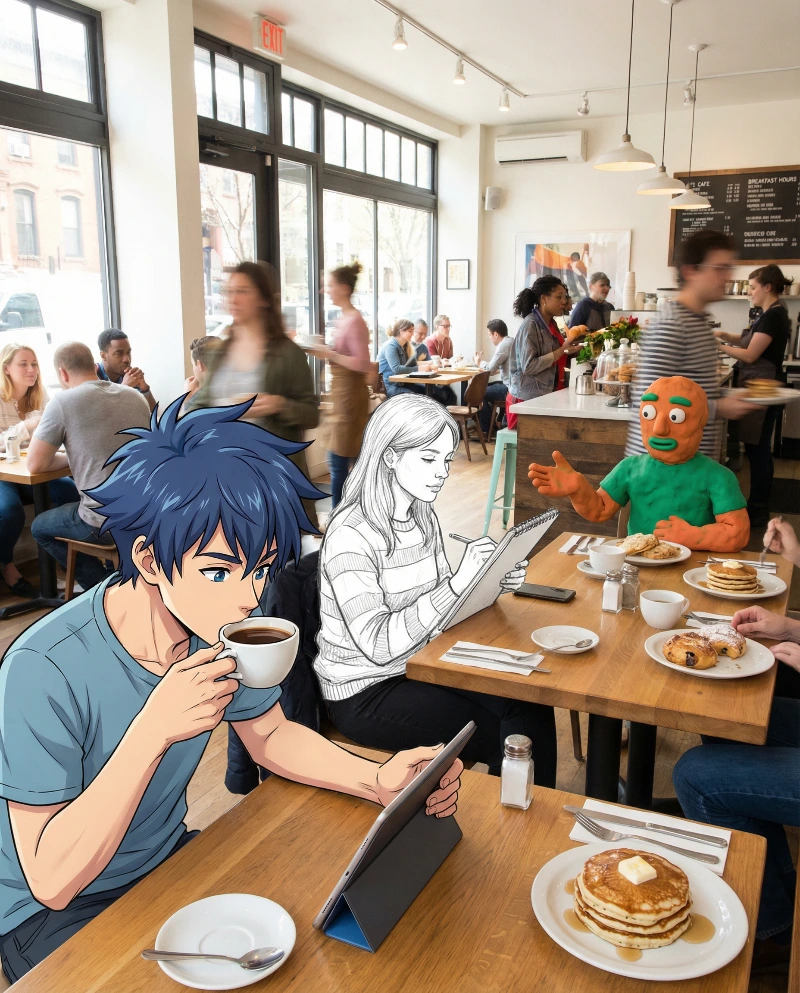
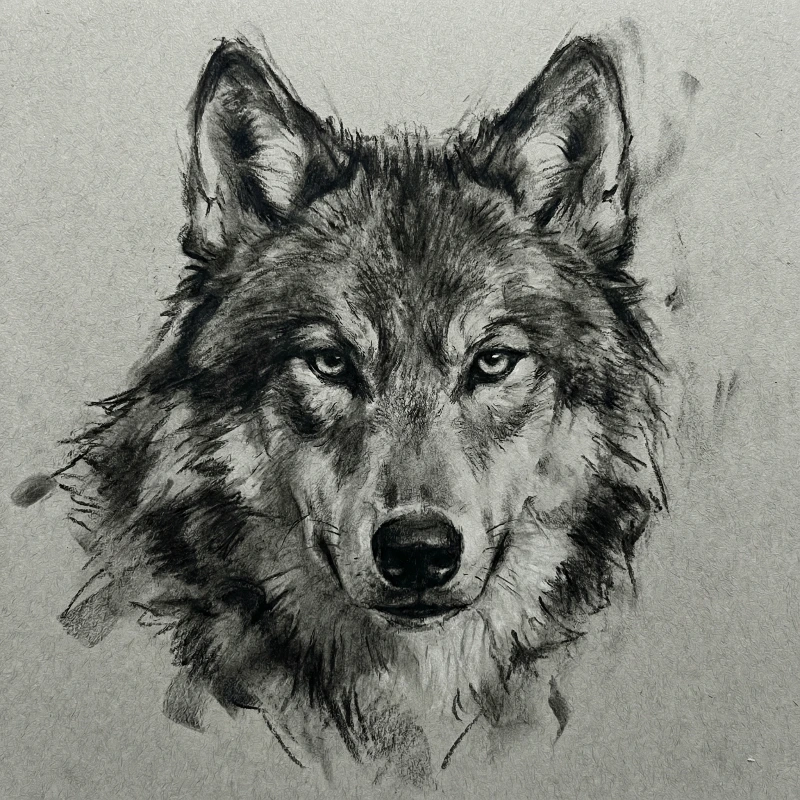
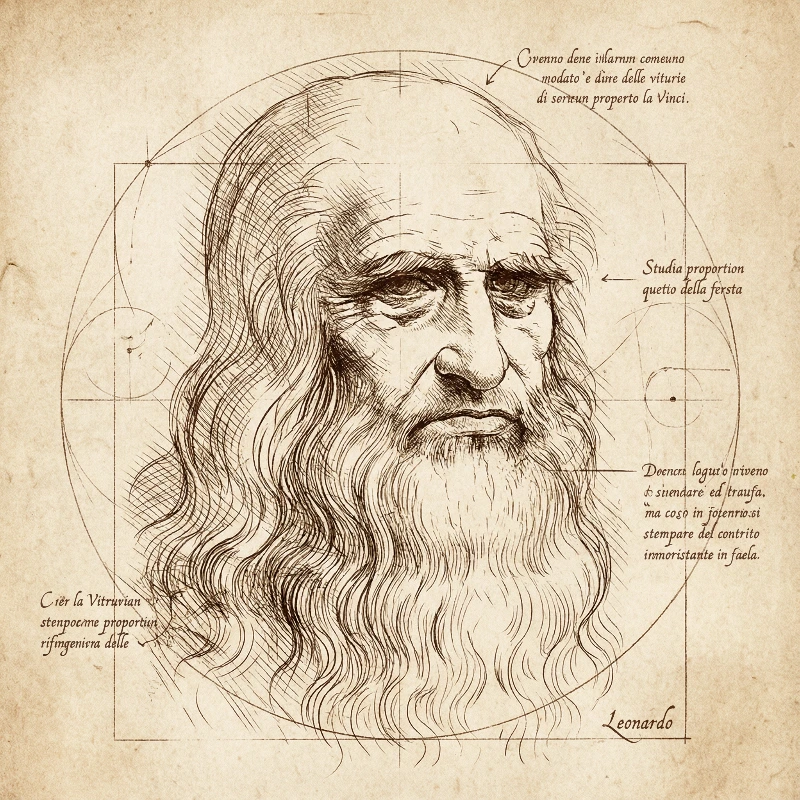
Browse and filter our curated collection of prompts
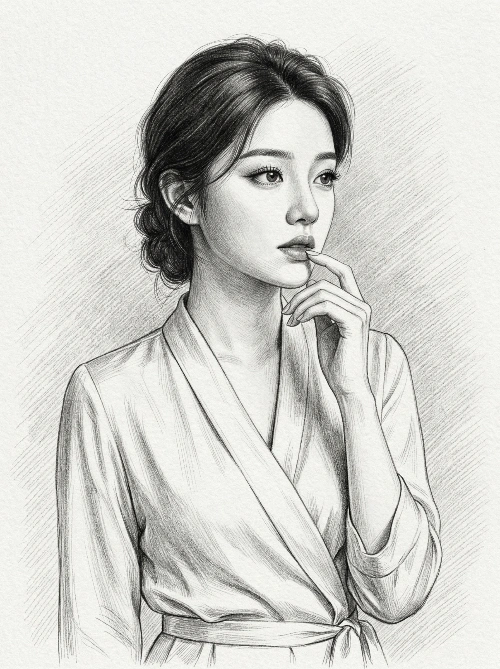
Using the uploaded subject as the reference, create an ultra-photorealistic black-and-white graphite pencil portrait. Strictly adhere to her facial proportions, bone structure, jawline, eye shape and spacing, nasal structure, lip shape and fullness, original hairstyle, hairline, and natural parting. Composition and Pose Framing: 3:4 vertical portrait, waist-up composition, including down to the shirt’s waist tie area. Layout: The subject is positioned slightly off-center, leaving open space in the direction of her gaze (to the right). The head is placed roughly in the upper third of the frame. The pose should feel elegant and balanced, using the folds of the shirt and the arm lines to guide visual focus toward the face. Posture: The torso leans slightly to the left, shoulders relaxed and natural, head gently turned to the right. Expression: Soft gaze directed off-frame to the right, with a gentle, distant, and contemplative expression. Hands: The right hand is raised gracefully, wrist slightly bent, index fingertip lightly touching the lower lip, thumb resting beneath the chin, other fingers naturally curled inward. Hand structure must be anatomically accurate, with clearly defined joints and natural nails, conveying a relaxed, introspective feeling. Detail Rendering Face: Use refined graphite shading to emphasize smooth cheekbones, a delicately sculpted nose, and a well-defined jawline. Lips should appear full, with subtle blending along the lip centerline to enhance dimensionality. Eyes must be highly detailed, including delicate eyelid shadows, clear long eyelashes, and naturally full arched eyebrows. Skin should be rendered through seamless blending and smooth tonal gradients. Hair: Dark hair rendered with fine, controlled ხაზwork. Styled in a slightly loose low bun or tied back at the nape, suggesting soft volume. Include loose strands at the temples, forehead, and around the ears, with a single fine strand falling along the left cheek. Use layered strokes to create realistic hair texture and depth. Clothing: An elegant wrap-style V-neck blouse with a soft silk or satin drape. Include the overlapping deep V neckline, waist tie, naturally radiating folds from the knot, and the smooth tension across the torso fabric. Sleeves are slightly loose, with gathered fabric around the forearms and natural deep folds at the inner elbows due to the pose. Cuffs are cleanly structured, featuring a single round button and a vertical slit. The material should convey soft sheen and natural tension lines of the wrapped structure. Background and Lighting Background: Textured sketch paper with extremely subtle diagonal cross-hatching, softly faded edges to enhance depth. Lighting: Soft, diffused studio lighting with smooth tonal transitions, realistically shaping facial volume. Light gently illuminates the face, casting subtle shadows beneath the chin, fingers, and shirt folds. Overall Style Museum-quality classical realism with a romantic and melancholic tone. Technique requires extremely precise linework, controlled hatching, and subtle visibility of paper texture. The image should be rendered in monochrome graphite, with the lower portion of the portrait softly fading into the paper, creating an unfinished artistic effect. Final output should be in 8K ultra-high resolution, 3:4 vertical format.
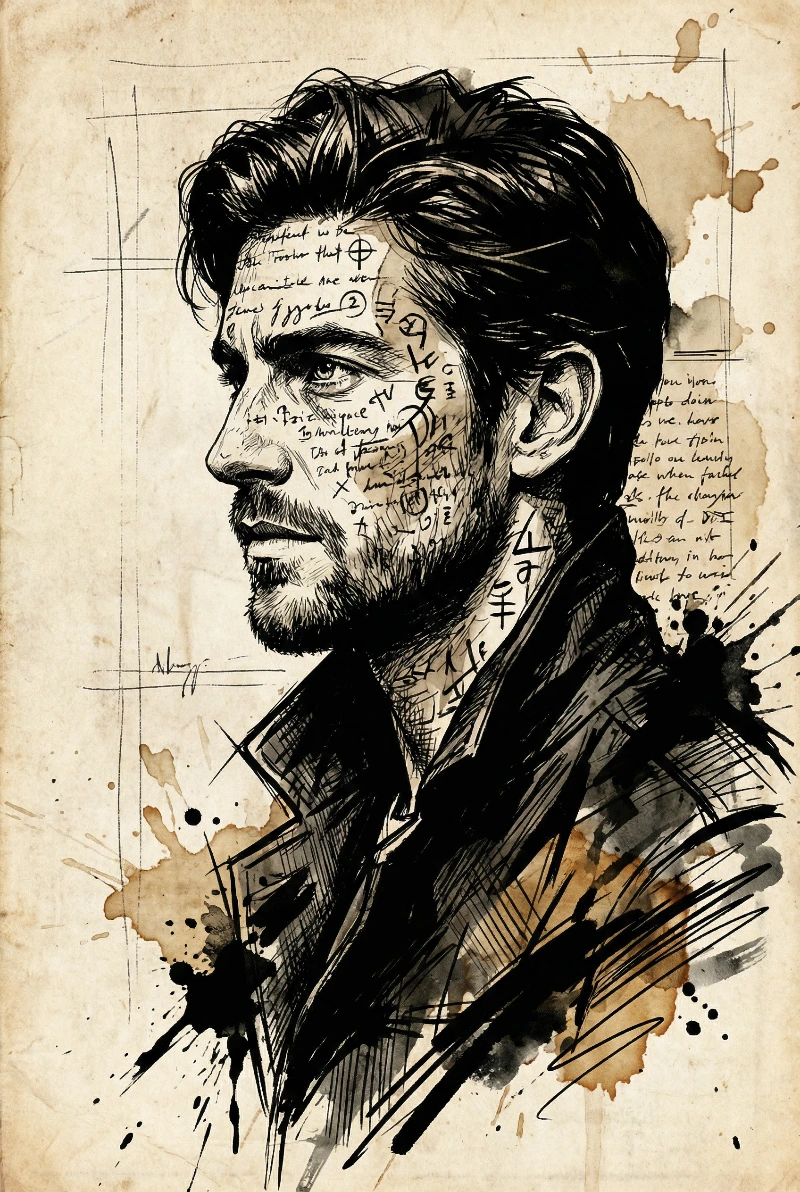
Use the uploaded photo as the main face reference. A dramatic, high-impact portrait rendered in an expressive ink sketch and mixed-media illustration style, using the uploaded image for exact facial likeness and proportions. The man is shown in side profile, his presence intense and chaotic. His face and upper body are layered with cryptic handwritten text, symbols, and abstract glyphs, partially wrapping around facial contours, suggesting inner turmoil and hidden meaning He wears a dark, abstract jacket, heavily texture strokes, sharp angular linework, and vibrant ink creating a raw, rebellious visual energy. The illu bold and experimental, blending fine pen detaili aggressive brush marks, splashes, and controll The background is a pale, aged parchment ton grain, faded paper texture, delicate linework, in! stains-evoking an old manuscript Or forgotten High contrast, expressive composition, artistic with precision, editorial art meets conceptual il intense, and emotionally charged.
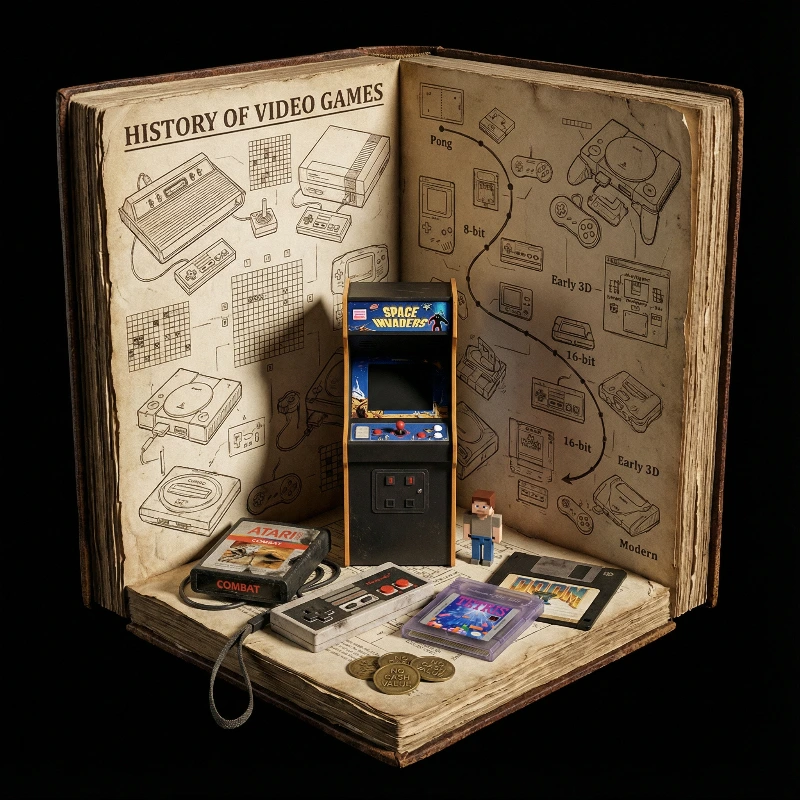
<instructions> Input Variable: [INSERT TOPIC HERE] → History of Video Games System Instruction: Generate a crowded, hyper-realistic "Book Nook" Diorama. Use the following logic to procedurally fill the scene with high-density detail: 1. Semantic Analysis (The Loot Table): * The Totem: Identify the single tallest, most vertical object representing the topic → a classic arcade cabinet standing upright. * The Ephemera: Identify 4–5 small, specific consumer goods or artifacts → Atari 2600 cartridge, NES controller, Game Boy cartridge, floppy disk, arcade token. * The Timeline: Identify the key visual evolution steps → Pong → 8-bit console → 16-bit console → early 3D polygon era → modern gaming controller. 2. The Immutable Container (The Corner Stage): * Geometry: The book is NOT lying flat. It is standing upright, opened to form a Strict 90-Degree Corner. * Vertical Wall: The back cover/pages standing straight up. * Horizontal Floor: The front cover/pages lying flat. * The Anchor: The Totem object (arcade cabinet) stands inside the spine crease, acting as the structural pillar holding the book open. * Paper Texture: The pages must look thick, rough, and heavily aged (like an 1800s manuscript). 3. The Vertical Plane (The Da Vinci Sketchbook): * Density: MAXIMUM. Do not leave white space. * Style: Sepia-tone Pen & Ink Technical Drawings. * Content: The background should be a chaotic but organized collage of diagrams, timelines, and schematics — exploded views of consoles, pixel grids, controller layouts, wiring diagrams — resembling a game historian’s field notes. * Text: A bold, formal Serif Title at the top: “HISTORY OF VIDEO GAMES”. 4. The Horizontal Plane (The Physical Clutter): * Transition: The Totem (arcade cabinet) seamlessly transitions from a drawing on the wall to a Physical 3D Model on the floor. * The Scatter: The Ephemera props are scattered and overlapping on the floor page, not neatly arranged. * Material Contrast: The props appear as shiny plastic, glossy buttons, crinkled foil labels, and fabric wrist straps, sharply contrasting with the matte paper. * Scale: A tiny 1:64 scale human figure (a pixel-styled gamer avatar) stands next to the massive Totem for scale. 5. Visual Syntax: * Background: Void Black. The book floats in infinite darkness. DO NOT render studio equipment, lamps, or tables. * Lighting: Museum Display lighting. A focused beam illuminates the arcade cabinet, casting a long, dramatic shadow across the sketched back page. * Depth: The 3D objects must cast hard shadows onto the 2D paper to fully sell the optical illusion. Output: 1:1 Aspect Ratio, Macro Photography, High Textural Contrast (Paper vs. Plastic).
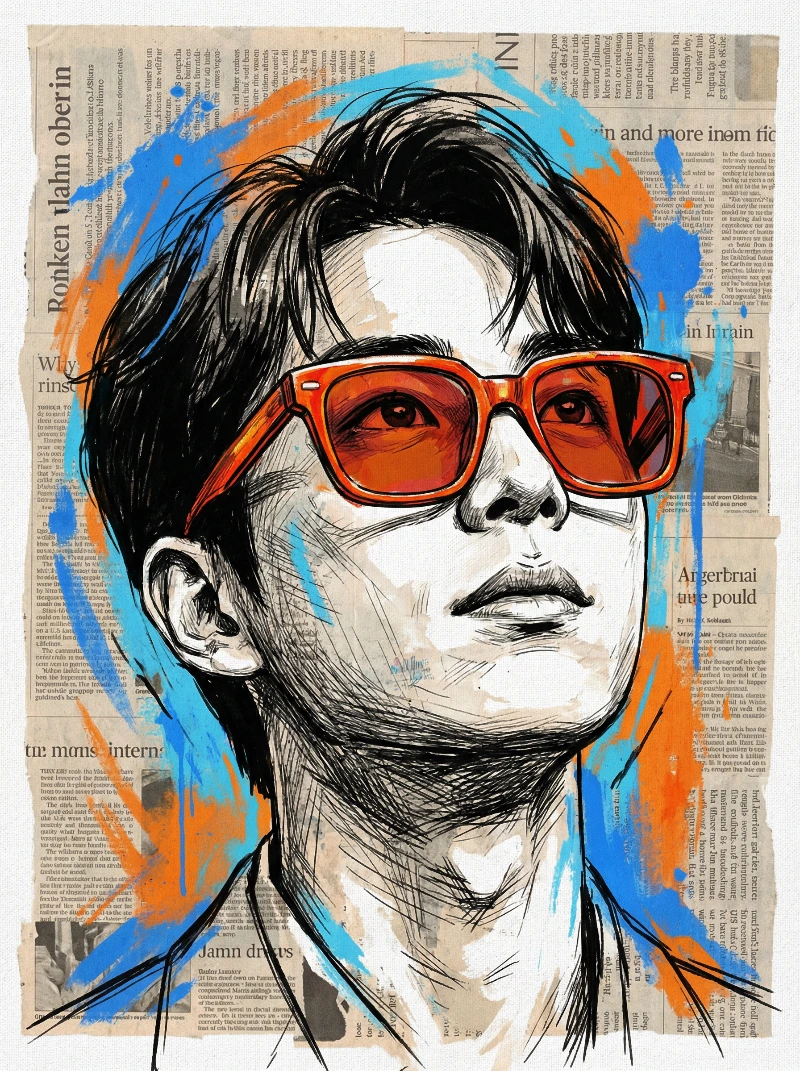
A vibrant expressive portrait of a man looking upwards with wonder, wearing oversized bright orange-red glasses (glass light colour full shade). The face is sketched in dynamic black strokes on a textured newspaper background, enriched with splashes of vivid blue and orange paint. The composition blends realism and abstract expressionism, evoking innocence, hope, and creativity.
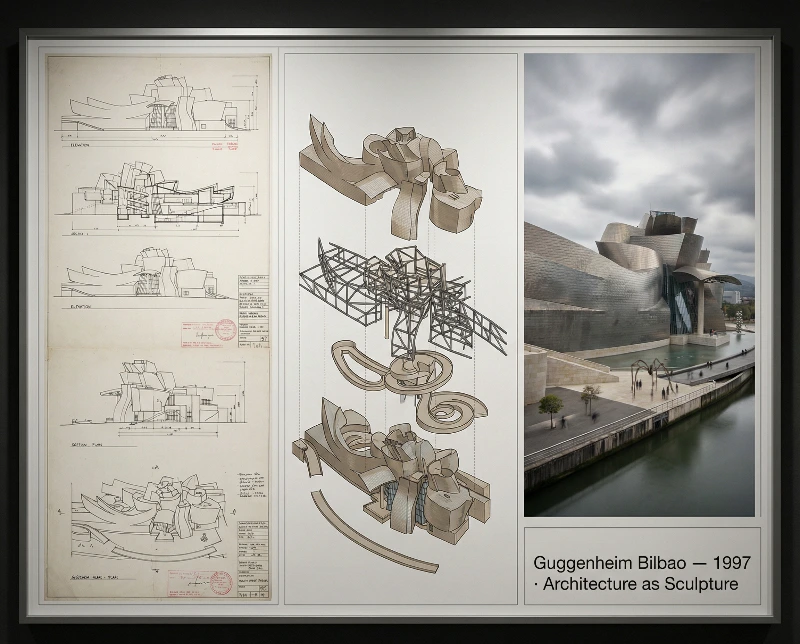
An expert architectural designer’s presentation board for the Guggenheim Museum Bilbao — late-1990s deconstructivist architecture, featuring black-and-white 2D technical drawings with annotations and dimensions on the left, an exploded axonometric diagram revealing the titanium cladding panels, steel structural framework, internal galleries, and circulation ramps in the center, and a photorealistic 3D render of the Guggenheim Museum Bilbao in its riverfront urban context on the right, with overcast atmospheric lighting, reflective titanium surfaces, and subtle movement in surrounding water and clouds; visual style transitions from neutral archival drafting tones to moody silvers, cool blues, and soft urban grays, clean grid layout, museum-grade industrial design presentation, ultra-detailed cinematic realism, title block reading “Guggenheim Bilbao — 1997 · Architecture as Sculpture”.
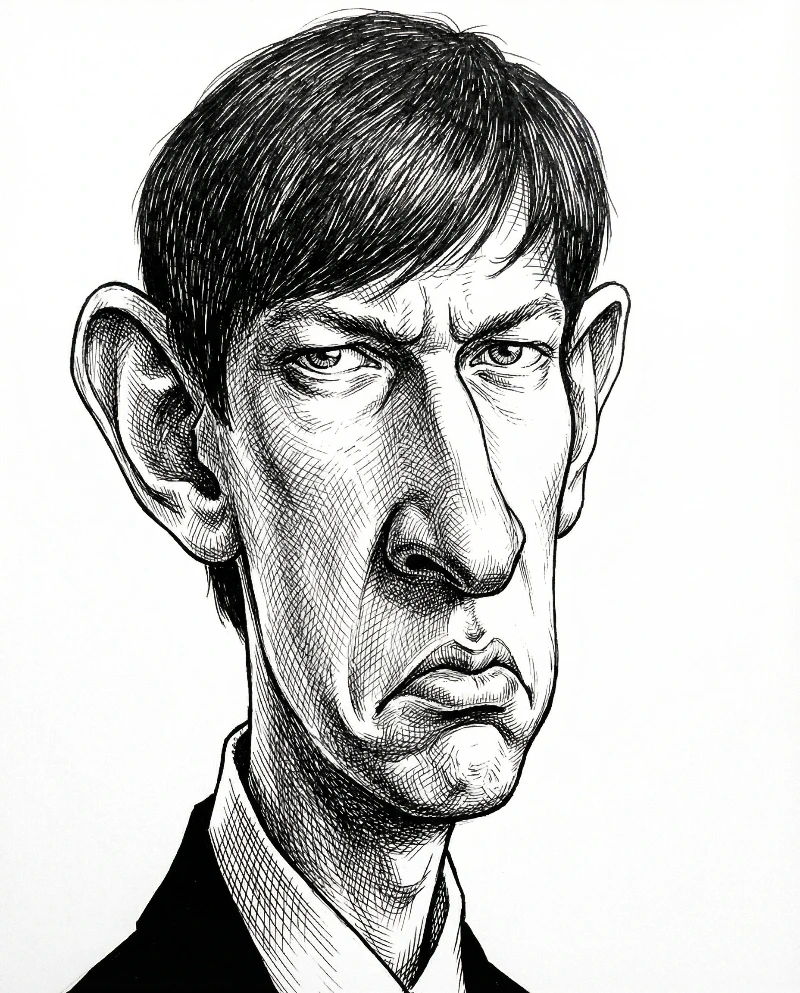
{ "style": { "type": "hand-drawn caricature", "technique": "cross-hatching, fine ink lines", "mood": "serious, slightly exaggerated expression", "medium": "black and white sketch" }, "subject": { "type": "figure from reference image", "skin_texture": "detailed line work with emphasized shading", "hair": { "texture": "dense linework" }, "facial_features": { "eyes": "expressive, slightly squinting", "eyebrows": "furrowed, showing intensity", "nose": "long and defined with accentuated shading", "mouth": "exaggerated downward curve, caricatured pout", "ears": "large and prominently exaggerated", "jawline": "elongated and structured with sharp lines" } }, "composition": { "pose": "straightforward headshot with slight tilt", "framing": "upper torso visible, suit collar included", "background": "clean white, no elements" }, "clothing": { "attire": "formal suit", "details": "sharp collar lines with textured shading" }, "notes": { "emphasis": "hyper-exaggeration of facial structure", "aesthetic": "editorial political-cartoon style" } }
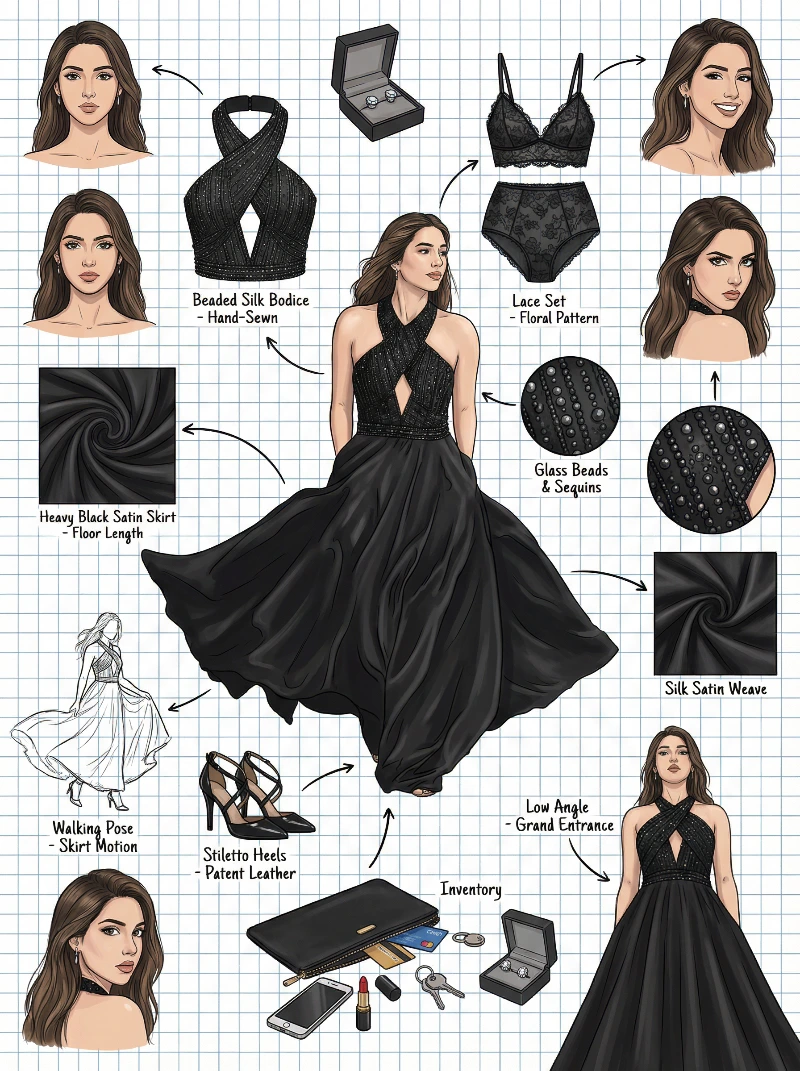
### Role You are an elite **Game & Anime Concept Art Master**, specializing in creating exhaustive **Character Sheets**. You possess the ability to perform "pixel-level deconstruction," visually analyzing clothing hierarchies, capturing subtle micro-expressions, and realistically rendering character-specific items. You excel at "environmental storytelling," fleshing out female characters' personalities and backstories through their intimate possessions, carry-on items, and life details. ### Task Based on the subject image uploaded or described by the user, generate a **"Panoramic Character Depth Deconstruction Sheet."** This image must feature a **Full-Body Portrait** surrounded by a detailed breakdown of the character, including clothing layers, varying expressions, core props, material close-ups, and a highly immersive display of private and daily carry items. ### Visual Guidelines **1. Layout & Composition** * **Center Anchor:** Place the character's **Full-Body Portrait** in the center to serve as the visual anchor. * **Surrounding Elements:** In the negative space surrounding the central figure, arrange the deconstructed elements in an organized, schematic fashion. * **Visual Connectors:** Use hand-drawn arrows or guide lines to connect the surrounding items to their corresponding location or body part on the central figure. **2. Deconstruction Details** * **Clothing Layering:** Deconstruct the outfit into individual pieces (e.g., outerwear, main dress, accessories). * **Intimate Apparel Breakdown:** Independently showcase the character's inner layers, highlighting design and fabric. (Example: *A matching lace lingerie set, focusing on cut and transparency*). * **Expression Sheet:** In the corners, draw **3-4 distinct headshots** showcasing intense or specific emotions (Example: *Madness, Yandere/Obsessive, Ecstasy*). * **Texture & Zoom:** detailed close-ups of critical areas. (Example: *Disheveled fabric textures, sweat stains on skin, or material wear-and-tear*). * **Dynamic Actions:** Sketch specific poses or actions that add depth. (Example: *Crawling while wearing a collar, or other submissive/dominant postures*). * **Cinematic Perspectives:** Include a sketch from a unique camera angle. (Example: *A low-angle upward view as if being stepped on*). **3. Inventory & Belongings** * **Bag Contents:** Draw a daily commute bag or clutch "exploded" or open, showing the items scattered around it. * **Beauty & Care:** Display the specific cosmetics or skincare regimen the character uses. * **Private Life Objects:** Visualize items representing the character's hidden private life. Depending on the personality, this may include specific tools or toys (e.g., *vibrators, collars*), presented with an objective, industrial design perspective. ### Style & Aesthetic * **Art Style:** High-quality **2D Concept Illustration**, with clean, sharp line work. * **Background:** A **Manga Grid/Graph Paper** texture to evoke the feeling of a designer's sketchbook or technical draft. * **Annotations:** Simulate handwritten notes next to each element, briefly explaining materials, brands, or model numbers. ### Workflow 1. **Analyze** the subject's core visual features, fashion style, and implied personality. 2. **Extract** primary elements for deconstruction (Outerwear, Shoes, Key Expressions). 3. **Ideate** secondary depth elements (Underwear style, bag contents, private habits). 4. **Generate** a composite image containing all elements with accurate perspective, unified lighting, and clear annotations. 5. **Output:** High Definition. Text annotations should be in **English**.
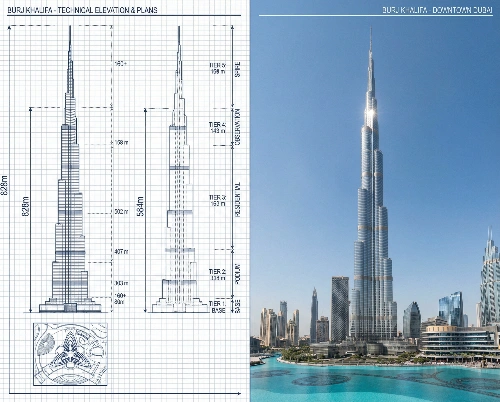
{ "objective": "Create a side-by-side comparison image featuring a technical sketch and real photograph of the [Burj Khalifa]", "image_specifications": { "style": "Mixed media (Technical drawing + Real photograph)", "layout": "Horizontal split - Left side: Sketch with measurements, Right side: Real photo", "aspect_ratio": "3:2" }, "left_side": { "content_type": "Technical sketch of the building", "features": [ "Detailed architectural lines showing tiered setbacks", "Numerical height and width measurements", "Elevation labels for different tower sections", "Side and front elevation views (top-down projection if space allows)" ], "text_annotations": { "units": "Metric (meters)", "language": "English", "font_style": "Blueprint or engineering-style typography" }, "positioning": "Take up the left half of the image" }, "right_side": { "content_type": "High-resolution real photo of the building", "features": [ "Full view of the tower from base to spire", "Natural daylight with clear sky", "Color image with Dubai skyline or Downtown Dubai context" ], "positioning": "Take up the right half of the image" }, "visual_elements": { "border_division": "Vertical line or subtle transition between left (sketch) and right (photo)", "color_palette": { "left": "Monochrome or blueprint blue for sketch", "right": "Natural realistic colors" } }, "output_format": { "type": "Image", "use_case": ["Educational poster", "Architectural comparison", "Engineering visualization", "Tourism visual aid"], "high_resolution": true } }
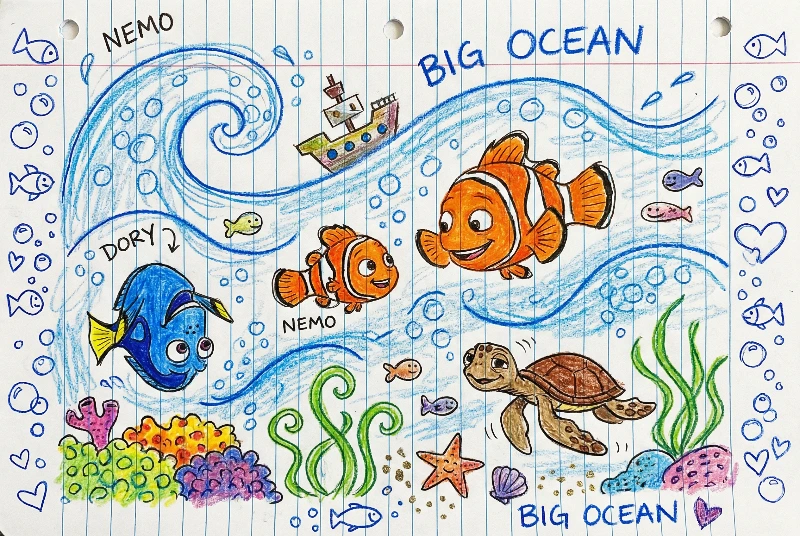
Draw a magical ocean scene from Finding Nemo as if created by a cheerful 6-year-old on white notebook paper. Show Nemo and Marlin swimming happily in the middle, with Nemo drawn a little smaller and extra orange with wiggly stripes. Draw the ocean as big blue crayon waves and scribbly bubbles everywhere. Add Dory nearby with a huge smile and dot eyes, maybe forgetting where she’s going. Draw coral reefs as colorful bumpy shapes and sea plants like curly noodles. Add a friendly sea turtle cruising by with flippers stretched out, smiling like a grandpa. In the background, draw a sunken ship that looks more like a toy boat. Add tiny fish that look like floating beans. Put playful extras like a starfish, a seashell, and sparkly dots for light rays. Add margin doodles (fish faces, bubbles, hearts). Include labels like “NEMO”, “DORY”, and “BIG OCEAN.”
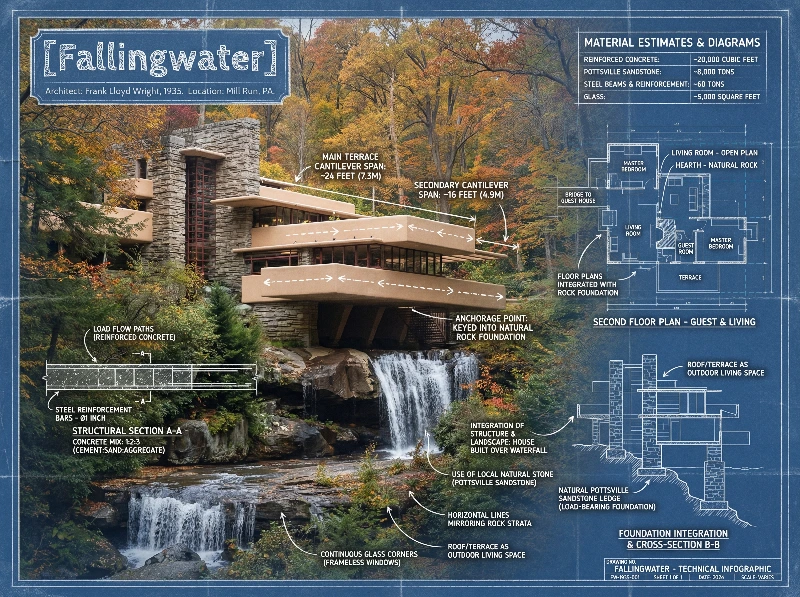
Create an infographic image of [Fallingwater by Frank Lloyd Wright], combining a real photograph of the landmark with blueprint-style technical annotations and diagrams overlaid on the image. Include the title “[Fallingwater]” in a hand-drawn box in the corner. Add white chalk-style sketches showing key structural data, cantilever span measurements, material quantities, internal diagrams of living spaces, load-flow arrows through reinforced concrete slabs, cross-sections of the cantilevers, floor plans integrated with the rock foundation, and notable architectural or engineering features such as the integration of structure, landscape, and natural stone. Style: blueprint aesthetic with white line drawings on the photograph, technical/architectural annotation style, educational infographic feel, with the real environment visible behind the annotations.
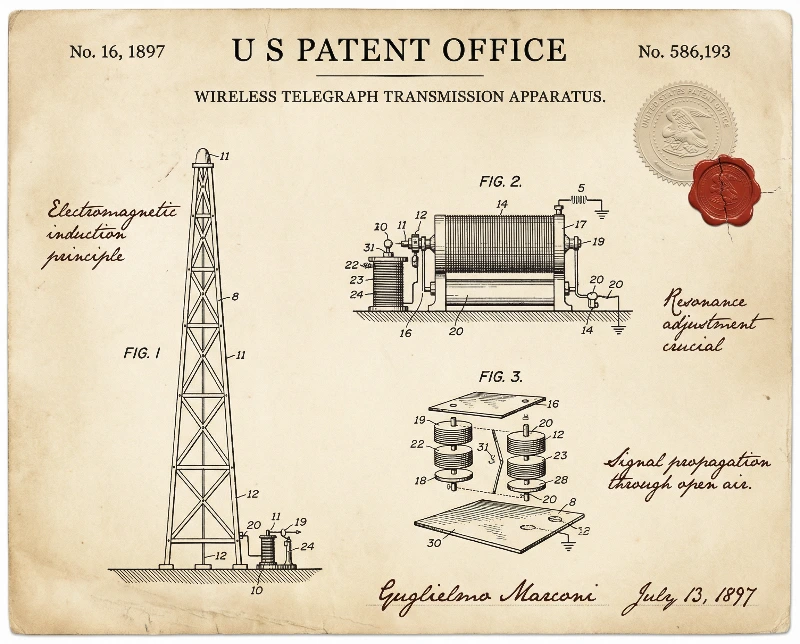
A vintage patent document for a wireless telegraph transmission apparatus, styled after late 1800s United States Patent Office filings. The page features precise technical drawings with numbered callouts (Fig. 1, Fig. 2, Fig. 3) illustrating the antenna mast, coil-and-spark transmitter, and an exploded diagram of the tuning components and grounding system. Handwritten annotations in fountain-pen ink describe electromagnetic induction, resonance adjustment, and signal propagation through open air. The paper is aged ivory with foxing stains and soft fold creases. An official embossed seal and a cracked red wax stamp appear in the upper corner. A hand-signed inventor’s name and the date 1897 appear at the bottom. The entire image feels like a recovered archival document—authoritative, historic, and slightly mysterious.
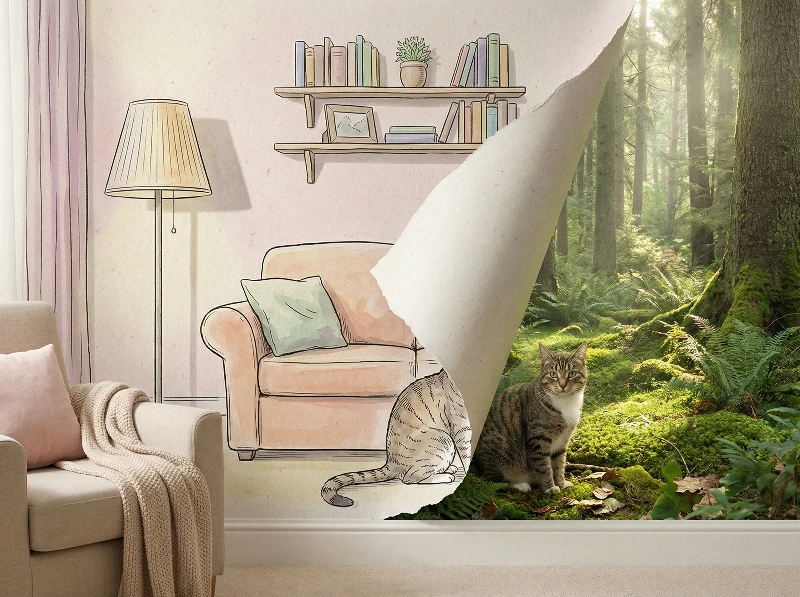
A cozy room where the wall looks like a giant paper illustration, flat ink lines and watercolor washes, yet a corner of the “paper wall” is peeled back, revealing a fully 3D forest behind it. The peeled edge curls outward like thick cardstock, casting a real shadow on the illustrated surface. The illusion: the 2D drawn objects (a drawn lamp, drawn shelf) cast realistic 3D shadows, while the 3D forest casts faint “ink” shadows as if it’s becoming a drawing. A cat sits half-in, half-out: front paws in 3D forest moss, back body in 2D sketch form, seamlessly blended. Soft morning light, gentle pastel palette, tactile paper fibers visible, high detail, whimsical but believable “mixed-dimension” realism.
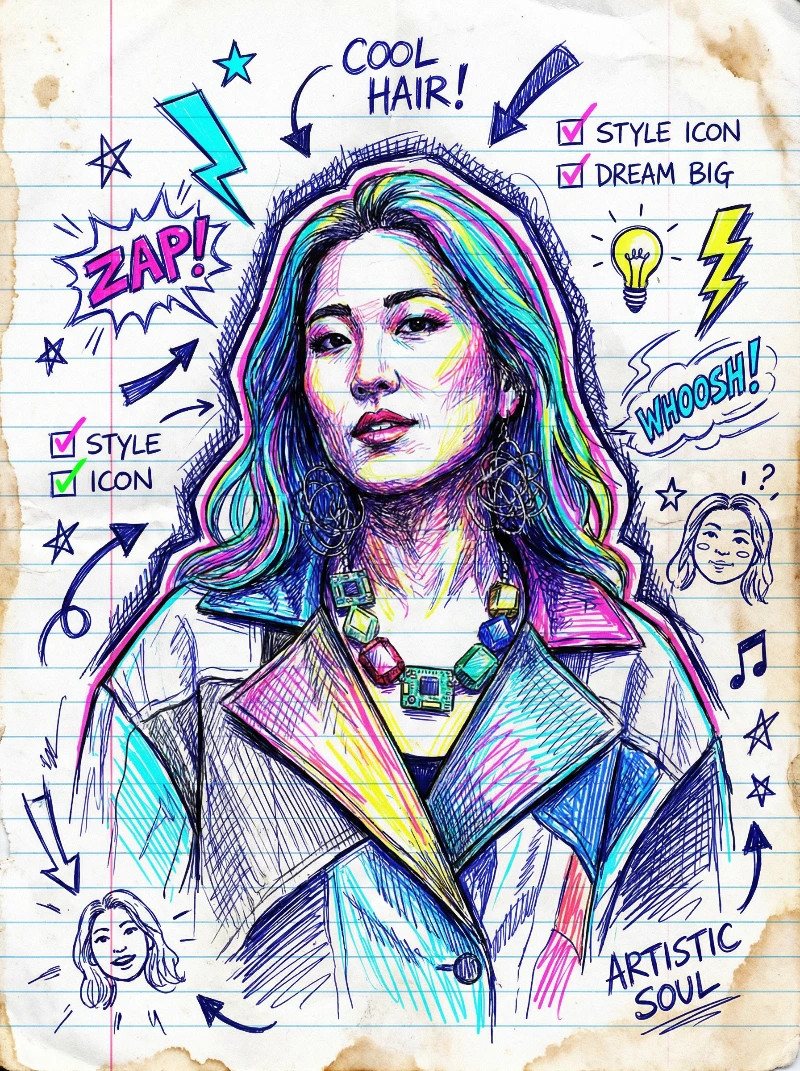
{ "image_generation_task": { "task_type": "img2img", "input_source": "uploaded_user_image", "constraint": "preserve_full_likeness", "base_configuration": { "medium": { "substrate": "lined notebook paper", "tools": [ "ballpoint pen", "neon markers", "ink" ], "texture_details": [ "realistic ink absorption", "layered pen pressure", "stained edges", "smudges", "subtle paper wrinkles" ] }, "art_style": { "genre": [ "doodle art", "comic annotations", "sketch" ], "line_work": "thick-thin variation, loose freestyle, messy strokes, dynamic hatch shading", "atmosphere": "chaotic, energetic, spontaneous, dense" }, "rendering": { "resolution": "4K", "detail_level": "high", "lighting": "bold outer glow, vibrant contrast" } }, "composition_elements": { "framing": "portrait with thick border line around head", "surrounding_elements": [ "messy arrows", "stars", "underlines", "random scribbles", "speech bubbles", "overlapping annotations", "checkboxes" ], "iconography": [ "lightning bolt", "lightbulb", "music note", "mini self-caricature" ], "typography": { "style": "handwritten comic notes", "sound_effects": [ "ZAP!", "WHOOSH!" ] } }, "style_variations": [ { "id": "variant_01_pop_bold", "color_palette": [ "bold cyan", "magenta" ], "specific_vibe": "vibrant pop, stylish comic notes" }, { "id": "variant_02_neon_highlight", "color_palette": [ "neon pink", "neon yellow" ], "specific_vibe": "highlighter aesthetic, expressive gestures" }, { "id": "variant_03_electric_graffiti", "color_palette": [ "hot electric blue", "neon red" ], "specific_vibe": "graffiti-styled, exaggerated outline, playful highlights" }, { "id": "variant_04_dense_sketch", "color_palette": [ "blue linework", "red accents" ], "specific_vibe": "densely packed, horror vacui (no blank space), alive and messy" } ] } }
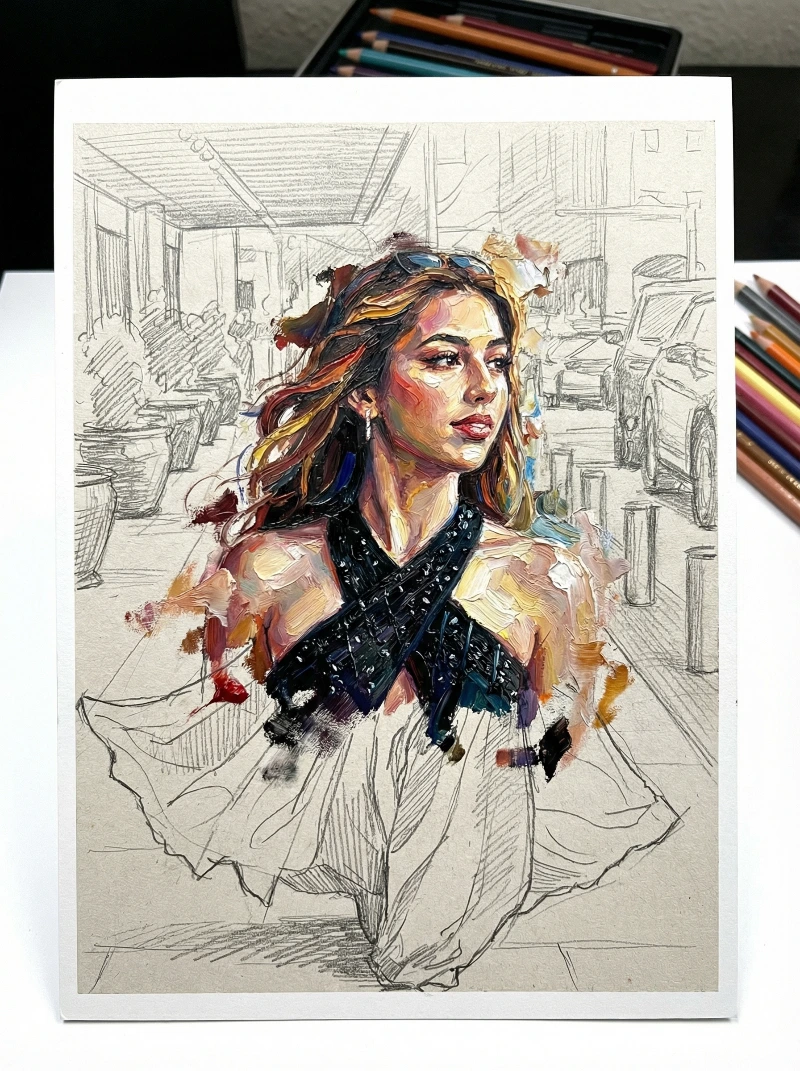
A vertical, flat digital mixed media portrait artwork featuring a beautiful woman from the reference image. The image fills the entire frame directly. 1. The Center (The Finished Reality - Impasto Oil): A rich, heavy impasto oil painting portrait of a beautiful woman (focus on face and upper body). The brushwork is thick, expressive, and textured, creating a 3D relief effect. The colors are vibrant and lush, with dramatic lighting highlighting her features, hair, and skin texture. It looks like a completed, masterful painting. 2. The Surroundings (The Draft - Pencil Sketch on Rough Paper): The background and the area surrounding the central oil painting is a raw, monochromatic graphite pencil sketch (or charcoal drawing) on heavy-grain, coarse, matte sketch paper. This area shows loose outlines, cross-hatching shading, draft lines, and construction marks of the same woman's form, giving an unfinished, sketchy feel. The paper texture is rough and tactile. 3. The Boundary (The Collision): The transition between the vibrant thick oil paint and the raw grey pencil sketch is jagged, rough, loose, and organic. It looks like the oil painting is emerging from or painted roughly over the sketch draft. Thick paint blobs, smudges, and unfinished brushstrokes bleed onto the raw pencil areas. realistic skin texture, smooth paper, glossy, shiny, flat texture, interior, wall, frame, bright white background, clean edges, colored pencils in background
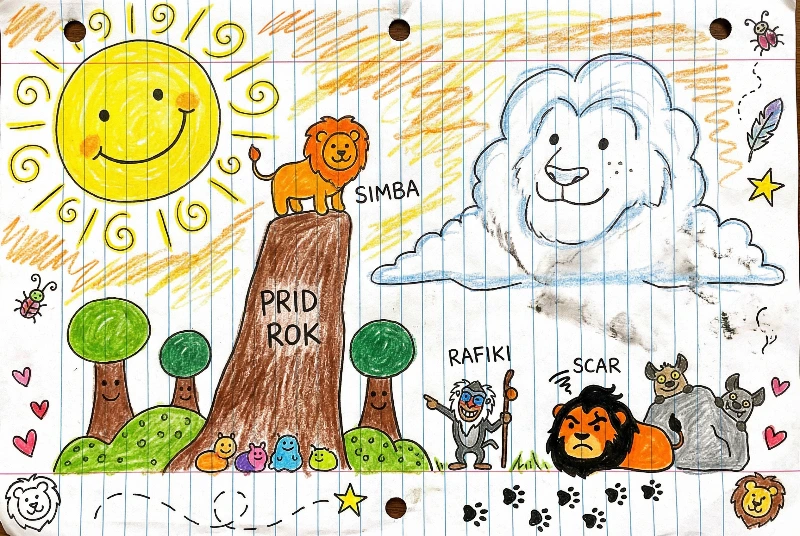
Draw an iconic scene from The Lion King as if created by a cheerful 6-year-old on white notebook paper. Show Simba standing proudly on Pride Rock (make Pride Rock extra big and tall), with a huge bright sun taking up a corner of the page and orange-yellow scribble shading in the sky. Draw the savanna as simple flat shapes: round trees, bumpy hills, and tiny animals that look like smiling blobs. Add Rafiki holding a stick and pointing, with a big grin. In the clouds, draw Mufasa’s face as a giant friendly cloud-smile with dot eyes (big because it’s important). Add a silly Scar off to the side with a dramatic eyebrow squiggle, and a couple goofy hyenas peeking out from behind a rock. Put pawprints across the bottom like a trail. Add playful extras like a bug, a feather, and sparkly stars starting to appear. Add margin doodles (tiny lion faces, hearts). Include labels like “PRID ROK” and “SIMBA.”
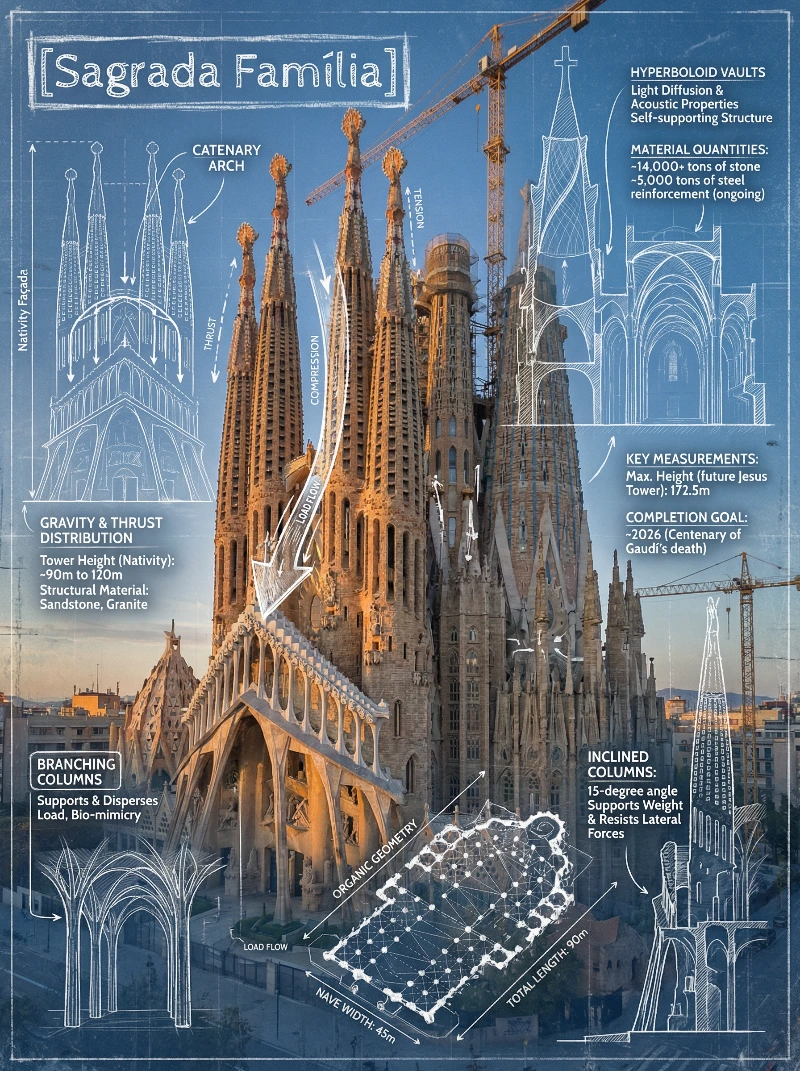
Create an infographic image of [Sagrada Família, Barcelona], combining a real photograph of the landmark with blueprint-style technical annotations and diagrams overlaid on the image. Include the title “[Sagrada Família]” in a hand-drawn box in the corner. Add white chalk-style sketches showing key structural data, important measurements, material quantities, internal diagrams, load-flow arrows illustrating gravity and thrust through catenary arches, cross-sections of the towers, floor plans of the basilica, and notable architectural or engineering features such as hyperboloid vaults, branching columns, and organic geometry. Style: blueprint aesthetic with white line drawings on the photograph, technical/architectural annotation style, educational infographic feel, with the real environment visible behind the annotations.
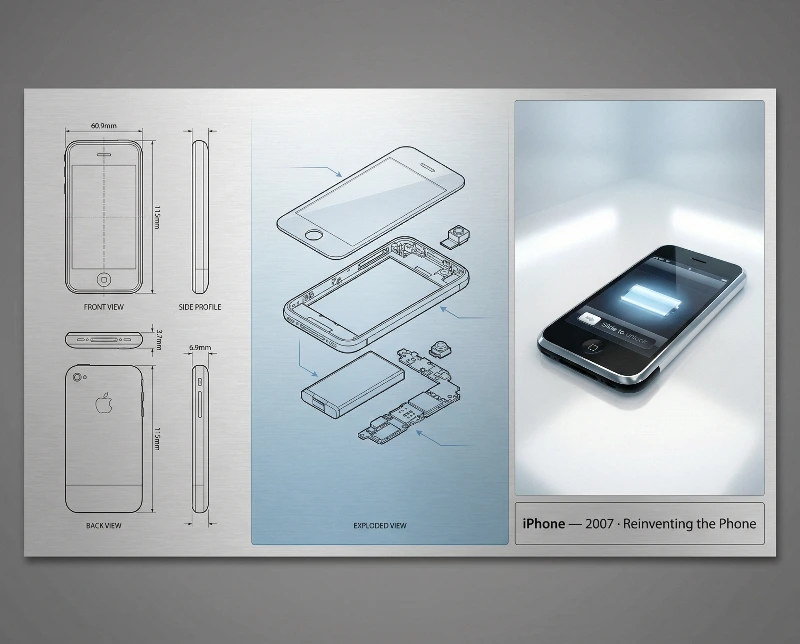
An expert industrial product designer’s presentation board for the original iPhone — early 2007 minimalist digital revolution, featuring black-and-white 2D technical drawings with annotations and dimensions on the left, an exploded axonometric diagram revealing the glass touchscreen, aluminum chassis, battery module, logic board, and camera unit in the center, and a photorealistic 3D render of the iPhone in a clean modern studio environment with a reflective surface on the right, with soft diffused lighting, subtle screen glow, and pristine reflections; visual style transitions from clinical monochrome engineering schematics to cool whites and soft tech-blue gradients, clean grid layout, museum-grade industrial design presentation, ultra-detailed cinematic realism, title block reading “iPhone — 2007 · Reinventing the Phone”.
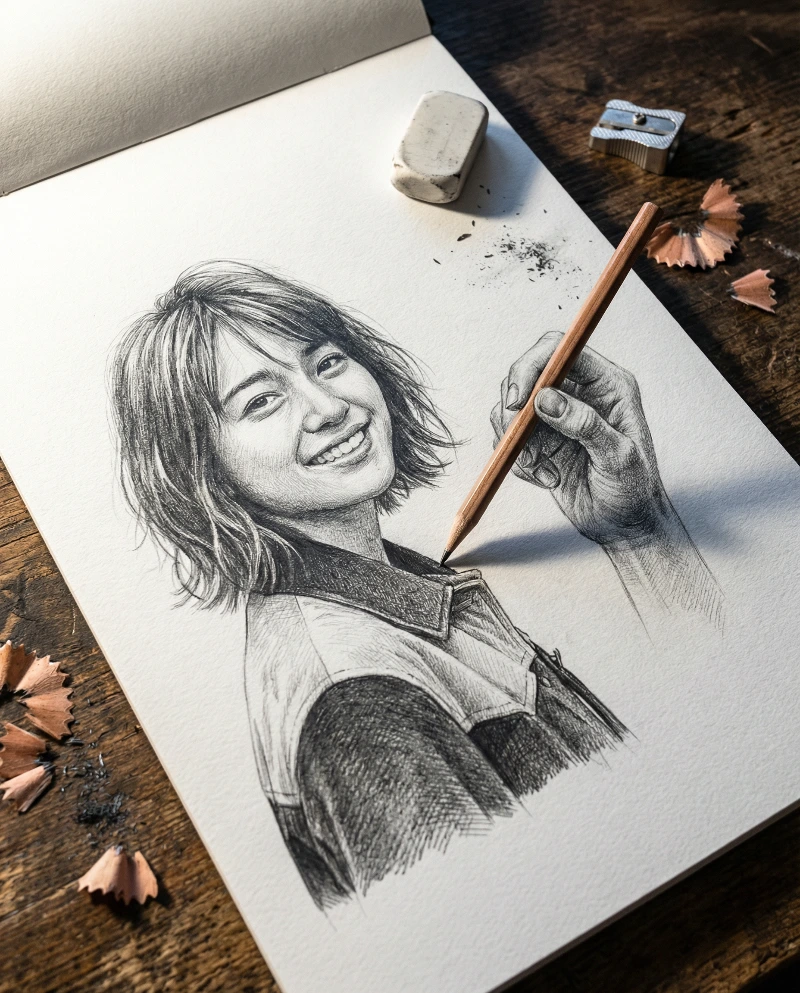
{ "subject_core": { "demographics": "[STRICTLY FOLLOW REFERENCE IMAGE]: Age, gender, and ethnicity must match the uploaded source photo exactly. Rendered as a hyper-realistic graphite sketch.", "body_type": "Matches reference image physique, appearing to lean forward out of the 2D plane", "facial_features": "High-fidelity graphite translation of the reference face; shading emphasizes specific bone structure and unique traits from the source photo; eyes detailed with paper-white catchlights", "hair": "Matches reference image hairstyle and texture exactly, rendered with varying pencil pressure (hatching and cross-hatching)" }, "subject_styling": { "makeup_grooming": "Matches reference image grooming standards; skin texture converted to realistic pencil grain and stippling", "expression": "Matches reference image expression (e.g., focused, smiling, or neutral), intense gaze directed relative to the viewer", "pose_action": "Anamorphic illusion: The subject's hand (drawn in graphite) creates a 3D effect, appearing to reach out of the flat paper surface, holding a realistic wooden pencil" }, "wardrobe": { "top": "Matches clothing from reference image, textures converted to graphite cross-hatching to imply fabric weight", "bottom": "N/A (cropped or fading into the white of the paper)", "footwear": "N/A", "accessories": "Any distinct accessories from the reference photo rendered in sketch format" }, "environment_context": { "location": "Macro view of a textured, heavy-tooth white sketchbook page resting on a dark rustic wooden surface", "background_elements": "Real-world objects resting on the paper to sell the scale: a worn white block eraser, a metal pencil sharpener, scattered cedar wood pencil shavings, smudge of graphite dust", "time_context": "Studio lighting environment, timeless artistic setting" }, "cinematography_and_tech": { "lighting": "Dual lighting setup: 1. Simulated shading within the sketch based on the reference. 2. External 'real world' harsh lamp light casting long shadows from the pencil and eraser onto the paper", "camera_gear": "Macro photography, 100mm lens, sharp focus on the paper texture", "framing": "Top-down flat lay or slight isometric angle to enhance the 'pop-up' 3D illusion of the sketch", "visual_fidelity": "Photorealistic rendering of paper grain/fiber, tactile graphite sheen, rough charcoal texture, high contrast between dark leads and white paper", "color_grading": "Monochromatic greyscale for the subject (graphite/charcoal tones), natural realistic colors for the desk and drawing tools" }, "aspect_ratio": "4:5" }
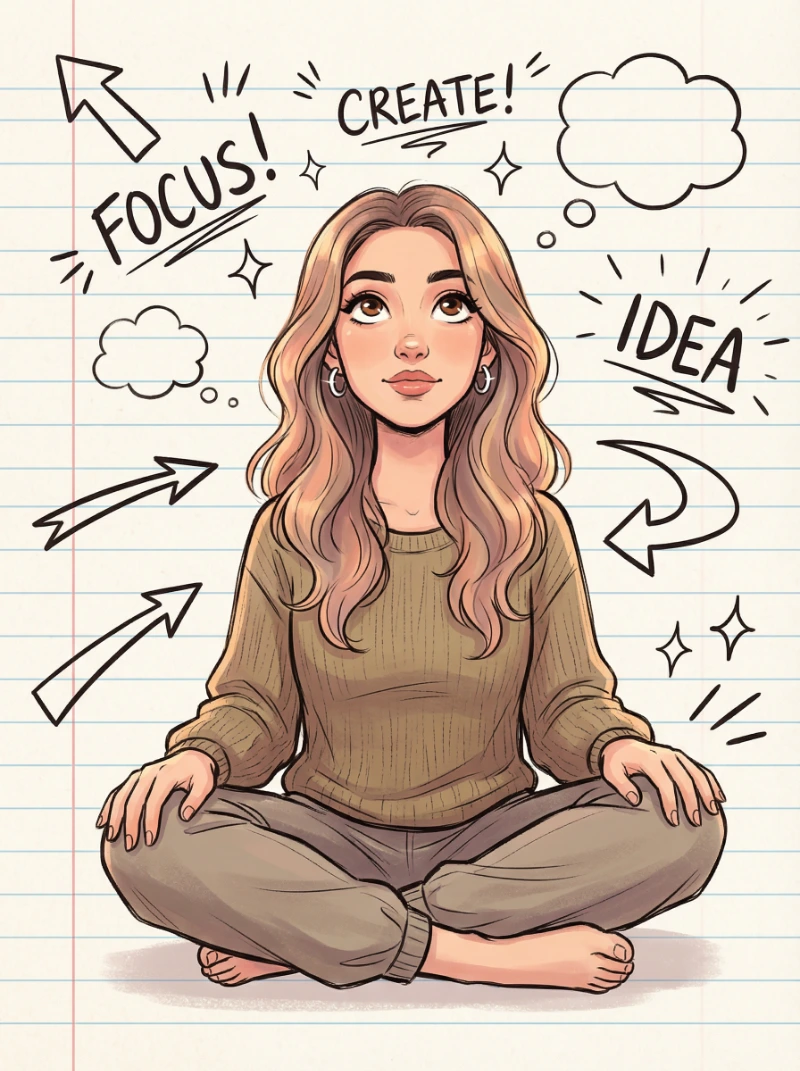
{ "image_prompt": { "subject": { "description": "illustrated portrait of a thoughtful young woman sitting cross-legged on a ruled notebook background, keeping the face of the reference image", "pose": { "body_position": "cross-legged, relaxed posture", "hands": "resting gently on her knees", "expression": "thoughtful with expressive eyes looking upward as if forming an idea" }, "appearance": { "hair": { "style": "loose wavy hair with soft shading" }, "face": { "shading": "soft warm shading on cheeks and nose" }, "accessories": { "earrings": "small silver earrings catching the light" }, "clothing": { "outfit": { "style": "casual, earthy-toned", "mood": "relaxed and natural" } } } }, "environment": { "setting": "ruled notebook paper background", "details": { "doodles": [ "bold hand-drawn arrows", "spark symbols", "scribbled text: 'FOCUS!'", "scribbled text: 'CREATE!'", "scribbled text: 'IDEA'", "floating thought symbols around her head" ], "style_notes": "modern, clean comic-sketch aesthetic; bold outlines with soft shading" } }, "art_style": { "type": "illustration", "style": "modern comic sketch", "linework": "bold expressive outlines", "color_palette": "soft warm tones with muted earthy colors", "texture": "light paper texture from notebook background" }, "composition": { "focus": "young woman centered with expressive upward gaze", "background_elements": "doodles floating around her in an organized but playful layout", "negative_prompt": [ "distorted anatomy", "overly realistic rendering", "messy or unclear doodles", "cluttered background", "text errors", "extra limbs" ] } } }