
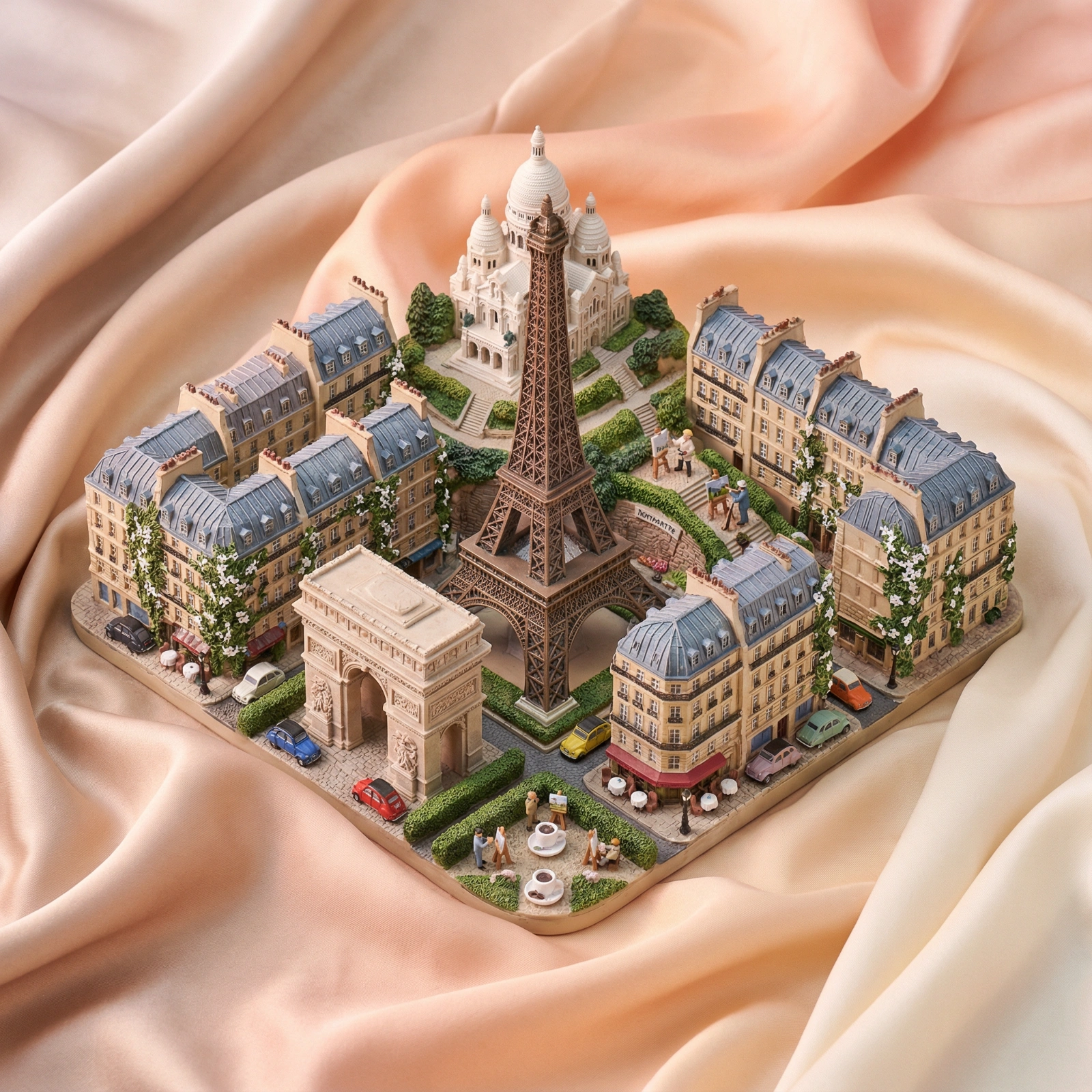
Ethereal Paris Miniature Scene
Prompt
A 45° top-down isometric view of an exquisite [Paris] miniature scene figurine, featuring iconic landmarks: [The Eiffel Tower (intricate iron lattice), the Arc de Triomphe (detailed stone carvings), and the white domes of Sacré-Cœur]; surrounded by dense mini [Haussmann-style apartments (limestone facades, zinc blue roofs)] and [manicured garden hedges (white jasmine vines climbing)]; the scene is crafted as a fine resin miniature figurine with rich details: mini [street-side bistro tables with tiny espresso cups, painters with easels at Montmartre, and miniature classic Citroën cars]; the background is not plain white, but flowing dreamy silk fabric ([gradient tones of champagne, soft peach, and cream]) encircling the miniature; soft [rosy morning sunrise light] illuminates the figurine, highlighting intricate details and casting gentle shadows, creating a [romantic, airy, and sophisticated] atmosphere.
Aspect Ratio
Model
Nano Banana ProYou might also like
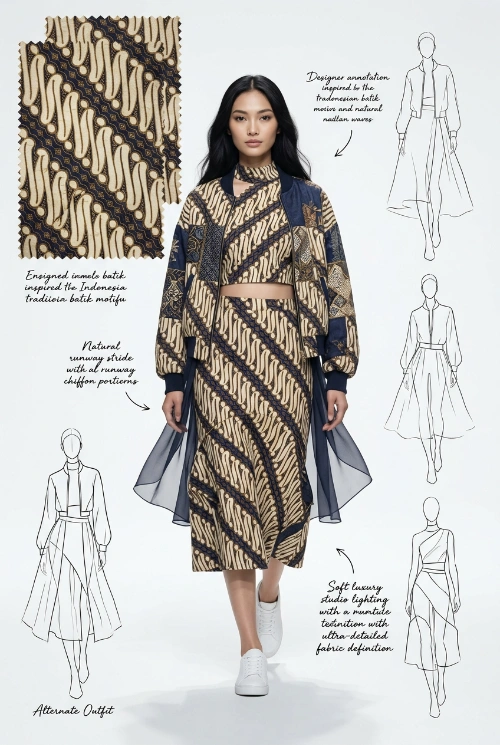
Ultra-Premium Batik Couture Board
{ "prompt": "Ultra-premium luxury fashion designer concept board on a pristine white studio canvas, inspired by high-end couture fashion houses. CENTER MODEL A tall slender Javanese female fashion model with elegant runway proportions walking gracefully in a natural runway stride pose. FASHION THEME Modern couture fashion inspired by traditional Indonesian Batik Parang motif. The textile pattern features flowing diagonal blade-like waves and repeating curved lines with rich tones of deep indigo, warm ivory, and antique gold. OUTFIT DESIGN • Cropped asymmetric mock-neck top decorated with the batik pattern • Relaxed oversized bomber jacket with patchwork batik panels and soft semi-transparent chiffon layers flowing from the waist • Sculptural segmented midi skirt with modern architectural silhouette • Minimalist clean white sneakers MODEL APPEARANCE Long jet-black hair with soft natural waves, delicate oval face, natural makeup, calm confident expression. DESIGN BOARD ELEMENTS • Top-left: enlarged fabric swatch showing the batik texture • Right side: three minimalist fashion sketches • Lower-left: alternate outfit sketch • Elegant handwritten designer annotations across the board LIGHTING Soft luxury studio lighting with subtle shadows and detailed textile highlights. STYLE High-end couture design board, editorial fashion presentation, masterpiece quality, ultra-detailed fabric texture." }
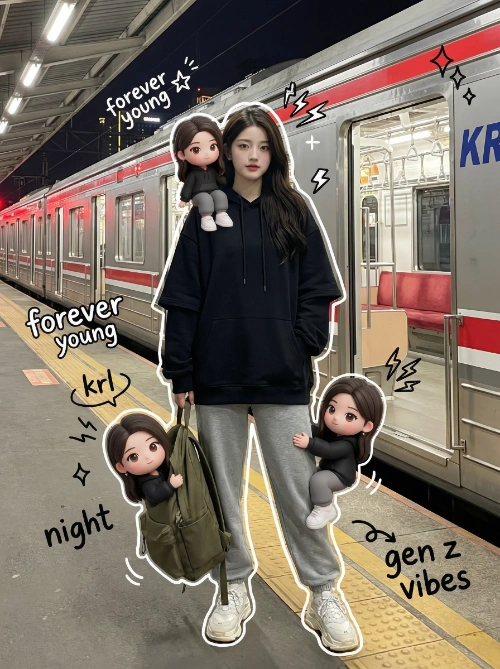
Gen Z Night Train Chibis
A high-quality mixed-media portrait of a trendy Gen Z teenager (using my uploaded person photo) standing on a train station platform at night. The subject is posing coolly, holding the strap of their olive backpack with one hand. They are wearing a stylish Gen Z outfit (oversized streetwear, layered black hoodie, gray sweatpants, and chunky sneakers). The background features a realistic 'KRL Jabodetabek' Commuter Line train side view with its signature red striping, with the train doors wide open, bathed in bright, cinematic station lighting and city night ambiance. Surrounding the realistic main subject are several cute, 3D-style 'Chibi' versions of the theirself. same wears and same face. These chibis are interacting playfully: one is sitting on the subject's shoulder, one is climbing their leg, and another is peeking out from the backpack. Overlay the image with vibrant, hand-drawn doodle effects: white drawn outlines around the subject, playful scribbles, stars, sparkles, electric sparks, and floating white and black handwritten slogans like 'forever young', 'krl', 'night', and 'gen z vibes'. The style should seamlessly blend hyper-realistic photography with colorful, flat cartoon illustrations. Keeping face and all shape person unchanged.
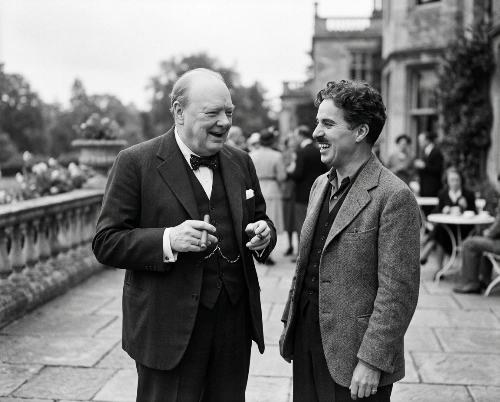
Candid Historic Legends
candid photo of two iconic historical legends
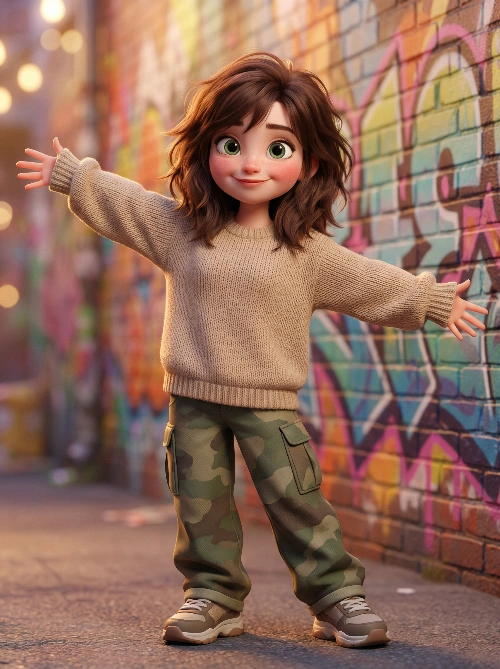
Cute Urban 3D Cartoon Girl
A cute stylized 3D cartoon girl with a Pixar–Disney-inspired look, big expressive green eyes, soft freckles, rosy cheeks, and a warm innocent smile. She is standing confidently in a colorful urban alley with a vibrant graffiti brick wall background, cinematic depth of field and soft bokeh lights. The character has a cozy oversized knitted sweater in a neutral beige tone with long sleeves covering part of the hands. She wears loose-fit cargo pants (olive green / camouflage tone), slightly baggy, paired with chunky casual sneakers. Her pose is joyful and playful with both arms stretched wide outward, conveying happiness and freedom. Hair is medium-length brown, slightly messy yet cute, styled naturally (can be open or lightly tied), with soft realistic strands. Lighting is warm and cinematic, soft ambient glow, ultra-detailed textures, high-quality 3D render, realistic fabric knit details, smooth skin shading, shallow depth of field, vibrant colors, whimsical mood, modern animated movie character style, ultra HD, sharp focus.
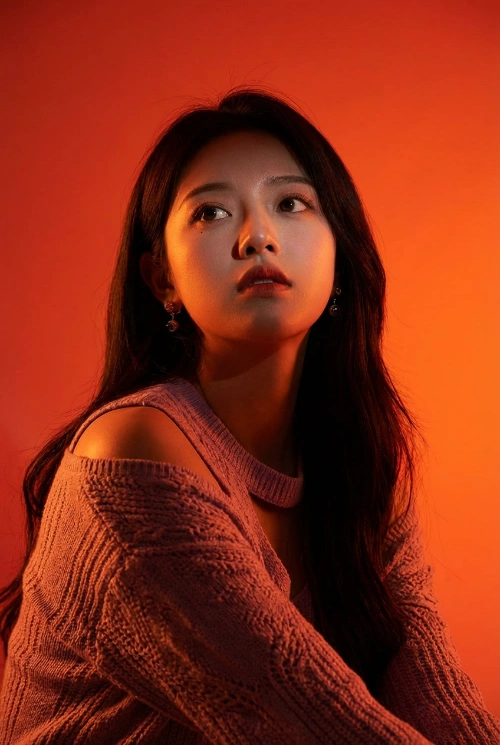
Heroic Dramatic Studio Port
{ "meta": { "title": "Heroic Dramatic Studio Portrait", "role": "World-class photographer specializing in editorial portraits", "aesthetic": "Dramatic, saturated studio lighting with a heroic feel" }, "constraints": { "identity_anchor": { "source": "ATTACHED REFERENCE PHOTO", "strictness": "Critical", "instruction": "Perfectly preserve exact facial features, skin tone, hairstyle, and natural likeness without changes." }, "clothing_anchor": { "source": "EXACTLY AS IN REFERENCE PHOTO", "strictness": "Critical", "instruction": "Style, color, material, and fit must fully correspond to the original without stylization." } }, "subject_details": { "expression": "Serious, tense, focused", "gaze": "Directed away from camera, into space above", "universality": "Lighting and angle applicable regardless of gender" }, "composition": { "background": "Saturated solid orange-red backdrop, smooth intense gradients, no patterns, 'hot' atmosphere", "camera_angle": "Low angle (shot from below upwards) to create dominance", "framing": "Medium close-up, emphasis on face and shoulders" }, "lighting": { "palette": "Dominant bright oranges and deep red shades", "key_light": "Strong directional source, deep dramatic shadows (chiaroscuro), emphasizing facial structure", "backlight": "Powerful expressive rim light or color halo separating subject from background", "mood": "Mysterious, tense, high-contrast" }, "technical_specs": { "style": "Photorealism, high detail", "focus": "Sharp focus on face vs smooth gradient background", "texture_quality": "Preserve natural pores and skin texture" }, "combined_prompt_text": "World-class editorial portrait, dramatic studio lighting, heroic feel. [REFERENCE PHOTO IDENTITY PRESERVED]: Exact facial features, skin tone, hairstyle. [CLOTHING EXACT MATCH]: No changes to fit or material. Expression: serious, tense, focused, looking up and away. Background: Saturated solid orange-red, smooth intense gradients, hot atmosphere. Camera Angle: Low angle shot from below for dominance. Framing: Medium close-up. Lighting: Bright orange and deep red palette, strong directional chiaroscuro key light, powerful rim light separating subject from background. Technical: Photorealistic, high detail, sharp focus on face, natural skin texture and pores." }
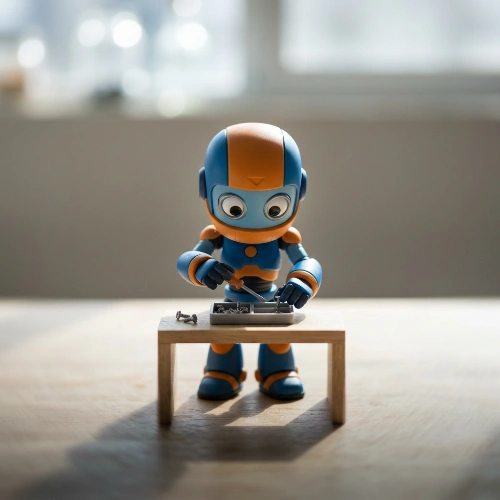
Candid High-Angle Slice
A high-angle tilt-shift cinematic image of the character captured naturally doing an everyday activity. The moment must feel candid and unstaged, like a quiet slice of life observed from above. Likeness Preservation Maintain exact proportions, eye shape, spacing, stylization, and material identity from the reference. Do not humanize. Do not reinterpret anatomy. Do not exaggerate realism. Camera & Perspective High-angle, slightly offset bird’s-eye view. Subtle isometric feeling. Equivalent to a 35mm lens adapted for tilt-shift photography. The character fills approximately 60–65% of the frame vertically. Breathing room above the head. Visible ground plane beneath. No extreme distortion. Focus Discipline (CRITICAL) Extremely shallow depth of field. Only the face and upper torso must be razor sharp. Hands interacting with an object may also be sharp. Lower legs and shoes must be slightly softened. Ground surface must progressively soften toward the bottom edge. Top and bottom edges must show strong optical tilt-shift blur. The focus band must be narrow and centered horizontally. No full-body sharpness. Pose Behavior The character must be naturally engaged in a daily action. Movement must feel subtle and believable. No staged hero poses. No exaggerated symmetry. Silhouette must remain clean and readable. Props or minimal furniture may be included only if necessary to support the action. Keep them simple and secondary. Lighting Control Bright natural daylight with firm directional key light. Light must carve the form clearly. Defined shadow under feet or object. Crisp shadow edge on ground. Subtle rim light separating character from background. No flat studio wash. No overly diffused light. Background Discipline Abstract minimal environment. Soft tonal gradient. Slight atmospheric depth. No detailed storytelling clutter. No heavy furniture unless essential to action. Background must support the character, not compete. Background Directional Structure (CRITICAL) Upper third of frame must contain soft luminous bokeh shapes or circular light blobs, gently out of focus, slightly brighter than mid-ground. Mid-ground remains neutral and unobtrusive. Lower ground plane must have subtle diagonal orientation, with a light-to-dark gradient guiding the eye upward toward the character’s head. Ground texture may contain faint linear perspective cues, but remain soft and minimal. The tonal gradient must travel from slightly darker bottom edge toward brighter mid-upper region behind the head. No flat monotone background. Color & Material Character slightly higher saturation than background. Background slightly muted. Clean premium collectible finish. Subtle surface sheen. No gritty realism. No artificial wear. Emotion Calm presence. Quiet confidence. A simple daily act elevated through composition and light. Not dramatic. Not heroic. Intimate but cinematic. Negative Lock No full-body sharpness No flat background No cluttered environment No stiff symmetrical pose No soft diffused lighting No dramatic battle energy No exaggerated realism
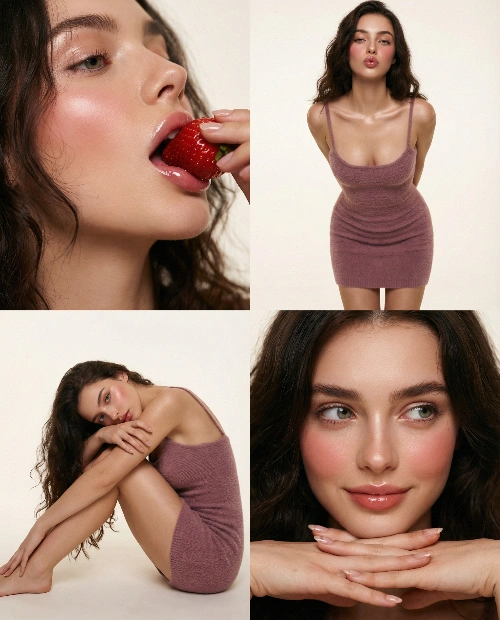
Ultra-Real Beauty Grid
{ "project_specifications": { "format": "2x2 Grid Collage", "aspect_ratio": "4:5", "aesthetic_style": "High-end Beauty Editorial", "rendering_engine_hints": { "realism_level": "Ultra-photorealistic", "texture_quality": "8k", "lighting_simulation": "Ray-traced studio lighting" } }, "global_assets": { "subject_definition": { "hair": { "style": "Long, loosely wavy, voluminous", "texture": "Natural, individual strands defined", "behavior": "Messy but styled, framing face and shoulders" }, "complexion": { "skin_texture": "Porous, hyper-realistic", "finish": "Dewy, glass-skin effect", "makeup": { "cheeks": "Heavy flush/blush", "lips": "High-gloss, plump, natural pink", "eyes": "Clean, defined lashes, natural brows" } }, "wardrobe": { "item": "Mini dress", "fit": "Bodycon / Tight", "fabric": { "material": "Soft textured knit / Boucle", "tactility": "Fuzzy, light-catching fibers", "color": "Soft mauve or neutral taupe" }, "details": "Spaghetti straps, mid-thigh length" } }, "environment_definition": { "studio_setup": { "background": "Seamless paper, soft off-white/beige", "atmosphere": "Clean, warm, intimate" }, "lighting_rig": { "key_light": "Large diffuse softbox (Front-Left)", "fill_light": "Reflector (Right)", "highlights": "Specular highlights on lips, cheekbones, and shoulders" } } }, "panel_architecture": [ { "position": "Top-Left (1)", "shot_type": "Extreme Close-Up (Macro)", "composition": { "angle": "Low angle, looking up slightly", "focus": "Mouth and nose area", "depth_of_field": "Shallow" }, "action": { "primary": "Eating a strawberry", "nuance": "Delicate finger hold, lips slightly parted" }, "visual_anchors": [ "Moisture on strawberry surface", "Gloss reflection on lips", "Baby hairs at temple" ] }, { "position": "Top-Right (2)", "shot_type": "Medium Shot (Thigh-up)", "composition": { "angle": "Eye level", "pose_dynamic": "Leaning forward slightly towards lens" }, "action": { "stance": "Standing straight on", "arms": "Relaxed at sides", "expression": "Direct gaze, alluring pout" }, "visual_anchors": [ "Texture of knit dress", "Collarbone shadows", "Curvature of waist" ] }, { "position": "Bottom-Left (3)", "shot_type": "Full Body (Seated)", "composition": { "angle": "Side profile", "framing": "Subject compacted on floor" }, "action": { "pose": "Knees to chest (fetal position variation)", "interaction": "Cheek resting on knee, arms embracing legs", "hair_flow": "Cascading onto the floor" }, "visual_anchors": [ "Smooth leg definition", "Dress stretching over thigh", "Dreamy gaze" ] }, { "position": "Bottom-Right (4)", "shot_type": "Beauty Portrait (Head & Hands)", "composition": { "angle": "Frontal close-up", "framing": "Chin to hairline" }, "action": { "gesture": "Chin resting on interlaced fingers", "expression": "Soft smile, looking off-camera" }, "visual_anchors": [ "Hand detail and manicure", "Eye clarity", "Flush on cheeks" ] } ] }
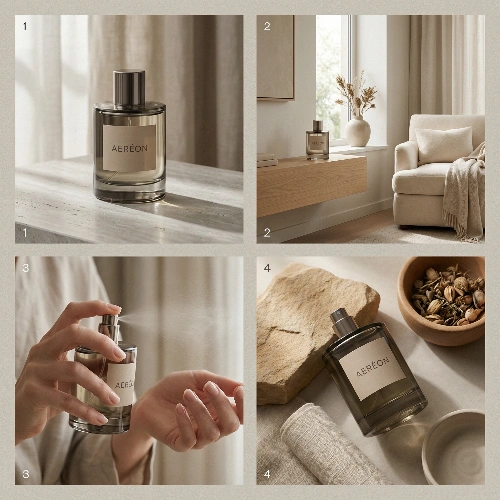
AERÉON Luxe Sensory Grid
{ "Objective": "Create a refined 2×2 grid advertisement for the luxury home fragrance 'AERÉON', emphasizing mood, atmosphere, and sensory elegance through minimal, editorial-style visuals.", "Canvas": { "Aspect_Ratio": "1:1", "Grid_Structure": "2×2 equal panels", "Orientation": "Square", "Use_Case": [ "Luxury brand social media", "Home & lifestyle campaigns", "E-commerce product storytelling", "Editorial-style digital ads" ] }, "Panels": [ { "Panel_Number": 1, "Title": "Hero Fragrance Object", "Description": "Studio hero shot of the AERÉON fragrance bottle centered on a stone or wood surface.", "Visual_Details": { "Lighting": "Soft diffused light with gentle shadows", "Background": "Neutral warm tones linen", "Focus": "Bottle shape, glass quality, minimalist label", "Mood": ["Elegance", "Calm", "Premium"] } }, { "Panel_Number": 2, "Title": "Atmospheric Interior", "Description": "Lifestyle interior scene with the fragrance placed on a shelf or table.", "Visual_Details": { "Setting": "Modern, serene living space", "Lighting": "Natural window light", "Mood": ["Comfort", "Warmth", "Refined living"] } }, { "Panel_Number": 3, "Title": "Scent Ritual Detail", "Description": "Close-up of hands interacting with the fragrance (spraying or opening).", "Visual_Details": { "Focus": "Human interaction and ritual", "Depth_of_Field": "Shallow and intimate", "Mood": ["Sensory", "Personal", "Mindful"] } }, { "Panel_Number": 4, "Title": "Material & Mood", "Description": "Macro or still-life composition featuring fragrance alongside natural elements.", "Visual_Details": { "Elements": ["Stone", "Linen", "Wood", "Ceramic"], "Lighting": "Soft highlights, low contrast", "Mood": ["Natural", "Timeless", "Atmospheric"] } } ], "Branding": { "Product_Name": "AERÉON", "Brand_Personality": "Quiet luxury, modern, sensory-focused", "Color_Palette": ["Warm Beige", "Soft Taupe", "Smoked Glass"], "Logo_Presentation": "Minimal, understated, centered or embossed" }, "Visual_Style": { "Style_Keywords": [ "Luxury home lifestyle advertising", "Editorial still-life photography", "Minimalist composition", "High realism", "Soft natural tones" ] }, "Camera_And_Lighting": { "Photography_Type": "Editorial and commercial hybrid photography", "Shot_Types": [ "Hero product shot", "Interior lifestyle shot", "Macro detail", "Still-life composition" ], "Lighting_Style": "Natural window light with soft diffusion", "Exposure": "Low contrast, warm, balanced", "Shadows": "Soft and organic" }, "Mood_Keywords": [ "Calm", "Refined", "Atmospheric", "Elegant", "Warm", "Sensory" ], "Negative_Prompt": [ "Harsh lighting", "Cluttered interiors", "Cheap glass appearance", "Bold or loud colors", "Unreadable labels", "CGI or artificial look", "Over-styling", "Watermarks", "Text overlays" ] }