
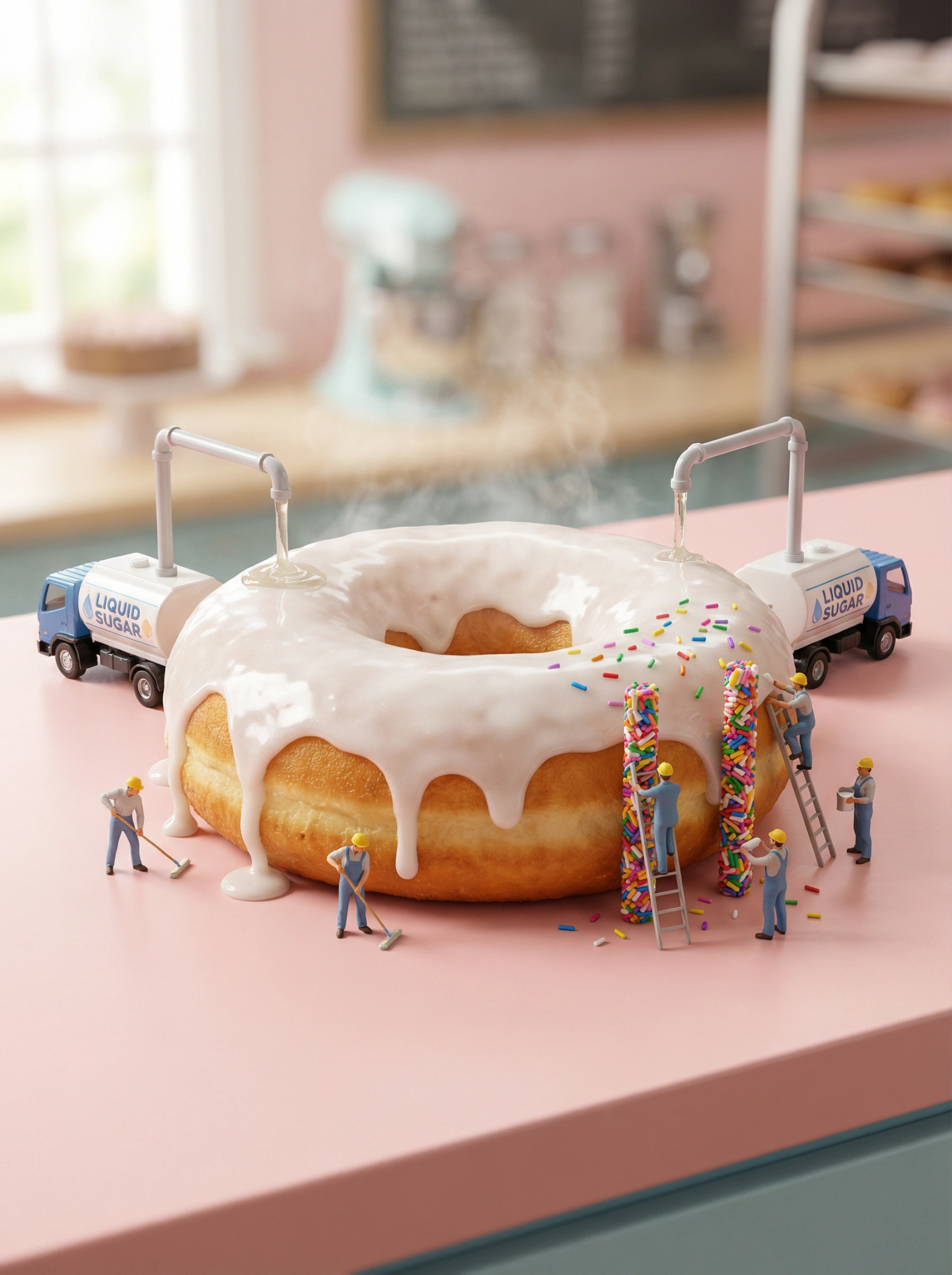
Giant Donut Glaze Fun
Prompt
{ "title": "Glazed Donut Glazing Operation", "subject": { "main_element": "Giant fluffy Ring Donut", "orientation": "Lying flat", "details": [ "Golden-brown fried dough texture", "Thick, wet, dripping sugar glaze", "Steam rising from the fresh dough." ] }, "environment": { "setting": "Pastel pink bakery counter", "elements": [ "Trucks carrying liquid sugar", "Workers with mops spreading the glaze", "Ladders leaning against the donut sides" ] }, "action": [ "Pouring glaze from overhead pipes", "Smoothing the sugar coating", "Installing giant rainbow sprinkles like pillars", "Inspecting the dough porosity." ], "style": { "camera_view": "Overhead tilt-shift", "technique": "Food photography macro", "lighting": "Soft, bright, appetizing window light", "theme": "Satisfying and sweet" }, "parameters": { "aspect_ratio": "--ar 3:4", "reference_constraint": "Style must match the miniature macro photography reference" } }
Aspect Ratio
Source
@_MehdiSharifi_Model
Nano Banana ProYou might also like
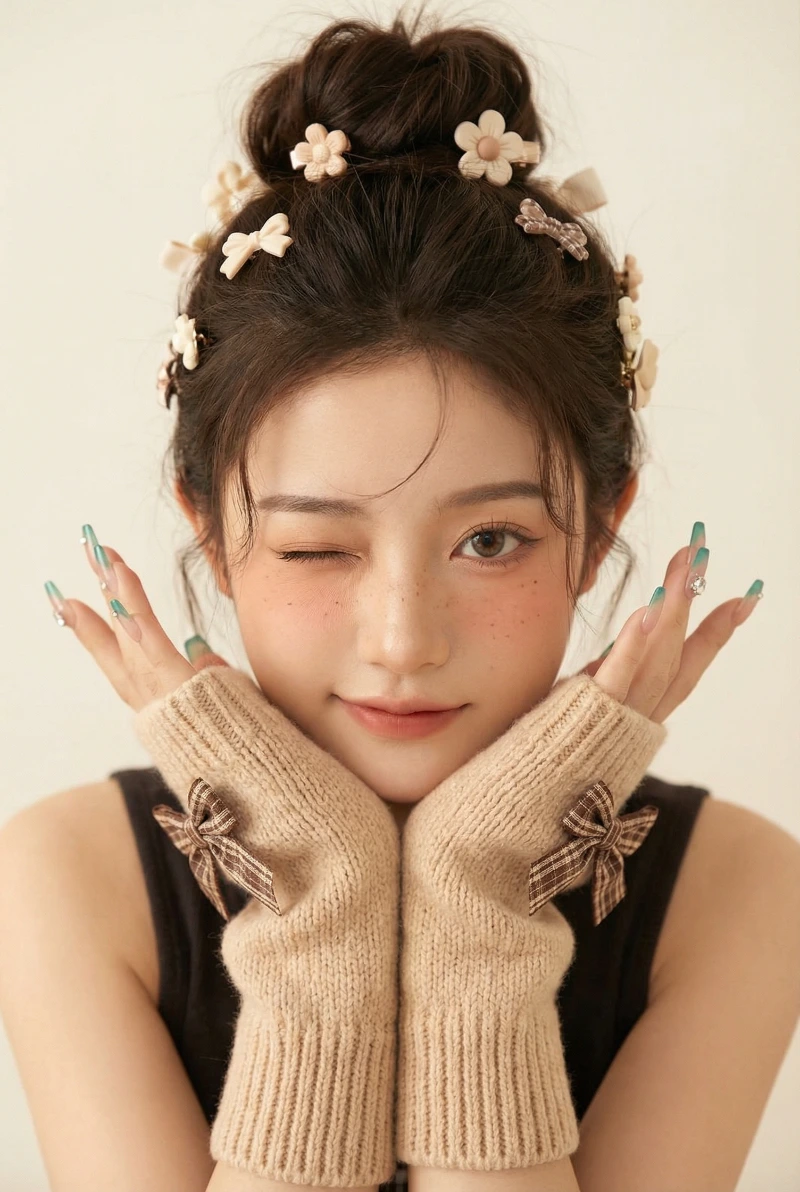
Spirited Cool Portrait
I. Subject and mood objectives 1. Subject: young woman, medium-shot portrait; upper body dominates the frame, looking directly into the camera 2. Mood: sweet yet cool and playful, not childish; with a touch of confidence and spirited elegance 3. Expression and action: left eye winking, right eye open and expressive; subtle smile with slightly upturned lips 4. Gaze relationship: eyes sharply focused on the camera, creating strong interaction II. Composition and camera language 1. Shot size: medium shot, framing from the top of the head to the upper chest; face and hands visible in the same frame 2. Composition: centered composition, face centered slightly higher than mid-frame; arms positioned below to form support and enclosure 3. Camera angle: eye-level with a very slight top-down angle 4. Focal length: medium-to-long focal length for a half-body portrait look, with compressed background 5. Depth of field: * Focus point: eyes as the sharpest focus * Sharp zone: from both eyes to the tip of the nose * Softened zone: noticeable softening from the mouth to the ears and back hair * Hands: slightly softer than the face; knit texture visible but not crisp * Transition: smooth and gradual transition from sharp to blur, no hard cutoff * Quantified target: overall depth of field approximately 1–3 cm, enhancing layering without overdoing it 6. Aspect ratio (must be followed): vertical orientation; clear background space on both left and right sides; all limbs must remain within the frame III. Lighting and background 1. Light source: softbox-style diffused soft light; key light from the front and slightly above, with very light shadows 2. Fill light: gentle frontal fill to reduce nose and nasolabial shadows; overall high brightness 3. Contrast: low contrast with smooth tonal transitions; skin highlights delicate and not overexposed 4. Background: clean, light-colored background (slightly warm white), no visible texture or props 5. Color temperature: warm white light, overall creamy warm tone IV. Facial features and makeup details 1. Skin: clear and translucent with fine texture preserved; natural highlights on the bridge of the nose and cheekbones 2. Features: small freckles scattered across the cheeks and nose 3. Blush: large-area diffused blush from the apples of the cheeks to under the eyes; warm pink-apricot tone 4. Eye makeup: clean and transparent; long, lifted eyelashes; lower lashes clearly visible 5. Eyes: sharp and clear with clean sclera; overall natural and translucent appearance 6. Lip makeup: glossy, jelly-like lip glaze with highlights; color between warm rose-bean and peach-red, with soft edges V. Hairstyle and hair accessories (key replication) 1. Hairstyle: high-position, voluminous, slightly messy bun or updo, with flyaways and outward-flipped strands at the crown 2. Bangs: light, wispy bangs with a natural part; a few strands resting on the forehead and softly floating 3. Sides: loose strands falling on both sides to create a casual, airy feel 4. Hair accessories: multiple light-colored hair clips and small ornaments (flowers, bows, cream-toned mini clips) 5. Hair color: deep brown with a subtle warm sheen VI. Clothing and hand styling (key replication) 1. Top: dark sleeveless dress or tank-style top, with brown plaid details or straps 2. Gloves: beige-apricot knitted fingerless long hand warmers; thick texture with clearly visible knit pattern 3. Accessories: brown plaid bow decorations on the hand warmers; thin gold bracelet on the wrist 4. Hand gestures: playful, cute, and spontaneous hand poses 5. Nails: long transparent extension nails with teal-green French tips or accents, featuring small rhinestone sparkle details VII. Color and texture style 1. Primary colors: creamy white background, warm brown hair, beige-apricot knit, brown plaid accents 2. Texture quality: soft focus without muddiness; skin smooth like cream; knit and plaid textures clearly defined 3. Image processing: light skin smoothing and brightening while preserving freckles; overall fresh, clean, and translucent look
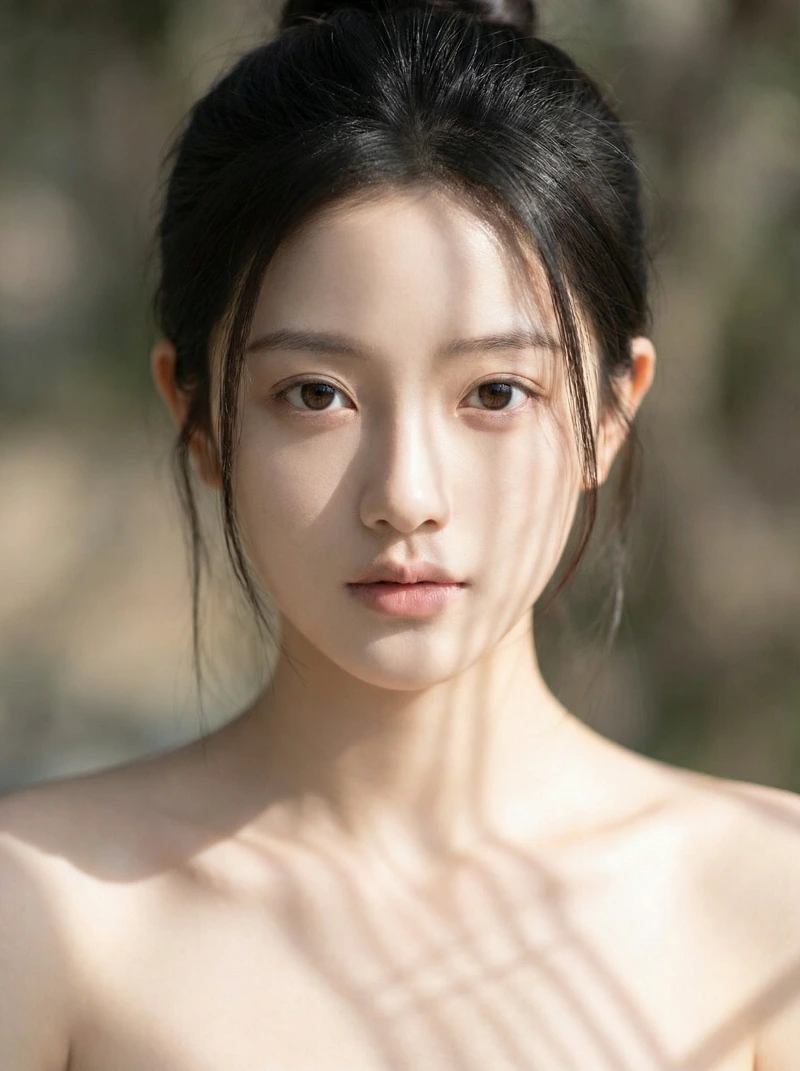
Serene Surreal Fashion Portrait
{ "generation_manifest": { "system_directives": { "output_version": "5.0_UltraDetail", "canvas_parameters": { "aspect_ratio": "3:4", "compositional_style": "High-Fashion Cinematic Surrealism", "fidelity_target": "Anatomical_Identity_Lock" } }, "subject_node": { "biometrics": { "identity_anchor": "female from reference photo", "facial_configuration": { "feature_retention": ["Eyes", "Nose", "Mouth"], "alignment_logic": "Symmetrical_Proportional_Integrity", "expression_profile": "Serene_Calm_Innocent" }, "dermatology_rendering": { "surface": "Flawless_White_Porcelain", "finish": "Radiant_Luminous", "pigmentation": "Subtle_Natural_Blush", "makeup_logic": "Minimalist_Bare_Aesthetic" }, "follicle_dynamics": { "base_color": "Long_Blonde", "primary_state": "Neatly_Tied_Back", "secondary_state": "Loose_Strands_Peripheral_Framing" } }, "geometry_and_pose": { "framing": "Upper_Torso_Facial_Focus", "visibility": "Bare_Shoulders_Exposed", "posture": "Graceful_Static" } }, "optics_and_lighting_rig": { "camera_telemetry": { "angle_vector": "90_Degree_Top_Down_Overhead", "lens_characteristic": "Soft_Focus_Expressive", "perspective": "Surreal_Dreamy" }, "lighting_architecture": { "primary_source": "Soft_Direct_Natural_Sunlight", "shadow_mapping": { "geometry_patterns": ["Vertical_Artistic", "Gridded_Mesh"], "projection_surface": ["Facial_Planes", "Clavicle", "Shoulders"], "contrast_ratio": "Low_Soft_Diffused" } } }, "atmospheric_meta": { "tonality": "Pure_Graceful_Atmospheric", "chroma_profile": "Gentle_Naturalistic", "emotional_layer": "Tranquility_Innocence" } } }
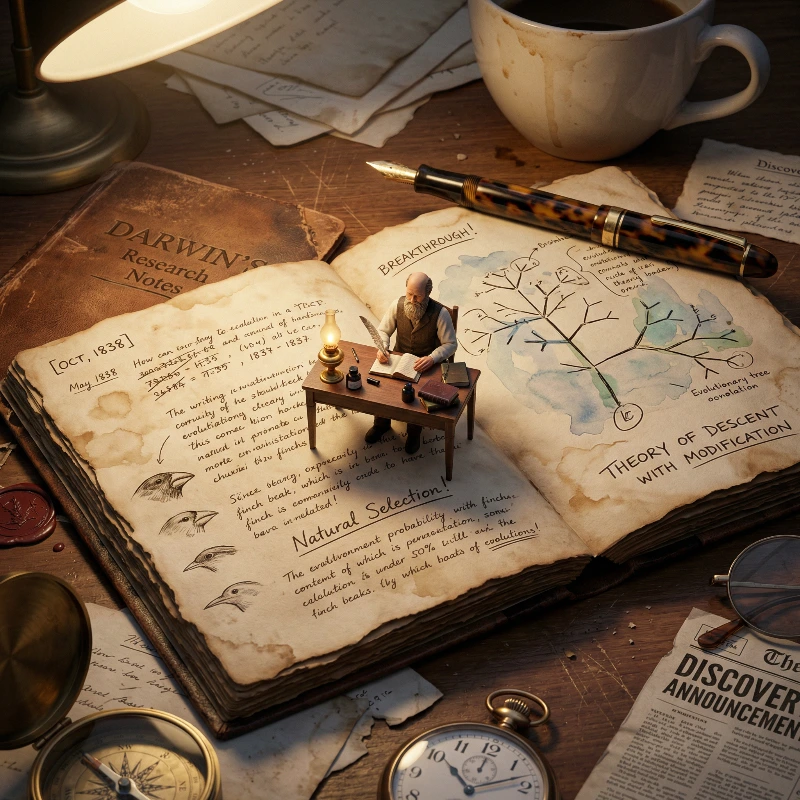
Darwin's Macro Research Realm
do this for Darwin: An extreme macro photograph centered on an antique leather-bound journal lying open on a wooden surface, with the pages serving as a physical landscape for a living miniature scene. JOURNAL DETAILS: - Aged leather cover partially visible, with embossed title: "[SCIENTIST NAME]'s Research Notes" - Thick, textured paper with deckled edges - Visible binding stitching and spine - Water stains, coffee rings, ink blots showing authentic use - Pages filled with dense handwritten notes in period-appropriate script WRITTEN CONTENT (both pages visible): - LEFT PAGE: Dense equations, calculations, crossed-out attempts, marginal corrections * [SPECIFIC FORMULAS] relevant to theory * Dated entries: "[MONTH, YEAR]" * Small sketches in margins * Underlined passages, exclamation marks showing breakthrough moments - RIGHT PAGE: Larger diagram or illustration central to discovery * [TECHNICAL DRAWING] - apparatus, experiment setup, theoretical model * Annotations and dimension labels * Color highlights (if period-appropriate) in specific inks * "BREAKTHROUGH!" or "IT WORKS!" notation MINIATURE FIGURE PLACEMENT: - 1:12 scale figurine of [SCIENTIST] sitting at tiny wooden desk/table - Desk positioned ON TOP OF the journal pages (creating surreal scale) - Figure actively writing with miniature quill/pen - Small oil lamp providing practical light source on tiny desk - Additional miniature props: ink bottle, blotter, reference books at tiny scale SURROUNDING MACRO OBJECTS (giant relative to figure): - Oversized fountain pen lying across top of journal - Massive coffee cup with visible staining on rim, positioned at corner - Giant brass compass or drawing tool - Pocket watch showing time relevant to discovery moment - Spectacles partially folded - Period newspaper fragment with [DISCOVERY ANNOUNCEMENT] headline ENVIRONMENTAL ATMOSPHERE: - Scattered loose papers beneath journal - Wooden desk surface showing grain, scratches, ink stains - Dust particles visible in light beams - Other period-appropriate desk items at edges: wax seal, stamps, letters DEPTH AND FOCUS: - Sharp focus on miniature figure and central journal text - Gentle falloff to slight blur on giant surrounding objects - Bokeh effect on background items - Implies macro lens photography (100mm+) LIGHTING SCHEME: - Primary: Warm overhead light (desk lamp implied) from upper left at 45-degree angle - Secondary: Practical light from miniature oil lamp creating tiny glow - Shadows falling naturally across journal pages creating text legibility - Rim lighting on metallic objects (compass, pen, watch) - Golden hour quality suggesting late night study session TEMPORAL INDICATORS: - Clock showing late hour (11:45 PM, etc.) - Calendar page showing [SIGNIFICANT DATE] - Multiple coffee cups suggesting hours of work - Candle burned down significantly PERSPECTIVE: 45-degree elevated macro view, as if viewer is standing and looking down at desk COMPOSITION: Figure and central journal pages at geometric center, diagonal lines created by pen and papers ASPECT RATIO: 4:5 STYLE: Fine art macro photography, dramatic chiaroscuro lighting, Vermeer-esque quality, editorial magazine spread
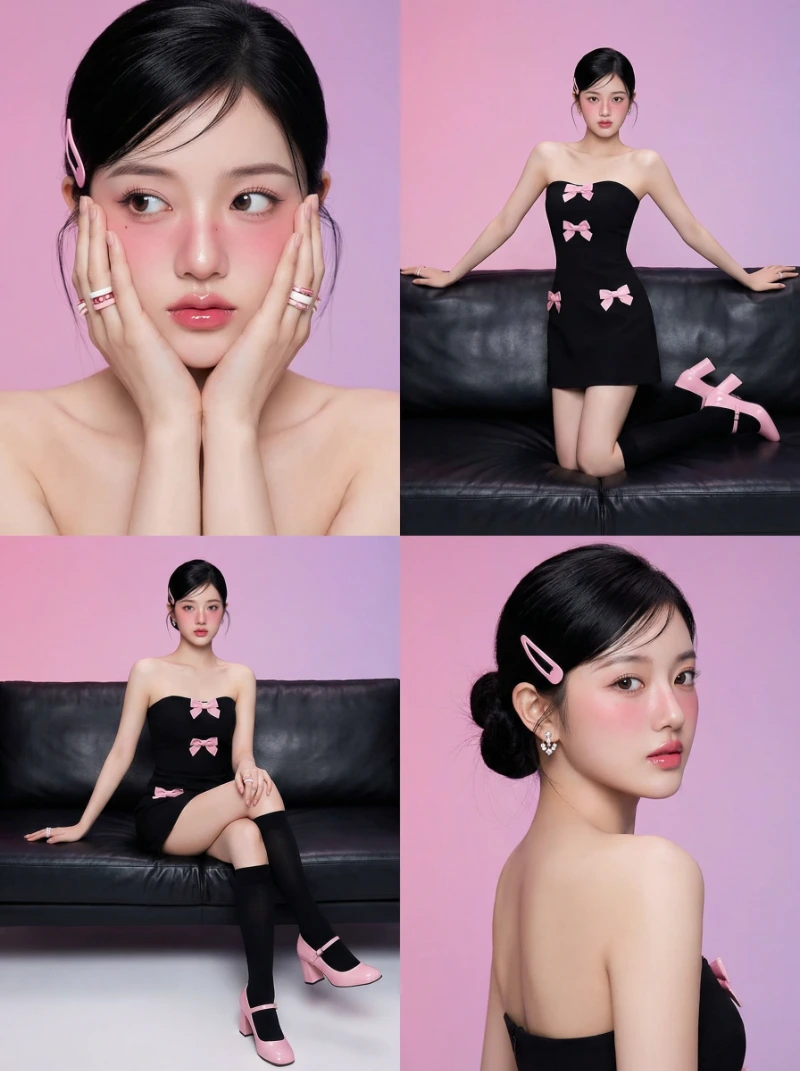
Sweet-Cool Fashion Collage
I. Composition & Layout 1. Format: Four-panel collage, 3:4 ratio, arranged in a 2×2 grid. All four images share the same theme and feature the same person. 2. Shot types: Two close-up–focused shots and two medium-to-full-body shots, with the subject occupying a large portion of the frame. 3. Camera angle: Primarily eye-level, with slight side-angle variations to emphasize facial features and body lines. 4. Visual continuity: Same setting and unified color tone across all four images, forming a cohesive fashion editorial narrative. II. Main Subject (Character) 1. Gender & age impression: Young woman, balancing cool elegance with a sweet-cool vibe. 2. Posture & aura: Slim, slightly angular physique; pronounced shoulder and neck lines; restrained, cool-toned gaze. 3. Facial highlights: Large-eye impression; blush concentrated on both cheeks and across the bridge of the nose; hydrated, glossy lips with a soft pink tone. 4. Hairstyle: Black hair in a low bun or sleek pinned-up style; side-parted bangs; secured with a light pink hair clip; a few loose strands softly framing the face. III. Makeup & Skin Texture 1. Base makeup: Smooth, fine soft-focus finish; clean and flawless with a subtle natural glow. 2. Blush: Highly saturated pink, diffused under the eyes and across the nose bridge to create a cute, youthful mood. 3. Eye makeup: Clean and elongated eye shape; long, delicate lashes; cool, restrained expression. 4. Lip makeup: Mirror-like glossy finish with a pink-to-peach gradient. IV. Outfit & Accessories 1. Clothing: Black strapless dress, decorated with multiple pink bow accents. 2. Neck: Thin strap necklace or ribbon-like bow detail around the neck. 3. Earrings: Small, sparkling earrings with a sweet and delicate feel. 4. Rings: Bold sweet-cool statement rings, stacked in multiples, with prominent pink-and-white color contrast. 5. Socks & shoes: Black knee-high socks or semi-sheer stockings; pink Mary Jane high heels. V. Poses & Shot Breakdown 1. Top-left: Close-up portrait; hands cupping the cheeks or lightly pressing fists against them; gaze looking left to break visual balance; emphasis on rings and blush. 2. Top-right: Half-body to full-body shot; kneeling on a black sofa, arms extended to both sides resting on the backrest; posture conveys a subtle sense of pressure and dominance. 3. Bottom-left: Full-body seated pose; sitting slightly sideways on the sofa, one leg crossed or extended; palm pressing against the sofa or floor to create strong lines. 4. Bottom-right: Side-profile close-up; looking back toward the camera; arms wrapped around the body or resting in front of the shoulder, revealing shoulder-back highlights and details of earrings and hair clip. VI. Scene & Props 1. Background: Clean, solid pink-to-purple gradient background with no clutter. 2. Furniture: Black leather sofa with strong reflections and pronounced wrinkle texture. 3. Floor: Light-colored floor or carpet, minimal and clean. VII. Lighting & Color 1. Lighting: Soft studio lighting with even facial illumination and very gentle shadows. 2. Highlights: Noticeable soft highlights on both skin and sofa, emphasizing material contrast. 3. Primary color scheme: Pink–purple background + black outfit and sofa + pink bows and shoes as accent colors. 4. Overall mood: Sweet-cool, dreamy, high-fashion magazine aesthetic. VIII. Texture & Image Quality Requirements 1. Realistic texture: Fair, delicate skin without excessive smoothing; clear leather reflections on the sofa. 2. Sharpness: Focus on the eyes, makeup, and accessories; slight background blur. 3. Consistency: Same character identity, outfit, setting, and color tone across all four images. 4. Clean visuals: No extra text, logos, watermarks, or distracting background elements.
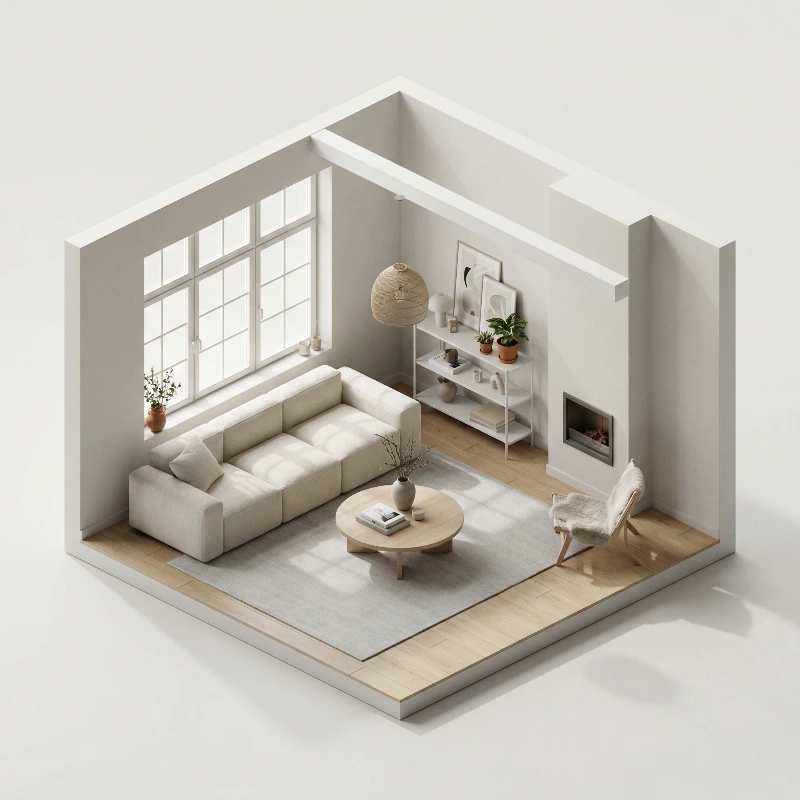
Scandi Urban Living Diorama
Create a highly detailed isometric 3D interior diorama of a (Scandinavian minimal) (urban apartment living room) Design the space with coherent architecture, furniture, lighting, materials, and decoration that naturally match the chosen concept. Use realistic textures, soft natural daylight, gentle shadows, and a calm minimal white background. Perspective: isometric cutaway diorama. Ultra high detail, premium interior visualization, soft global illumination.
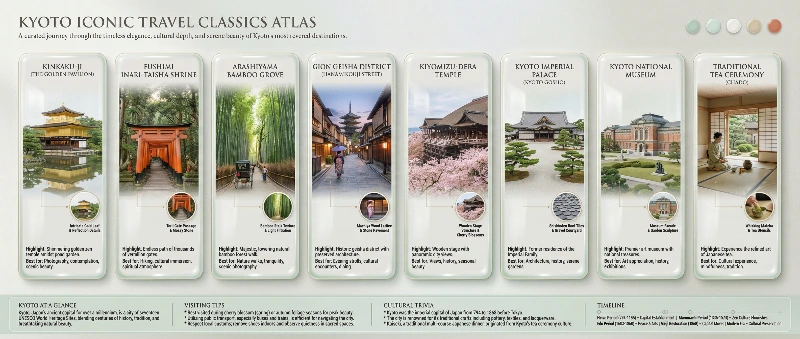
Kyoto Iconic Travel Atlas
Create an ultra-wide infographic poster titled “Kyoto Iconic Travel Classics Atlas”, with a 21:9 horizontal layout in true 8K resolution. The visual language blends ceramic glaze and jade-like softness, expressing calm luxury, precision, and cultural depth. The overall mood is restrained, warm, and translucent—evoking the feeling of a museum-grade exhibition combined with refined cultural branding. All on-image text is in English. Background and overall material tone * Background features a light rice-white to misty off-white gradient, similar to a high-end ceramic exhibition space * Global lighting is gentle and diffused: soft HDRI illumination with subtle rim light, avoiding harsh contrast or strong shadows * Color palette centers on jade white, pale celadon, soft moss green, warm beige, with minimal accents of vermilion or muted gold (no more than 3–4 dominant hues across the entire image) Layout: eight equal-width “ceramic/jade plaques” (strictly eight columns) * The central composition uses a strict eight-column grid, each column designed as a ceramic-style information plaque * Plaque material resembles fine white porcelain glaze: rounded corners, smooth highlights, subtle reflective sheen, clean edges * Borders may include an extremely delicate gold trace or jade-edge effect, applied with restraint * Shadows are soft and shallow, as if the plaques are placed on a curated museum display surface Core visuals: realistic 3D landmarks (PBR) with a serene glazed aesthetic * Each column top features one real, iconic Kyoto landmark (automatically select eight authentic sites, no fictional entries) * Use realistic 3D environment rendering with physically based materials, while maintaining a calm, jade-like visual softness * Materials must follow real-world physical rules: wood, stone, tile, water, foliage, and paper surfaces rendered with accurate PBR properties * Unified color grading: soft highlights, moderate contrast, low saturation, and gentle warmth inspired by ceramic glaze and polished jade * Composition emphasizes depth and quiet grandeur through layered space and subtle scale references (small figures, lanterns, trees) * Water elements (rivers, ponds, moats) should display delicate reflections and smooth tonal transitions * Avoid cartoon styles, low-poly geometry, plastic textures, excessive sharpness, or dramatic cinematic lighting Detail view: glazed “micro dish” or “jade charm” window * Each column includes one small detail window in the lower-right corner, using a single consistent shape across all columns * Option A: a small circular dish resembling a porcelain saucer, showcasing fine details (wood grain, roof tiles, stone steps, garden gravel, water ripples) * Option B: a jade-charm-shaped window with rounded contours, highlighting close-up textures and materials * Surfaces should exhibit soft glaze or jade-like highlights with smooth, rounded edges * A thin, elegant leader line connects the detail window to the main 3D landmark, accompanied by a concise 2–6 word label Text per column (concise, refined, understated) * Landmark name (4–8 English words, refined serif typeface recommended) * Two short informational lines: * Highlight: maximum 8 words * Best for: maximum 6 words * Text color uses ink gray or bluish charcoal; accent colors appear only in small dots or separators Top title area (museum exhibit label style) * Main title: Kyoto Iconic Travel Classics Atlas * Subtitle: one refined positioning sentence, maximum 18 words, calm and poetic in tone * Top-right corner includes five small glazed color dots: pale celadon, jade white, moon white, warm beige, with a subtle vermilion accent Bottom information band (exhibition caption style) * A full-width bottom band divided into four sections by fine lines, resembling museum display captions * Kyoto at a glance: one sentence, maximum 22 words * Visiting tips: three bullet points, each no more than 12 words * Cultural trivia: three items, each no more than 18 words * Timeline: 3–6 key nodes (era or year plus keyword), connected with minimal linear icons using thin, consistent strokes Automatic landmark selection rules * Cover at least five categories: natural scenery, historical temples or shrines, traditional architecture, museums or cultural institutions, classic streets or seasonal night scenes, and intangible cultural experiences (tea ceremony, festivals, crafts) * If necessary, fill gaps with safe, general entries such as “Kyoto National Museum” or “Historic Gion District” * All landmark names must be real and verifiable; if uncertain, use conservative generic naming and never fabricate locations Output constraints * English text only * Strong alignment, minimalist spacing, generous white space * No logos, no branding marks, no watermarks * True 8K ultra-high resolution, suitable for cultural tourism displays and horizontal social media covers
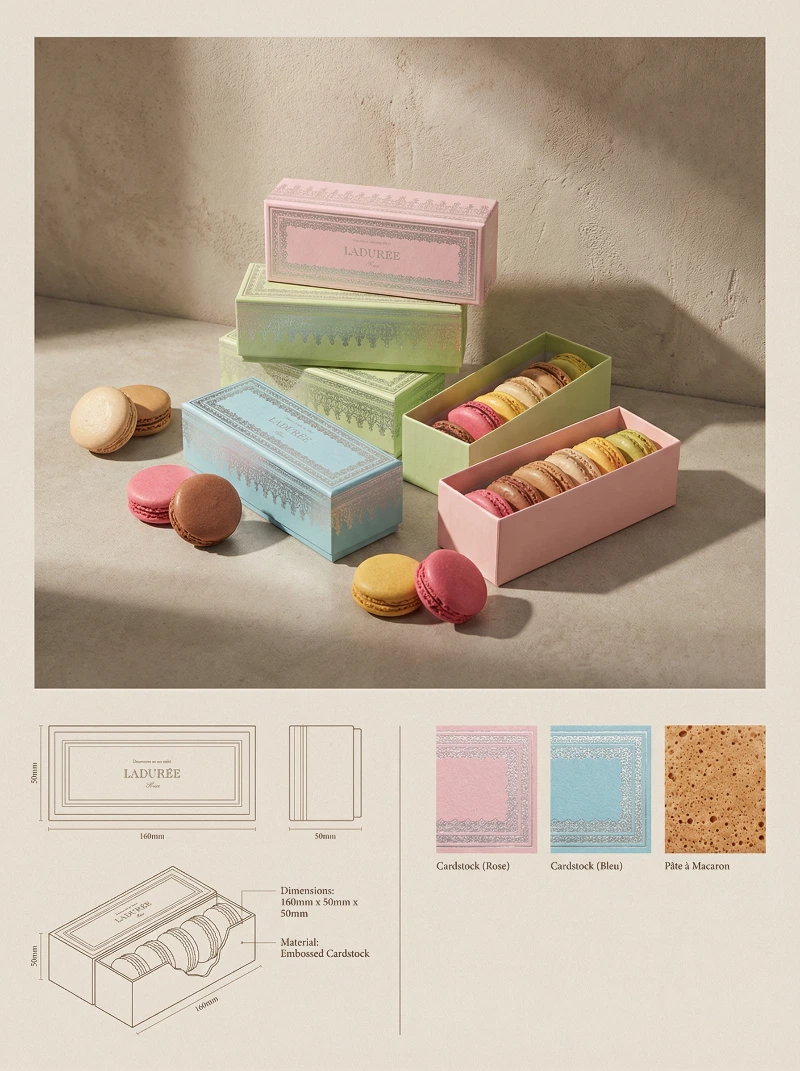
Architectural Product Specs
{ "reference_images": { "product_image": "UPLOADED_IMAGE", "usage_rule": "Use the uploaded image as the exact visual reference for the product’s form, proportions, materials, and overall identity. Do not redesign or reinterpret the product." }, "layout": { "canvas": { "orientation": "vertical", "aspect_ratio": "3:4", "background": "warm neutral paper-like surface" }, "structure": { "top_section": "lifestyle_hero", "bottom_section": "technical_specification" } }, "top_section": { "type": "lifestyle_product_image", "composition": { "placement": "top_center", "scale": "dominant", "margin": "generous whitespace around product" }, "environment": { "setting": "minimal architectural interior", "lighting": { "type": "natural sunlight", "direction": "angled side light", "quality": "soft but high-contrast shadows" }, "floor": "subtle concrete or stone surface", "background": "textured plaster wall" }, "rendering": { "style": "editorial lifestyle photography", "detail": "high realism", "color_grading": "warm, muted, premium" } }, "bottom_section": { "type": "technical_specification_panel", "layout": { "grid": "modular", "alignment": "clean, architectural" }, "technical_drawings": { "placement": "bottom_left_and_center", "style": "architectural line drawings", "views": [ "front view", "side view", "three-quarter cutaway or profile view" ], "projection": "orthographic", "line_style": { "color": "muted red or sepia", "weight": "fine technical lines" }, "annotations": { "type": "measurement and construction callouts", "language": "neutral technical labels", "density": "minimal, editorial" } }, "materials_panel": { "placement": "bottom_right", "content": { "type": "material_swatches", "count": "3-4 depending on product", "format": "square or rectangular samples" }, "textures": { "source": "derived from the product materials", "examples": [ "fabric", "leather", "metal", "wood", "plastic" ] }, "labels": { "style": "small editorial captions", "tone": "technical but refined" } } }, "typography": { "style": "minimal editorial", "usage": "subtle captions, no large headlines", "color": "soft black or dark brown" }, "overall_style": { "mood": "design catalog / product design journal", "aesthetic": "architectural, premium, calm", "avoid": [ "clutter", "bold colors", "heavy branding", "overly decorative graphics" ] }, "constraints": { "do_not": [ "change product design", "invent new materials", "add logos unless present in reference", "use perspective distortion in drawings" ] } }
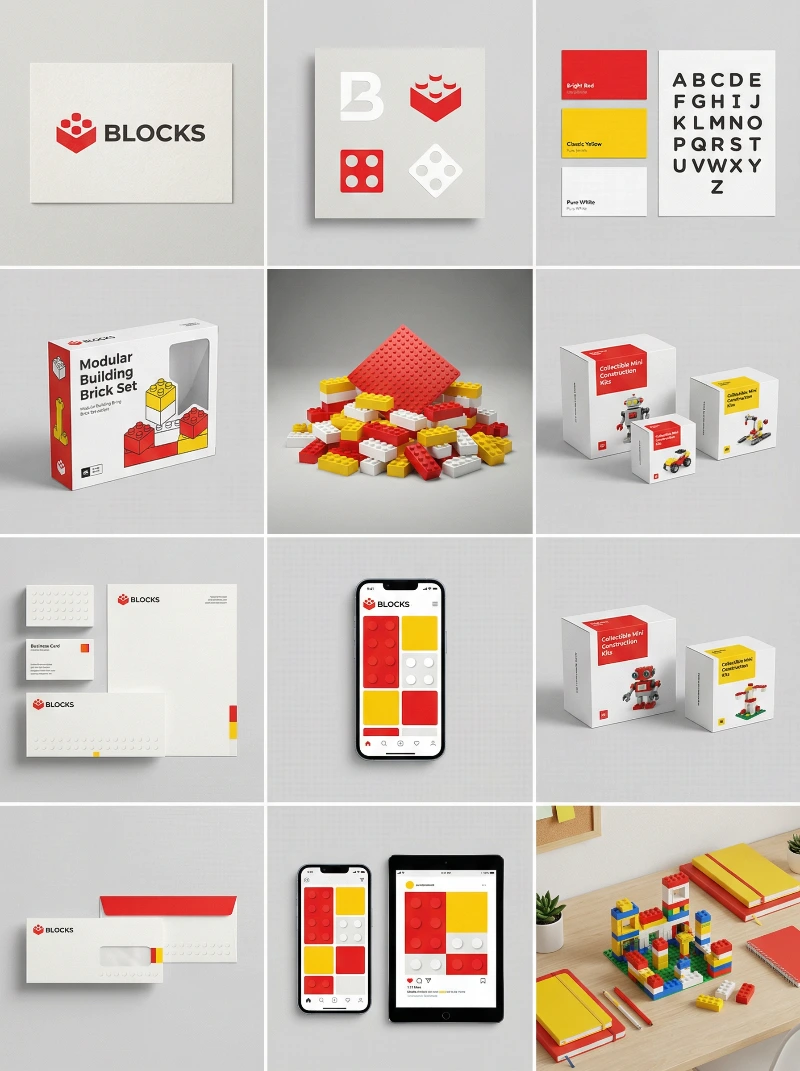
LEGO Brand Identity Grid
[LEGO], complete brand identity grid, 3x3 layout, nine tiles showing a full cohesive brand system, light gray seamless background, soft diffused studio lighting, subtle shadows, clean modern minimal style, consistent color palette of [bright red] [classic yellow] [pure white], high-end studio mockups, ultra-realistic, 8k, 1:1, tile 1 primary logo lockup on paper card, tile 2 secondary logo mark and monogram variations inspired by interlocking brick geometry, tile 3 color palette swatches and typography specimen poster with playful geometric letterforms, tile 4 packaging mockup for [modular building brick set], tile 5 hero product photo for [classic interlocking bricks assortment], tile 6 set of three products for [collectible mini construction kits] in different sizes, tile 7 stationery mockups business card letterhead envelope with stud-pattern embossing, tile 8 social media post mockups and phone screen UI preview featuring bold block layouts, tile 9 lifestyle scene featuring [modular building brick set] with colorful creative desk props matching the brand, no people, no readable real-world brand names, no watermark.