
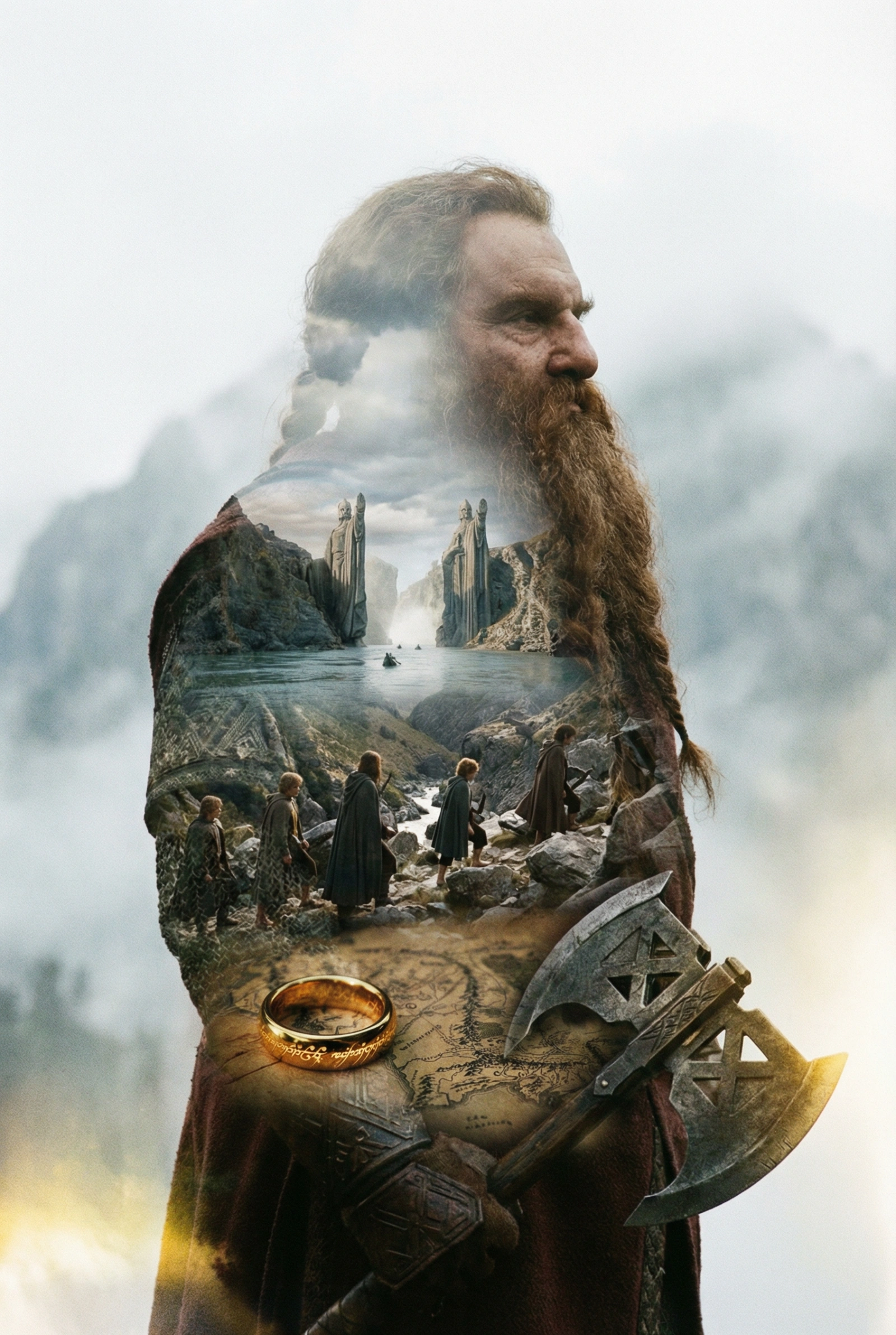
LOTR Double Exposure Contemplation
Prompt
A cinematic double exposure portrait embodying the essence of [Subject], seamlessly blending character silhouette with layered scenes across multiple focal lengths — establishing a visual metaphor of inner architecture shaped by narrative. Subject: A character in hero shot composition (profile or three-quarter view) serves as the primary frame. The portrait contains 3 distinct narrative layers within the silhouette, each with clear visual presence: - Establishing layer (WS): iconic landmarks and vast environments with relatively clear detail, positioned in areas with ample spatial width (torso, shoulders). Dynamic camera angles. This layer tells visual stories, not just atmospheric backdrop - Narrative layer (MS): story moments with clear subject matter, distributed across mid-body zones - Detail layer (CU): signature textures, objects, or atmospheric elements with distinct clarity, concentrated in compact areas (head, neck, peripheral edges) All 3 layers within the silhouette maintain sufficient clarity to be visually readable. Background space beyond the silhouette serves as atmospheric extension — softer, more diffused, providing breathing room without competing for narrative attention. Vary camera angles across layers (aerial, low angle, dutch angle, eye-level) to create spatial depth and visual rhythm, avoiding monotonous flat composition. Match scene scale to available space — wide shots need room to breathe, close-ups thrive in intimate zones Visual design (character, scenes, iconic elements, style, cultural aesthetics): contextually appropriate to [Subject], maintaining stylistic coherence. Composition: Portrait orientation with breathing space for scene integration. Facial features (eyes, nose, mouth) remain relatively clear and recognizable through controlled transparency — this is the visual anchor. Scene layers concentrate more heavily in peripheral areas (hair, shoulders, background space) rather than densely overlapping facial center. Scene elements respect anatomical structure — horizons align with eye level, architectural lines follow facial contours with smooth, gradient-based transitions. Progressive narrative transition from top to bottom: upper regions (head, shoulders) embrace full double-exposure blending, while lower regions gradually break free from the silhouette — scenes emerging with increasing clarity and independence, eventually extending beyond the figure as distinct narrative windows. This creates dramatic temporal-spatial convergence, suggesting inner consciousness materializing into tangible reality. Edge Treatment: CRITICAL — avoid hard cutout boundaries. Portrait edges dissolve naturally into scenes through irregular, organic fade transitions (not uniform masks). Selective areas allow scenes to extend gently beyond silhouette, creating subtle overspill. Varying opacity across different facial zones enables naturalistic integration. The blend should feel effortless and photographic, not manually painted. Light: Cinematic lighting with enhanced drama — rich highlights, deep shadows, and atmospheric haze create depth and emotional weight. Layers may capture different times or lighting conditions as needed for narrative storytelling, united by emotional coherence rather than physical uniformity. Light wraps around forms naturally within each layer, avoiding flat overlay appearance. Color: Harmonized palette drawn from the narrative's emotional core. Cinematic color grading with elevated saturation and contrast for visual impact, while maintaining coherence across layers. Film-like color science with controlled roll-off and intentional color shifts between layers to enhance storytelling mood. Mood: Contemplative, introspective. The portrait suggests memory, transformation, or identity shaped by place — evoking "landscapes in motion, crafted by memory, reshaped by courage." Medium: Artistic photographic double exposure with handcrafted quality — not digital compositing. 8K resolution. Analog film aesthetic with organic imperfections — subtle grain that enhances texture without overwhelming detail, natural vignetting, nuanced tonal transitions, slight color drift between layers. Borderless composition that extends naturally to frame edges without visible canvas boundaries or decorative frames. Avoid: [over-saturated, rigid mask edges, sterile digital compositing, perfect cutouts, disconnected lighting, uniform opacity]. ar=2:3 [Subject] = The Lord of the Rings
Aspect Ratio
Model
Nano Banana ProYou might also like
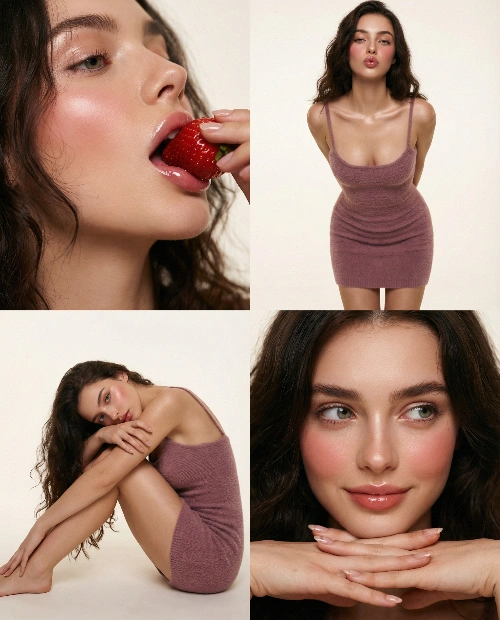
Ultra-Real Beauty Grid
{ "project_specifications": { "format": "2x2 Grid Collage", "aspect_ratio": "4:5", "aesthetic_style": "High-end Beauty Editorial", "rendering_engine_hints": { "realism_level": "Ultra-photorealistic", "texture_quality": "8k", "lighting_simulation": "Ray-traced studio lighting" } }, "global_assets": { "subject_definition": { "hair": { "style": "Long, loosely wavy, voluminous", "texture": "Natural, individual strands defined", "behavior": "Messy but styled, framing face and shoulders" }, "complexion": { "skin_texture": "Porous, hyper-realistic", "finish": "Dewy, glass-skin effect", "makeup": { "cheeks": "Heavy flush/blush", "lips": "High-gloss, plump, natural pink", "eyes": "Clean, defined lashes, natural brows" } }, "wardrobe": { "item": "Mini dress", "fit": "Bodycon / Tight", "fabric": { "material": "Soft textured knit / Boucle", "tactility": "Fuzzy, light-catching fibers", "color": "Soft mauve or neutral taupe" }, "details": "Spaghetti straps, mid-thigh length" } }, "environment_definition": { "studio_setup": { "background": "Seamless paper, soft off-white/beige", "atmosphere": "Clean, warm, intimate" }, "lighting_rig": { "key_light": "Large diffuse softbox (Front-Left)", "fill_light": "Reflector (Right)", "highlights": "Specular highlights on lips, cheekbones, and shoulders" } } }, "panel_architecture": [ { "position": "Top-Left (1)", "shot_type": "Extreme Close-Up (Macro)", "composition": { "angle": "Low angle, looking up slightly", "focus": "Mouth and nose area", "depth_of_field": "Shallow" }, "action": { "primary": "Eating a strawberry", "nuance": "Delicate finger hold, lips slightly parted" }, "visual_anchors": [ "Moisture on strawberry surface", "Gloss reflection on lips", "Baby hairs at temple" ] }, { "position": "Top-Right (2)", "shot_type": "Medium Shot (Thigh-up)", "composition": { "angle": "Eye level", "pose_dynamic": "Leaning forward slightly towards lens" }, "action": { "stance": "Standing straight on", "arms": "Relaxed at sides", "expression": "Direct gaze, alluring pout" }, "visual_anchors": [ "Texture of knit dress", "Collarbone shadows", "Curvature of waist" ] }, { "position": "Bottom-Left (3)", "shot_type": "Full Body (Seated)", "composition": { "angle": "Side profile", "framing": "Subject compacted on floor" }, "action": { "pose": "Knees to chest (fetal position variation)", "interaction": "Cheek resting on knee, arms embracing legs", "hair_flow": "Cascading onto the floor" }, "visual_anchors": [ "Smooth leg definition", "Dress stretching over thigh", "Dreamy gaze" ] }, { "position": "Bottom-Right (4)", "shot_type": "Beauty Portrait (Head & Hands)", "composition": { "angle": "Frontal close-up", "framing": "Chin to hairline" }, "action": { "gesture": "Chin resting on interlaced fingers", "expression": "Soft smile, looking off-camera" }, "visual_anchors": [ "Hand detail and manicure", "Eye clarity", "Flush on cheeks" ] } ] }
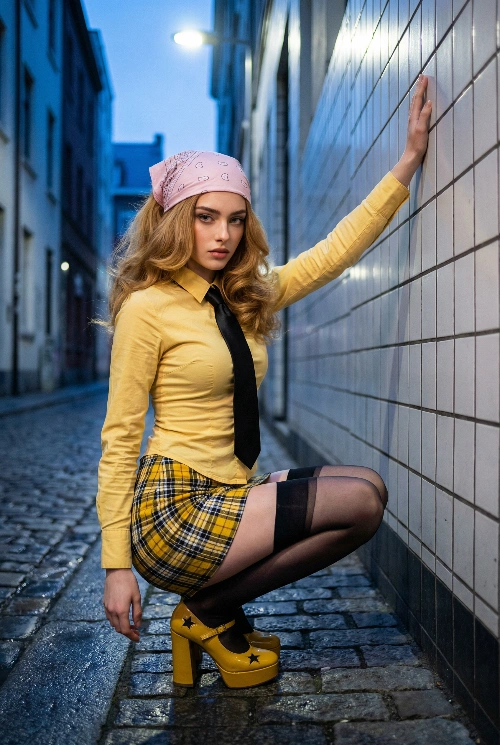
Cinematic Squat Fashion Portrait
{ "subject": { "identity": { "biometric_reference": "female from reference photo", "dentition": "Visible maxillary central incisors with natural alignment and translucent enamel edges, displayed in a slight mouth-open neutral expression.", "ocular_details": "Highly detailed iris patterns featuring radial furrows and Crypts of Fuchs. Iris pigmentation: Light cerulean blue with a hint of golden-green peripupillary ring. Detailed scleral vasculature and wet-look corneal reflections.", "hair": "Voluminous honey blonde hair (Hex: #E2BC74) with visible follicular texture, cascading naturally from under the bandana. Strands exhibit high specular highlights and anisotropic scattering." }, "body": { "morphology": "Mesomorphic-endomorphic somatotype, petite stature, approximately 151cm height. Precise waist-to-hip ratio (WHR) of 0.7. Body positioned in a full squatting stance in side profile.", "skin_physics": "Fair complexion (Hex: #F7E0D2) with subsurface scattering (SSS) effects. High-fidelity skin texture showing pores and natural epidermal micro-details. No beautify smoothing." }, "wardrobe": { "headwear": "Light pink bandana (Hex: #FF91AF) with subtle paisley micro-patterns, tied over the crown of the head.", "top": "Long-sleeved button-down shirt in vibrant yellow (Hex: #FDEE00). Tight-fit tailoring with realistic tension folds across the torso. Paired with a slim black silk necktie.", "bottom": "High-waisted pleated mini skirt featuring a yellow, black, and white plaid weave. Extremely short length with sharp pleats showing fabric tension in the crouching pose.", "hosiery": "Sheer black thigh-high stockings (20 denier) with a thick, opaque black elastic band at the mid-thigh. Clear skin-to-fabric transition above the knee.", "footwear": "Yellow platform heels (Hex: #FDEE00) with wide ankle straps and star-shaped decorative cutouts. Glossy synthetic leather finish with hard-surface reflections." }, "pose_action": "The subject is in a full squatting position viewed from a side-profile. The subject's right arm is extended vertically upwards with the palm pressed flat against the white tiled wall. The left arm hangs naturally by the side. The head is turned toward the camera with a direct, intense gaze. The subject is balanced on the balls of her feet.", "scene": { "environment": "Narrow urban alleyway at night. The wall on the right is composed of white square ceramic tiles with dark grout lines. The ground is grey cobblestone/pavement with a matte texture.", "depth": "Deep perspective showing the continuation of the alleyway and modern architectural structures in the background under a twilight sky.", "atmosphere": "Cinematic nighttime clarity with high contrast between the lit subject and the dark, shadowed urban environment." }, "lighting": { "primary": "Cool-toned overhead street lighting combined with soft ambient blue twilight. Strong directional light creates defined shadows on the tiled wall.", "secondary": "Soft fill lighting to preserve detail in the black tie and plaid skirt textures.", "physics": "Accurate Fresnel reflections on the white tiles and specular highlights on the glossy platform shoes." }, "camera": { "format": "9:16 vertical aspect ratio", "lens": "35mm prime lens for cinematic perspective.", "angle": "Low-angle shot, positioned at knee level to emphasize the posture and the height of the wall.", "settings": "f/2.8 aperture, ISO 100, 8k resolution, raw capture style." }, "negative_constraints": [ "no logos", "no text", "no trademarks", "no beautify smoothing", "no extra limbs", "no watermark", "no jewelry on neck", "reflection integrity rules applied to tiled surfaces" ] } }

Modern Pro 3:4 Headshot
Intelligent professional portrait headshot in the style of American ID photography. The subject size is balanced and natural within the frame. Use a subtle light gray to white gradient studio background. Lighting is soft and natural, highlighting realistic skin tones and gentle depth. The image should be clear and high-quality with sharp facial focus. Skin texture appears clean, luminous, and healthy. The head-to-shoulder proportion is comfortable and natural. The overall mood is modern and elegant. The subject has a relaxed, natural, and confident expression with bright, lively eyes. Medium portrait framing with the subject centered in the composition. Low contrast lighting to create a refined, professional studio portrait aesthetic. Suitable for business and professional profile photos. Aspect ratio: 3:4.
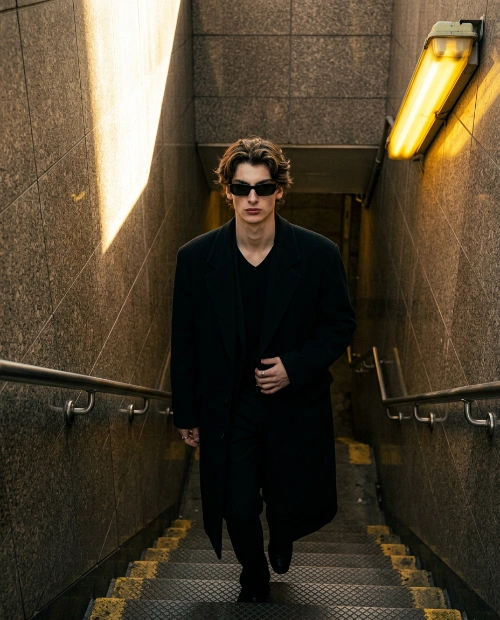
Cinematic Urban Fashion Model
{ "metadata": { "image_type": "photograph", "primary_purpose": "editorial" }, "composition": { "rule_applied": "rule of thirds", "aspect_ratio": "4:5", "layout": "single subject", "focal_points": [ "Subject's face and dark sunglasses", "Yellow fluorescent light fixture leading to the subject" ], "visual_hierarchy": "Eye starts at the subject's face due to contrast with sunglasses, follows the V-neck down the black coat, moves outward along the metallic handrails, and catches the bright sunlight shaft on the left wall and the yellow light on the right.", "balance": "asymmetric" }, "color_profile": { "dominant_colors": [ { "color": "Black", "hex": "#111111", "percentage": "45%", "role": "primary subject" }, { "color": "Warm Gray", "hex": "#7A7269", "percentage": "35%", "role": "background" }, { "color": "Golden Yellow", "hex": "#E5B05C", "percentage": "10%", "role": "accent" } ], "color_palette": "complementary", "temperature": "warm", "saturation": "moderate", "contrast": "high contrast" }, "lighting": { "type": "mixed", "source_count": "multiple sources", "direction": "front", "directionality": "highly directional", "quality": "dramatic", "intensity": "moody", "contrast_ratio": "high contrast (dramatic shadows)", "mood": "mysterious", "shadows": { "type": "harsh defined edges", "density": "deep black", "placement": "under handrails, within stair treads, and engulfing the subject's lower body", "length": "medium" }, "highlights": { "treatment": "blown out", "placement": "on upper left wall from sun shaft, fluorescent light fixture, and reflective handrails" }, "ambient_fill": "present", "light_temperature": "warm (golden)" }, "technical_specs": { "medium": "digital photography", "style": "realistic", "texture": "sharp", "sharpness": "tack sharp", "grain": "digital noise", "depth_of_field": "medium", "perspective": "high angle" }, "artistic_elements": { "genre": "street", "influences": [ "Urban street style fashion photography", "Cinematic cyberpunk/matrix aesthetic" ], "mood": "sophisticated", "atmosphere": "Gritty yet polished urban transit environment with a moody, imposing, and highly stylized fashion presence", "visual_style": "structured" }, "typography": { "present": false, "fonts": [], "placement": "", "integration": "" }, "subject_analysis": { "primary_subject": "Young male model wearing an oversized, structured long black overcoat, black V-neck top, black trousers, and dark rectangular sunglasses, walking down stairs. Hair: Medium length, textured cut (e.g., modern shag/tapered cut). Length: Roughly ear-level/temple-level on the sides, slightly longer and voluminous on top (3-4 inches), with soft layers and natural movement. Texture: Natural wavy texture, showing varied strands, slight frizz, and natural volume (imperfections visible, not 'AI smooth'), styled loosely back from the forehead without a distinct part. Evidence of light matte product application.", "positioning": "center", "scale": "medium", "interaction": "interacting with environment", "facial_expression": { "mouth": "neutral", "smile_intensity": "no smile", "eyes": "direct gaze", "eyebrows": "neutral", "overall_emotion": "serious", "authenticity": "posed" }, "hands_and_gestures": { "left_hand": "resting at waist level, lightly holding the edge of the black overcoat, silver ring visible on finger", "right_hand": "not visible, hidden behind the coat's bulk or swinging backward", "finger_positions": "left hand thumb and index finger slightly curled and gripping fabric, remaining fingers obscured", "finger_interlacing": "none", "hand_tension": "relaxed", "interaction": "holding coat", "naturalness": "deliberately posed" }, "body_positioning": { "posture": "standing", "angle": "facing camera", "weight_distribution": "shifted", "shoulders": "level" } }, "background": { "setting_type": "indoor", "spatial_depth": "medium", "elements_detailed": [ { "item": "Stainless steel handrail", "position": "left", "distance": "foreground", "size": "medium", "condition": "worn", "specific_features": "Tubular metal with distinct mounting brackets and subtle reflections" }, { "item": "Stainless steel handrail", "position": "right", "distance": "midground", "size": "medium", "condition": "worn", "specific_features": "Tubular metal matching the left side, catching edge highlights" }, { "item": "Fluorescent light fixture", "position": "top right", "distance": "background", "size": "medium", "condition": "vintage", "specific_features": "Rectangular housing emitting a strong, warm amber/yellow light" } ], "wall_surface": { "material": "tile", "surface_treatment": "finished", "texture": "perfectly smooth", "finish": "satin", "color": "warm grayish-brown", "color_variation": "patchy", "features": "clean, distinct grid-like grout lines separating large rectangular stone/granite panels, sharp diagonal shaft of warm sunlight hitting the upper left section", "wear_indicators": "industrial" }, "floor_surface": { "material": "concrete", "color": "dark gray with yellow accents", "pattern": "striped" }, "objects_catalog": "Metal diamond-plate stair treads with yellow painted safety edges running horizontally across the bottom and midground, dual tubular stainless steel handrails flanking the stairs, rectangular yellow light fixture mounted to the ceiling angled directly above the stairwell, large rectangular stone tiles covering the walls.", "background_treatment": "sharp" }, "generation_parameters": { "prompts": [ "Editorial street style photography, a handsome young man with medium length, textured modern shag haircut showing natural wavy movement and styled loosely back. He wears dark rectangular sunglasses, a long black oversized wool coat, and an all black outfit, walking down urban subway stairs. The walls are made of large polished brown-gray stone tiles with visible grid grout lines. A dramatic shaft of warm golden sunlight hits the upper left wall. A vintage yellow fluorescent light fixture is on the upper right ceiling. The stairs are concrete with metal edges and yellow safety paint. Stainless steel handrails. Cinematic lighting, deep dramatic black shadows, sharp focus, 85mm lens, high contrast, moody, fashionable underground matrix aesthetic.", "Cinematic fashion portrait, male model in structural black overcoat descending transit stairs, medium length textured hair with soft waves, tinted glasses. High angle shot looking down the steps. Brutalist architecture background, granite wall panels. Mixed lighting featuring harsh geometric sunbeams on the wall contrasting with artificial yellow ambient light. Gritty texture, high dynamic range, hyper-realistic, sophisticated urban mood." ], "keywords": [ "street style", "oversized black coat", "subway stairs", "cinematic lighting", "medium length hair", "textured hair", "modern shag" ], "technical_settings": "85mm lens, f/4.0 aperture for medium depth of field keeping background architectural elements recognizable, 1/250s shutter speed, ISO 400. Metered to preserve the sun shaft highlight while letting shadows fall to deep blacks.", "post_processing": "Color grading to enhance warm golden highlights against neutral/cool shadows, boosted contrast curve, subtle film grain introduced in the deep shadow areas for texture." } }
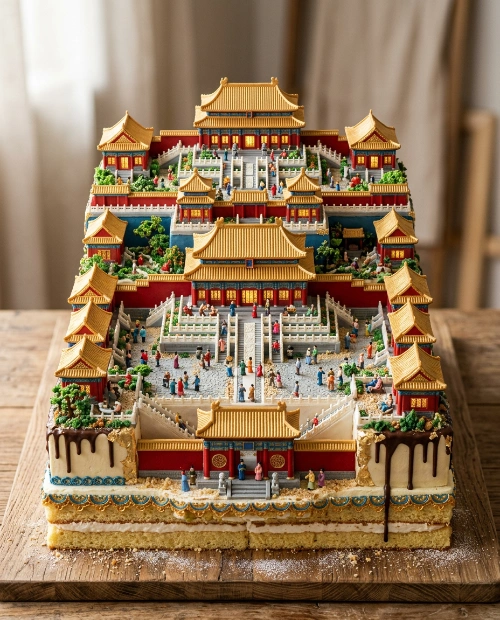
Edible Forbidden City Cake
MONUMENT: The Forbidden City Photorealistic hero product photography shot on Sony A7III with 85mm f/1.4 lens at f/2.8, soft natural daylight from upper left creating gentle realistic shadows and visible surface textures: A giant famous [MONUMENT] masterfully recreated as a delicious multi-tiered edible cake. Visible fluffy sponge cake layers, thick silky buttercream frosting, smooth fondant details, subtle edible gold leaf accents, realistic cake crumbs and ganache drips. The cake tiers ingeniously transformed into a luxurious miniature vibrant living city with tiny glowing windows, staircases, gardens and balconies built into the frosting and sponge. Miniature visitors in tiny colorful clothes walk the buttercream pathways, relax on cake terraces, sip tiny drinks and take photos. Intricate realistic cake textures mixed with whimsical architecture, physically plausible yet surreal. Shot for a luxury architecture magazine cover, ultra-detailed 8K, perfectly centered square composition, no text, no artifacts.
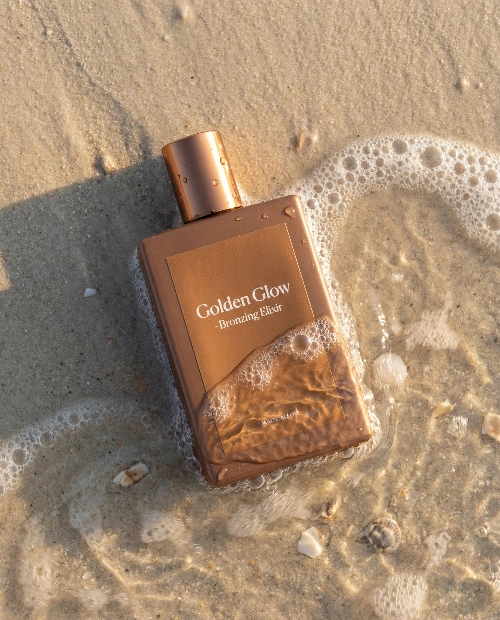
Golden Glow Beach Elixir
Ultra-realistic summer skincare product photography of a bronzing drop bottle named "Golden Glow - Bronzing Elixir", rectangular matte bottle in warm sun-kissed bronze tone with a clean white cap, placed diagonally on wet beach sand as a gentle ocean wave washes over it, delicate sea foam and tiny bubbles surrounding the base, water partially flowing across the label, fine sand texture visible beneath shallow clear water, golden sunlight casting natural highlights and soft shadows, high-detail water ripples and realistic foam patterns, fresh summer aesthetic, minimal clean branding centered and sharp, warm golden-hour beach lighting, cinematic top-down flat lay composition, natural reflections on wet surface, editorial beauty campaign style, ultra-detailed, photorealistic 8K, soft warm color grading, luxury skincare advertisement Aspect ratio 4.5
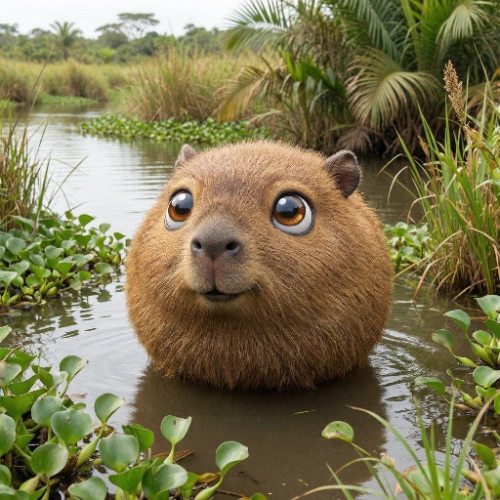
Spherical Cute Animal
Make a photo of a cute ball-shaped version of a [animal: Capybara], with big adorable over-sized eyes, it has no head, instead its face is part of the ball, its head and body are one. They are in their usual habitat. Must be almost spherical and cartoonishly cute. Its eyes are looking up in the most adorable cheeky fashion.
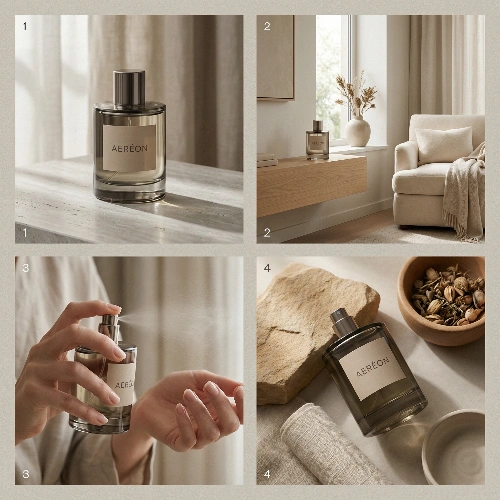
AERÉON Luxe Sensory Grid
{ "Objective": "Create a refined 2×2 grid advertisement for the luxury home fragrance 'AERÉON', emphasizing mood, atmosphere, and sensory elegance through minimal, editorial-style visuals.", "Canvas": { "Aspect_Ratio": "1:1", "Grid_Structure": "2×2 equal panels", "Orientation": "Square", "Use_Case": [ "Luxury brand social media", "Home & lifestyle campaigns", "E-commerce product storytelling", "Editorial-style digital ads" ] }, "Panels": [ { "Panel_Number": 1, "Title": "Hero Fragrance Object", "Description": "Studio hero shot of the AERÉON fragrance bottle centered on a stone or wood surface.", "Visual_Details": { "Lighting": "Soft diffused light with gentle shadows", "Background": "Neutral warm tones linen", "Focus": "Bottle shape, glass quality, minimalist label", "Mood": ["Elegance", "Calm", "Premium"] } }, { "Panel_Number": 2, "Title": "Atmospheric Interior", "Description": "Lifestyle interior scene with the fragrance placed on a shelf or table.", "Visual_Details": { "Setting": "Modern, serene living space", "Lighting": "Natural window light", "Mood": ["Comfort", "Warmth", "Refined living"] } }, { "Panel_Number": 3, "Title": "Scent Ritual Detail", "Description": "Close-up of hands interacting with the fragrance (spraying or opening).", "Visual_Details": { "Focus": "Human interaction and ritual", "Depth_of_Field": "Shallow and intimate", "Mood": ["Sensory", "Personal", "Mindful"] } }, { "Panel_Number": 4, "Title": "Material & Mood", "Description": "Macro or still-life composition featuring fragrance alongside natural elements.", "Visual_Details": { "Elements": ["Stone", "Linen", "Wood", "Ceramic"], "Lighting": "Soft highlights, low contrast", "Mood": ["Natural", "Timeless", "Atmospheric"] } } ], "Branding": { "Product_Name": "AERÉON", "Brand_Personality": "Quiet luxury, modern, sensory-focused", "Color_Palette": ["Warm Beige", "Soft Taupe", "Smoked Glass"], "Logo_Presentation": "Minimal, understated, centered or embossed" }, "Visual_Style": { "Style_Keywords": [ "Luxury home lifestyle advertising", "Editorial still-life photography", "Minimalist composition", "High realism", "Soft natural tones" ] }, "Camera_And_Lighting": { "Photography_Type": "Editorial and commercial hybrid photography", "Shot_Types": [ "Hero product shot", "Interior lifestyle shot", "Macro detail", "Still-life composition" ], "Lighting_Style": "Natural window light with soft diffusion", "Exposure": "Low contrast, warm, balanced", "Shadows": "Soft and organic" }, "Mood_Keywords": [ "Calm", "Refined", "Atmospheric", "Elegant", "Warm", "Sensory" ], "Negative_Prompt": [ "Harsh lighting", "Cluttered interiors", "Cheap glass appearance", "Bold or loud colors", "Unreadable labels", "CGI or artificial look", "Over-styling", "Watermarks", "Text overlays" ] }