
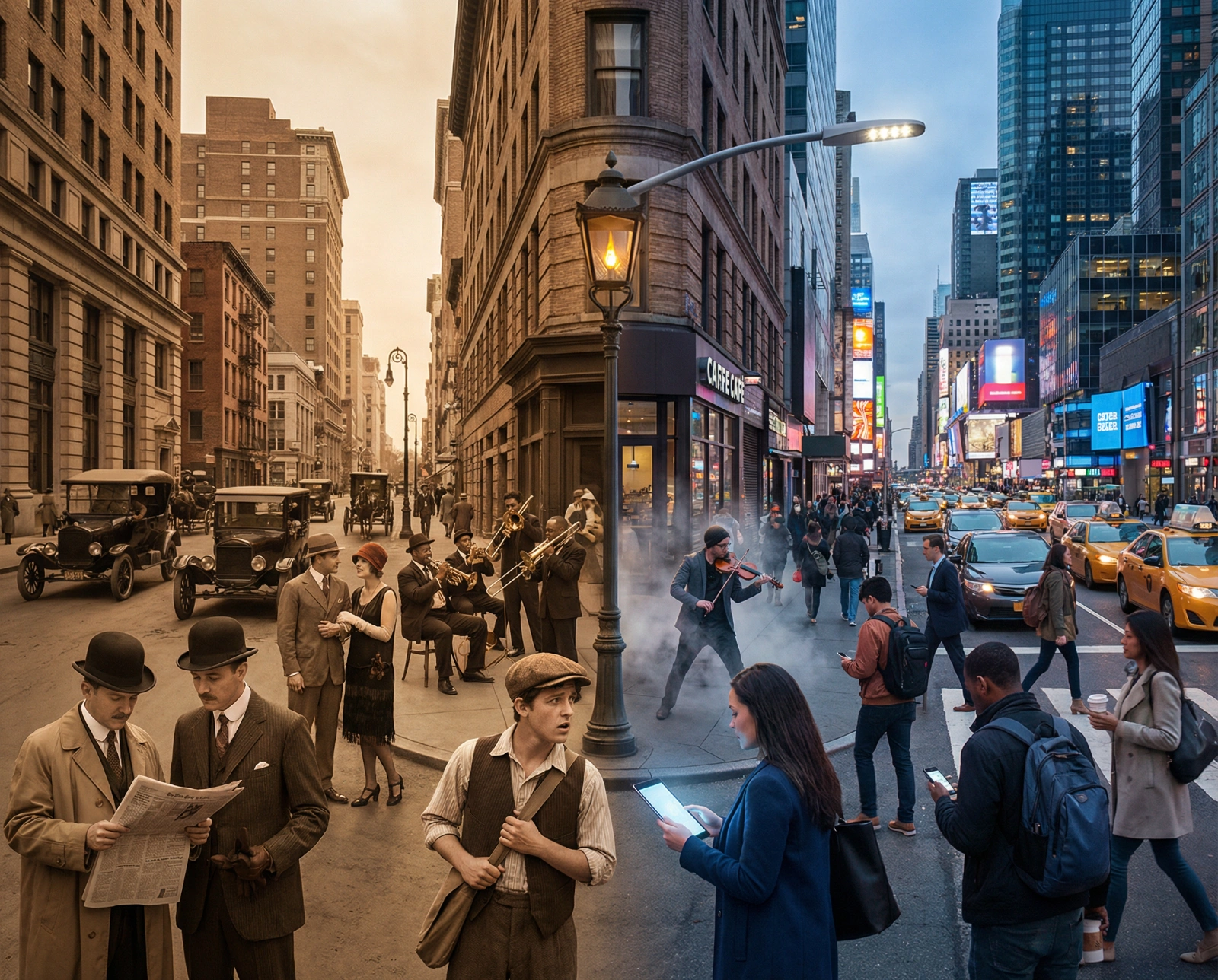
NYC Eras Split Screen
Prompt
A horizontal split-screen cinematic shot of [New York City Street Corner], seamlessly blending two different eras: [1920s New York] on the left and [Present-Day New York] on the right (default: about 100 years ago vs. present day). On the left side ([1920s New York]): show era-appropriate architecture, interior or environment design, materials, vehicles, and props that clearly belong to that historical period. People wear authentic clothing from [1920s New York], including flapper dresses, bowler hats, suspenders, newsboy caps, and typical items like newspapers, jazz instruments, leather suitcases, or cigarette holders. The overall mood feels nostalgic and historically accurate. On the right side ([Present-Day New York]): show the same [New York City Street Corner] in the modern era, with updated architecture, contemporary materials (glass façades, steel structures, LED signage), modern cars, bikes, and current technology (smartphones, tablets, mirrorless cameras, etc.). People wear contemporary New York street fashion—hoodies, business attire, sneakers, backpacks, coffee cups in hand. In the center: the two eras merge and overlap organically, without a hard dividing line. Elements from [1920s New York] and [Present-Day New York] visually interact: jazz musicians stare at modern street performers, newsboys look confused at smartphones, and old brick storefronts morph into sleek cafés with neon lighting. Classic vehicles fade into modern taxis and rideshare cars, and vintage lamp posts transition into LED streetlights. Make sure the scene is not just a simple left/right comparison but a dynamic time-travel interaction where buildings, clothing, props, and human gestures clearly emphasize the contrast and fusion between the two eras. Photorealistic, 8k resolution, cinematic lighting, wide angle, highly detailed textures, rich sense of time-travel storytelling.
Aspect Ratio
Model
Nano Banana ProYou might also like
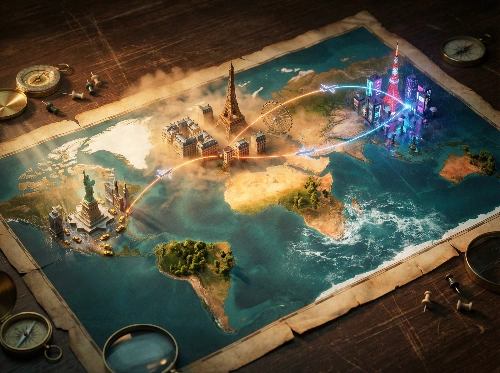
Living Diorama World Map
A weathered {antique parchment world} map spread across {a scarred wooden explorer’s table}, bursting with photorealistic miniature worlds erupting from marked locations. {Paris} explodes from {Europe} as a living diorama—{the Eiffel Tower} towers above {winding Haussmann streets}, surrounded by {golden sunset mist} and {slowly rotating ferris wheels}. {Tokyo} rises from {Asia} with {Tokyo Tower} emerging through {neon-lit rainstorms}, tiny {salarymen crossing busy intersections} frozen mid-motion. {New York City} materializes from {North America} where {the Statue of Liberty} pierces through {dramatic god rays}, {yellow taxi cabs and street vendors} spilling across miniature streets. Connecting routes glow as {pulsing lines of light}—miniature {airplanes} suspended impossibly between worlds. The map's surface transitions from flat parchment to living terrain: oceans become actual churning water with {foamy crashing waves}, deserts shimmer with real heat haze, forests sprout miniature trees. Each city exists in its own time: {warm golden hour light} bathes one, {cool blue twilight} illuminates another, {electric night glow} glows over the third. {tiny compasses, magnifying glasses, and scattered push pins} scatter around the map edges. {cinematic macro photography}, {rich teal-and-amber tones}, extreme depth of field, 8K, {retro-futuristic} meets magical realism.
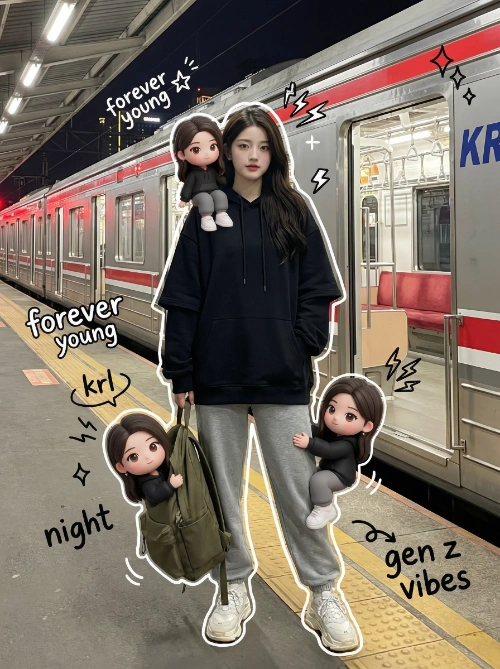
Gen Z Night Train Chibis
A high-quality mixed-media portrait of a trendy Gen Z teenager (using my uploaded person photo) standing on a train station platform at night. The subject is posing coolly, holding the strap of their olive backpack with one hand. They are wearing a stylish Gen Z outfit (oversized streetwear, layered black hoodie, gray sweatpants, and chunky sneakers). The background features a realistic 'KRL Jabodetabek' Commuter Line train side view with its signature red striping, with the train doors wide open, bathed in bright, cinematic station lighting and city night ambiance. Surrounding the realistic main subject are several cute, 3D-style 'Chibi' versions of the theirself. same wears and same face. These chibis are interacting playfully: one is sitting on the subject's shoulder, one is climbing their leg, and another is peeking out from the backpack. Overlay the image with vibrant, hand-drawn doodle effects: white drawn outlines around the subject, playful scribbles, stars, sparkles, electric sparks, and floating white and black handwritten slogans like 'forever young', 'krl', 'night', and 'gen z vibes'. The style should seamlessly blend hyper-realistic photography with colorful, flat cartoon illustrations. Keeping face and all shape person unchanged.
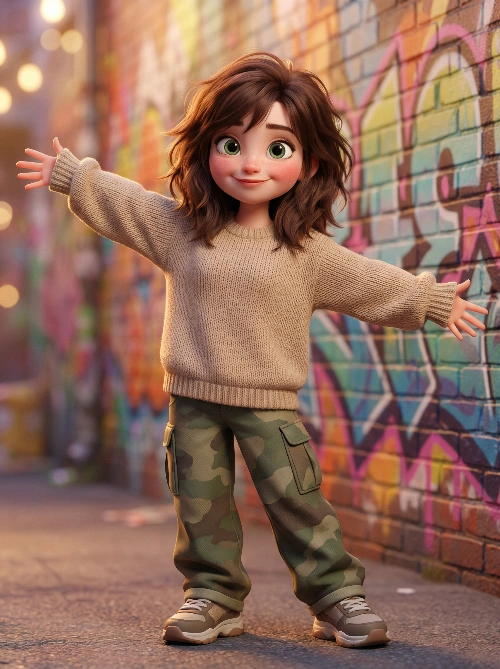
Cute Urban 3D Cartoon Girl
A cute stylized 3D cartoon girl with a Pixar–Disney-inspired look, big expressive green eyes, soft freckles, rosy cheeks, and a warm innocent smile. She is standing confidently in a colorful urban alley with a vibrant graffiti brick wall background, cinematic depth of field and soft bokeh lights. The character has a cozy oversized knitted sweater in a neutral beige tone with long sleeves covering part of the hands. She wears loose-fit cargo pants (olive green / camouflage tone), slightly baggy, paired with chunky casual sneakers. Her pose is joyful and playful with both arms stretched wide outward, conveying happiness and freedom. Hair is medium-length brown, slightly messy yet cute, styled naturally (can be open or lightly tied), with soft realistic strands. Lighting is warm and cinematic, soft ambient glow, ultra-detailed textures, high-quality 3D render, realistic fabric knit details, smooth skin shading, shallow depth of field, vibrant colors, whimsical mood, modern animated movie character style, ultra HD, sharp focus.
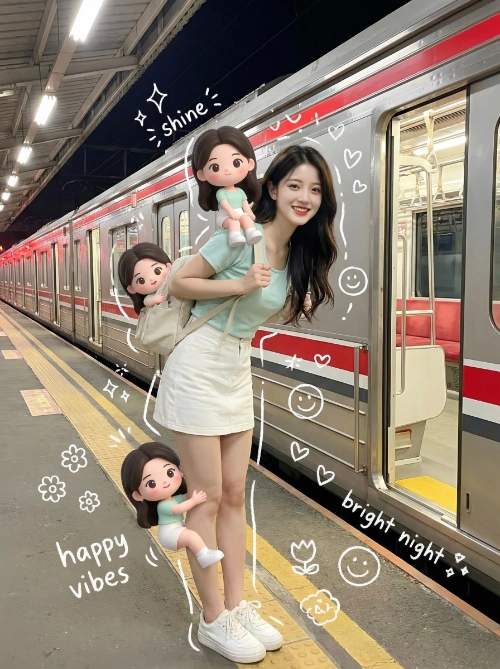
Cheerful Night Train Chibis
A high-quality mixed-media portrait of a bright and cheerful young woman with fresh, lively energy (using my uploaded person photo) standing on a train station platform at night. The subject has a friendly smile and bright eyes, posing with a lively, energetic expression, slightly leaning forward in a natural, upbeat stance, one hand playfully holding the strap of her light-colored backpack. She is wearing a stylish pastel casual outfit (soft mint or sky-blue top, clean white mini skirt made of structured fabric, white sneakers, and small cute accessories). Full body visible from head to toe Feet fully in frame, no cropping at legs or shoes Centered composition with safe margin around the subject Camera positioned far enough to capture the entire body Natural leg proportions, no distortion The background features a realistic 'KRL Jabodetabek' Commuter Line train side view with its signature red striping, with the train doors wide open, bathed in bright, cinematic station lighting and city night ambiance. Surrounding the realistic main subject are several cute, 3D-style 'Chibi' versions of herself, wearing the same outfit and same face. These chibis are interacting playfully: one is sitting on the subject's shoulder, one is climbing her leg, and another is peeking out from the backpack. Overlay the image with vibrant, hand-drawn doodle effects: soft white outlines around the subject, playful sparkles, doodle hearts, tiny flowers, smiley icons, and floating white handwritten phrases like "shine", "bright night", and "happy vibes". The style seamlessly blends hyper-realistic photography with colorful, soft cartoon illustrations. Keeping face and all body shape unchanged.
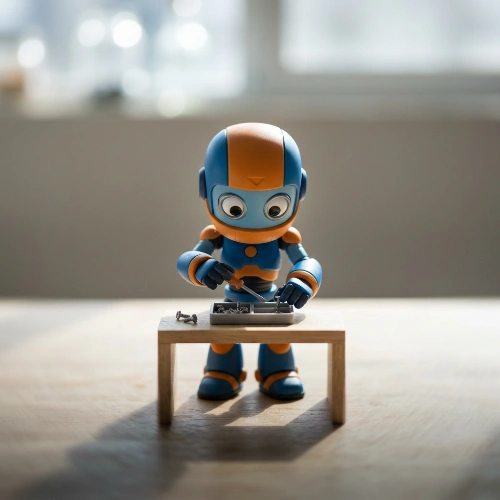
Candid High-Angle Slice
A high-angle tilt-shift cinematic image of the character captured naturally doing an everyday activity. The moment must feel candid and unstaged, like a quiet slice of life observed from above. Likeness Preservation Maintain exact proportions, eye shape, spacing, stylization, and material identity from the reference. Do not humanize. Do not reinterpret anatomy. Do not exaggerate realism. Camera & Perspective High-angle, slightly offset bird’s-eye view. Subtle isometric feeling. Equivalent to a 35mm lens adapted for tilt-shift photography. The character fills approximately 60–65% of the frame vertically. Breathing room above the head. Visible ground plane beneath. No extreme distortion. Focus Discipline (CRITICAL) Extremely shallow depth of field. Only the face and upper torso must be razor sharp. Hands interacting with an object may also be sharp. Lower legs and shoes must be slightly softened. Ground surface must progressively soften toward the bottom edge. Top and bottom edges must show strong optical tilt-shift blur. The focus band must be narrow and centered horizontally. No full-body sharpness. Pose Behavior The character must be naturally engaged in a daily action. Movement must feel subtle and believable. No staged hero poses. No exaggerated symmetry. Silhouette must remain clean and readable. Props or minimal furniture may be included only if necessary to support the action. Keep them simple and secondary. Lighting Control Bright natural daylight with firm directional key light. Light must carve the form clearly. Defined shadow under feet or object. Crisp shadow edge on ground. Subtle rim light separating character from background. No flat studio wash. No overly diffused light. Background Discipline Abstract minimal environment. Soft tonal gradient. Slight atmospheric depth. No detailed storytelling clutter. No heavy furniture unless essential to action. Background must support the character, not compete. Background Directional Structure (CRITICAL) Upper third of frame must contain soft luminous bokeh shapes or circular light blobs, gently out of focus, slightly brighter than mid-ground. Mid-ground remains neutral and unobtrusive. Lower ground plane must have subtle diagonal orientation, with a light-to-dark gradient guiding the eye upward toward the character’s head. Ground texture may contain faint linear perspective cues, but remain soft and minimal. The tonal gradient must travel from slightly darker bottom edge toward brighter mid-upper region behind the head. No flat monotone background. Color & Material Character slightly higher saturation than background. Background slightly muted. Clean premium collectible finish. Subtle surface sheen. No gritty realism. No artificial wear. Emotion Calm presence. Quiet confidence. A simple daily act elevated through composition and light. Not dramatic. Not heroic. Intimate but cinematic. Negative Lock No full-body sharpness No flat background No cluttered environment No stiff symmetrical pose No soft diffused lighting No dramatic battle energy No exaggerated realism
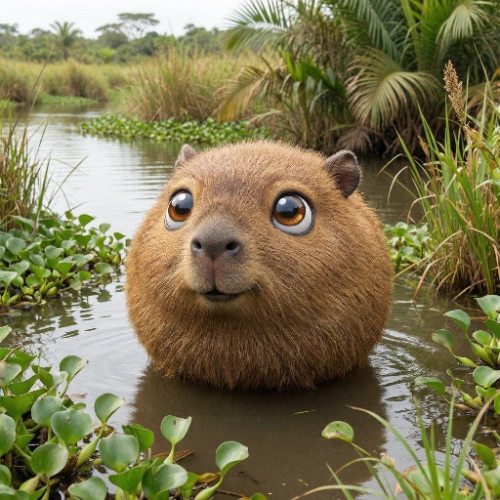
Spherical Cute Animal
Make a photo of a cute ball-shaped version of a [animal: Capybara], with big adorable over-sized eyes, it has no head, instead its face is part of the ball, its head and body are one. They are in their usual habitat. Must be almost spherical and cartoonishly cute. Its eyes are looking up in the most adorable cheeky fashion.
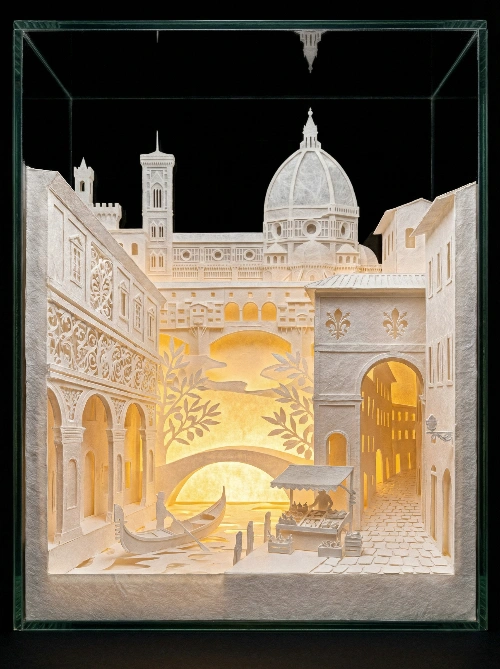
Florence Paper Cut Diorama
CITY_NAME: Florence -- A hyper-detailed 3D layered paper cutting art diorama of [CITY_NAME]. The cityscape features iconic landmarks and recognizable architecture of the city looming in the background, rendered in pure white paper. Buildings and layers are adorned with intricate culturally relevant filigree pattern cutouts and traditional motifs suitable for the location. Characteristic local elements are in the foreground. The entire scene is illuminated by a **radiant, intense warm amber light source from within** the layers. The pure white paper acts as a diffuser, becoming **translucent and glowing brightly**, revealing all intricate details. **Subsurface scattering effect**, **golden hour atmosphere** against a pitch-black background. Miniature world, exquisite texture, 8k resolution. --ar 3:4

Whimsical 3D Cartoon Character
A 3D cartoon-style render of a [subject], with a soft matte translucent body in [color1] and glowing [color2] accents. Features include oversized head, exaggerated facial features, and fun accessories. Subtle internal glow and ambient lighting, centered on a dark gradient background. Stylized in a playful and imaginative atmosphere.