
Reference Images:
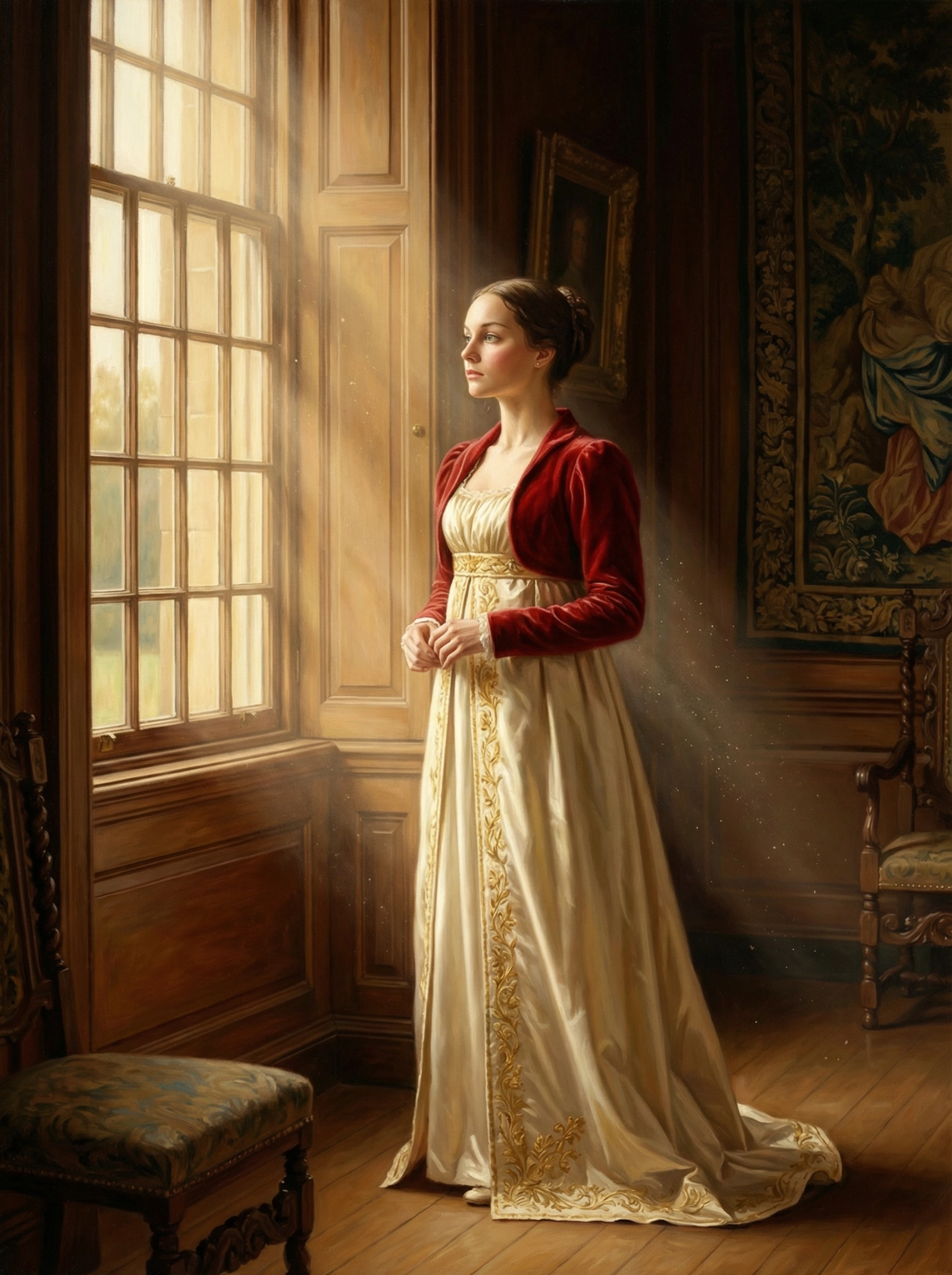
Regency Noblewoman Golden Glow
Prompt
A Regency-era style portrait of a noblewoman in a silk empire-waist gown. She stands by a tall window in a grand manor house. The lighting is natural and soft, resembling a painting by Vermeer. Dust motes dance in the light beams. The color grading is warm and golden.
Aspect Ratio
Model
Nano Banana ProYou might also like

Serene Surreal Fashion Portrait
{ "generation_manifest": { "system_directives": { "output_version": "5.0_UltraDetail", "canvas_parameters": { "aspect_ratio": "3:4", "compositional_style": "High-Fashion Cinematic Surrealism", "fidelity_target": "Anatomical_Identity_Lock" } }, "subject_node": { "biometrics": { "identity_anchor": "female from reference photo", "facial_configuration": { "feature_retention": ["Eyes", "Nose", "Mouth"], "alignment_logic": "Symmetrical_Proportional_Integrity", "expression_profile": "Serene_Calm_Innocent" }, "dermatology_rendering": { "surface": "Flawless_White_Porcelain", "finish": "Radiant_Luminous", "pigmentation": "Subtle_Natural_Blush", "makeup_logic": "Minimalist_Bare_Aesthetic" }, "follicle_dynamics": { "base_color": "Long_Blonde", "primary_state": "Neatly_Tied_Back", "secondary_state": "Loose_Strands_Peripheral_Framing" } }, "geometry_and_pose": { "framing": "Upper_Torso_Facial_Focus", "visibility": "Bare_Shoulders_Exposed", "posture": "Graceful_Static" } }, "optics_and_lighting_rig": { "camera_telemetry": { "angle_vector": "90_Degree_Top_Down_Overhead", "lens_characteristic": "Soft_Focus_Expressive", "perspective": "Surreal_Dreamy" }, "lighting_architecture": { "primary_source": "Soft_Direct_Natural_Sunlight", "shadow_mapping": { "geometry_patterns": ["Vertical_Artistic", "Gridded_Mesh"], "projection_surface": ["Facial_Planes", "Clavicle", "Shoulders"], "contrast_ratio": "Low_Soft_Diffused" } } }, "atmospheric_meta": { "tonality": "Pure_Graceful_Atmospheric", "chroma_profile": "Gentle_Naturalistic", "emotional_layer": "Tranquility_Innocence" } } }
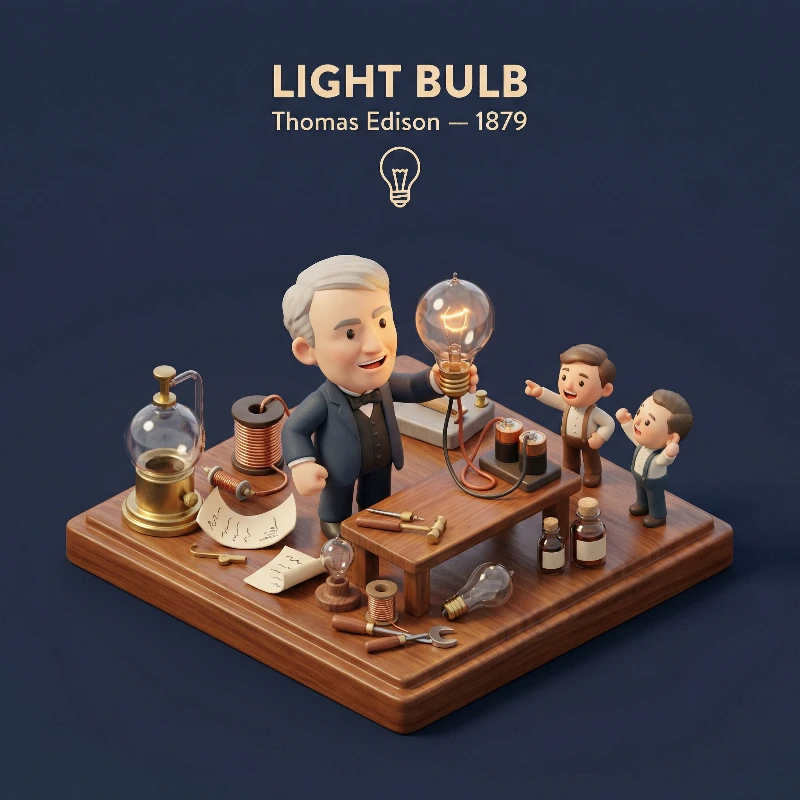
Edison's Light Bulb Invention Diorama
Create a miniature 3D isometric diorama showing the invention of [Light Bulb] at the moment of [Edison successfully testing the first long-lasting carbon filament bulb]. Camera angle around 40° from above. Textures feel soft and polished. Materials follow realistic PBR rules. Lighting feels natural and balanced. The raised base includes tools, workshop elements, notes, and early prototypes. Tiny stylized inventors interact with objects. Faces are visible and recognizable with clean shapes and expressions. Background stays solid [warm dark navy blue]. Top center text shows [Light Bulb] in bold. Second line shows [Thomas Edison — 1879]. A simple line icon of the invention sits below. Text color adapts to background contrast.
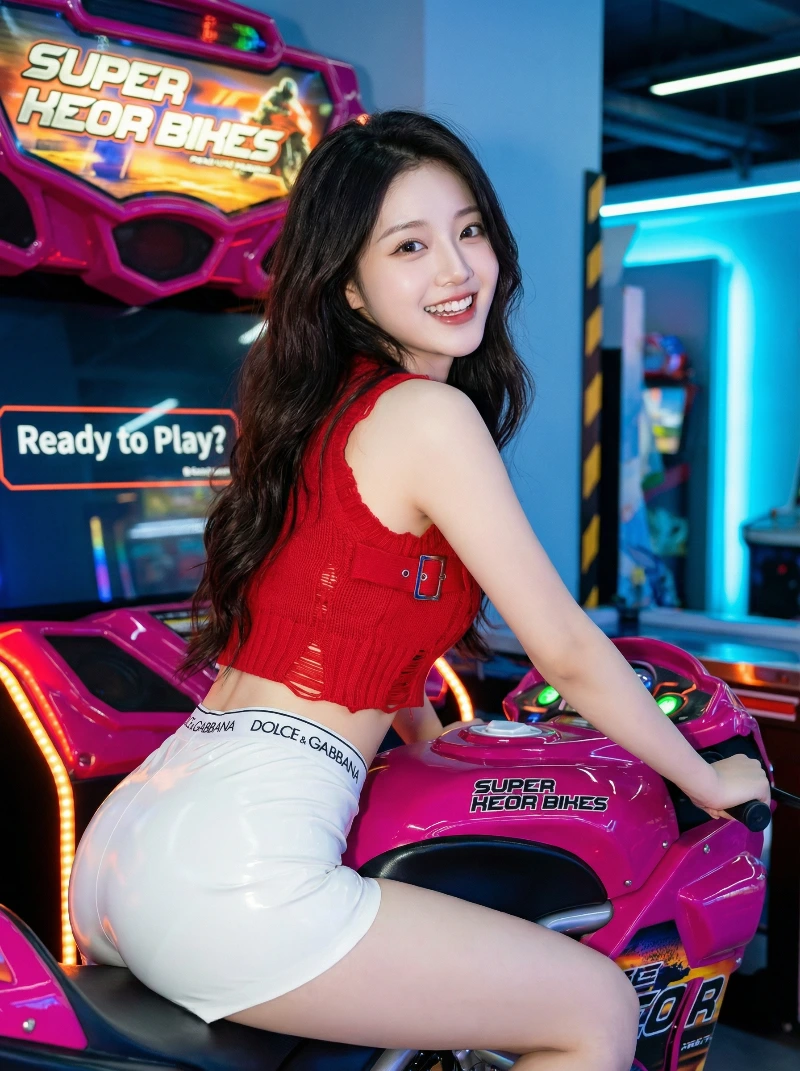
Vibrant Arcade Biker
{ "prompt_structure": { "subject": { "appearance": "Young woman with long, wavy hair and a radiant, joyful expression featuring a wide smile.", "pose": "Seated on a electric fuchsia arcade motorcycle game, leaning slightly forward with hands on the handlebars, body angled in profile while turning head to face the camera making visible clearly her fit curvaceous low back." }, "attire": { "top": "Strapless red knit crop top with deep V neckline featuring distressed/ripped texture and a decorative buckle strap across the chest.", "bottoms": "Matching tight white latex shorts.", "accessories": "Visible white Dolce & Gabbana waistband with black logo text peering above the shorts." }, "environment": { "location": "Indoor amusement arcade.", "foreground": "Bright electric yellow 'SUPER KEOR BIKES' arcade racing cabinet with a realistic motorcycle seat and dashboard.", "background": "Blurry array of other arcade machines, including game screens and a neon sign reading 'Ready to Play?.", "lighting": "Vibrant, high-contrast arcade lighting with dominant orange LED strips outlining the machines and cool electric blue ambient light in the background." }, "style": { "aesthetic": "Energetic, playful, and vibrant.", "color_palette": "Saturated red and pink (outfit), neon orange, electric blue, and deep shadows.", "photography_style": "Medium shot, high-flash or bright environmental lighting, sharp focus on the subject with a shallow depth of field background." } } }
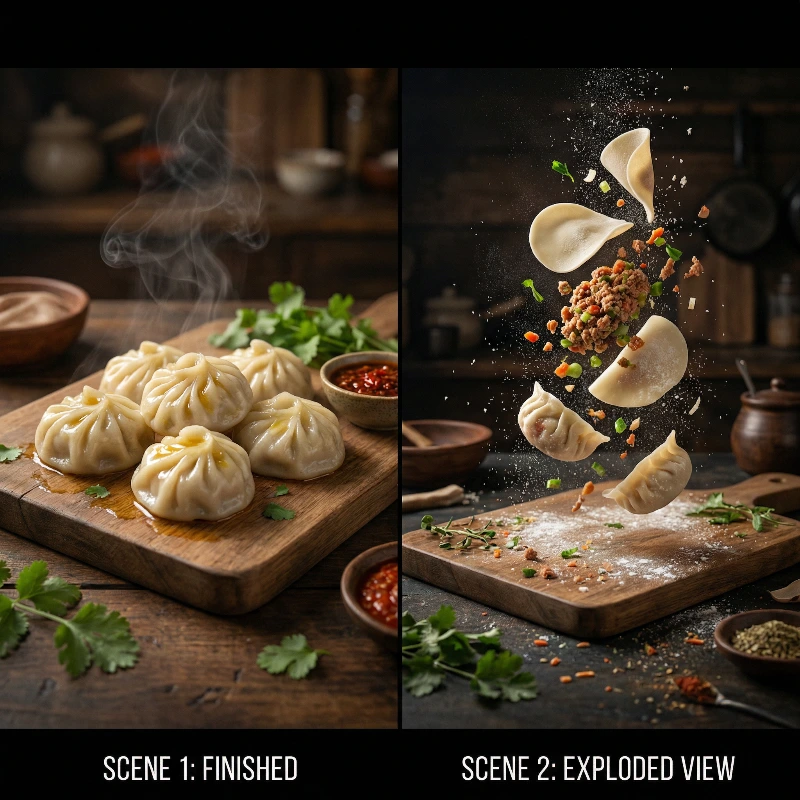
Cinematic Momo Food Art
Ultra-realistic cinematic food photography of freshly steamed dumplings (momos) on a rustic wooden board. One scene shows finished dumplings with glossy dough, delicate pleats, light oil sheen, and steam rising. Another scene shows an exploded view: dumpling wrappers and spiced minced filling floating mid-air, flour particles frozen in motion, herbs scattered, dramatic slow-motion effect. Warm moody lighting, shallow depth of field, dark rustic kitchen background, professional studio food styling, hyper-detailed textures, cinematic realism, 8K, macro photography, high contrast.
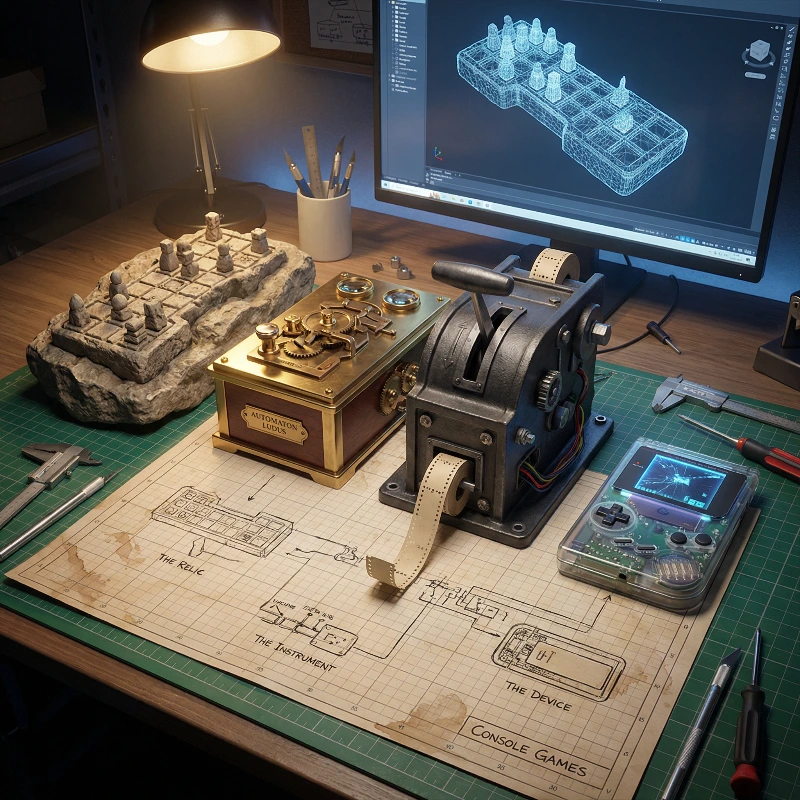
Console Tech Evolution
Input A = Console games <instruction> Input A is a Core Technological Function (e.g., Computing, Navigation, Music, Communication). Deconstruct the function into 4 Chronological Artifacts: The Relic (Ancient): Identify the stone or bronze age precursor. (e.g., Computing -> Antikythera Mechanism/Abacus. Navigation -> Lodestone/Sundial). The Instrument (Classical): Identify the brass and wood scientific instrument. (e.g., Computing -> Pascaline. Navigation -> Sextant/Astrolabe). The Machine (Industrial): Identify the steam/steel era mechanism. (e.g., Computing -> Difference Engine/Punch Card Machine. Navigation -> Gyrocompass). The Device (Modern): Identify the current digital interface. (e.g., Computing -> Tablet/Smartphone. Navigation -> GPS Unit). 2. Container Goal: "Tech History" Workbench Photography. Setting: A cluttered Green Cutting Mat on a sturdy wooden workshop table. Background: A computer monitor displays the CAD Wireframe/3D Scan of the "Relic" or "Instrument," implying a restoration or study project. Tools: Calipers, X-Acto knives, and screwdrivers are scattered around the objects. 3. Lineup (The Artifacts): Arrangement: The four objects are arranged left-to-right (Oldest to Newest). Object 1 (Relic): Heavily damaged, calcified, or encased in rock. Looks like an archaeological find. Object 2 (Instrument): Polished Brass and Mahogany. intricate gears and lenses. Object 3 (Machine): Cast Iron, heavy bolts, punch cards, or paper tape. Object 4 (Device): Sleek glass and aluminum. The screen is cracked or the casing is transparent, revealing the circuitry inside. 4. Blueprint (The Connection): The Drawing: A large, coffee-stained Schematic Grid Paper lies flat under the objects. The Content: Hand-drawn diagrams connect the mechanical logic of the Ancient Relic to the circuit logic of the Modern Device. 5. Lighting & Atmosphere: Lighting: Mixed Lighting. A warm, articulated desk lamp illuminates the physical objects, while the cool blue light from the monitor washes over the back wall. Vibe: Intellectual, inquisitive, and tactile. Output: ONE image, 1:1 Aspect Ratio, 3D Render, "Maker Space" aesthetic, High Texture Fidelity. </instruction>
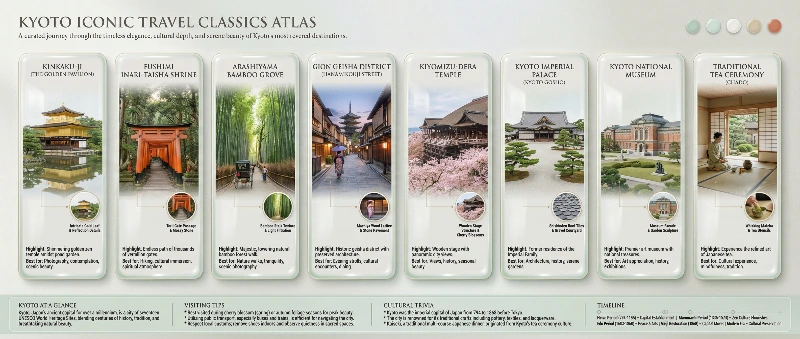
Kyoto Iconic Travel Atlas
Create an ultra-wide infographic poster titled “Kyoto Iconic Travel Classics Atlas”, with a 21:9 horizontal layout in true 8K resolution. The visual language blends ceramic glaze and jade-like softness, expressing calm luxury, precision, and cultural depth. The overall mood is restrained, warm, and translucent—evoking the feeling of a museum-grade exhibition combined with refined cultural branding. All on-image text is in English. Background and overall material tone * Background features a light rice-white to misty off-white gradient, similar to a high-end ceramic exhibition space * Global lighting is gentle and diffused: soft HDRI illumination with subtle rim light, avoiding harsh contrast or strong shadows * Color palette centers on jade white, pale celadon, soft moss green, warm beige, with minimal accents of vermilion or muted gold (no more than 3–4 dominant hues across the entire image) Layout: eight equal-width “ceramic/jade plaques” (strictly eight columns) * The central composition uses a strict eight-column grid, each column designed as a ceramic-style information plaque * Plaque material resembles fine white porcelain glaze: rounded corners, smooth highlights, subtle reflective sheen, clean edges * Borders may include an extremely delicate gold trace or jade-edge effect, applied with restraint * Shadows are soft and shallow, as if the plaques are placed on a curated museum display surface Core visuals: realistic 3D landmarks (PBR) with a serene glazed aesthetic * Each column top features one real, iconic Kyoto landmark (automatically select eight authentic sites, no fictional entries) * Use realistic 3D environment rendering with physically based materials, while maintaining a calm, jade-like visual softness * Materials must follow real-world physical rules: wood, stone, tile, water, foliage, and paper surfaces rendered with accurate PBR properties * Unified color grading: soft highlights, moderate contrast, low saturation, and gentle warmth inspired by ceramic glaze and polished jade * Composition emphasizes depth and quiet grandeur through layered space and subtle scale references (small figures, lanterns, trees) * Water elements (rivers, ponds, moats) should display delicate reflections and smooth tonal transitions * Avoid cartoon styles, low-poly geometry, plastic textures, excessive sharpness, or dramatic cinematic lighting Detail view: glazed “micro dish” or “jade charm” window * Each column includes one small detail window in the lower-right corner, using a single consistent shape across all columns * Option A: a small circular dish resembling a porcelain saucer, showcasing fine details (wood grain, roof tiles, stone steps, garden gravel, water ripples) * Option B: a jade-charm-shaped window with rounded contours, highlighting close-up textures and materials * Surfaces should exhibit soft glaze or jade-like highlights with smooth, rounded edges * A thin, elegant leader line connects the detail window to the main 3D landmark, accompanied by a concise 2–6 word label Text per column (concise, refined, understated) * Landmark name (4–8 English words, refined serif typeface recommended) * Two short informational lines: * Highlight: maximum 8 words * Best for: maximum 6 words * Text color uses ink gray or bluish charcoal; accent colors appear only in small dots or separators Top title area (museum exhibit label style) * Main title: Kyoto Iconic Travel Classics Atlas * Subtitle: one refined positioning sentence, maximum 18 words, calm and poetic in tone * Top-right corner includes five small glazed color dots: pale celadon, jade white, moon white, warm beige, with a subtle vermilion accent Bottom information band (exhibition caption style) * A full-width bottom band divided into four sections by fine lines, resembling museum display captions * Kyoto at a glance: one sentence, maximum 22 words * Visiting tips: three bullet points, each no more than 12 words * Cultural trivia: three items, each no more than 18 words * Timeline: 3–6 key nodes (era or year plus keyword), connected with minimal linear icons using thin, consistent strokes Automatic landmark selection rules * Cover at least five categories: natural scenery, historical temples or shrines, traditional architecture, museums or cultural institutions, classic streets or seasonal night scenes, and intangible cultural experiences (tea ceremony, festivals, crafts) * If necessary, fill gaps with safe, general entries such as “Kyoto National Museum” or “Historic Gion District” * All landmark names must be real and verifiable; if uncertain, use conservative generic naming and never fabricate locations Output constraints * English text only * Strong alignment, minimalist spacing, generous white space * No logos, no branding marks, no watermarks * True 8K ultra-high resolution, suitable for cultural tourism displays and horizontal social media covers
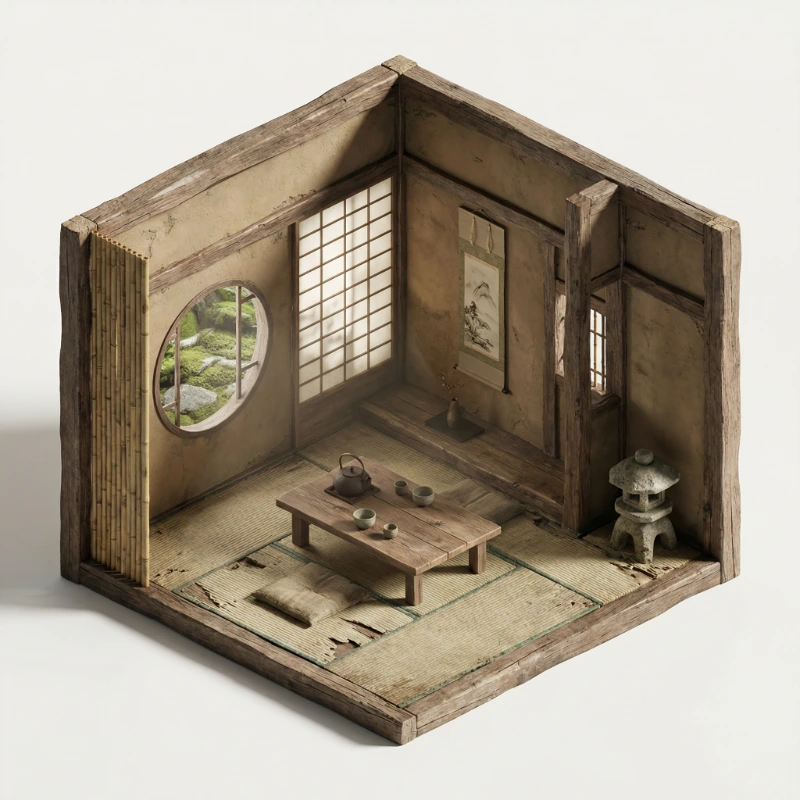
Isometric Wabi-Sabi Tea Room
Create a highly detailed isometric 3D interior diorama of a (Japanese wabi-sabi) (traditional tea room) Design the space with coherent architecture, furniture, lighting, materials, and decoration that naturally match the chosen concept. Use realistic textures, soft natural daylight, gentle shadows, and a calm minimal white background. Perspective: isometric cutaway diorama. Ultra high detail, premium interior visualization, soft global illumination.
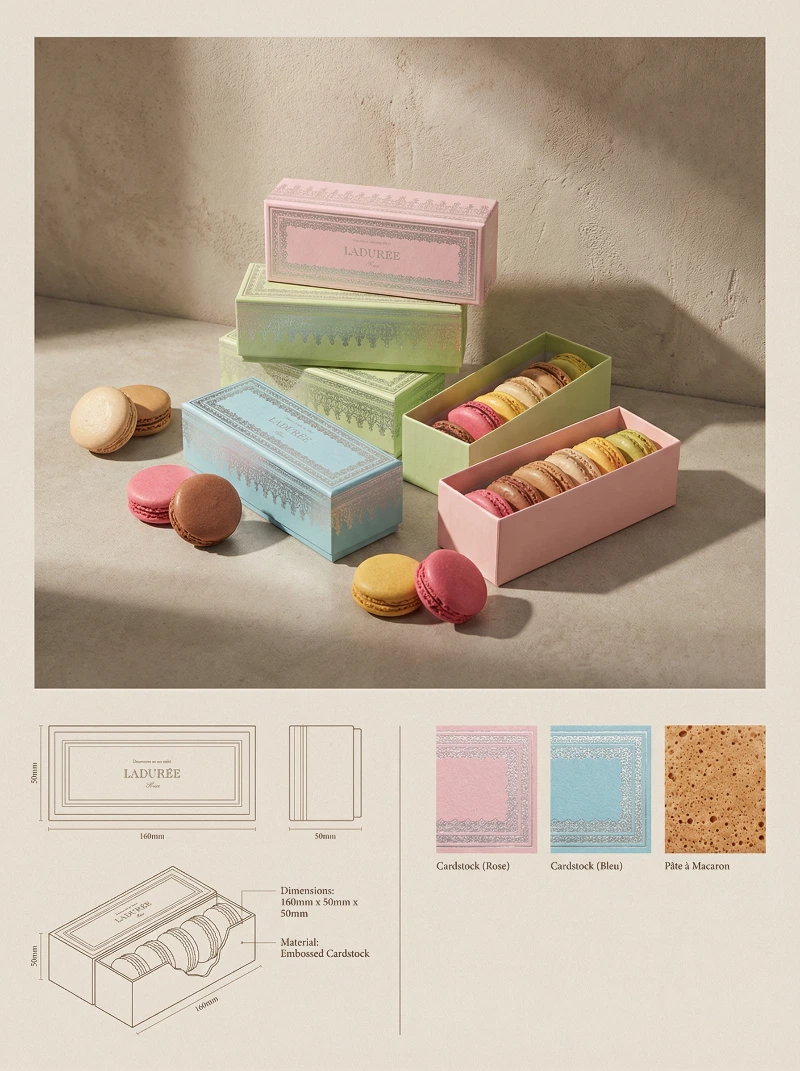
Architectural Product Specs
{ "reference_images": { "product_image": "UPLOADED_IMAGE", "usage_rule": "Use the uploaded image as the exact visual reference for the product’s form, proportions, materials, and overall identity. Do not redesign or reinterpret the product." }, "layout": { "canvas": { "orientation": "vertical", "aspect_ratio": "3:4", "background": "warm neutral paper-like surface" }, "structure": { "top_section": "lifestyle_hero", "bottom_section": "technical_specification" } }, "top_section": { "type": "lifestyle_product_image", "composition": { "placement": "top_center", "scale": "dominant", "margin": "generous whitespace around product" }, "environment": { "setting": "minimal architectural interior", "lighting": { "type": "natural sunlight", "direction": "angled side light", "quality": "soft but high-contrast shadows" }, "floor": "subtle concrete or stone surface", "background": "textured plaster wall" }, "rendering": { "style": "editorial lifestyle photography", "detail": "high realism", "color_grading": "warm, muted, premium" } }, "bottom_section": { "type": "technical_specification_panel", "layout": { "grid": "modular", "alignment": "clean, architectural" }, "technical_drawings": { "placement": "bottom_left_and_center", "style": "architectural line drawings", "views": [ "front view", "side view", "three-quarter cutaway or profile view" ], "projection": "orthographic", "line_style": { "color": "muted red or sepia", "weight": "fine technical lines" }, "annotations": { "type": "measurement and construction callouts", "language": "neutral technical labels", "density": "minimal, editorial" } }, "materials_panel": { "placement": "bottom_right", "content": { "type": "material_swatches", "count": "3-4 depending on product", "format": "square or rectangular samples" }, "textures": { "source": "derived from the product materials", "examples": [ "fabric", "leather", "metal", "wood", "plastic" ] }, "labels": { "style": "small editorial captions", "tone": "technical but refined" } } }, "typography": { "style": "minimal editorial", "usage": "subtle captions, no large headlines", "color": "soft black or dark brown" }, "overall_style": { "mood": "design catalog / product design journal", "aesthetic": "architectural, premium, calm", "avoid": [ "clutter", "bold colors", "heavy branding", "overly decorative graphics" ] }, "constraints": { "do_not": [ "change product design", "invent new materials", "add logos unless present in reference", "use perspective distortion in drawings" ] } }