
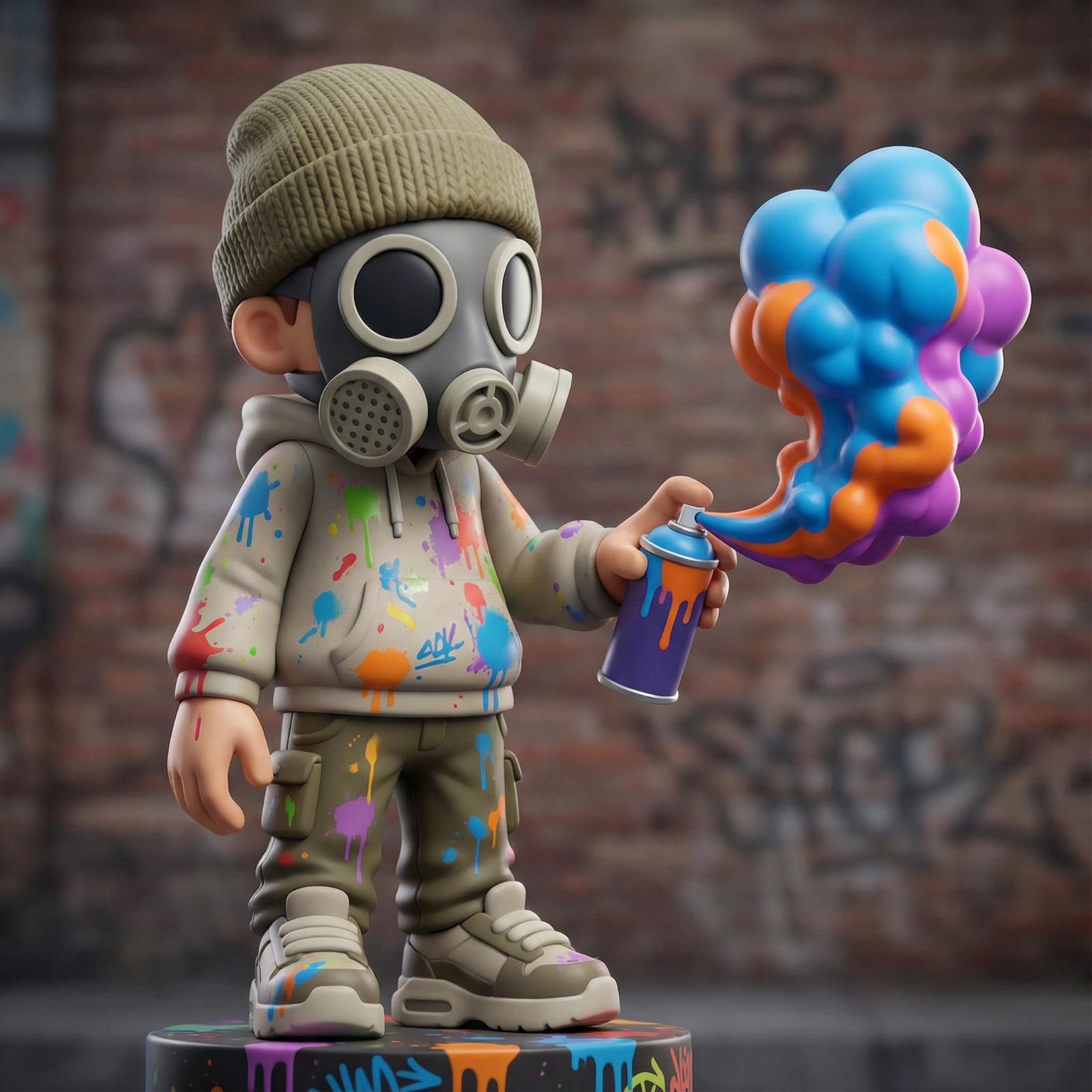
Urban Graffiti Vinyl Toy
Prompt
A stylized vinyl toy of a graffiti artist wearing a gas mask and a beanie. Holding a spray can that is spraying a solid 3D cloud of paint. Clothes covered in colorful paint splatters. Street art culture, matte vinyl finish, urban vibe, studio photography, high fidelity 3D model.
Aspect Ratio
Model
Nano Banana ProYou might also like
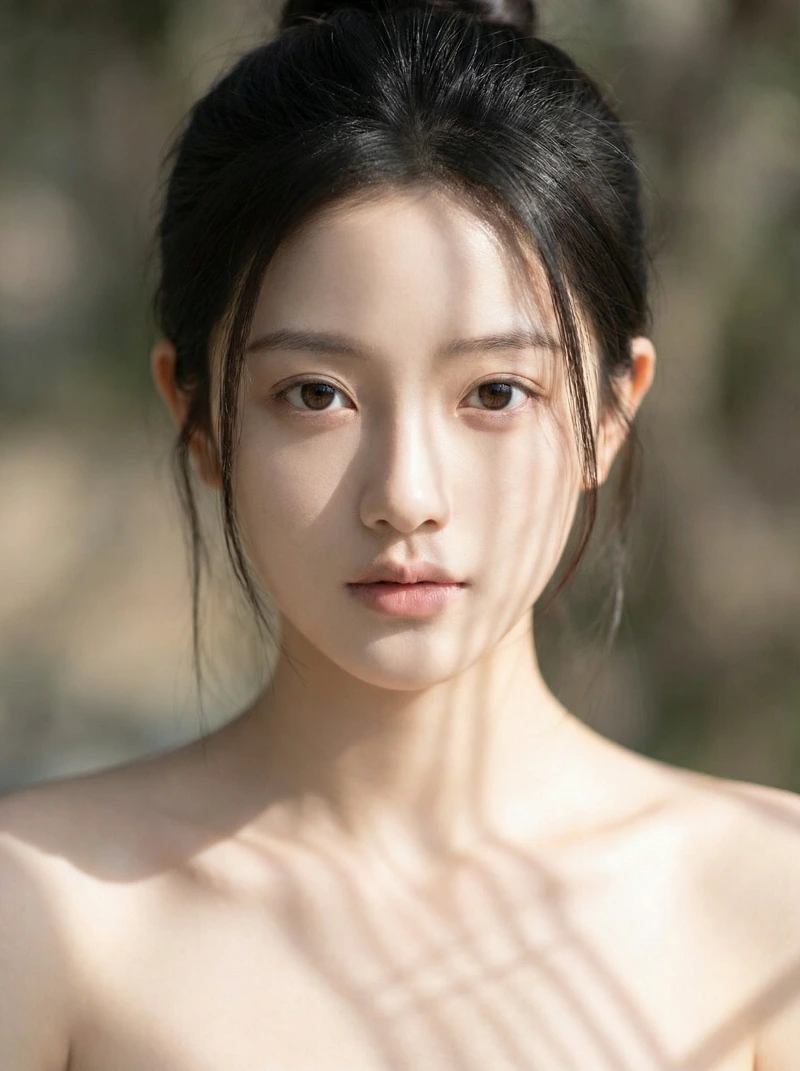
Serene Surreal Fashion Portrait
{ "generation_manifest": { "system_directives": { "output_version": "5.0_UltraDetail", "canvas_parameters": { "aspect_ratio": "3:4", "compositional_style": "High-Fashion Cinematic Surrealism", "fidelity_target": "Anatomical_Identity_Lock" } }, "subject_node": { "biometrics": { "identity_anchor": "female from reference photo", "facial_configuration": { "feature_retention": ["Eyes", "Nose", "Mouth"], "alignment_logic": "Symmetrical_Proportional_Integrity", "expression_profile": "Serene_Calm_Innocent" }, "dermatology_rendering": { "surface": "Flawless_White_Porcelain", "finish": "Radiant_Luminous", "pigmentation": "Subtle_Natural_Blush", "makeup_logic": "Minimalist_Bare_Aesthetic" }, "follicle_dynamics": { "base_color": "Long_Blonde", "primary_state": "Neatly_Tied_Back", "secondary_state": "Loose_Strands_Peripheral_Framing" } }, "geometry_and_pose": { "framing": "Upper_Torso_Facial_Focus", "visibility": "Bare_Shoulders_Exposed", "posture": "Graceful_Static" } }, "optics_and_lighting_rig": { "camera_telemetry": { "angle_vector": "90_Degree_Top_Down_Overhead", "lens_characteristic": "Soft_Focus_Expressive", "perspective": "Surreal_Dreamy" }, "lighting_architecture": { "primary_source": "Soft_Direct_Natural_Sunlight", "shadow_mapping": { "geometry_patterns": ["Vertical_Artistic", "Gridded_Mesh"], "projection_surface": ["Facial_Planes", "Clavicle", "Shoulders"], "contrast_ratio": "Low_Soft_Diffused" } } }, "atmospheric_meta": { "tonality": "Pure_Graceful_Atmospheric", "chroma_profile": "Gentle_Naturalistic", "emotional_layer": "Tranquility_Innocence" } } }
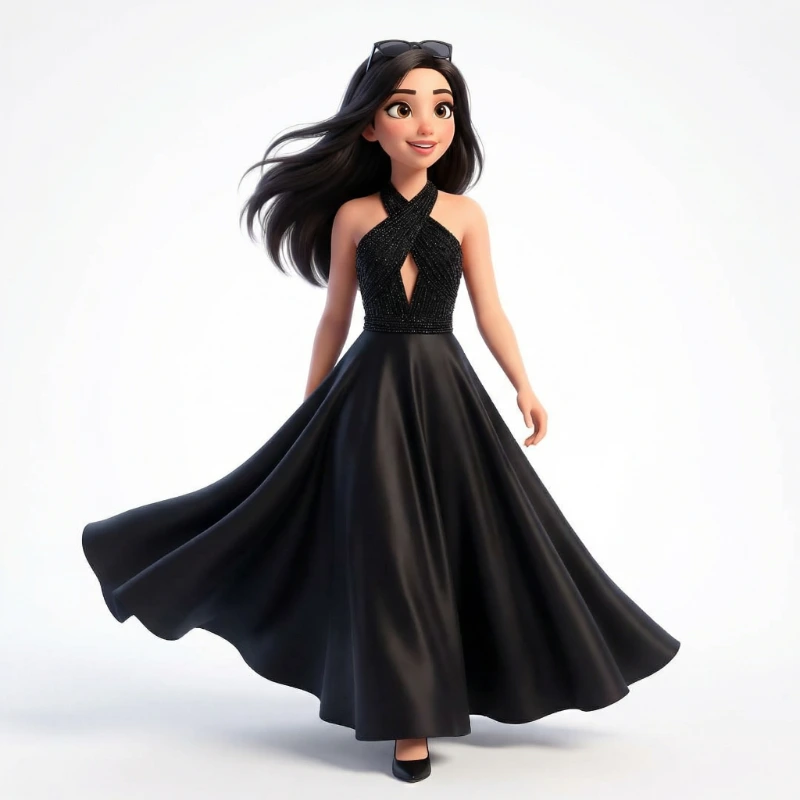
Cheerful Pixar 3D Portrait
Convert the uploaded photo into a cheerful and cute 3D Pixar-style animated portrait. Keep the person’s facial features, hairstyle, and unique expression so the character clearly resembles the real person. Use a smooth and clean cartoon style. Apply soft skin shading, expressive eyes, and a polished animated look while preserving the original identity. Place the character against a plain white studio background with clean, even lighting. Keep the outfit the same as in the reference
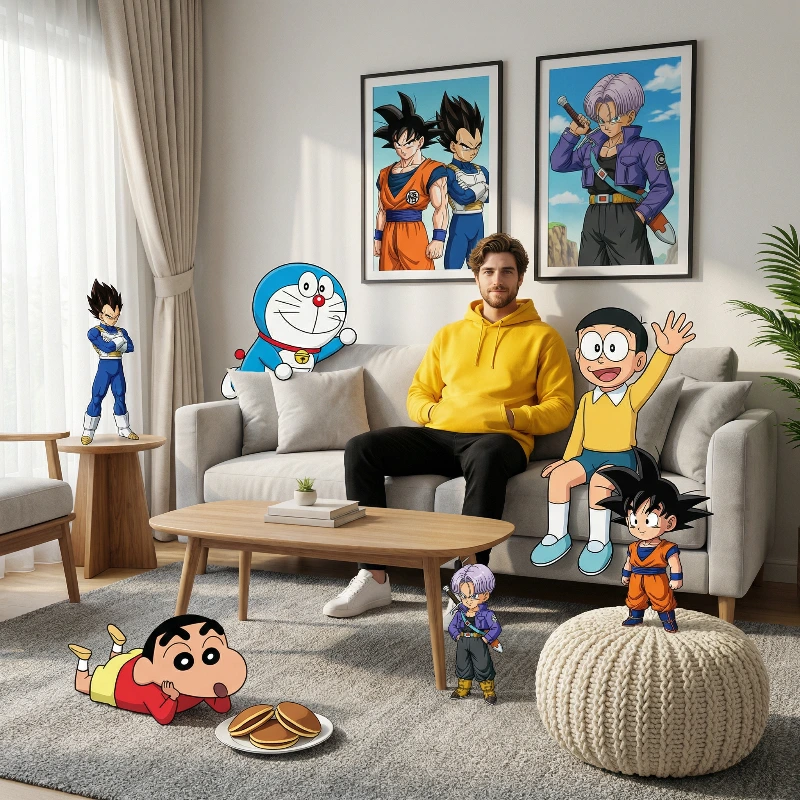
Surreal Anime Living Room Mix
A high-fidelity, wide-angle interior shot captures a surreal, mixed-media composition within a modern living room. It features a man resembling the face in the reference photo—using an uploaded face as a reference—wearing a bright yellow hoodie and black pants, sitting centrally on a plush light gray sofa. The scene seamlessly blends photorealistic 3D environments with cel-shaded 2D anime and cartoon characters interacting directly with the physical space. On the right side of the subject on the sofa, Nobita sits casually waving his hand, while on the left side, Doraemon leans casually on a pillow. Behind the sofa, two framed posters hang on the white wall—one featuring Son Goku and Vegeta, and the other featuring Trunks in a dynamic anime style. In the foreground, Shinchan lies relaxed on a textured gray carpet near a plate of dorayaki, while a chibi version of Son Goku stands triumphantly on a cream-colored knit pouf. On the left side of the room, Vegeta stands tall on a grooved wooden side table in a confident pose, while a miniature version of Trunks is near the wooden coffee table in the center, as if observing the scene with a curious expression. Soft natural light streams in from the left side through sheer curtains, creating subtle volumetric lighting that accentuates the texture of the blanket, the wood grain of the tiered table, and the leaves of the snake plant in the corner of the room. The entire scene is rendered in 8K resolution with sharp focus, vivid colors, and a dreamy, cinematic, and playful aesthetic blending between the real world and the anime world, with no AI visible.
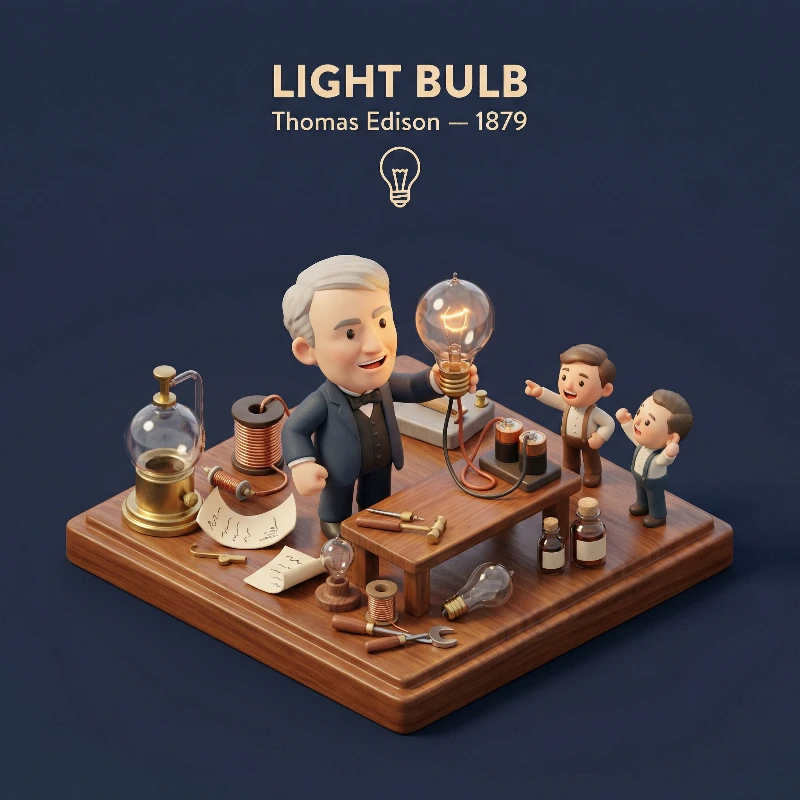
Edison's Light Bulb Invention Diorama
Create a miniature 3D isometric diorama showing the invention of [Light Bulb] at the moment of [Edison successfully testing the first long-lasting carbon filament bulb]. Camera angle around 40° from above. Textures feel soft and polished. Materials follow realistic PBR rules. Lighting feels natural and balanced. The raised base includes tools, workshop elements, notes, and early prototypes. Tiny stylized inventors interact with objects. Faces are visible and recognizable with clean shapes and expressions. Background stays solid [warm dark navy blue]. Top center text shows [Light Bulb] in bold. Second line shows [Thomas Edison — 1879]. A simple line icon of the invention sits below. Text color adapts to background contrast.
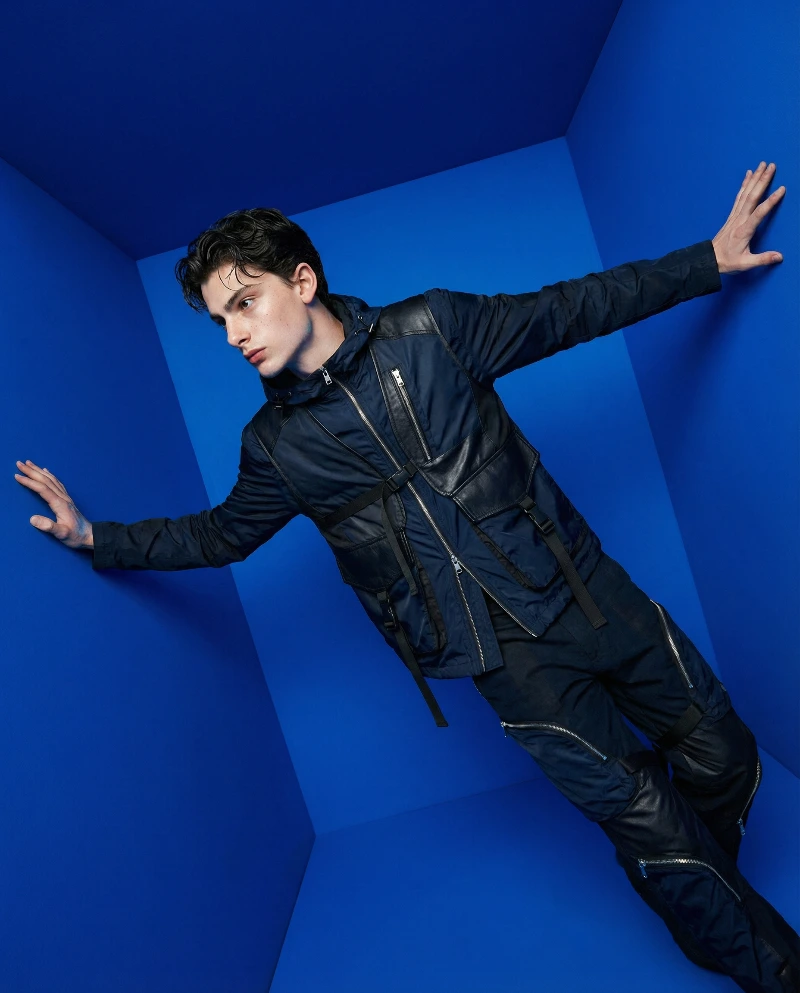
Surreal Fashion Cube Shoot
[INPUT IMAGE: USER_PHOTO] Use the person in the input image as the ONLY subject. Preserve their identity and facial features clearly. Create a hyper-realistic high-fashion editorial photo inside a surreal 3D geometric “color box” room (a hollow cube / tilted cube set). Each render MUST randomly choose: 1) a bold single-color box (monochrome environment, vivid and saturated), 2) a dynamic “cool” fashion pose (gravity-defying or extreme stretch / leap / sideways bracing against the walls), 3) a dramatic camera angle (wide-angle 24–35mm equivalent, tilted horizon, strong perspective). The subject appears full-body and sharp, wearing an avant-garde fashion styling that feels modern and editorial (clean silhouette, stylish layering, premium fabric texture). Keep clothing tasteful and fashion-forward. The subject’s pose should feel athletic, stylish, and unusual—like a magazine campaign shot. Lighting: studio quality, crisp and cinematic; strong key light with controlled soft shadows, subtle rim light; realistic reflections and bounce light from the colored walls. Ultra-detailed skin texture, natural pores, realistic fabric weave, clean edges, high dynamic range. Composition: subject centered with plenty of negative space and strong geometric lines; the box perspective frames the subject. Color: the box color is a SINGLE bold color and MUST be different each run (random vivid hue). The subject’s outfit contrasts well with the box color. Output: hyper-real, photorealistic, 8k detail, editorial campaign quality, sharp focus on subject, no motion blur, no distortion of face, natural proportions.
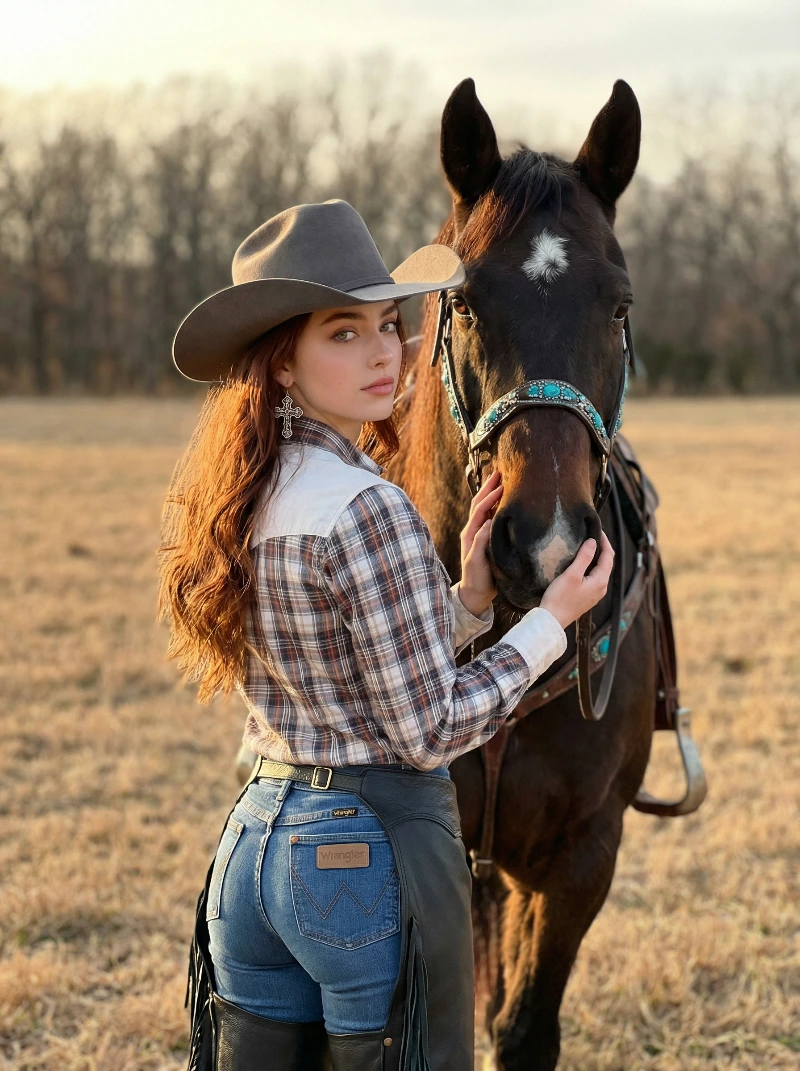
Rustic Cowgirl Horse Connection
{ "subject": { "description": "Young woman with long, wavy reddish-brown hair reaching past her mid-back.", "features": "Pale skin, soft youthful facial features, looking back over her left shoulder directly at the viewer with a calm, serious, and captivating expression.", "pose": "Standing with her back mostly to the camera, torso slightly twisted. Her hands are gently cupping and caressing the face/muzzle of a dark brown horse standing intimately beside her right side." }, "attire": { "headwear": "Grey felt cowboy hat with a wide brim, textured felt material.", "upper_body": "Plaid long-sleeve western shirt (light cream/beige base with red and grey check pattern), featuring a distinctive white western yoke design on the back shoulder.", "lower_body": "Classic blue denim jeans, tight-fitting, with a visible tan leather 'Wrangler' patch on the back right pocket.", "accessories": "Large, ornate silver cross earrings dangling; silver bangles/bracelets on the right wrist; black leather shotgun chaps worn over jeans with white lace ties or fabric hanging from the back waist belt.", "styling": "Authentic western cowgirl aesthetic, rugged yet feminine styling." }, "animal": { "type": "Horse", "appearance": "Dark bay or brown horse, sleek coat.", "details": "White star marking on the forehead.", "tack": "Intricate western bridle featuring a browband and cheek pieces embellished with turquoise stones and silver conchos; rope reins attached to the bit." }, "environment": { "setting": "Rural outdoor field or pasture.", "ground": "Dry, golden-brown grass indicating autumn or winter.", "background": "Blurred forest line with leafless trees, creating a soft, textured backdrop that suggests a crisp, cold day." }, "lighting": { "type": "Soft natural light, reminiscent of golden hour or late afternoon.", "quality": "Warm, diffused sunlight coming from the left, highlighting the waves in her hair and the texture of the horse's face.", "shadows": "Gentle, natural shadows providing depth to the clothing folds and facial features." }, "camera_details": { "shot_type": "Medium shot from a rear-quarter angle.", "focal_length": "85mm or 50mm portrait lens.", "aperture": "f/1.8 to f/2.8 for shallow depth of field (bokeh) to separate subject from background.", "composition": "Rule of thirds, focusing on the connection between the girl's eyes and the horse." }, "mood": { "atmosphere": "Nostalgic, serene, rustic, intimate connection between human and animal.", "color_palette": "Earthy tones: browns, beiges, creams, muted greens, and soft warm skin tones." }, "photorealism": { "quality": "High fidelity, 8k resolution, cinematic lighting.", "textures": "Hyper-realistic rendering of denim fabric, felt hat texture, horse hair, leather grain, and individual strands of human hair." } }
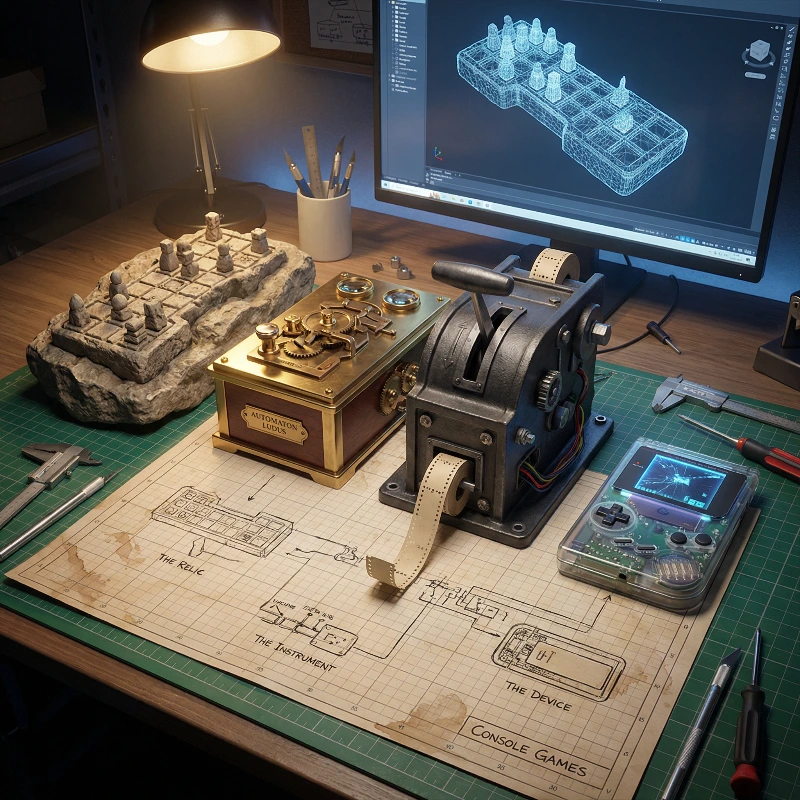
Console Tech Evolution
Input A = Console games <instruction> Input A is a Core Technological Function (e.g., Computing, Navigation, Music, Communication). Deconstruct the function into 4 Chronological Artifacts: The Relic (Ancient): Identify the stone or bronze age precursor. (e.g., Computing -> Antikythera Mechanism/Abacus. Navigation -> Lodestone/Sundial). The Instrument (Classical): Identify the brass and wood scientific instrument. (e.g., Computing -> Pascaline. Navigation -> Sextant/Astrolabe). The Machine (Industrial): Identify the steam/steel era mechanism. (e.g., Computing -> Difference Engine/Punch Card Machine. Navigation -> Gyrocompass). The Device (Modern): Identify the current digital interface. (e.g., Computing -> Tablet/Smartphone. Navigation -> GPS Unit). 2. Container Goal: "Tech History" Workbench Photography. Setting: A cluttered Green Cutting Mat on a sturdy wooden workshop table. Background: A computer monitor displays the CAD Wireframe/3D Scan of the "Relic" or "Instrument," implying a restoration or study project. Tools: Calipers, X-Acto knives, and screwdrivers are scattered around the objects. 3. Lineup (The Artifacts): Arrangement: The four objects are arranged left-to-right (Oldest to Newest). Object 1 (Relic): Heavily damaged, calcified, or encased in rock. Looks like an archaeological find. Object 2 (Instrument): Polished Brass and Mahogany. intricate gears and lenses. Object 3 (Machine): Cast Iron, heavy bolts, punch cards, or paper tape. Object 4 (Device): Sleek glass and aluminum. The screen is cracked or the casing is transparent, revealing the circuitry inside. 4. Blueprint (The Connection): The Drawing: A large, coffee-stained Schematic Grid Paper lies flat under the objects. The Content: Hand-drawn diagrams connect the mechanical logic of the Ancient Relic to the circuit logic of the Modern Device. 5. Lighting & Atmosphere: Lighting: Mixed Lighting. A warm, articulated desk lamp illuminates the physical objects, while the cool blue light from the monitor washes over the back wall. Vibe: Intellectual, inquisitive, and tactile. Output: ONE image, 1:1 Aspect Ratio, 3D Render, "Maker Space" aesthetic, High Texture Fidelity. </instruction>
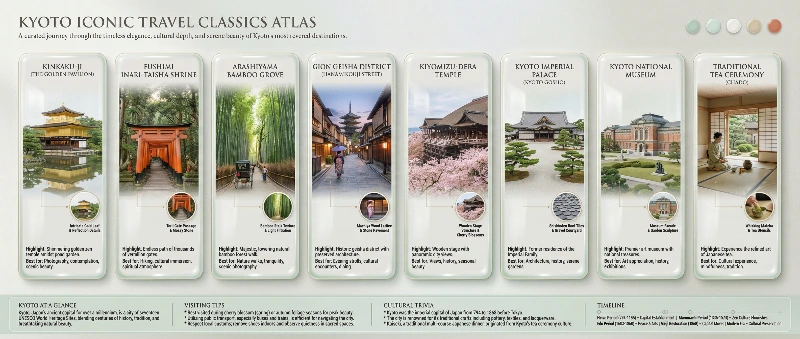
Kyoto Iconic Travel Atlas
Create an ultra-wide infographic poster titled “Kyoto Iconic Travel Classics Atlas”, with a 21:9 horizontal layout in true 8K resolution. The visual language blends ceramic glaze and jade-like softness, expressing calm luxury, precision, and cultural depth. The overall mood is restrained, warm, and translucent—evoking the feeling of a museum-grade exhibition combined with refined cultural branding. All on-image text is in English. Background and overall material tone * Background features a light rice-white to misty off-white gradient, similar to a high-end ceramic exhibition space * Global lighting is gentle and diffused: soft HDRI illumination with subtle rim light, avoiding harsh contrast or strong shadows * Color palette centers on jade white, pale celadon, soft moss green, warm beige, with minimal accents of vermilion or muted gold (no more than 3–4 dominant hues across the entire image) Layout: eight equal-width “ceramic/jade plaques” (strictly eight columns) * The central composition uses a strict eight-column grid, each column designed as a ceramic-style information plaque * Plaque material resembles fine white porcelain glaze: rounded corners, smooth highlights, subtle reflective sheen, clean edges * Borders may include an extremely delicate gold trace or jade-edge effect, applied with restraint * Shadows are soft and shallow, as if the plaques are placed on a curated museum display surface Core visuals: realistic 3D landmarks (PBR) with a serene glazed aesthetic * Each column top features one real, iconic Kyoto landmark (automatically select eight authentic sites, no fictional entries) * Use realistic 3D environment rendering with physically based materials, while maintaining a calm, jade-like visual softness * Materials must follow real-world physical rules: wood, stone, tile, water, foliage, and paper surfaces rendered with accurate PBR properties * Unified color grading: soft highlights, moderate contrast, low saturation, and gentle warmth inspired by ceramic glaze and polished jade * Composition emphasizes depth and quiet grandeur through layered space and subtle scale references (small figures, lanterns, trees) * Water elements (rivers, ponds, moats) should display delicate reflections and smooth tonal transitions * Avoid cartoon styles, low-poly geometry, plastic textures, excessive sharpness, or dramatic cinematic lighting Detail view: glazed “micro dish” or “jade charm” window * Each column includes one small detail window in the lower-right corner, using a single consistent shape across all columns * Option A: a small circular dish resembling a porcelain saucer, showcasing fine details (wood grain, roof tiles, stone steps, garden gravel, water ripples) * Option B: a jade-charm-shaped window with rounded contours, highlighting close-up textures and materials * Surfaces should exhibit soft glaze or jade-like highlights with smooth, rounded edges * A thin, elegant leader line connects the detail window to the main 3D landmark, accompanied by a concise 2–6 word label Text per column (concise, refined, understated) * Landmark name (4–8 English words, refined serif typeface recommended) * Two short informational lines: * Highlight: maximum 8 words * Best for: maximum 6 words * Text color uses ink gray or bluish charcoal; accent colors appear only in small dots or separators Top title area (museum exhibit label style) * Main title: Kyoto Iconic Travel Classics Atlas * Subtitle: one refined positioning sentence, maximum 18 words, calm and poetic in tone * Top-right corner includes five small glazed color dots: pale celadon, jade white, moon white, warm beige, with a subtle vermilion accent Bottom information band (exhibition caption style) * A full-width bottom band divided into four sections by fine lines, resembling museum display captions * Kyoto at a glance: one sentence, maximum 22 words * Visiting tips: three bullet points, each no more than 12 words * Cultural trivia: three items, each no more than 18 words * Timeline: 3–6 key nodes (era or year plus keyword), connected with minimal linear icons using thin, consistent strokes Automatic landmark selection rules * Cover at least five categories: natural scenery, historical temples or shrines, traditional architecture, museums or cultural institutions, classic streets or seasonal night scenes, and intangible cultural experiences (tea ceremony, festivals, crafts) * If necessary, fill gaps with safe, general entries such as “Kyoto National Museum” or “Historic Gion District” * All landmark names must be real and verifiable; if uncertain, use conservative generic naming and never fabricate locations Output constraints * English text only * Strong alignment, minimalist spacing, generous white space * No logos, no branding marks, no watermarks * True 8K ultra-high resolution, suitable for cultural tourism displays and horizontal social media covers