
This article is part of our collection at Banana Prompts, where you can explore high-quality Nano Banana prompts.
The Philosophy of Less
The core premise of Nano Banana Pro is that the model should understand the world, not just the pixels. When a user prompts "A coffee cup on a table," a simple diffusion model sees a request for shapes resembling a cup and a table. It does not inherently understand gravity, ceramic textures, or the way light refracts through steam. The user must provide those details.
Nano Banana Pro, however, integrates a large language model (LLM) backbone directly into the image generation pipeline. It possesses "world knowledge." It reasons that coffee is hot, therefore there might be steam. It reasons that a table in a morning setting (implied by coffee) likely has side-lighting. This shift from pattern matching to semantic reasoning means the user no longer needs to describe the physics of the scene—they only need to direct the action.

The Legacy of Noise: Why Legacy Models Demanded Verbosity
To understand the power of Nano Banana Pro’s minimalism, one must first dissect the architecture of its predecessors, particularly models like MidJourney (v5/v6) and early Stable Diffusion. These models established the "verbose" standard that many users still instinctively follow.
The CLIP Bottleneck and Token Salad
Legacy models primarily utilized CLIP (Contrastive Language-Image Pre-training) text encoders. CLIP was revolutionary, but it functioned largely as a "bag-of-words" processor. It struggled with syntax, grammar, and complex relationships.
The Associative Trap: If a user prompted "A horse riding an astronaut," CLIP models would often generate a horse and an astronaut, but fail to understand the relationship "riding." They might merge them into a centaur or place them side-by-side.
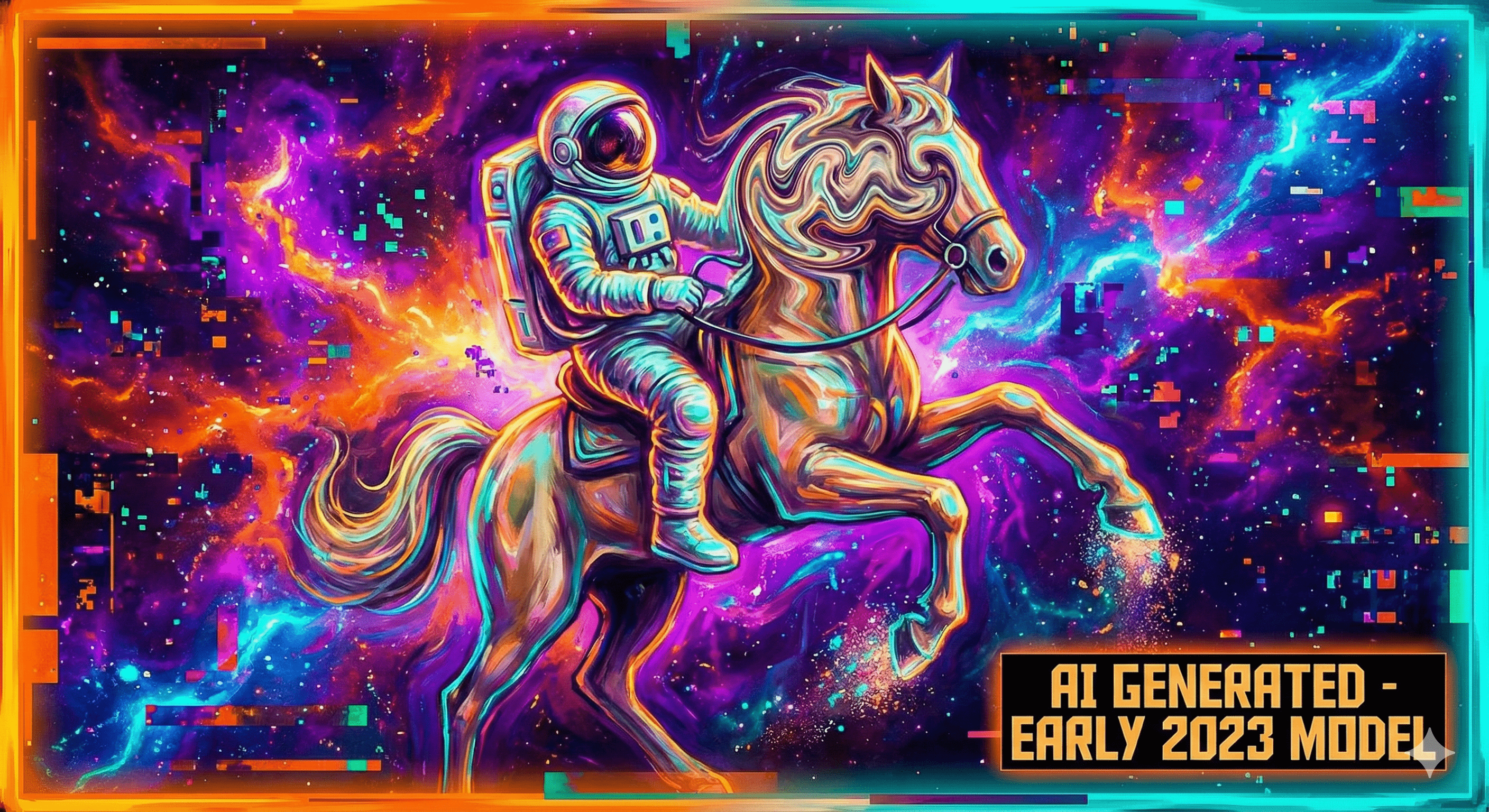
The Weighting Game: To compensate, users learned to repeat words or use weighting syntax (e.g., (astronaut:1.5)). They had to "shout" at the model mathematically to get it to pay attention.
Aesthetic Steering: Without a strong internal concept of "quality," these models tended toward the statistical average of the internet—often low-resolution or watermark-heavy. Users had to append "4k, trending on ArtStation, masterpiece, award-winning" to force the model toward the high-quality clusters of its latent space.
MidJourney and the "House Style" Bias
MidJourney gained dominance by overfitting on a specific "house style"—highly contrasted, artistically rendered, and cinematically lit. While beautiful, this created a new problem: the "MidJourney Look."
To break away from this default aesthetic, users had to use massive prompt structures.
Verbosity as a Constraint: In MidJourney, brevity often resulted in the model taking creative liberties. A short prompt for "a woman" might result in a stylized fantasy character. To get a real photo, the user had to list camera models, lenses, film stocks, and lighting setups. The prompt became a cage to trap the model into realism.
Negative Prompting: Users had to explicitly list what they didn't want (e.g., --no cartoon, illustration, painting, drawing, sketch). This is "sculpting by subtraction," a tedious process that bloats the metadata of an image.
The Architecture of Reasoning: Nano Banana Pro’s "Thinking" Engine
Nano Banana Pro breaks the reliance on verbosity through what Google DeepMind refers to as a "Reasoning" engine. This is not merely a marketing term; it describes a fundamental change in the generation workflow.
The Pre-Generation Planning Phase
When a minimal prompt is entered into Nano Banana Pro, the model does not immediately begin denoising pixels. It first passes the text through a massive Large Language Model (Gemini 3 Pro). This LLM acts as a "Director of Photography."
Inference of the Unsaid: If the prompt is "A busy Tokyo street in the rain," the LLM infers the following scene graph nodes:
- Lighting: Neon signs reflecting on wet pavement (implied by "Tokyo" + "Rain")
- Crowd: Many people holding umbrellas (implied by "Busy" + "Rain")
- Atmosphere: Mist, humidity, blue/cyan color cast (implied by "Rain")
Physics Simulation: The model calculates the interactions. It knows that rain creates puddles, and puddles create reflections. It ensures that the reflections match the light sources.
Semantic Attention and Syntax
Nano Banana Pro understands grammar. The preposition "on" in "A cat on a mat" is treated as a spatial instruction, not just a keyword. This allows for complex compositions without complex descriptions.
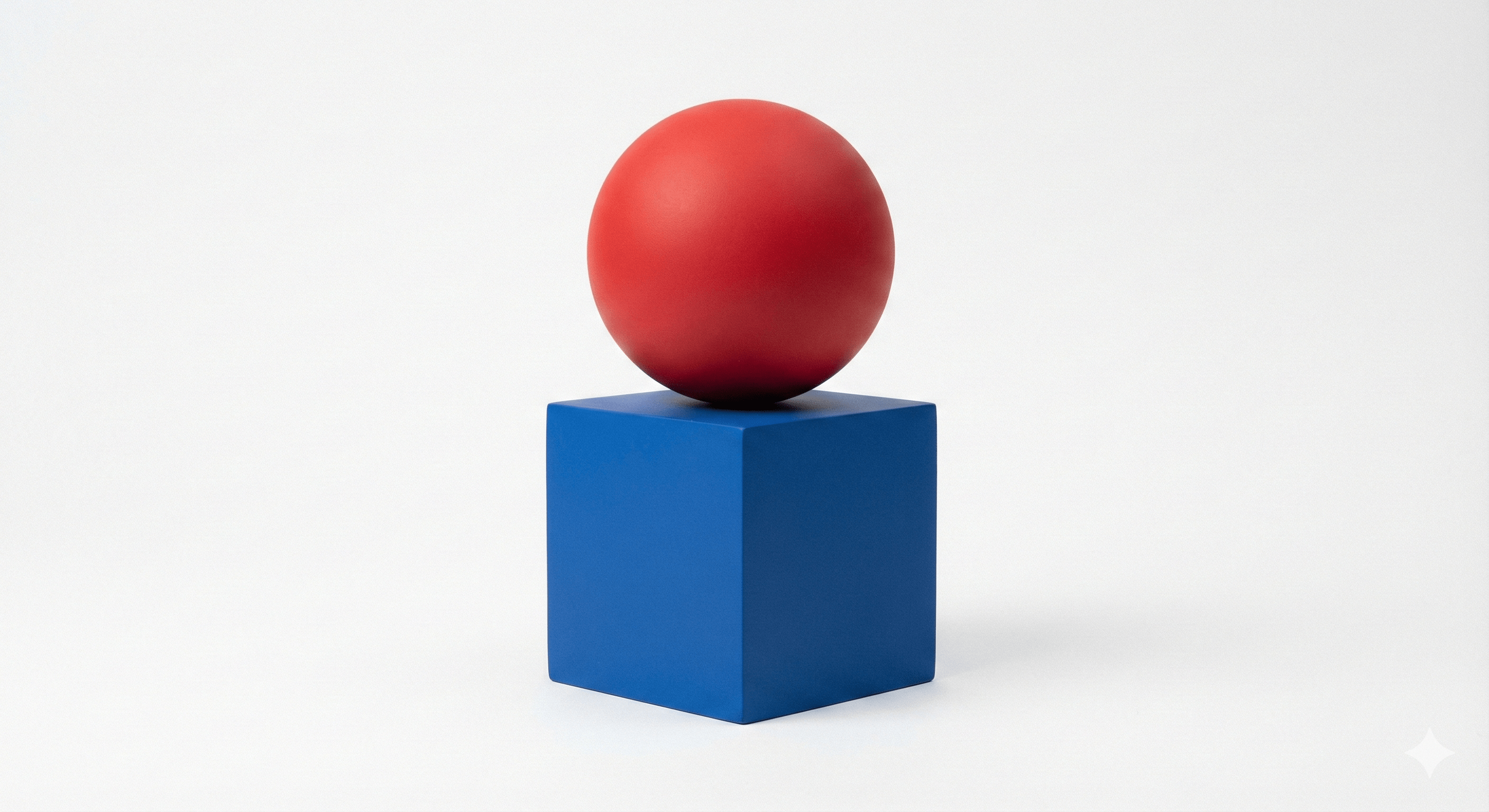
The "Red Ball" Test: In early AI, asking for "A red ball on a blue box" often resulted in a purple ball or a red box (color bleed). Nano Banana Pro’s attention mechanisms are semantically bound. It isolates the object "ball" and assigns the attribute "red" to it specifically, preventing leakage to the "box."
Text and Data as Visual Elements
One of the most striking capabilities of this architecture is its ability to treat text as a visual element. Because the model "knows" what letters look like and how they function in design, minimal prompts can generate infographics and posters.
The Mechanism: The model plans the layout, reserving specific pixel coordinates for the text string before generating the background texture. This prevents the "spaghetti text" common in MidJourney.
Implication for Minimalism: A prompt like "A sign that says 'OPEN'" is sufficient. You do not need to specify "white letters, bold font, legible, clear text, no typos." The model assumes legibility is the intent.
Inference Style: The Aesthetic of Truth
When you type a minimal prompt, you are effectively defaulting to the model's base training bias. Understanding Nano Banana Pro’s specific inference style—its "default mode"—is crucial for mastering minimal prompting.
Composition: The "Documentary" Standard
Nano Banana Pro biases heavily toward Documentary Realism.
Framing: Unless instructed otherwise, it defaults to eye-level, medium shots that clearly display the subject. It mimics the composition of high-end editorial stock photography or photojournalism.
Stability: It avoids the "Dutch angles" (tilted camera) or extreme fish-eye distortions that artistic models often employ to create false drama.
Lighting: Context-Aware Illumination
Lighting in Nano Banana Pro is inferred from the environment described in the prompt.
Contextual Logic:
- Prompt: "A sunny beach." -> Inference: Harsh, high-contrast sunlight, sharp shadows
- Prompt: "A cozy library." -> Inference: Soft, warm, diffused indoor lighting, likely from lamps or windows
- Prompt: "A cybercafe." -> Inference: Cool, neon, directional lighting
Color: Neutrality and Dynamic Range
MidJourney V6 is known for a "teal and orange" bias—a cinematic color grade that makes everything look like a movie poster. Nano Banana Pro, by contrast, targets a Neutral White Balance.
Fidelity: Colors are rendered as they appear in reality, not as they appear in post-production. Skin tones are varied and textured, not uniformly golden.
Editability: This neutral output is actually preferred by professionals because it provides a "clean plate" for editing.
Comparative Case Studies: From Messy to Minimal
To demonstrate the efficacy of the minimalist approach, we analyze three scenarios where "Pro" workflows outperform the "Engineer" workflows.
Case Study A: The Environmental Portrait
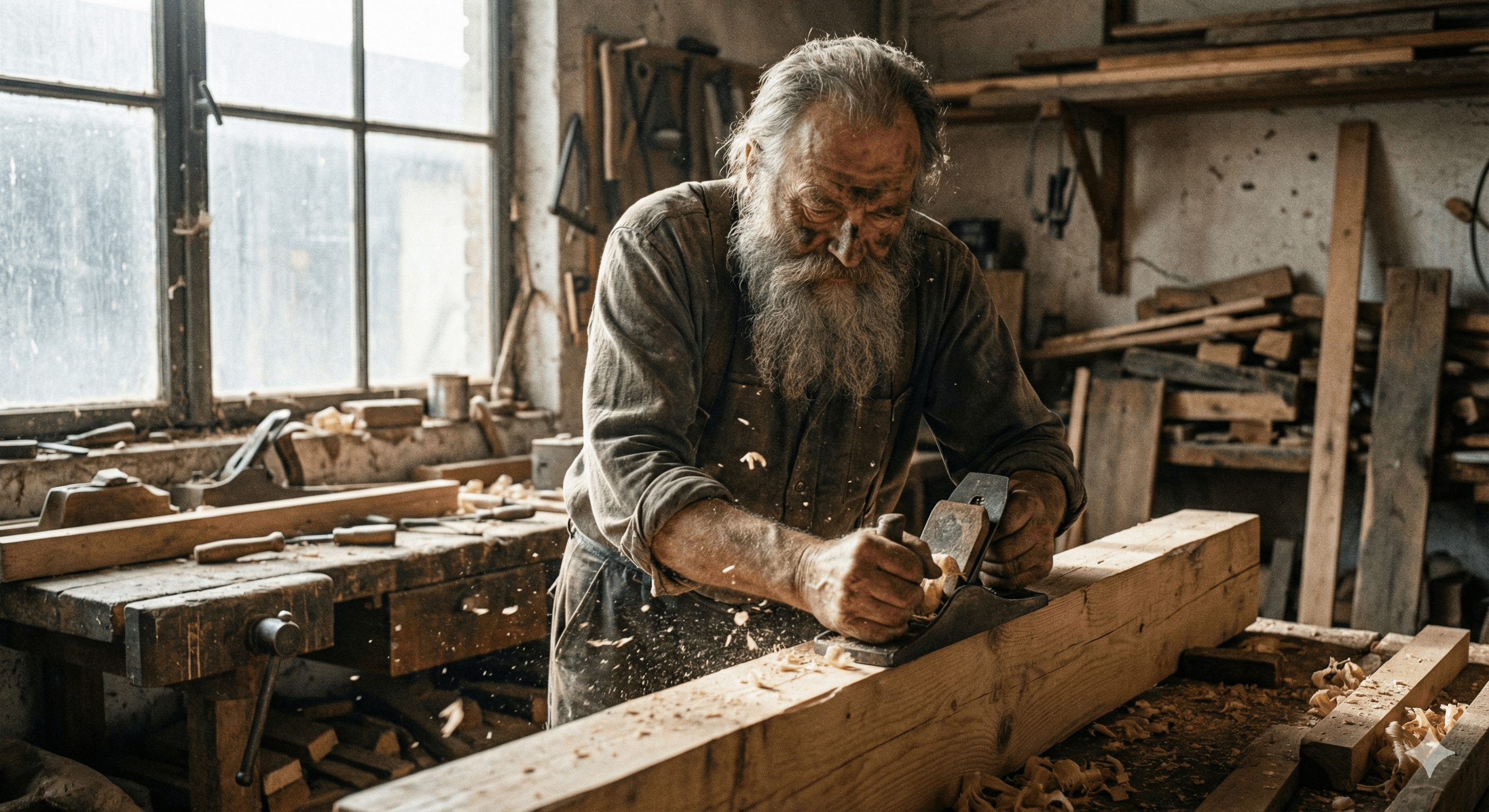
Goal: A realistic portrait of an elderly man in a workshop.
The Messy Prompt (Legacy Style): "Portrait of an old man, 80 years old, wrinkles, highly detailed face, beard, carpenter workshop background, wood shavings, dust motes, cinematic lighting, rim light, volumetric fog, 8k, unreal engine 5, octane render, sharp focus, canon 5d mark iv, 85mm f1.2 lens, hyperrealistic, masterpiece, trending on artstation, no blur."
The Failure: The token "Unreal Engine 5" conflicts with "Canon 5D," causing the skin to look waxy or digital. The "rim light" and "volumetric fog" overwhelm the scene.
The Minimal Prompt (Nano Banana Pro): "A candid photograph of an elderly carpenter working in his dusty workshop. Natural window light."
The Success:
- "Candid": Tells the reasoning engine to pose the subject naturally
- "Carpenter": Semantically pulls in the wood shavings, tools, and apron
- "Dusty": Handles the atmosphere physically, placing dust in the air shafts
- "Natural window light": Creates a specific, realistic lighting setup
Case Study B: The Product Visualization
Goal: A clean, modern image of a skincare bottle.
The Messy Prompt (Legacy Style): "Skincare bottle, white lotion, pump bottle, luxury, gold accents, splashing water, water droplets, condensation, wet, studio setup, softbox, white background, isolation, product photography, commercial, 4k, high fidelity, shiny, reflective, raytracing, global illumination."
The Failure: The model hallucinates aggressive water splashes that obscure the product. "Luxury" might add gold filigree that isn't part of the brand design.
The Minimal Prompt (Nano Banana Pro): "A minimalist product shot of a white lotion bottle with gold accents on a white seamless background. Soft studio lighting."
The Success:
- "Seamless background": A specific photography term (infinity curve) that Nano understands
- "Minimalist": Instructs the model to remove clutter and focus on geometry
- Logic: The model knows a "lotion bottle" implies a smooth texture
Case Study C: The Fantasy Landscape
Goal: A mystical stone tower on a mountain.
The Messy Prompt (Legacy Style): "Epic tower, lord of the rings style, dark souls vibes, scary, massive, clouds, lightning, storm, grey, stone, rubble, hyper-detailed, matte painting, concept art, greg rutkowski, artgerm, volumetric fog, god rays, ominous, dystopian, ruin."
The Failure: The "Greg Rutkowski" and "Artgerm" tokens clash. The result is a "muddy" composition with inconsistent texture.
The Minimal Prompt (Nano Banana Pro): "A stone watchtower perched on a jagged mountain peak during a thunderstorm. Cinematic wide shot."
The Success:
- "Watchtower": Defines the architecture (tall, narrow, fortified)
- "Perched": Defines the physics relation to the mountain
- "Thunderstorm": Semantically loads the grey palette, lightning, and dramatic mood
- "Cinematic wide shot": Sets the camera distance and aspect ratio
Minimal Prompt Rules That Always Help
Based on the analysis, here is the definitive rulebook for interacting with Nano Banana Pro:
-
Subject First, Modifiers Second
- Always start with the noun. The model prioritizes the first 5 words.
- Bad: "A cool, amazing, dark, moody picture of a car."
- Good: "A black sports car on a rainy street."
-
Define the Medium Explicitly
- Don't let the model guess if it's a photo or a painting.
- Use: "A photograph of...", "A 3D render of...", "A flat vector illustration of..."
-
Use "Camera" Language for Realism
- Nano Banana Pro understands photography lenses.
- Keywords: "Macro" (close up), "Wide angle" (landscape), "Telephoto" (portrait), "f/1.8" (bokeh)
-
Lighting is a Location, Not an Adjective
- Describe the source of the light.
- Bad: "Good lighting."
- Good: "Golden hour", "Overhead fluorescent", "Neon signage", "Window light"
-
Trust the Semantic Load of Nouns
- You don't need to describe the components of a known object.
- Bad: "A library with lots of books on shelves and tables and chairs and lamps."
- Good: "A cluttered academic library."
-
Text in Quotes
- If you want text, use double quotes.
- Rule: "A sign reading 'BANANA'."
- Tip: Specify the font vibe: "A sign reading 'BANANA' in bold sans-serif font."
-
Edit, Don't Re-roll
- Nano Banana Pro supports conversational editing.
- Workflow: Generate -> "Make it night time" -> "Add a cat."
Advanced Applications of Minimalism
Minimalism is not just for simple images; it is actually more critical for advanced, complex tasks where "messy" prompts cause model failure.
The Infographic Revolution
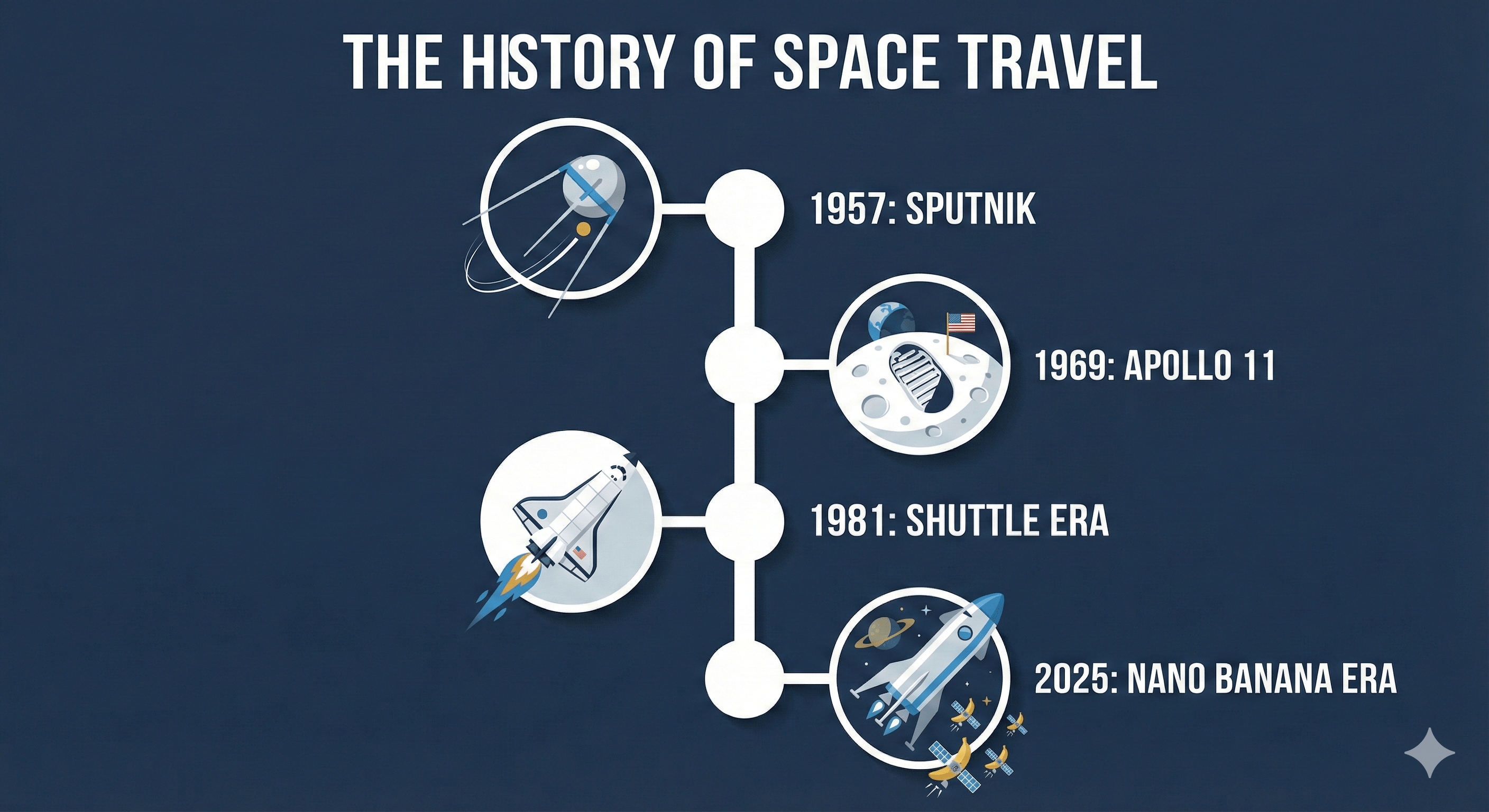
One of Nano Banana Pro's standout features is its ability to generate readable, structured data visualizations.
The Prompt: "A vertical timeline infographic of the history of space travel. Flat vector style."
The Logic: The model uses its internal knowledge base to populate the timeline with relevant eras (Sputnik, Apollo, Shuttle, SpaceX). It handles the layout automatically.
Character Consistency via "Few-Shot" Context
For storytellers, consistency is the holy grail. Nano Banana Pro allows for "Identity Locking" through reference images.
The Workflow: Upload a reference image of a character. The Prompt: "The character sitting in a coffee shop."
Why Minimal: You do not need to re-describe the character. The model uses the reference as the "ground truth" and the prompt purely for context.
High-Fidelity Text Rendering
Nano Banana Pro excels at text integration.
Use Case: Logo design and Typography. The Prompt: "A minimalist logo for a juice brand named 'Zest'. Vector style."
The Result: The model understands that "Logo" implies a vector graphic. It renders the word "Zest" clearly and likely infers citrus imagery associated with the word.
Why This Matters for BananaPrompts.fun
BananaPrompts.fun is built on the ethos of simplicity. The arrival of Nano Banana Pro validates this philosophy technically.
The User Experience of "Fun"
Complex prompting is not fun; it is work. It requires studying syntax and memorizing keywords. Minimal prompting returns the "fun" to the process. It allows the user to be a Creative Director rather than a syntax technician.
SEO and Shareability
From a platform perspective, minimal prompts are superior assets.
Readability: Users can scan a list of 10-word prompts and immediately understand the intent. Search: Natural language prompts align better with how people search the web. Remixability: It is easier to modify a short prompt.
Conclusion: The Art of Direction
The evolution from Nano Banana to Nano Banana Pro is more than a software update; it is a fundamental shift in the human-AI relationship. We have graduated from the era of "glitch art" and "prompt hacking" into the era of Semantic Directing.
For the community at BananaPrompts.fun, the message is clear: Stop fighting the model. Stop trying to overload the buffer with keywords. Trust the reasoning engine. The model has read the entire internet; it knows what a "sunset" looks like.
The most powerful prompt in 2025 is not the longest; it is the most precise. By stripping away the noise and focusing on Subject, Context, and Light, creators can unlock the true potential of Nano Banana Pro—generating masterpieces not through the brute force of vocabulary, but through the elegance of intent.
Final Takeaway Checklist for the Modern Creator
- Logic > Noise: Does the scene make sense physically? If yes, the model will render it well.
- Natural Language: Write like you are talking to a human artist.
- Default to Real: Assume the model will be photorealistic unless told otherwise.
- Edit, Don't Re-roll: Iterate on the idea, not the random seed.
Explore more high-quality Nano Banana prompts at Banana Prompts.