Browse and filter our curated collection of prompts
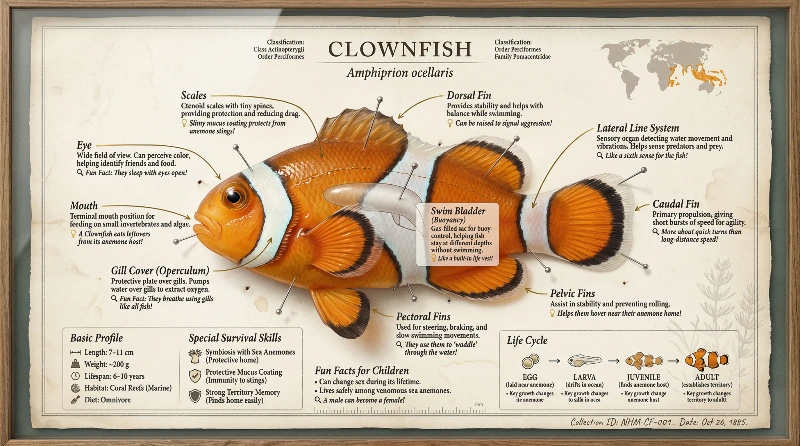
Create a museum-exhibit–grade educational fish infographic, focused on a Clownfish (Amphiprioninae). Core layout Center: a large clownfish specimen occupying 60–70% of the canvas. Surroundings: scientific annotations and fun educational facts arranged radially or in clearly separated sections. Overall feel: like a labeled fish specimen displayed inside a museum glass showcase. Fish specimen presentation (critical requirements) Physical realism: the fish specimen is physically placed flat on paper, not a photo within a photo, but a real tangible specimen. Viewpoint: strict top-down vertical view; fish and paper exist on the same physical plane. Lighting: soft natural overhead light; the fish casts delicate, realistic shadows onto the paper. Fixation method (natural history style): thin silver metal specimen pins or fine wires fix the fish to the paper; pins pass through key anatomical points such as the dorsal area or fin base; pin tips slightly pierce the paper; visible tiny pinholes and subtle paper indentations. Texture and detail: clearly visible scale arrangement and reflective highlights; semi-transparent fin membranes; layered structure of the gill cover; moist reflective shine in the eye; subtle thickness and dimensionality along the body edge; fins may be gently spread but never exaggerated. Proportion: the fish occupies about 60–70% of the paper surface, with surrounding negative space reserved for annotations. Natural state: relaxed, natural posture with a static real-specimen feeling, not a swimming pose. Annotation system design Use thin leader lines extending from anatomical structures to text boxes. Leader lines appear hand-drawn or printed directly on the paper. Required labeled body parts (6–8 total) Head Eye: field of view and whether it can perceive color. Mouth: terminal mouth type and relation to feeding habits. Gill cover (operculum): explanation of how oxygen is extracted from water. Body Scales: ctenoid scales, their protective function and drag reduction. Lateral line system: sensory organ for detecting water movement and vibration. Fin system Dorsal fin: balance. Pectoral fins: steering and braking. Pelvic fins: stability. Caudal fin: primary propulsion, with notes on agility rather than speed. Internal or special structure (visualized) Swim bladder: buoyancy control, or bony skeleton structure adapted to reef environments. Signature features Bright orange body with white vertical bands. Thick mucus layer protecting it from sea anemone stings. Adaptation to coral reef symbiosis. Information card content for each annotation Part name in English. One to two child-friendly functional explanations. A fun fact or trivia element marked with a magnifying glass or light-bulb icon. Additional page elements Top area Common name: Clownfish. Scientific name: Amphiprion ocellaris in italic. Classification: Class Actinopterygii, Order Perciformes, Family Pomacentridae. Distribution map icon showing a world map with Indo-Pacific coral reef regions highlighted. Bottom or side information panel Basic profile: length 7–11 cm; weight about 200 g; lifespan 6–10 years; habitat coral reefs (marine); diet omnivore. Special survival skills: symbiosis with sea anemones, protective mucus coating, strong territory memory, shown with icons and short explanations. Fun facts for children: can change sex during its lifetime; lives safely among venomous sea anemones. Life cycle diagram: egg → larva → juvenile → adult, with key growth changes labeled. Design aesthetics in natural history style Paper texture: ivory or off-white premium paper, color #F8F6F0 or #FFFEF7, visible paper fibers, optional subtle vintage wear. Spatial relationship: fish specimen is a real physical object on the paper; fixation pins or wires have silver metallic texture; text is printed or handwritten directly on the same paper; leader lines are thin pen-drawn strokes. Color scheme: paper background #F8F6F0 or #FFFEF7; annotation text #2C3E50; leader lines #8B7355 or #696969; emphasis markers #D4AF37; specimen pins #C0C0C0. Typography: title in an elegant printed or handwritten serif style such as Garamond; scientific name italicized; annotations in a clear small handwritten or printed style. Overall impression Like a 19th-century naturalist’s specimen sheet, personally annotated on a workbench. Optional decorative elements Thin corner frame lines; a millimeter ruler aligned with the fish; handwritten collection ID and date; a very faint aquatic plant watermark silhouette. Critical visual rules Do not place a photo of a fish into the image. The fish specimen itself must be physically on the paper. The entire scene is one flat specimen sheet viewed from above, as if looking down at a naturalist’s desk. Image specifications Aspect ratio 16:9 (landscape) or 3:4 (portrait). Resolution 300 DPI, suitable for A3 or A2 printing. Format high-quality PNG. Scientific accuracy requirements Realistic clownfish proportions. Correct anatomical terminology. Child-friendly descriptions that remain scientifically accurate.
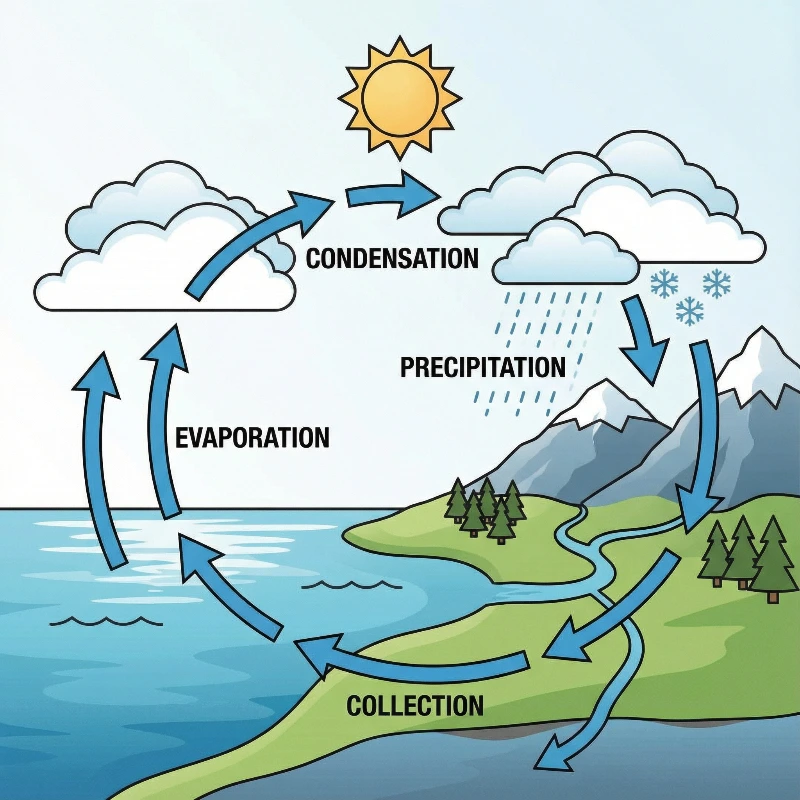
"Water Cycle" diagram. Evaporation, Condensation arrows. Clean vector.
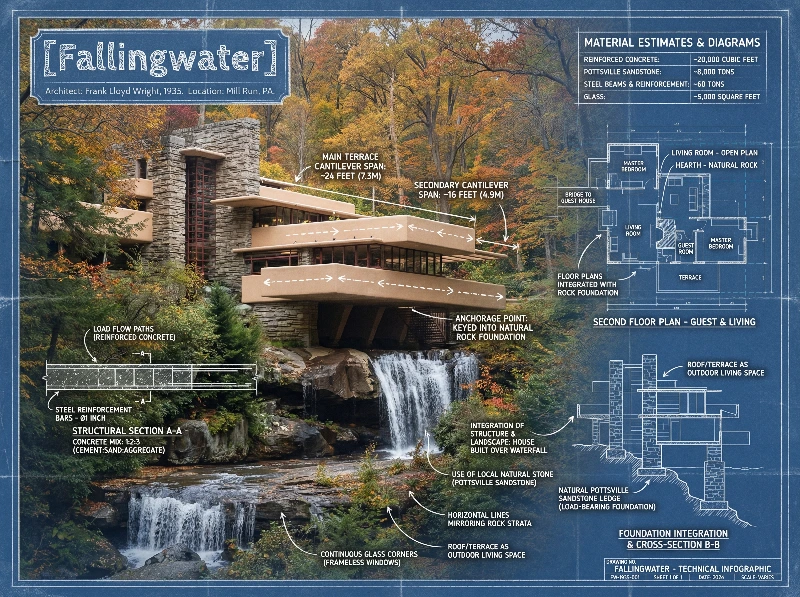
Create an infographic image of [Fallingwater by Frank Lloyd Wright], combining a real photograph of the landmark with blueprint-style technical annotations and diagrams overlaid on the image. Include the title “[Fallingwater]” in a hand-drawn box in the corner. Add white chalk-style sketches showing key structural data, cantilever span measurements, material quantities, internal diagrams of living spaces, load-flow arrows through reinforced concrete slabs, cross-sections of the cantilevers, floor plans integrated with the rock foundation, and notable architectural or engineering features such as the integration of structure, landscape, and natural stone. Style: blueprint aesthetic with white line drawings on the photograph, technical/architectural annotation style, educational infographic feel, with the real environment visible behind the annotations.
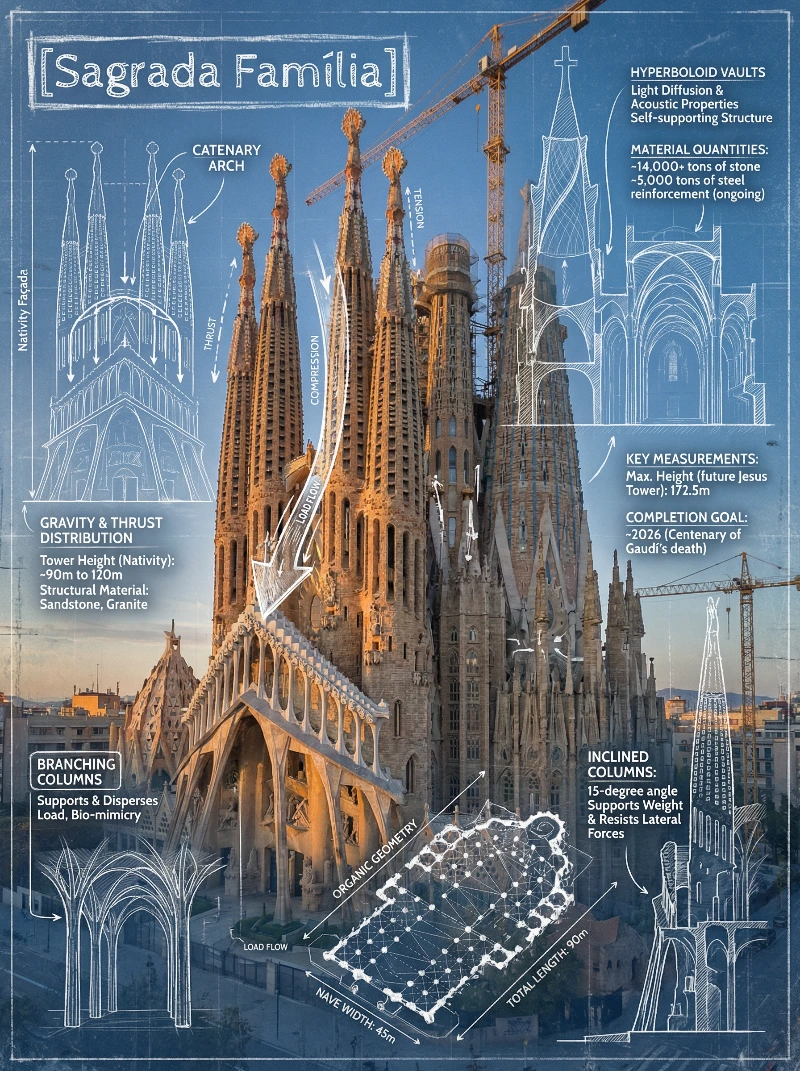
Create an infographic image of [Sagrada Família, Barcelona], combining a real photograph of the landmark with blueprint-style technical annotations and diagrams overlaid on the image. Include the title “[Sagrada Família]” in a hand-drawn box in the corner. Add white chalk-style sketches showing key structural data, important measurements, material quantities, internal diagrams, load-flow arrows illustrating gravity and thrust through catenary arches, cross-sections of the towers, floor plans of the basilica, and notable architectural or engineering features such as hyperboloid vaults, branching columns, and organic geometry. Style: blueprint aesthetic with white line drawings on the photograph, technical/architectural annotation style, educational infographic feel, with the real environment visible behind the annotations.