
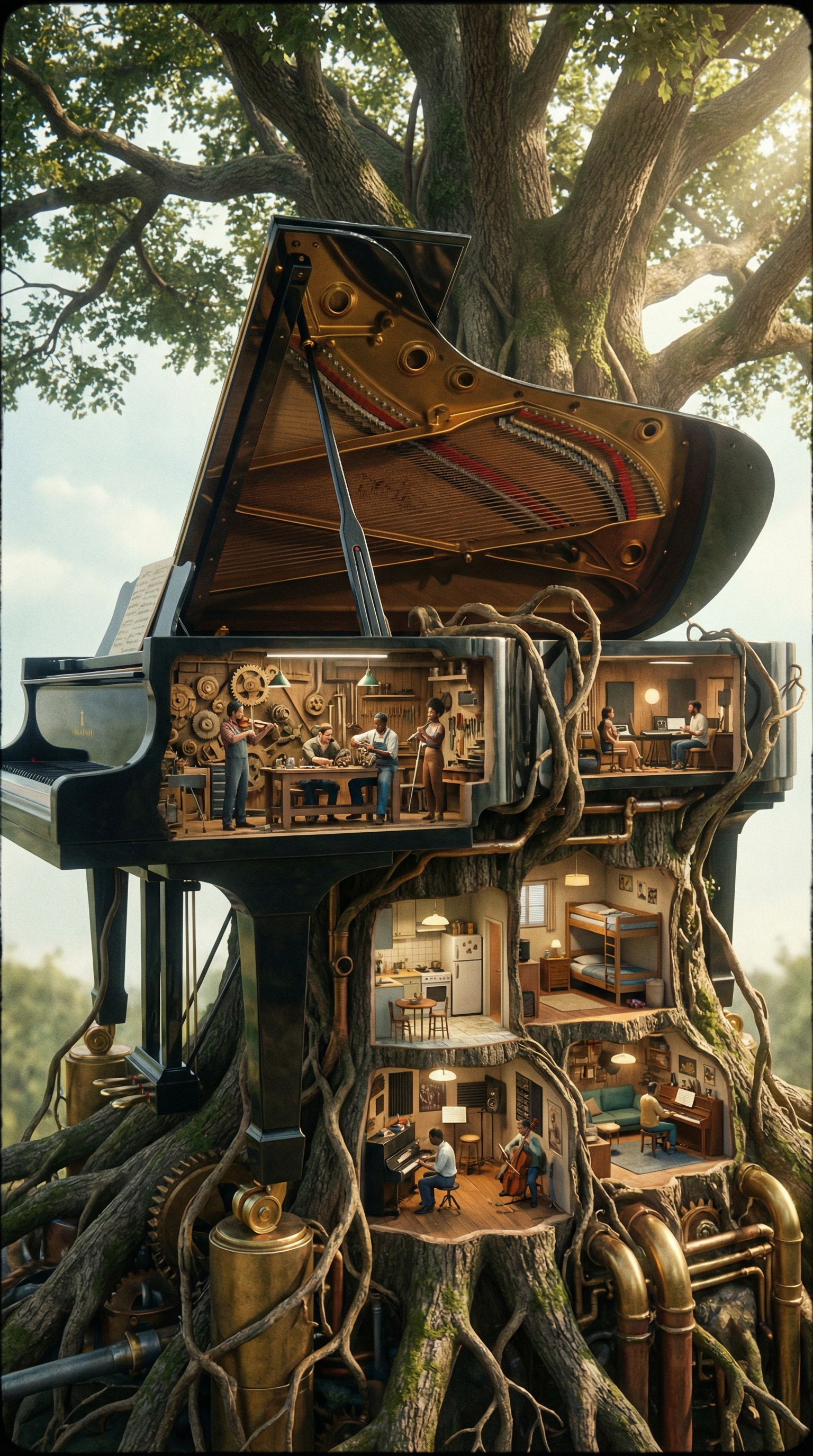
Cinematic Tree-Piano Fusion
Prompt
Real-life cinematic photograph of a giant [mechanical grand piano] fused with a living tree, vertical cross-section diorama style revealing interior living/working spaces, real human beings (diverse adult [musicians and piano technicians])
Aspect Ratio
Source
@servasyy_aiModel
Nano Banana ProYou might also like
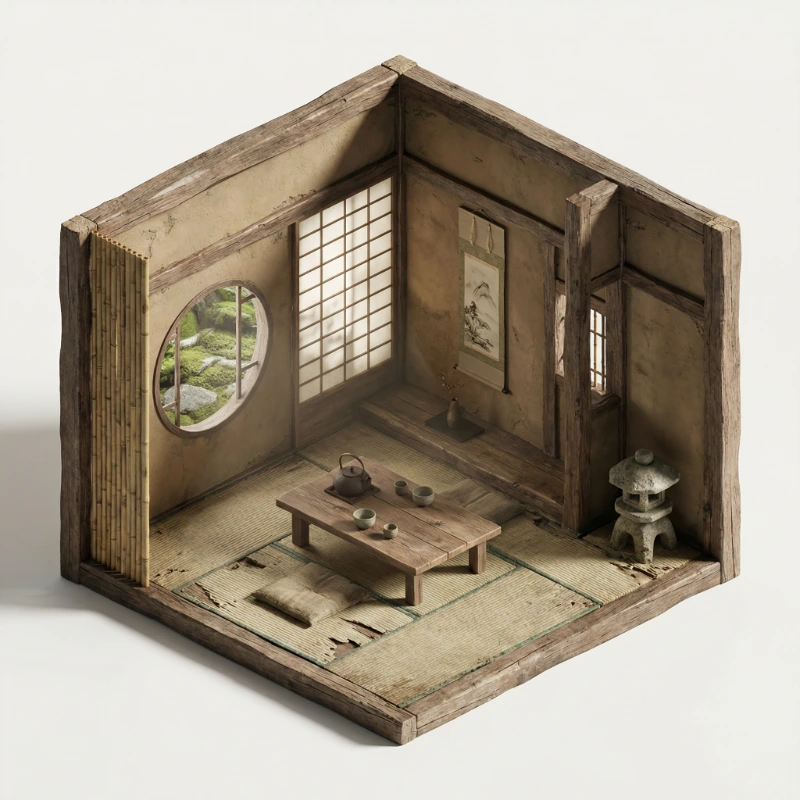
Isometric Wabi-Sabi Tea Room
Create a highly detailed isometric 3D interior diorama of a (Japanese wabi-sabi) (traditional tea room) Design the space with coherent architecture, furniture, lighting, materials, and decoration that naturally match the chosen concept. Use realistic textures, soft natural daylight, gentle shadows, and a calm minimal white background. Perspective: isometric cutaway diorama. Ultra high detail, premium interior visualization, soft global illumination.
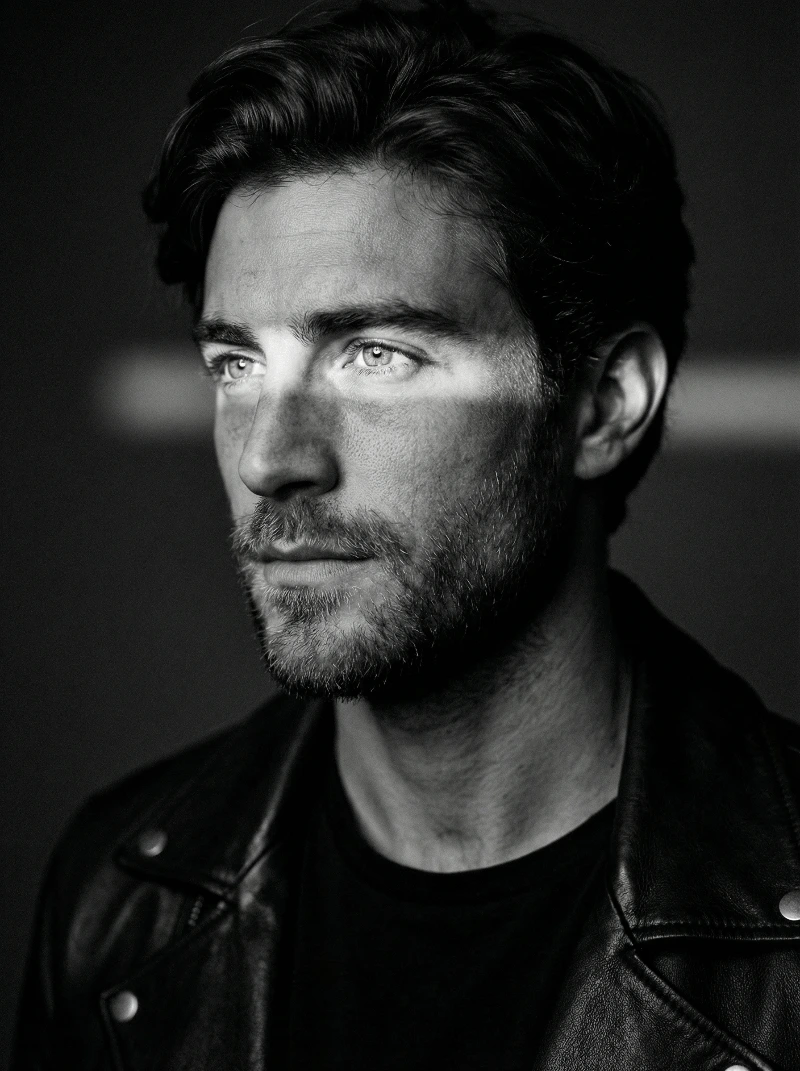
Cinematic Noir B&W Portrait
A hyper-realistic black-and-white cinematic portrait of a male model in a three-quarter profile pose, head slightly turned to the side, with a calm yet intense expression. A narrow horizontal band of soft white light passes cleanly across both eyes, illuminating only the eye area while the rest of the face falls into deep shadow. The light is sharp-edged yet diffused, creating a striking eye highlight and dramatic contrast. Wearing a black leather jacket over a dark crew-neck t-shirt. Dark minimal studio background, low-key lighting, cinematic noir mood. Natural skin texture with visible pores, realistic facial structure, shallow depth of field, subtle film grain, high contrast monochrome tones, professional fashion editorial photography, ultra-HD, 8K resolution, photorealistic, razor-sharp focus. Create a HD photo
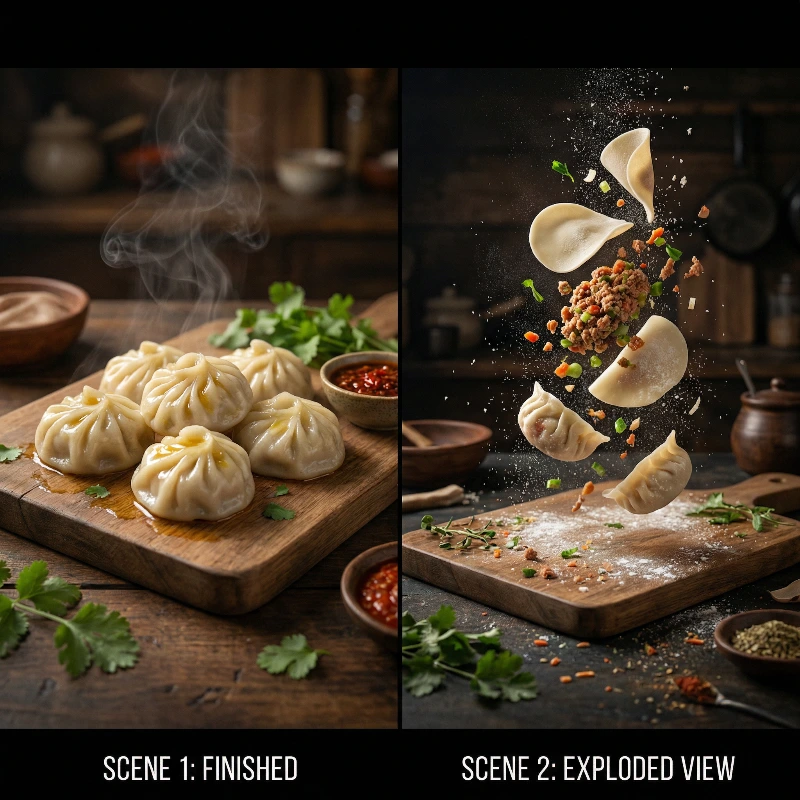
Cinematic Momo Food Art
Ultra-realistic cinematic food photography of freshly steamed dumplings (momos) on a rustic wooden board. One scene shows finished dumplings with glossy dough, delicate pleats, light oil sheen, and steam rising. Another scene shows an exploded view: dumpling wrappers and spiced minced filling floating mid-air, flour particles frozen in motion, herbs scattered, dramatic slow-motion effect. Warm moody lighting, shallow depth of field, dark rustic kitchen background, professional studio food styling, hyper-detailed textures, cinematic realism, 8K, macro photography, high contrast.
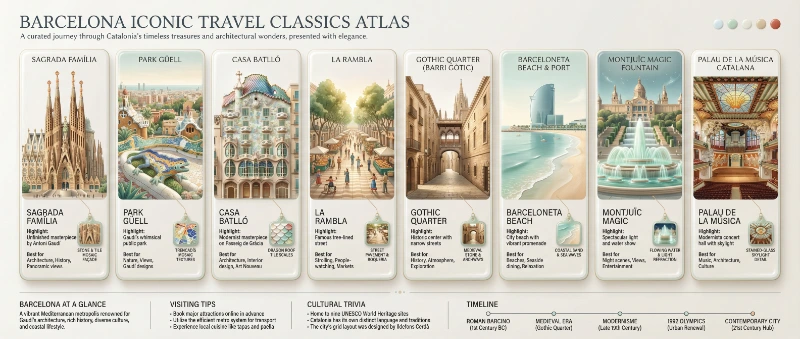
Barcelona Iconic Jade Atlas
Create an ultra-wide infographic poster titled “Barcelona Iconic Travel Classics Atlas”, with a 21:9 horizontal composition in true 8K resolution. The overall aesthetic blends ceramic glaze and jade-like warmth: minimalist, refined, premium, and contemporary, with a subtle Eastern luxury sensibility. The image should feel warm, translucent, restrained, and calm—like a fusion of a museum exhibition display and high-end brand packaging. All on-image text is in English. Background and overall material tone * Background uses a light ivory to mist-white gradient, resembling a pristine ceramic exhibition pedestal * Global lighting is soft and diffused: HDRI soft light with gentle rim lighting, avoiding harsh contrast or hard shadows * Color palette focuses on jade white, bluish white, pale celadon green, and warm beige, accented sparingly with cinnabar red or light gold (no more than 3–4 dominant hues overall) Layout: eight equal-width “ceramic/jade plaques” (strictly eight columns) * The center area is a strict eight-column grid, each column functioning as a ceramic-style information plaque * Card material resembles white porcelain glaze: rounded corners, delicate highlights, subtle glaze reflections, clean edges * Optional ultra-thin gold tracing or jade-edge detailing on card borders, extremely restrained * Shadows are soft and understated, as if the plaques are resting on a museum display platform Core visuals: realistic 3D landmarks (PBR) with warm glazed tonality * The top of each column features one real, iconic Barcelona landmark (automatically select eight, no fictional entries) * Use realistic 3D environment rendering with physically based materials, but with a jade-like, warm overall feel * Materials must be physically accurate: stone, wood, ceramic tile, water, and vegetation follow correct PBR rules (reflection, roughness, normal detail) * Unified color grading: soft highlights, moderate contrast, low-saturation and warm tones reminiscent of jade or ceramic glaze * Grand sense of scale through layered depth and subtle scale references (tiny people, trees, boats), emphasizing monumentality without dramatic effects * Water elements (if present) show gentle reflections and refractions with smooth shoreline gradients * Avoid cartoon styles, low-poly looks, plastic textures, over-sharpening, or sci-fi lighting effects Detail view: glazed “micro dish” or “jade pendant” window * Each column includes a small detail window in the lower-right corner, using one consistent shape across all columns * Option A: a small circular dish, like a porcelain saucer, showing key textures (stone carvings, mosaics, façades, roof tiles, water ripples) * Option B: a jade-pendant-shaped window with rounded contours, showing close-up material detail * The surface should have gentle glazed or jade-like highlights and smooth edges * A very thin leader line connects the detail window to the main 3D scene, accompanied by a concise 2–6 word label Text per column (short, elegant, restrained) * Landmark name (4–8 English words, refined serif typeface recommended) * Two short lines of information: * Highlight: maximum 8 words * Best for: maximum 6 words * Text color uses ink gray or bluish charcoal; accent colors are limited to small dots or separators Top title area (museum exhibit label style) * Main title: Barcelona Iconic Travel Classics Atlas * Subtitle: a single refined positioning sentence (maximum 18 words) * Top-right corner includes five small glazed color dots: bluish white, pale celadon, moon white, warm beige, with a subtle cinnabar accent Bottom information band (exhibition caption style) * A full-width bottom band divided into four sections by thin lines, resembling museum display captions * Barcelona at a glance: one sentence, maximum 22 words * Visiting tips: three bullet points, each no more than 12 words * Cultural trivia: three items, each no more than 18 words * Timeline: 3–6 key nodes (year or era + keyword), connected by minimal linear icons with fine, consistent strokes Automatic landmark selection rules * Cover at least five categories: natural scenery, historical monuments, city landmarks, museums or cultural venues, distinctive neighborhoods or night scenes, and intangible cultural or folk experiences * If needed, fill gaps with reliable general entries such as “Barcelona Art Museum” or “Historic Old Town District” * Landmark names must be real and verifiable; if uncertain, use safe generic naming and never fabricate locations Output constraints * English text only * Minimalist spacing, strong alignment, generous white space * No English logos, no branding marks, no watermarks * True 8K ultra-high resolution, suitable for cultural tourism displays and horizontal social media covers
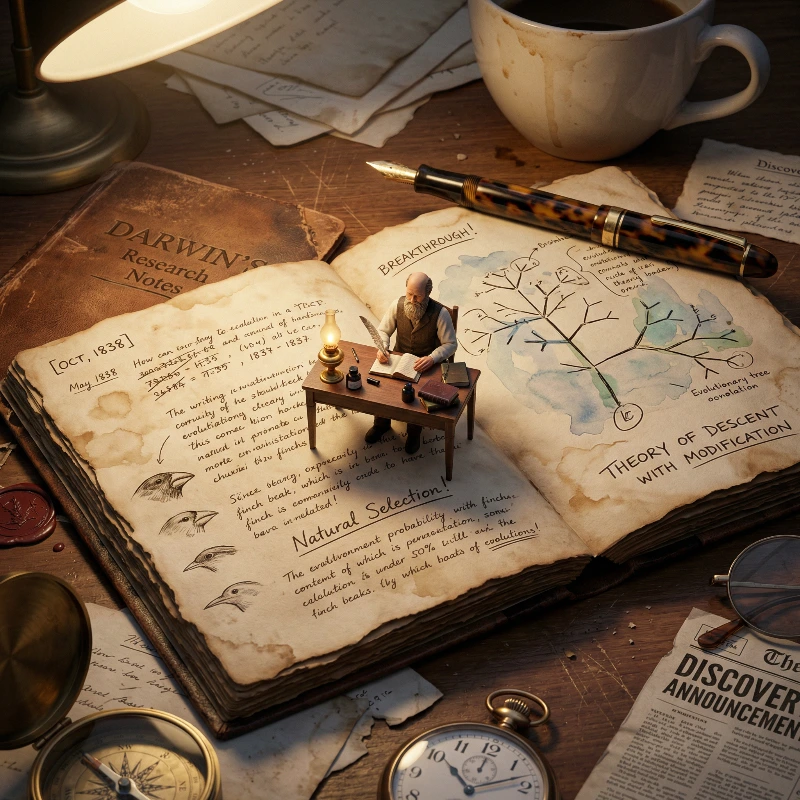
Darwin's Macro Research Realm
do this for Darwin: An extreme macro photograph centered on an antique leather-bound journal lying open on a wooden surface, with the pages serving as a physical landscape for a living miniature scene. JOURNAL DETAILS: - Aged leather cover partially visible, with embossed title: "[SCIENTIST NAME]'s Research Notes" - Thick, textured paper with deckled edges - Visible binding stitching and spine - Water stains, coffee rings, ink blots showing authentic use - Pages filled with dense handwritten notes in period-appropriate script WRITTEN CONTENT (both pages visible): - LEFT PAGE: Dense equations, calculations, crossed-out attempts, marginal corrections * [SPECIFIC FORMULAS] relevant to theory * Dated entries: "[MONTH, YEAR]" * Small sketches in margins * Underlined passages, exclamation marks showing breakthrough moments - RIGHT PAGE: Larger diagram or illustration central to discovery * [TECHNICAL DRAWING] - apparatus, experiment setup, theoretical model * Annotations and dimension labels * Color highlights (if period-appropriate) in specific inks * "BREAKTHROUGH!" or "IT WORKS!" notation MINIATURE FIGURE PLACEMENT: - 1:12 scale figurine of [SCIENTIST] sitting at tiny wooden desk/table - Desk positioned ON TOP OF the journal pages (creating surreal scale) - Figure actively writing with miniature quill/pen - Small oil lamp providing practical light source on tiny desk - Additional miniature props: ink bottle, blotter, reference books at tiny scale SURROUNDING MACRO OBJECTS (giant relative to figure): - Oversized fountain pen lying across top of journal - Massive coffee cup with visible staining on rim, positioned at corner - Giant brass compass or drawing tool - Pocket watch showing time relevant to discovery moment - Spectacles partially folded - Period newspaper fragment with [DISCOVERY ANNOUNCEMENT] headline ENVIRONMENTAL ATMOSPHERE: - Scattered loose papers beneath journal - Wooden desk surface showing grain, scratches, ink stains - Dust particles visible in light beams - Other period-appropriate desk items at edges: wax seal, stamps, letters DEPTH AND FOCUS: - Sharp focus on miniature figure and central journal text - Gentle falloff to slight blur on giant surrounding objects - Bokeh effect on background items - Implies macro lens photography (100mm+) LIGHTING SCHEME: - Primary: Warm overhead light (desk lamp implied) from upper left at 45-degree angle - Secondary: Practical light from miniature oil lamp creating tiny glow - Shadows falling naturally across journal pages creating text legibility - Rim lighting on metallic objects (compass, pen, watch) - Golden hour quality suggesting late night study session TEMPORAL INDICATORS: - Clock showing late hour (11:45 PM, etc.) - Calendar page showing [SIGNIFICANT DATE] - Multiple coffee cups suggesting hours of work - Candle burned down significantly PERSPECTIVE: 45-degree elevated macro view, as if viewer is standing and looking down at desk COMPOSITION: Figure and central journal pages at geometric center, diagonal lines created by pen and papers ASPECT RATIO: 4:5 STYLE: Fine art macro photography, dramatic chiaroscuro lighting, Vermeer-esque quality, editorial magazine spread
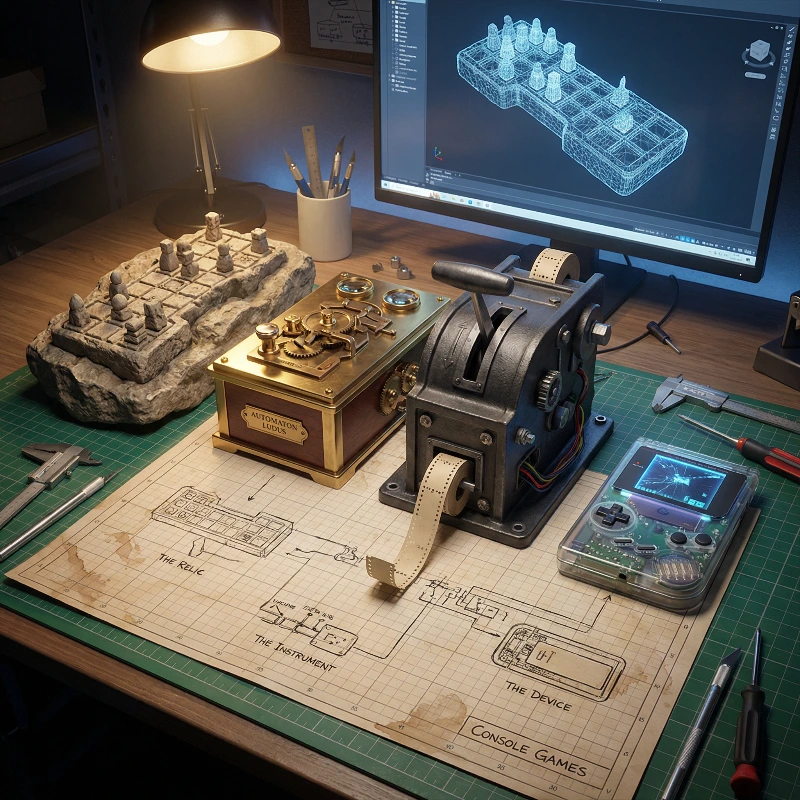
Console Tech Evolution
Input A = Console games <instruction> Input A is a Core Technological Function (e.g., Computing, Navigation, Music, Communication). Deconstruct the function into 4 Chronological Artifacts: The Relic (Ancient): Identify the stone or bronze age precursor. (e.g., Computing -> Antikythera Mechanism/Abacus. Navigation -> Lodestone/Sundial). The Instrument (Classical): Identify the brass and wood scientific instrument. (e.g., Computing -> Pascaline. Navigation -> Sextant/Astrolabe). The Machine (Industrial): Identify the steam/steel era mechanism. (e.g., Computing -> Difference Engine/Punch Card Machine. Navigation -> Gyrocompass). The Device (Modern): Identify the current digital interface. (e.g., Computing -> Tablet/Smartphone. Navigation -> GPS Unit). 2. Container Goal: "Tech History" Workbench Photography. Setting: A cluttered Green Cutting Mat on a sturdy wooden workshop table. Background: A computer monitor displays the CAD Wireframe/3D Scan of the "Relic" or "Instrument," implying a restoration or study project. Tools: Calipers, X-Acto knives, and screwdrivers are scattered around the objects. 3. Lineup (The Artifacts): Arrangement: The four objects are arranged left-to-right (Oldest to Newest). Object 1 (Relic): Heavily damaged, calcified, or encased in rock. Looks like an archaeological find. Object 2 (Instrument): Polished Brass and Mahogany. intricate gears and lenses. Object 3 (Machine): Cast Iron, heavy bolts, punch cards, or paper tape. Object 4 (Device): Sleek glass and aluminum. The screen is cracked or the casing is transparent, revealing the circuitry inside. 4. Blueprint (The Connection): The Drawing: A large, coffee-stained Schematic Grid Paper lies flat under the objects. The Content: Hand-drawn diagrams connect the mechanical logic of the Ancient Relic to the circuit logic of the Modern Device. 5. Lighting & Atmosphere: Lighting: Mixed Lighting. A warm, articulated desk lamp illuminates the physical objects, while the cool blue light from the monitor washes over the back wall. Vibe: Intellectual, inquisitive, and tactile. Output: ONE image, 1:1 Aspect Ratio, 3D Render, "Maker Space" aesthetic, High Texture Fidelity. </instruction>
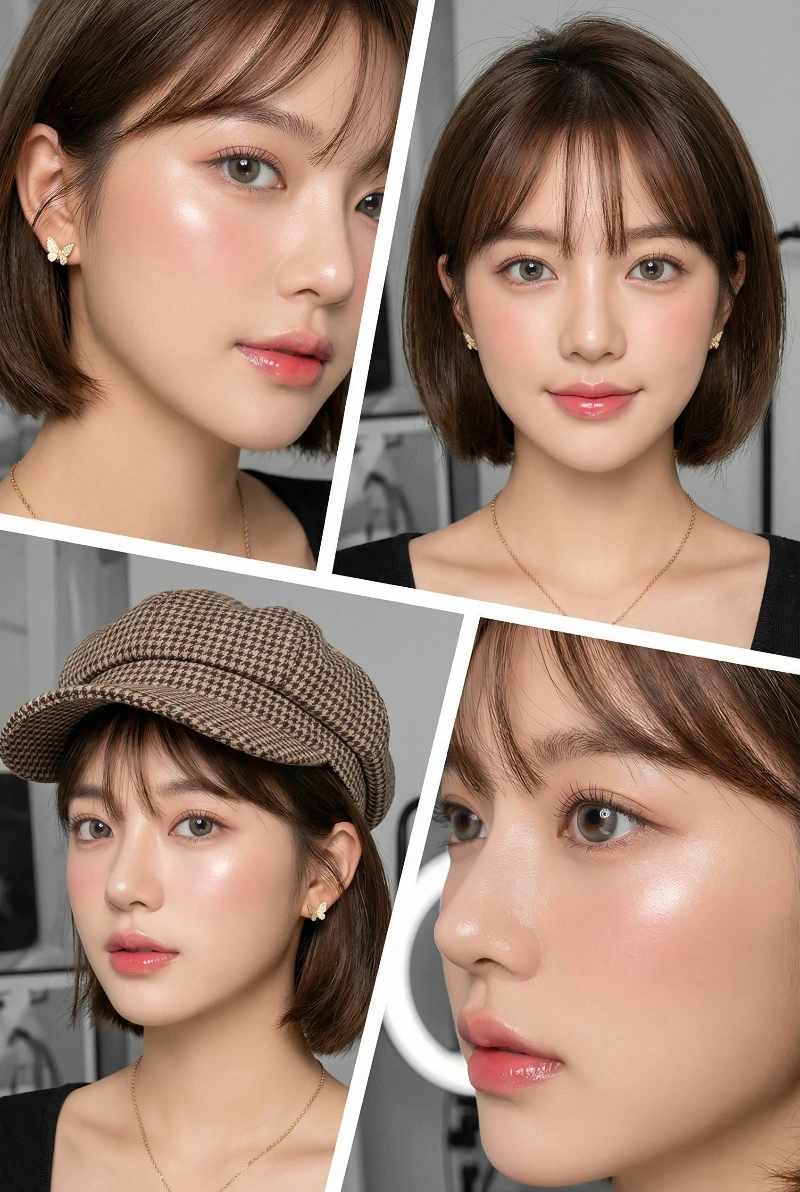
Modern K-Beauty Grid
{ "prompt_type": "beauty_editorial_collage", "layout": { "structure": "4-panel split-screen grid", "dividers": "Thick white diagonal borders", "style": "Modern magazine spread aesthetic" }, "subject": { "demographic": "Young woman", "aesthetic": "Clean girl / K-beauty influence", "features": { "skin": "Flawless, dewy, 'glass skin' texture, high luminosity", "hair": "Short brown bob cut with wispy bangs, smooth texture", "eyes": "Soft grey/hazel contacts" } }, "makeup": { "style": "No-makeup makeup look", "details": [ "Soft rosy blush high on cheeks", "Glossy pink lip tint", "Groomed natural fluffy brows", "Subtle mascara" ] }, "attire_and_accessories": { "headwear": "Brown houndstooth pattern newsboy cap (Baker boy hat)", "jewelry": "Small delicate gold butterfly stud earrings, thin gold chain necklace" }, "panel_composition": { "top_left": "Close-up 3/4 angle, focus on cheek highlight and earring", "top_right": "Direct front-facing portrait, symmetrical composition", "bottom_left": "Portrait with hat, 3/4 turn, looking at camera", "bottom_right": "Extreme close-up side profile, cropping into face" }, "technical_specs": { "resolution": "8K", "lighting": "Soft commercial studio lighting, ring light reflection in eyes", "color_grading": "Desaturated background, warm skin tones, high contrast", "style": "High-end beauty photography, hyper-realistic" } }
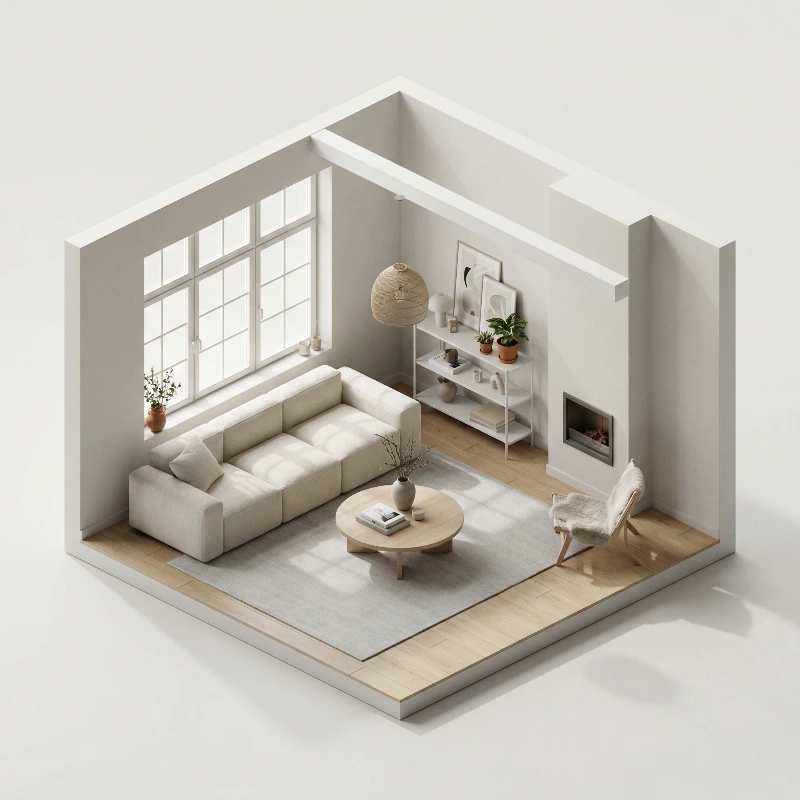
Scandi Urban Living Diorama
Create a highly detailed isometric 3D interior diorama of a (Scandinavian minimal) (urban apartment living room) Design the space with coherent architecture, furniture, lighting, materials, and decoration that naturally match the chosen concept. Use realistic textures, soft natural daylight, gentle shadows, and a calm minimal white background. Perspective: isometric cutaway diorama. Ultra high detail, premium interior visualization, soft global illumination.