Browse and filter our curated collection of prompts
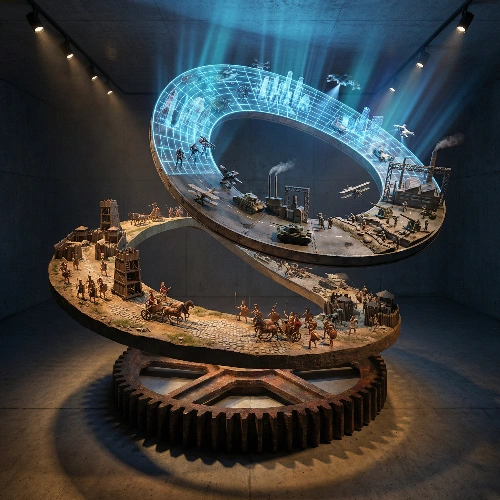
Do this for Warfare: <instruction> Input A is a Topic with a clear technological or cultural progression (e.g., Transportation, Warfare, Medicine, Architecture). Deconstruct the history into 3 Chronological Eras : Era 1 (The Origin - Bottom): Identify the pre-industrial state. (e.g., Transportation -> Horses & Carts on Cobblestone. Medicine -> Herbalists in a Village). Era 2 (The Industry - Middle): Identify the mechanical/modern state. (e.g., Transportation -> Early Cars & Steel Bridges. Medicine -> Victorian Surgery & Iron Beds). Era 3 (The Future - Top): Identify the sci-fi state. (e.g., Transportation -> Hovercars on Neon Roads. Medicine -> Med-Pods & Holograms). 2. Container Goal: "Chronological Loop" Museum Installation. The Form: A massive, continuous Mobius Strip or Twisted Ribbon rising from the floor. The Base: The structure is anchored by a giant Industrial Gear or Stone Foundation. The Setting: A dark, expansive concrete museum hall with overhead track lighting. 3. The Metamorphosis The Path: The surface of the ribbon acts as a road or floor that physically transforms as it ascends. Transition: It morphs from Rough Stone/Dirt (Bottom) to Asphalt/Steel (Middle) to Glowing Glass/Grid (Top). The Connectivity: A bridge or ramp connects the lower loop to the upper loop, implying a continuous journey. 4. The Narrative Scale Scale: 1:50 Scale Figures and Props populate the ribbon. Action: Bottom: Figures walking or using animals. Wooden market stalls. Middle: Factory workers, steel trusses, and combustion engines. Top: Futuristic figures in suits, floating vehicles, and Holographic Cityscapes projecting upwards from the glass surface. 5. Lighting & Atmosphere: Lighting: Gradient Temperature. Base: Warm, earthy halogen spots. Top: Cool, electric blue LED glow from the future section. Shadows: The twisting ribbon casts complex, dramatic shadows on the museum floor. Output: ONE image, 1:1 Aspect Ratio, 3D Render, "Installation Art" aesthetic, High Geometric Complexity. </instruction>
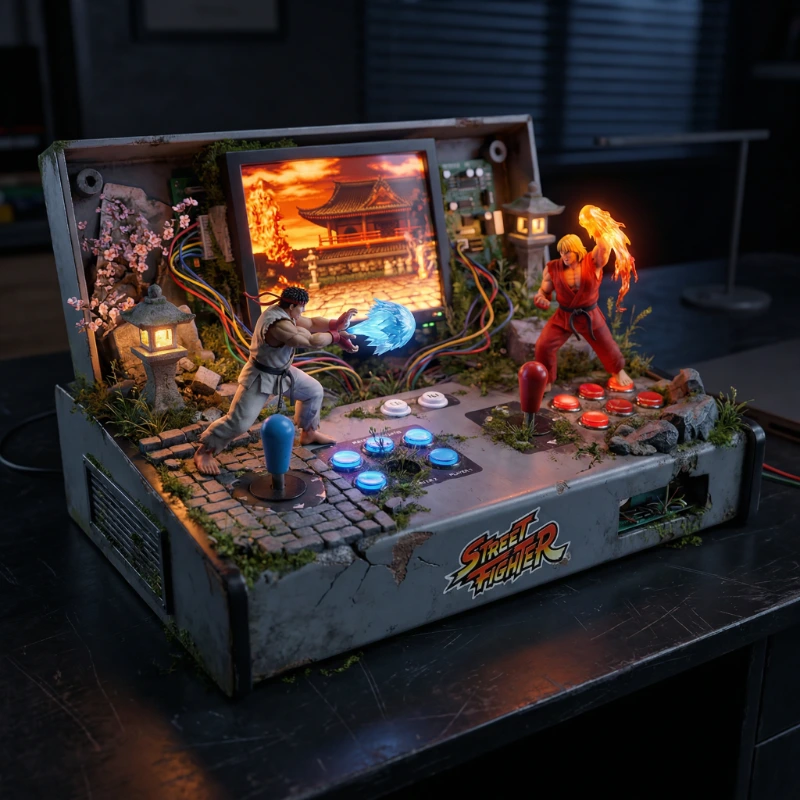
Input A: Street Fighter --- Input A is a Video Game Title (e.g., The Legend of Zelda, Halo, Street Fighter, Elden Ring). Deconstruct the game to generate 3 Integrated Assets : Container : Identify the defining hardware for that title. (e.g., Zelda -> Gold NES Cartridge or Switch. Halo -> Original Xbox. Street Fighter -> Arcade Cabinet Control Deck). Biome : Identify the primary environment of the game. (e.g., Zelda -> Hyrule Grass/Ruins. Halo -> Alien Metal/Ring Surface. Elden Ring -> Golden Erdtree Leaves/Ash). The Cast (The Figures): Identify the Protagonist and a key Enemy/NPC. 2. Dynamic Container Goal: "Hardware Diorama" Photography. Object: The "Container" (Step 1) sits on a dark desk. Transformation: The hardware is NOT pristine. It is partially Disassembled or Weathered . Effect: The "Biome" (Step 1) is physically growing out of the vents, cartridge slots, or screen bezels of the hardware. (e.g., Moss growing on an Xbox, Sand spilling from a Game Boy). 3. Diorama (The Conflict): The Figures: High-detail 1:18 Scale 3D Figures of the "Cast" stand on top of the modified hardware. The Interaction: They are engaged in combat or exploration using the console's geometry as terrain. (e.g., Link climbing the D-pad like a cliff. Master Chief taking cover behind a memory card slot). The Screen: If the hardware has a screen (Handheld/Arcade), it displays a glowing, pixelated backdrop that merges with the 3D foreground elements. 4. Visual Syntax (The Glitch): Wiring: Exposed colored wires or circuit boards protrude from the hardware, weaving through the environmental elements (vines/rocks), connecting the digital world to the physical one. Labels: A worn sticker or label on the device displays the Game Title in its original font. 5. Lighting & Atmosphere: Lighting: Diegetic Mood Lighting. The scene is lit by the glow of the screen or internal LEDs (matching the game's color palette: Green for Xbox, Gold for Zelda). Scale: Shallow depth of field to emphasize the miniature scale of the figures against the "giant" controller buttons. Output: ONE image, 1:1 Aspect Ratio, 3D Render, "Custom Mod" aesthetic, High Narrative Detail. </instruction>
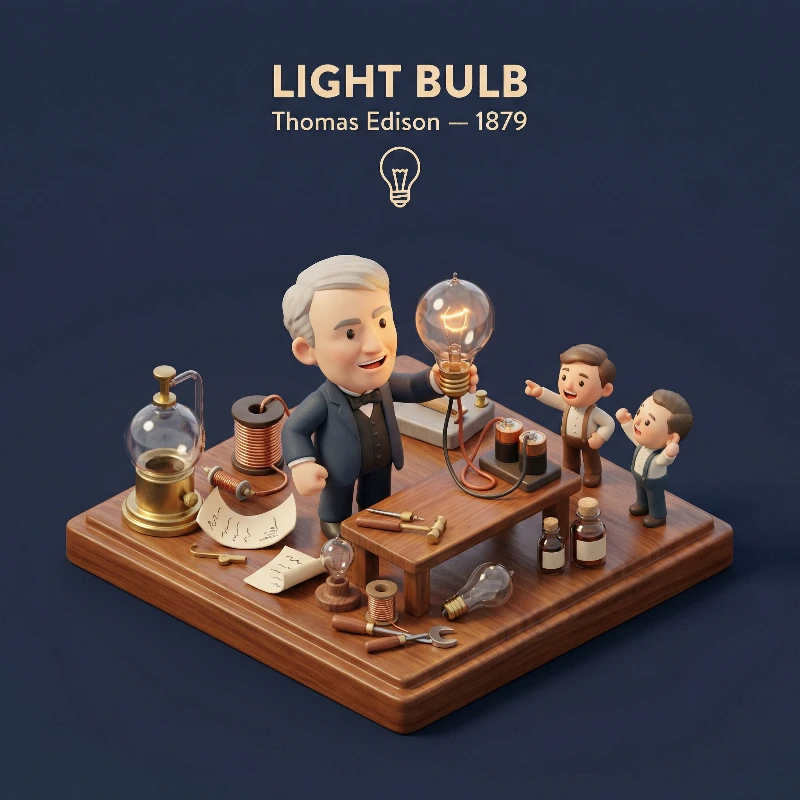
Create a miniature 3D isometric diorama showing the invention of [Light Bulb] at the moment of [Edison successfully testing the first long-lasting carbon filament bulb]. Camera angle around 40° from above. Textures feel soft and polished. Materials follow realistic PBR rules. Lighting feels natural and balanced. The raised base includes tools, workshop elements, notes, and early prototypes. Tiny stylized inventors interact with objects. Faces are visible and recognizable with clean shapes and expressions. Background stays solid [warm dark navy blue]. Top center text shows [Light Bulb] in bold. Second line shows [Thomas Edison — 1879]. A simple line icon of the invention sits below. Text color adapts to background contrast.
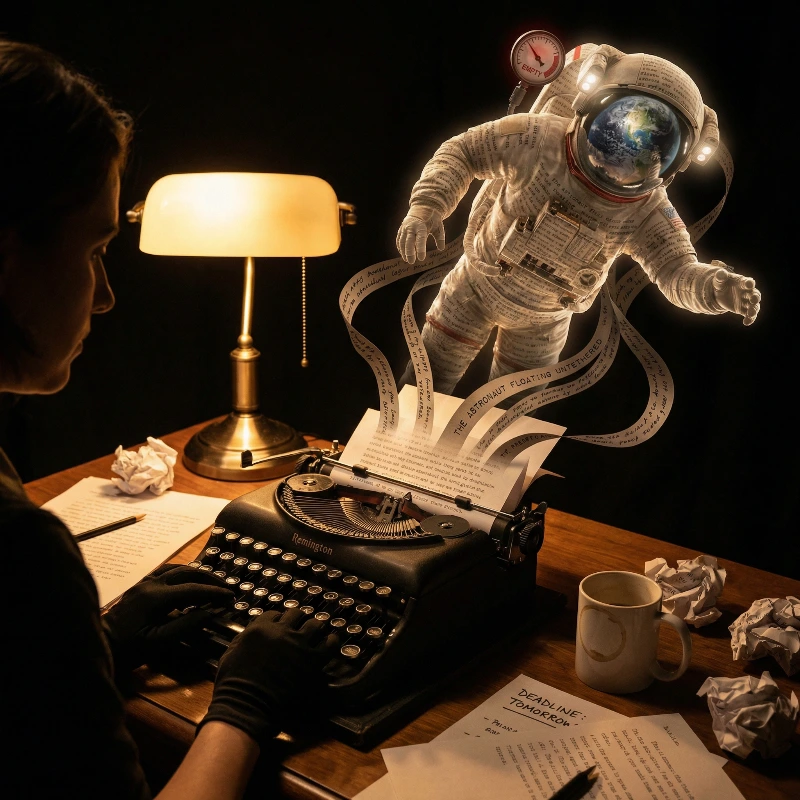
A vintage typewriter on a writer's desk, with the astronaut floating untethered in space materializing from the words being typed, rising from the page as narrative becomes reality. Letters at the base are still flat ink, sentences curl upward becoming ribbons of text that weave into three-dimensional form, her visor reflecting Earth, gloved hand reaching for nothing, and oxygen gauge in red fully realized at the apex while origin remains visible as pure language. The astronaut is literally made of story, words still legible in skin and surface. Fresh typing continues below, feeding the manifestation. Crumpled drafts, coffee rings, deadline notes surround the machine. The ribbon bleeds into being. The writer's hands hover at keys, unsure if they control this anymore. Late night desk lamp casting harsh pool of light, noir shadows, amber and cream tones, 8K, the fiction that writes itself.
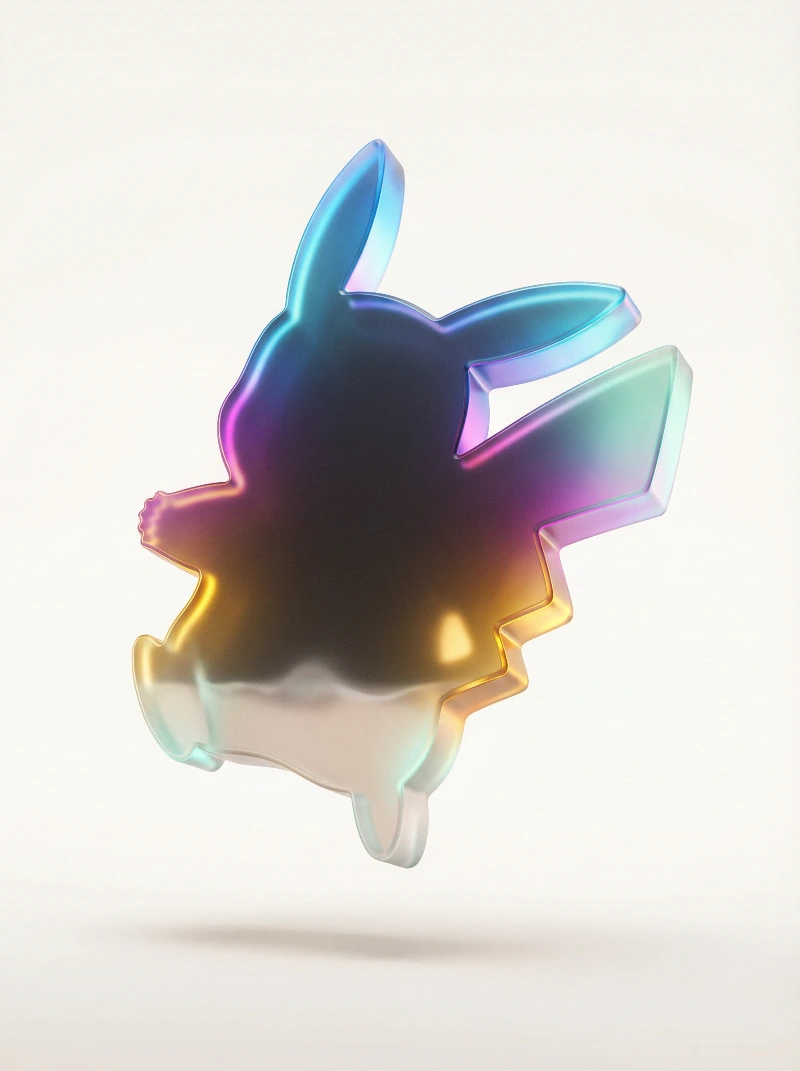
Do this for Pikachu: { "project_name": "Holographic_Gradient_Levitating_Object", "USER_CUSTOMIZATION": { "INSTRUCTIONS": "Change the object below to create different holographic gradient levitating compositions", "object": { "current_setting": "Balloon Dog ", "description": "Choose any object - works best with luxury products, fashion items, or elegant objects" } }, "settings": { "aspect_ratio": "3:4", "style": "holographic_gradient_product_photography" }, "prompt_construction": { "OBJECT_TREATMENT": { "object": "Use object from USER_CUSTOMIZATION - the main subject", "center_appearance": "Object CENTER/BODY appears DARK - silhouette quality with darker tones", "edge_appearance": "Object EDGES have SHARP vibrant gradient rim lighting - bright colorful defined edges", "gradient_on_edges": "Holographic gradient RIM LIGHTING on sharp edges - blue top, purple/magenta sides, warm yellow/orange bottom", "NOT_overall_gradient": "Gradient is on EDGES as rim light, NOT covering entire object surface", "bottom_transparency": "Bottom portion shows FROSTED TRANSPARENCY - can see through with frosted light interior visible", "opacity": "Top more opaque dark, bottom more transparent frosted - gradient of opacity", "edge_sharpness": "SHARP defined edges with gradient rim lighting - NOT soft blurred", "contrast": "High contrast - darker center body with bright sharp gradient-lit edges" }, "LEVITATION_CRITICAL": { "floating": "Object LEVITATING/FLOATING in mid-air - NOT sitting on surface", "height": "Suspended in space with clear gap visible below - hovering weightless", "shadow": "Soft diffused shadow cast on surface below showing object is floating above", "position": "Object appears to defy gravity - suspended mid-air in elegant pose", "feeling": "Magical ethereal levitation - dreamlike floating quality" }, "HOLOGRAPHIC_GRADIENT": { "type": "Iridescent holographic gradient overlay - shifting rainbow spectrum", "color_flow": "BLUE (top) → PURPLE/MAGENTA (upper mid) → WARM ORANGE/YELLOW (lower mid) → subtle CYAN/GREEN hints", "gradient_behavior": "Gradient wraps around three-dimensional form of object following its contours", "top_area": "Cool blue tones - bright cyan to deep blue at very top", "mid_upper": "Purple, magenta, pink transition tones", "mid_lower": "Warm orange, golden yellow, amber tones - strongest glow here", "bottom_hints": "Subtle cyan, turquoise, mint green accents", "quality": "Smooth soft gradient transitions - ethereal holographic shimmer", "intensity": "Gradient bright and saturated but soft - NOT harsh, dreamlike quality" }, "GRADIENT_AND_LIGHTING_CRITICAL": { "gradient_colors": "Holographic gradient - blue at top, purple/magenta mid, warm yellow/orange, cyan/green hints", "gradient_placement": "Gradient appears on EDGES and outer areas - RIM LIGHTING effect not overall glow", "center_darkness": "CENTER of object appears DARKER - gradient is brightest at EDGES creating rim light effect", "edge_quality": "SHARP EDGES with bright gradient rim lighting - NOT soft glow, defined sharp contours", "rim_lighting": "Strong vibrant gradient RIM LIGHTING on edges - blue top, purple sides, warm orange/yellow bottom edges", "NOT_glow": "NOT soft atmospheric glow - SHARP gradient rim lighting with darker centers", "contrast": "High contrast between darker center and bright gradient-lit edges" }, "FROSTED_TRANSPARENCY_CRITICAL": { "bottom_portion": "Bottom portion of object shows FROSTED TRANSPARENCY - can see through slightly", "frosted_quality": "Frosted glass effect - translucent but diffused, NOT clear glass", "see_through": "Can see INSIDE object at bottom - frosted light color visible through", "light_through": "Light passes through frosted bottom creating soft internal glow - LIGHT COLOR frosted interior visible", "opacity_gradient": "Top more opaque/solid, gradually becoming more transparent/frosted toward bottom", "frosted_appearance": "Like frosted acrylic or glass - milky translucent quality at bottom", "internal_light": "Soft light-colored frosted interior visible through translucent bottom portion" }, "BACKGROUND_CRITICAL": { "color": "EXACT #FFFFFD - pure white with faintest warm undertone, almost pure white", "hex_value": "#FFFFFD", "appearance": "Clean minimal pure white background with barely perceptible warm hint", "quality": "Perfectly clean seamless - soft dreamy photography backdrop", "lighting": "Softly and evenly lit - bright clean minimal", "gradient_in_bg": "Very subtle soft gradient in background - slightly brighter at bottom where object presence is", "atmosphere": "Ethereal dreamy minimal - clean modern luxury aesthetic" }, "SURFACE_AND_SHADOW": { "surface": "Clean minimal surface below object - same #FEFCFD color as background", "shadow": "SOFT DIFFUSED shadow cast on surface below - proves object is floating above", "shadow_quality": "Very soft gentle shadow - subtle grey with slight gradient color tint", "shadow_size": "Shadow smaller than object showing it's elevated/floating", "reflection_hint": "Very subtle soft reflection of gradient colors on surface - barely visible", "seamless": "Background and surface blend seamlessly - minimal clean" }, "LIGHTING_SETUP": { "primary_concept": "Soft diffused studio lighting with holographic gradient light overlay", "base_light": "Soft even diffused light creating clean bright atmosphere", "gradient_light": "Holographic gradient light source creating colorful glow on object", "backlight_element": "Soft backlight creating glow around object edges", "overall_feel": "Ethereal dreamy magical lighting - soft glowing holographic", "NOT_harsh": "All lighting SOFT DIFFUSED - NO harsh shadows or bright spots" }, "COMPOSITION": { "crop": "TIGHT CROP - object fills frame substantially, close framing like reference image 3", "object_size": "Object large in frame - NOT small, good substantial presence filling composition", "framing_tightness": "Cropped fairly close to object - minimal extra space, focused composition", "object_position": "Object centered in frame, levitating in mid-air", "angle": "Slight elegant angle showing object dimensionality - NOT flat straight-on", "space_above": "Moderate space above - NOT excessive, tight composition", "space_below": "Space below showing shadow and floating quality but NOT excessive", "balance": "Elegant balanced tight composition - object prominent and substantial", "reference": "Match tight crop of reference image 3 - object fills frame well" }, "STYLE_AND_AESTHETIC": { "overall": "LUXURY PRODUCT PHOTOGRAPHY - high-end ethereal holographic style", "feeling": "Magical dreamlike otherworldly - modern luxury", "quality": "Ultra-clean minimal sophisticated - editorial fashion/beauty photography", "mood": "Ethereal futuristic elegant - soft glowing dreamy", "reference": "High-end cosmetic/fashion advertising - Jacquemus, Fenty Beauty style", "NOT": "NOT CGI-looking, NOT overly digital, maintains photographic quality with magical elements" }, "COLOR_PALETTE": { "background": "#FEFCFD - pale pink-white", "gradient_blues": "Bright cyan, sky blue, deep blue", "gradient_purples": "Magenta, purple, pink", "gradient_warm": "Golden yellow, warm orange, amber", "gradient_accent": "Cyan, turquoise, mint green hints", "object_base": "Dark silhouette - deep grey to black with gradient overlay", "overall_harmony": "Soft dreamy pastel-bright gradient against clean minimal background" }, "TECHNICAL_SPECIFICATIONS": { "quality": "8K ultra high resolution professional product photography", "rendering": "Photorealistic with magical holographic gradient overlay", "gradient_rendering": "Smooth seamless gradient transitions - soft ethereal quality", "glow_rendering": "Soft diffused atmospheric glow - subtle luminescence", "levitation_rendering": "Convincing floating effect with proper shadow", "background_rendering": "Perfectly clean seamless #FEFCFD", "lighting_quality": "Soft diffused professional studio lighting with gradient glow", "overall_finish": "Ultra-clean luxury editorial product photography with holographic effect" }, "WHAT_NOT_TO_DO": { "NEVER": [ "object_sitting_on_surface_not_floating", "soft_blurred_edges", "gradient_covering_entire_object", "no_darker_center", "soft_overall_glow_instead_of_rim_light", "no_frosted_transparency_at_bottom", "fully_opaque_object", "loose_crop_with_small_object", "overly_CGI_digital_look", "cluttered_background", "wrong_background_color", "no_gradient_rim_lighting", "flat_2D_appearance" ] }, "NEGATIVE_CONSTRAINTS": [ "object_on_surface", "not_floating", "no_levitation", "soft_blurred_edges", "soft_glow_instead_of_sharp_rim", "gradient_on_entire_surface", "no_dark_center", "no_edge_contrast", "no_frosted_transparency", "fully_opaque", "no_see_through_bottom", "loose_crop", "small_object_in_frame", "cluttered", "busy_background", "wrong_background_color", "no_gradient_rim", "flat_appearance", "overly_CGI" ] } }
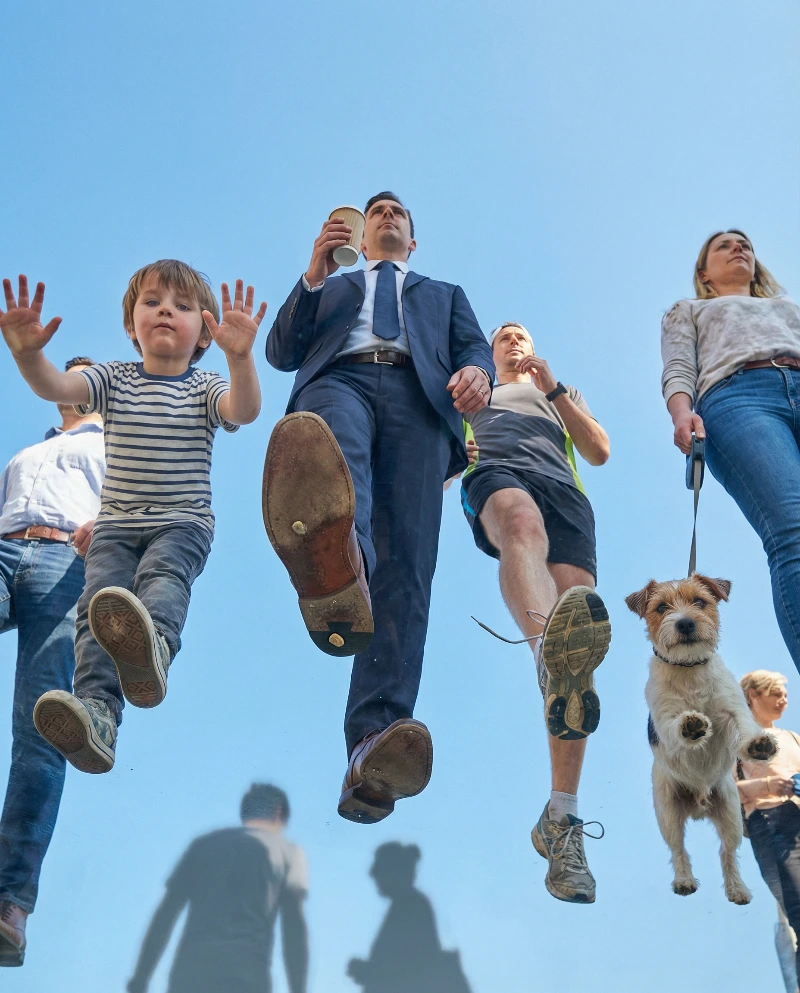
View from underneath an invisible plexiglass floor, looking straight up into a pure blue sky with no buildings at all. It feels like the people are walking on air. A stream of people is walking from left to right above us: a man in a suit balancing a coffee cup, a kid pressing their face and hands against the floor, a jogger mid-stride with a shoelace flying, a woman walking a small dog whose paws are right in front of the “camera.” We are extremely close to the soles of their shoes, seeing worn textures, tiny pebbles, bits of gum, and dust in sharp detail. Some people are slightly overlapping, creating a chaotic, playful pattern of legs and feet. Soft sunlight from above casts faint, distorted shadows through their bodies. There are no visible edges or separations in the plexiglass, no glass glare or reflections at all — it truly looks like a crowd casually strolling across the open sky.
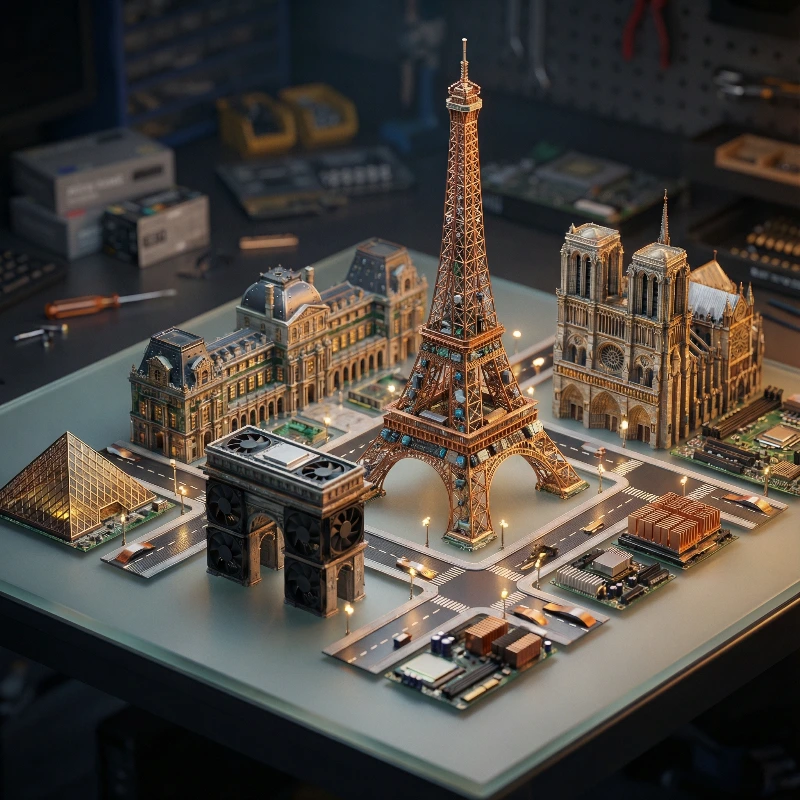
(Paris, PC) Anchor: [Location] :: [Material Concept]::4 Morphology: Miniature architectural cityscape of [Location], entire skyline constructed via the assemblage of [Material Concept] components, skyscrapers and structures formed from the constituent parts of [Material Concept], thematic structural engineering, hyper-detailed diorama::3 Material Physics: Physical properties of [Material Concept] applied to architecture, [Material Concept] textures replacing concrete and glass, innate material logic of [Material Concept], high-fidelity surface details::3 Illumination: Lighting exhibiting the surface properties of [Material Concept], ambient occlusion, volumetric atmosphere matching the material theme::2 Render Stack: Tilt-shift photography, macro lens, f/2.8, 8k, scale model aesthetic, detailed texture mapping, Unreal Engine 5 render::1 Negative: [Human presence, massive scale, blurry, low resolution, bad geometry, distortions, flat 2D, text, watermark]:: -1
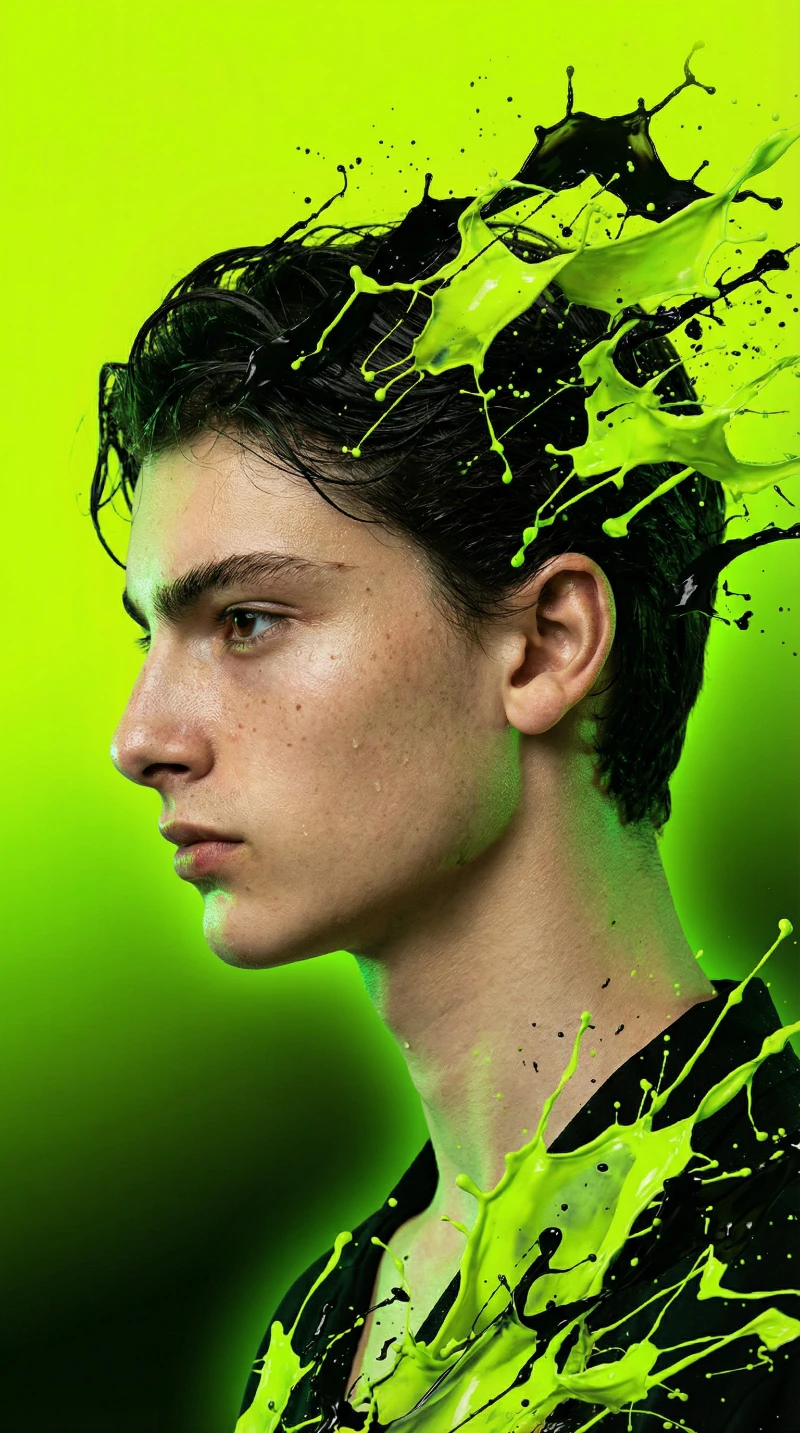
Convert this image into a bold, modern editorial portrait with a neon-futuristic edge, (use the same face as the uploaded photo), 9:16 vertical aspect ratio, featuring a sharply defined profile of a handsome young man looking to the left. The background is a vibrant lime-green gradient with subtle neon glow. Electric lime and black paint splashes erupt from the head and shoulders, creating high-energy motion and youthful visual impact. Ultra-sharp directional lighting with crisp highlights, strong cinematic contrast, ultra-high-resolution commercial photo quality.
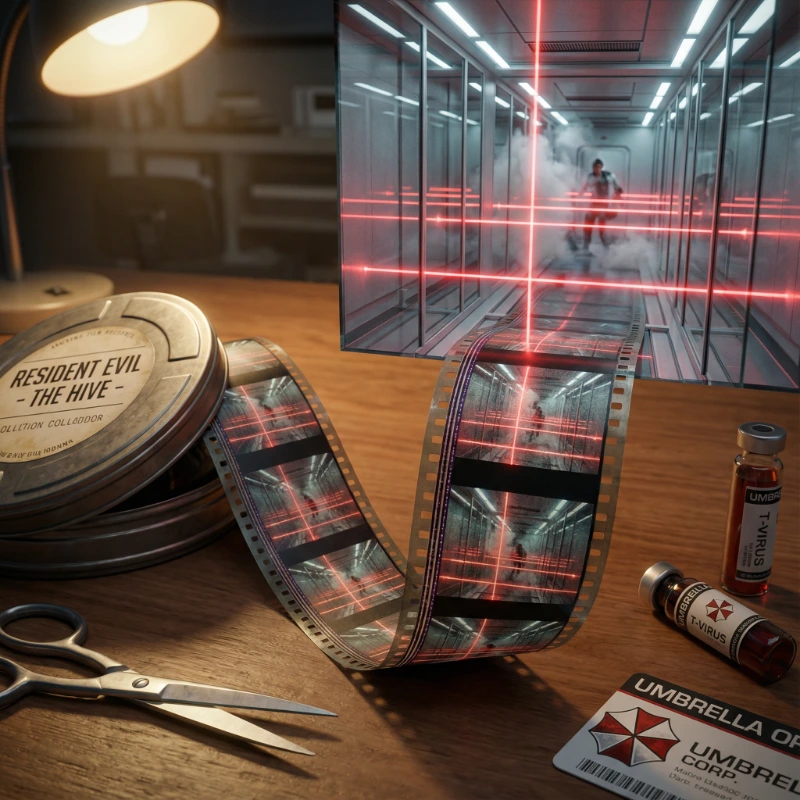
Input A: Resident Evil <instruction> Input A is a famous Movie Scene or Film Title. Analyze: The specific color grading of the film, the key iconic object from the scene, and the lighting mood (noir, sci-fi, daylight). Goal: A "Frame-Emergence" shot. A vintage film reel canister has tipped over on a editing table. Rules: The Source: The celluloid film strip is unspooled chaotically across the table. The Transformation: As the film strip unrolls, the 2D frames on the celluloid "peel up" and morph into a hyper-real 3D diorama of the scene. Do the deep analysis to find the perfect iconic scene that would be for this visualization Detail: The transition point is seamless—half the prop is 2D printed film grain, the other half is 3D texture. - Props: Film editing scissors as well as a couple of movie relevant items on the desk Lighting: Warm editing bay light, focused sharply on the transition point. Output: ONE image, 1:1 aspect ratio, macro photography. </instruction>
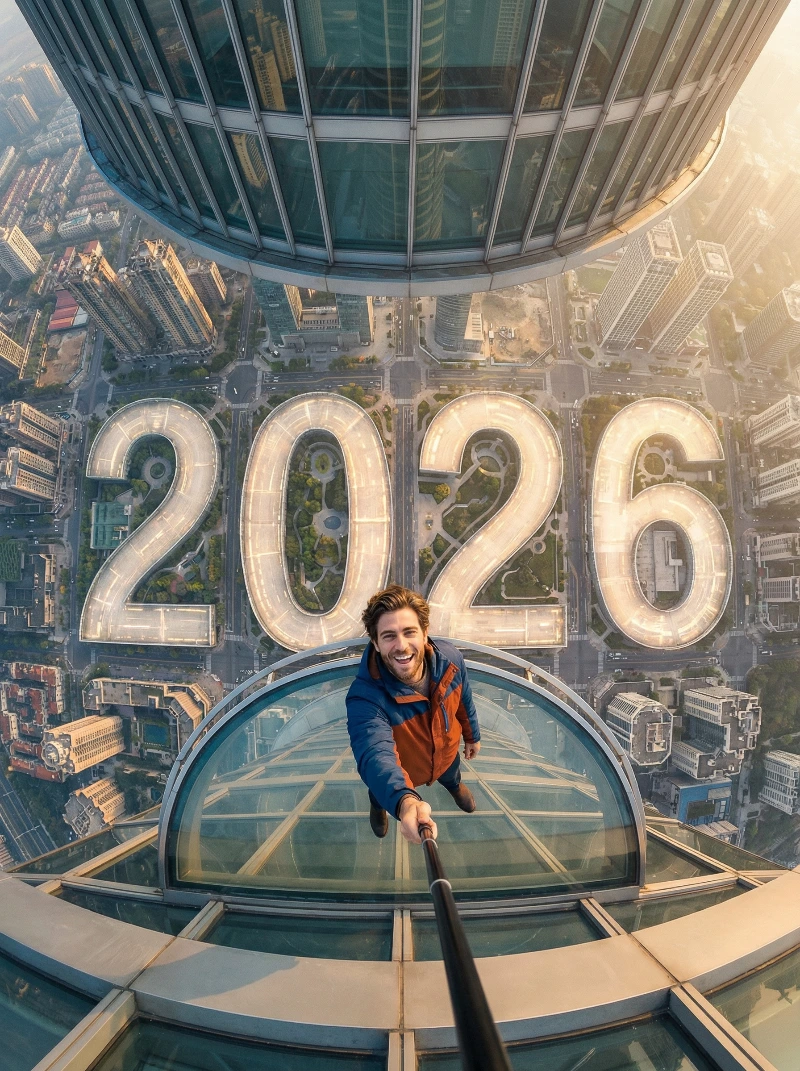
A fisheye ultra-wide-angle shot taken from directly above, looking down from the edge of a towering skyscraper. A confident man (attached photo) stands alone on a circular, transparent glass viewing platform suspended hundreds of meters in the air. He wears a vibrant jacket bold blue on one side, burnt orange on the other and holds a selfie stick extended outward, capturing his own smiling face with a sense of exhilaration. The fisheye lens exaggerates perspective, warping the edges of the platform and dramatically curving the skyline below, creating an intense sense of vertigo and precarious height. Beneath him, the entire urban landscape is meticulously designed: streets, rooftops, parks, and building blocks seamlessly flow together to form the colossal numerals “2026” when viewed from above. The city grid bends organically into the shape of the digits no text or signage, just clever architectural layout. Evening golden hour sunlight bathes the scene, casting long shadows and warm, glowing highlights along the contours of the numbers, making them softly luminescent against the urban fabric. The image is hyper-realistic, rendered in ultra-sharp 8K resolution, with cinematic depth of field, realistic glass reflections, atmospheric haze in the distance, and fine surface textures on fabric, metal, and concrete. The mood is electrifying yet serene balancing awe, danger, and futuristic optimism. Vertical 9: 16 composition, with the subject centered and the “2026” layout fully visible below, emphasizing scale and intentional design.
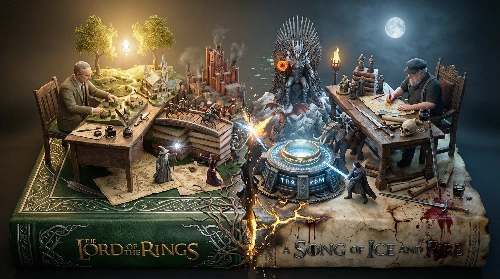
Author1: George R. R. Martin Author2: J. R. R. Tolkien -- Input Variable: [INSERT AUTHOR 1] vs. [INSERT AUTHOR 2] (e.g., J.R.R. Tolkien vs. George R.R. Martin, Arthur C. Clarke vs. Isaac Asimov, Jane Austen vs. the Brontë Sisters) System Instruction: Generate a hyper-detailed, macro 3D diorama of a "Literary Battleground." Use the following logic to create a scene of narrative conflict and fusion: Profile & Duality: Analyze both Inputs: Identify each Author's Vibe, Artifacts, and Magnum Opus. The Conflict: Define the core thematic opposition (e.g., Tolkien's Good vs. Evil vs. Martin's Moral Ambiguity; Clarke's Cosmic Indifference vs. Asimov's Human-centric Order). The Fusion: Identify 3-5 hybrid concepts where their worlds might merge (e.g., A Sauron-like figure on the Iron Throne; A positronic brain trying to interpret a Monolith). Container: The Base: A massive, ancient "Yggdrasil-like" Book whose trunk is split down the middle, forming two distinct covers. Texture: Each half of the book's cover texture reflects its author (e.g., Elven-leaf tooled leather vs. cracked, blood-spattered vellum). The Title: Each spine features the respective author's most famous title, but the gold leaf is "bleeding" across the divide. Workspace: The Desk: A single, massive writing desk is cleaved in two by the book. Each side is period-accurate to its author. The Authors: Two 1:12 scale figures, one on each side, are locked in a creative duel. One might be meticulously world-building, the other furiously red-penciling a map. The Clutter (Density Layer 1): The desk is a chaotic mix of both worlds. Crumpled manuscript pages from one author are used as coasters for the other's drink. Quills share space with typewriters. Manifestation: CRITICAL: The two fictional worlds are in a state of open war, using the desk as the no-man's-land. The "Micro-Population": Tiny characters from both universes are in direct conflict. (e.g., Rohirrim charging Dothraki spearmen; R2-D2 trying to reason with HAL 9000). The "Terrain Bleed": The environments are actively terraforming the desk. (e.g., The Shire's gentle hills are being overrun by the gritty, soot-stained streets of King's Landing; A crystal forest from Clarke's work is being colonized by Asimov's metallic robots). The Hybrid Artifacts: The most iconic artifacts are fused into new, paradoxical objects. (e.g., The One Ring is embedded in a Foundation base; A lightsaber hilt is crafted from a white walker's ice). Lighting & Atmosphere: Primary Light: Two conflicting light sources. Tolkien's side is lit by warm, golden "Valinor" light. Martin's side is lit by harsh, cold "Westerosi" moonlight. Secondary Light: The energy from the conflict itself—magical sparks, digital glitches, and clashing auras erupt where the two worlds meet. Scale: Extreme macro with a Tilt-Shift effect, emphasizing the epic nature of the conflict on a miniature scale. Output: ONE image, 16:9 Aspect Ratio, Octane Render, "Epic Clash" level of detail, Dynamic/Dramatic Aesthetic.
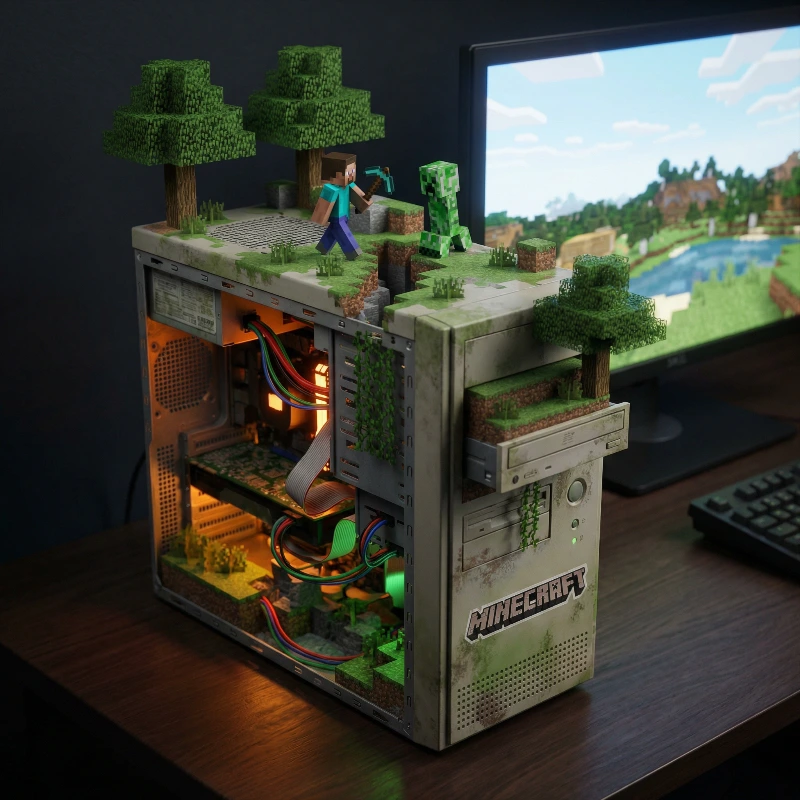
Input A: Minecraft --- Input A is a Video Game Title (e.g., The Legend of Zelda, Halo, Street Fighter, Elden Ring). Deconstruct the game to generate 3 Integrated Assets : Container : Identify the defining hardware for that title. (e.g., Zelda -> Gold NES Cartridge or Switch. Halo -> Original Xbox. Street Fighter -> Arcade Cabinet Control Deck). Biome : Identify the primary environment of the game. (e.g., Zelda -> Hyrule Grass/Ruins. Halo -> Alien Metal/Ring Surface. Elden Ring -> Golden Erdtree Leaves/Ash). The Cast (The Figures): Identify the Protagonist and a key Enemy/NPC. 2. Dynamic Container Goal: "Hardware Diorama" Photography. Object: The "Container" (Step 1) sits on a dark desk. Transformation: The hardware is NOT pristine. It is partially Disassembled or Weathered . Effect: The "Biome" (Step 1) is physically growing out of the vents, cartridge slots, or screen bezels of the hardware. (e.g., Moss growing on an Xbox, Sand spilling from a Game Boy). 3. Diorama (The Conflict): The Figures: High-detail 1:18 Scale 3D Figures of the "Cast" stand on top of the modified hardware. The Interaction: They are engaged in combat or exploration using the console's geometry as terrain. (e.g., Link climbing the D-pad like a cliff. Master Chief taking cover behind a memory card slot). The Screen: If the hardware has a screen (Handheld/Arcade), it displays a glowing, pixelated backdrop that merges with the 3D foreground elements. 4. Visual Syntax (The Glitch): Wiring: Exposed colored wires or circuit boards protrude from the hardware, weaving through the environmental elements (vines/rocks), connecting the digital world to the physical one. Labels: A worn sticker or label on the device displays the Game Title in its original font. 5. Lighting & Atmosphere: Lighting: Diegetic Mood Lighting. The scene is lit by the glow of the screen or internal LEDs (matching the game's color palette: Green for Xbox, Gold for Zelda). Scale: Shallow depth of field to emphasize the miniature scale of the figures against the "giant" controller buttons. Output: ONE image, 1:1 Aspect Ratio, 3D Render, "Custom Mod" aesthetic, High Narrative Detail. </instruction>
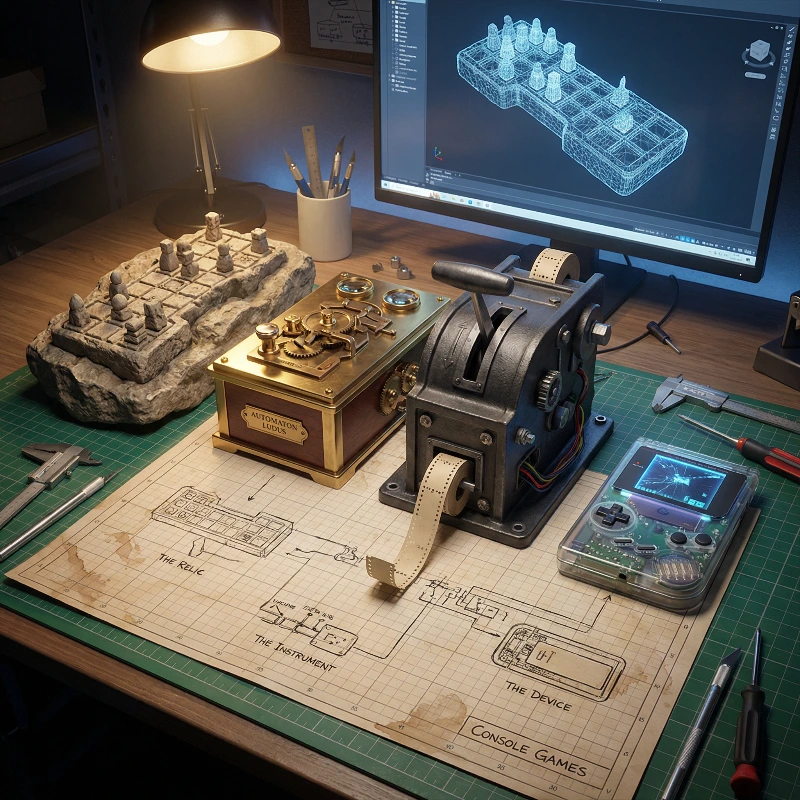
Input A = Console games <instruction> Input A is a Core Technological Function (e.g., Computing, Navigation, Music, Communication). Deconstruct the function into 4 Chronological Artifacts: The Relic (Ancient): Identify the stone or bronze age precursor. (e.g., Computing -> Antikythera Mechanism/Abacus. Navigation -> Lodestone/Sundial). The Instrument (Classical): Identify the brass and wood scientific instrument. (e.g., Computing -> Pascaline. Navigation -> Sextant/Astrolabe). The Machine (Industrial): Identify the steam/steel era mechanism. (e.g., Computing -> Difference Engine/Punch Card Machine. Navigation -> Gyrocompass). The Device (Modern): Identify the current digital interface. (e.g., Computing -> Tablet/Smartphone. Navigation -> GPS Unit). 2. Container Goal: "Tech History" Workbench Photography. Setting: A cluttered Green Cutting Mat on a sturdy wooden workshop table. Background: A computer monitor displays the CAD Wireframe/3D Scan of the "Relic" or "Instrument," implying a restoration or study project. Tools: Calipers, X-Acto knives, and screwdrivers are scattered around the objects. 3. Lineup (The Artifacts): Arrangement: The four objects are arranged left-to-right (Oldest to Newest). Object 1 (Relic): Heavily damaged, calcified, or encased in rock. Looks like an archaeological find. Object 2 (Instrument): Polished Brass and Mahogany. intricate gears and lenses. Object 3 (Machine): Cast Iron, heavy bolts, punch cards, or paper tape. Object 4 (Device): Sleek glass and aluminum. The screen is cracked or the casing is transparent, revealing the circuitry inside. 4. Blueprint (The Connection): The Drawing: A large, coffee-stained Schematic Grid Paper lies flat under the objects. The Content: Hand-drawn diagrams connect the mechanical logic of the Ancient Relic to the circuit logic of the Modern Device. 5. Lighting & Atmosphere: Lighting: Mixed Lighting. A warm, articulated desk lamp illuminates the physical objects, while the cool blue light from the monitor washes over the back wall. Vibe: Intellectual, inquisitive, and tactile. Output: ONE image, 1:1 Aspect Ratio, 3D Render, "Maker Space" aesthetic, High Texture Fidelity. </instruction>
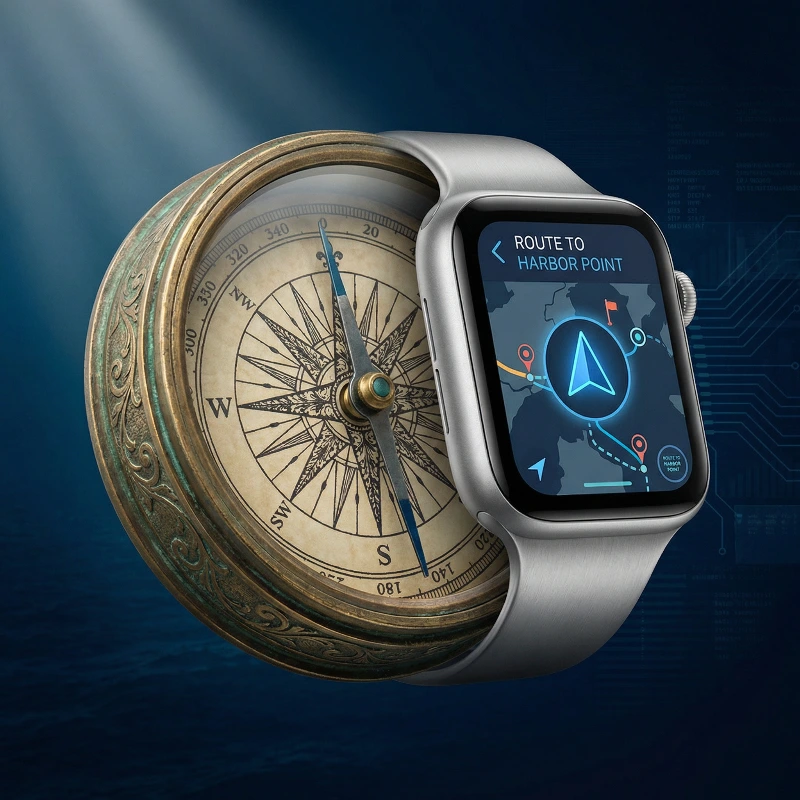
An antique brass nautical compass with ornate engravings and a glass dome, positioned at a slight angle. The compass rose and needle on the left side remain traditional, with aged verdigris patina on the brass housing. Moving rightward, the brass gradually becomes brushed aluminum, the glass dome flattens into a sapphire crystal watch face, and the entire object transforms into a modern GPS smartwatch. The compass needle morphs into a digital navigation arrow on the watch display. The watch screen shows a glowing map interface with route directions. Set against a navy blue gradient background suggesting ocean depths fading into digital space. Soft ambient lighting with a single highlight catching both the brass and the watch crystal. Product photography style, magazine advertisement quality, photorealistic materials and reflections, 8K detail.
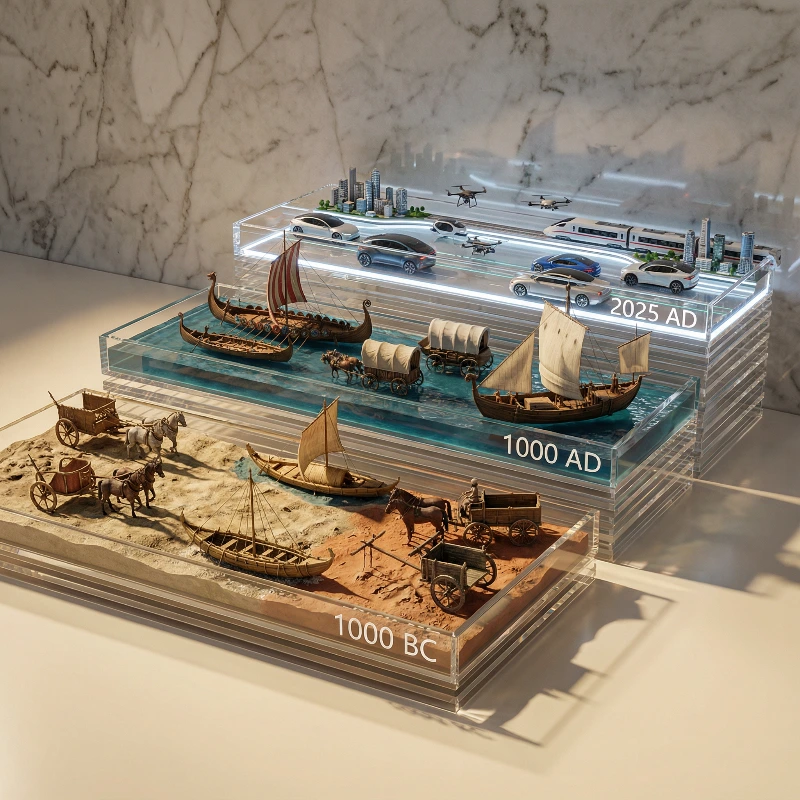
Cinematic, hyper-realistic. A stacked depth composition of ultra-detailed 16K 3D-scanned transportation evolving over time, each layer at 1:18 scale with [ELEMENTS = era-relevant elements, scenes, vehicles]. Mounted on an acrylic stack base with refractive layers. Foreground lighting penetrates to cast multi-layered, receding shadows. From front to back: - [ "1000 BC" ]: [hyper realistic, era relevant ELEMENTS] - [ "1000 AD" ]: [hyper realistic, era relevant ELEMENTS ] - [ "2025 AD" ]: [hyper realistic, era relevant ELEMENTS ] Set against a marble background. Ultra-realistic 4K HDR render.
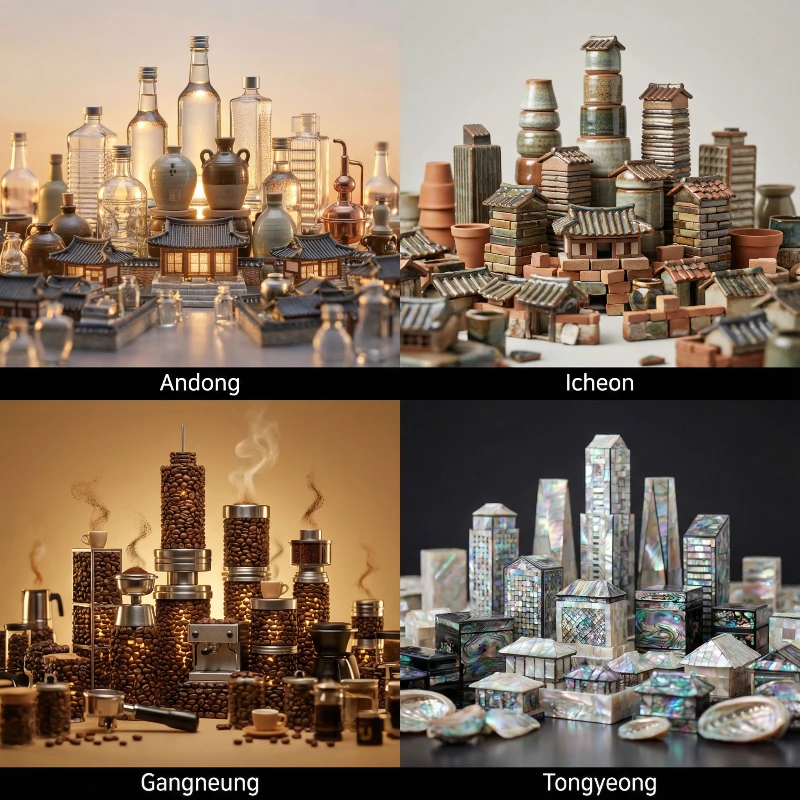
Do this for South Korea: <instructions> Input = Country Act as a world class visual artist and geography expert. For every country, find 4 less known cities and the one product that is very popular there. Do research to get this step right. Function Draw ($ City, $ Material) Anchor: [Location] :: [Material Concept]::4 Morphology: Miniature architectural cityscape of [Location], entire skyline constructed via the assemblage of [Material Concept] components, skyscrapers and structures formed from the constituent parts of [Material Concept], thematic structural engineering, hyper-detailed diorama::3 Material Physics: Physical properties of [Material Concept] applied to architecture, [Material Concept] textures replacing concrete and glass, innate material logic of [Material Concept], high-fidelity surface details::3 Illumination: Lighting exhibiting the surface properties of [Material Concept], ambient occlusion, volumetric atmosphere matching the material theme::2 Render Stack: Tilt-shift photography, macro lens, f/2.8, 8k, scale model aesthetic, detailed texture mapping, Unreal Engine 5 render::1 Negative: [Human presence, massive scale, blurry, low resolution, bad geometry, distortions, flat 2D, text, watermark]:: -1 Output: 2x2 grid, for each panel execute Draw Function for one of the cities plus the associated popular product. Name of the city underneath </instructions>
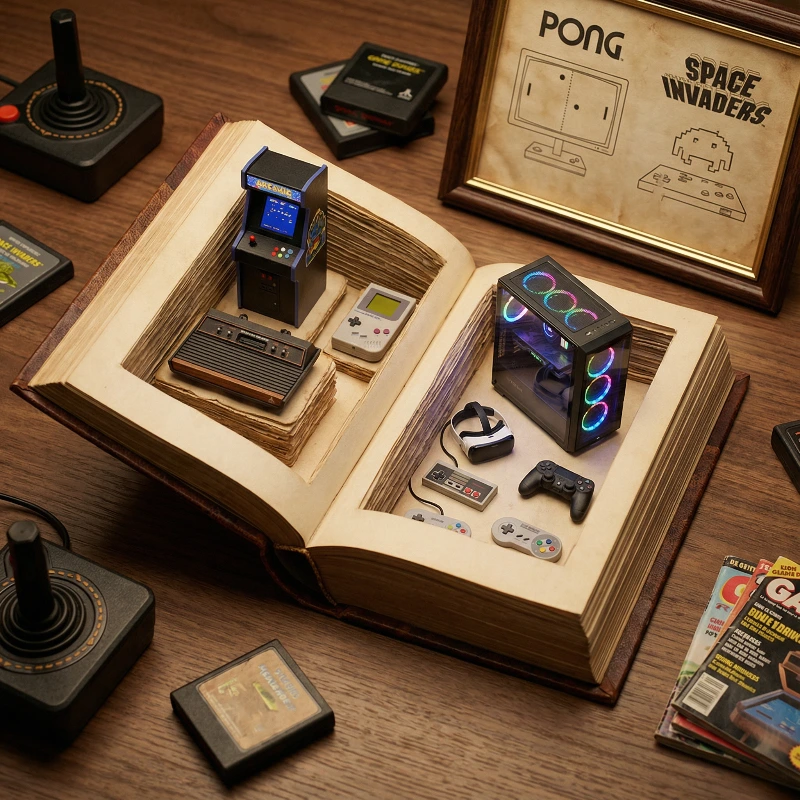
do this for history of gaming: <instructions> role: act as a world class level visual artist and history buff. Input a: topic instructions: draw a detailed photograph of an open antique book serving as a diorama for [input a] history with relevant elements (e.g. space model and small astronauts, space food) set against various [input a] illustrations and objects showing the history of [input a] Output: one image </instructions>
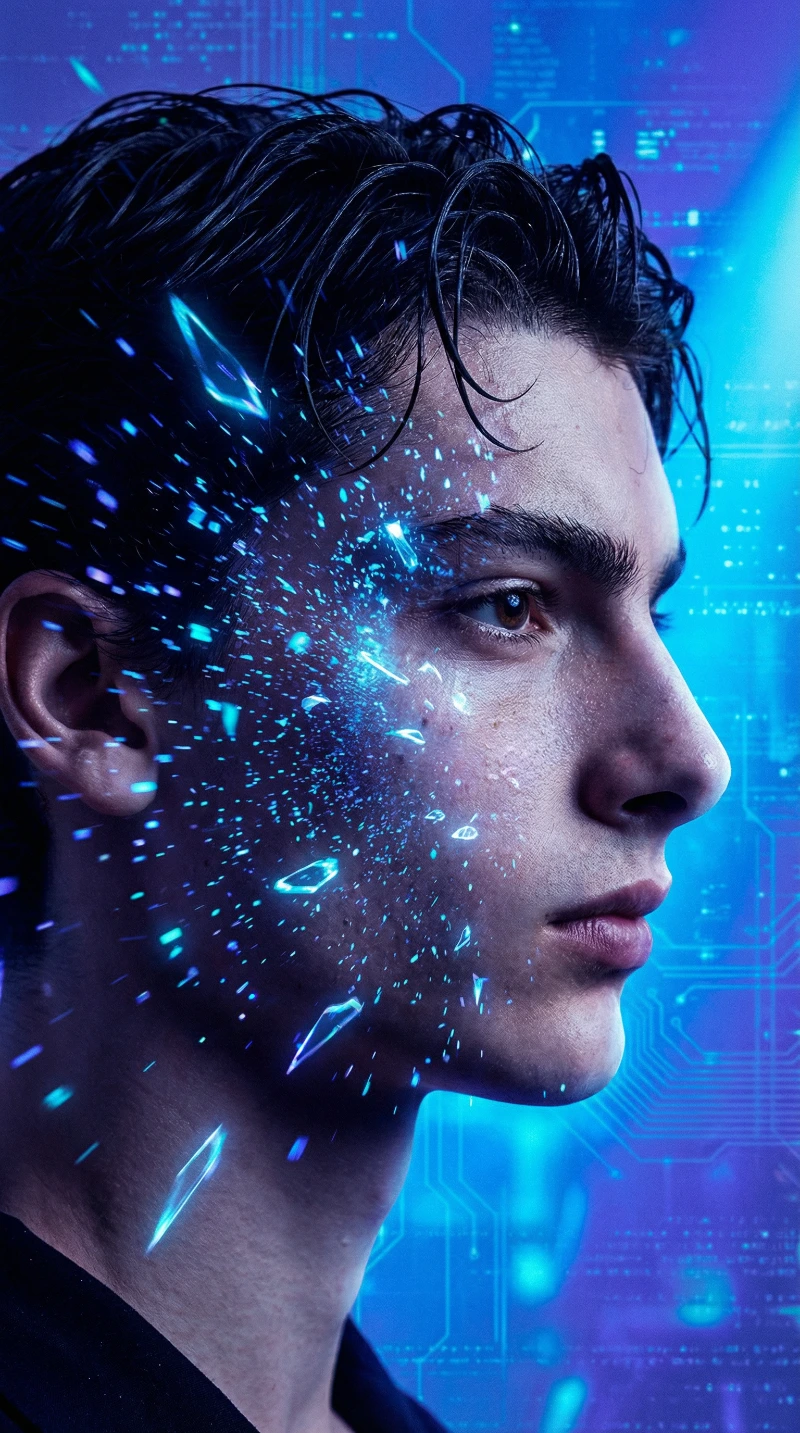
Convert this image into a futuristic sci-fi editorial portrait, (use the same face as the uploaded photo), 9:16 vertical aspect ratio, featuring a sharp head-and-shoulders profile of a young man looking to the right. The background is an abstract neon-blue and indigo color wash with faint digital noise. Fragmented light particles and luminous shards explode outward from the facial contour and hairline, creating explosive forward motion and modern visual intensity. Directional spotlight illumination, HDR-style cinematic contrast, commercial-grade image quality with a sleek editorial finish.
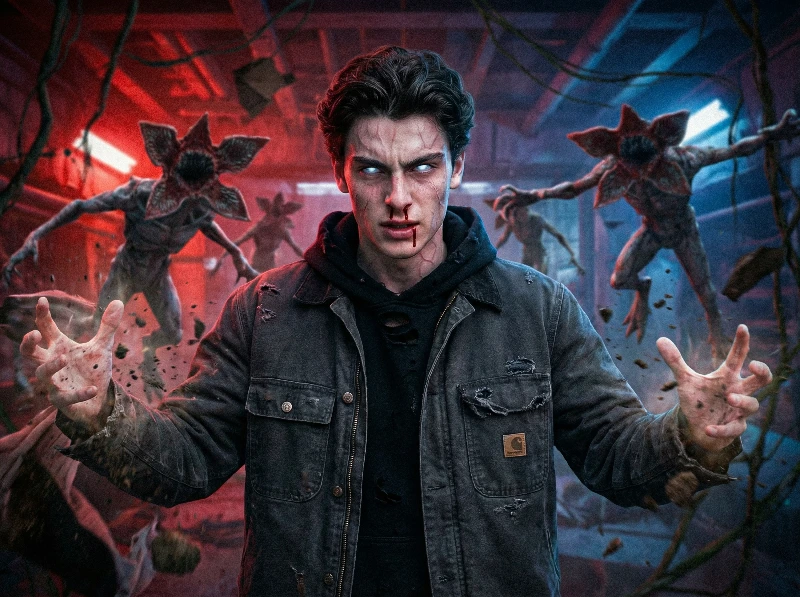
The man in reference faces a group of advancing creatures stranger thinks, using powerful telekinetic abilities to defend himself. Eyes: glowing white, veins visible, blood slowly running from his nose. Outfit: dark charcoal hooded jacket, thick canvas fabric, torn and soaked; black hoodie underneath ripped at the shoulders; dark pants torn at the thighs; boots coated in ash-like residue. His clothes lift slightly as energy radiates from his body. Several creatures are pushed back mid-step, claws raised, bodies partially lifted by invisible force. Environment: Upside Down chamber, organic walls cracking, debris and vines levitating violently. Lighting: violent red and blue contrast, flickering practical light sources. Camera: close-medium shot, handheld, shallow focus, imperfect exposure. Feels like a climactic Stranger Things battle frame.
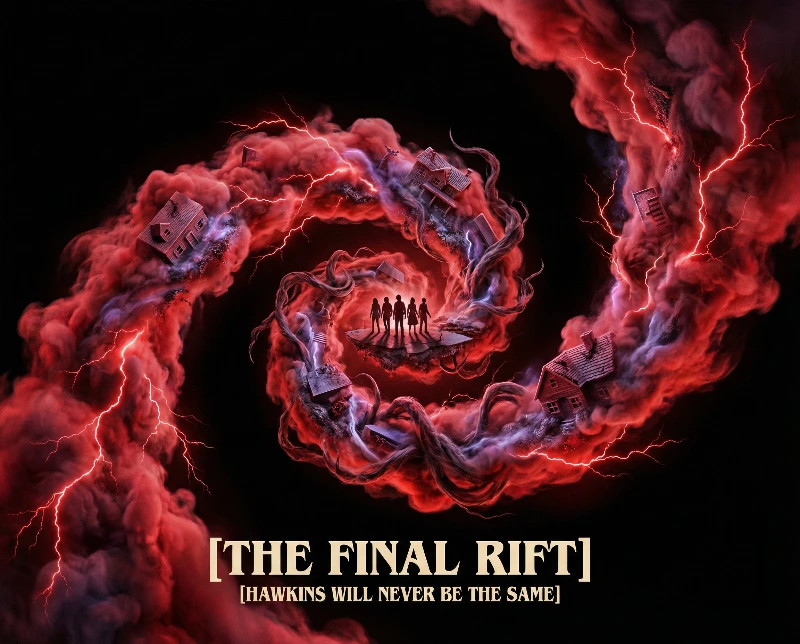
A [MACRO MEDIUM - billowing crimson smoke mixed with electric ash], captured mid-motion, forming a dynamic [SHAPE - violent rift-like spiral] from the lower left to the upper right. Suspended within the [TEXTURE/MATERIAL - dense smoke threaded with crackling red lightning] lives a miniature world of [MICRO SUBJECT - the collapsing town of Hawkins between realities], rendered as highly detailed structures sculpted entirely from the [MACRO MEDIUM] itself. Inside the [MEDIUM]: [DETAIL 1 - fractured suburban houses being pulled upward], [DETAIL 2 - twisted organic tendrils creeping through streets], and [DETAIL 3 - a small group of silhouetted teenagers standing united at the center]. The forms appear [ADJECTIVE - ominous, unstable, pulsating], strictly defined by the physics of the [MACRO MEDIUM]. Style: [PHOTOGRAPHY STYLE - cinematic macro narrative photography] fused with [ARTISTIC GENRE - dark sci-fi horror realism]. High emphasis on texture, lighting, and material contrast. Color palette: [COLORS - blood red, charcoal black, sickly purple, cold blue highlights] derived naturally from the material. View & background: Plain, matte [BACKGROUND COLOR - absolute black] to create maximum contrast. Minimalist composition. Typography: Title: “[TITLE - The Final Rift]” Subtitle: “[SUBTITLE - Hawkins Will Never Be the Same]” Font style: [FONT DESCRIPTION - bold retro serif inspired by 1980s horror film titles] placed cleanly in the negative space. Composition rules: The [MEDIUM] creates a defined boundary. All details remain strictly inside the stroke/flow; nothing exists in the negative space. 8K, hyper-realistic texture, [LIGHTING STYLE - high-contrast cinematic lighting with red underglow and deep shadows].
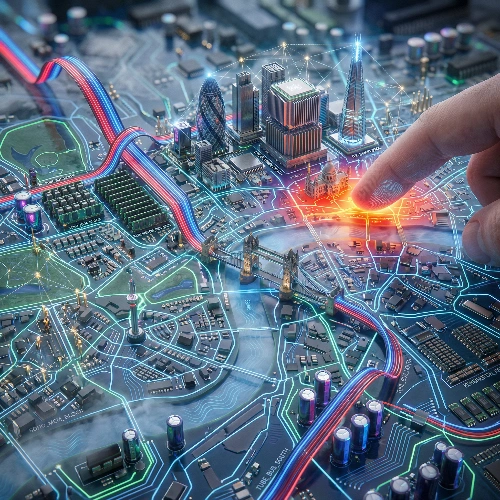
Do this for London: Input Variable: [INSERT CITY NAME] (e.g., Tokyo, Chicago, Rio de Janeiro) System Instruction: Generate a hyper-detailed "Smart City Circuit Board" macro shot. The Concept: The city is a living motherboard. Every urban element is translated into a piece of computer hardware. 1. Urban Translation Analyze the City: Identify the geography (Hills, Water, Grid) and landmarks. Landmarks (The Processors): The iconic buildings act as the "CPUs" or "GPUs." They are the tallest, most intricate metal components. Neighborhoods (The Memory): Residential areas are dense grids of RAM Sticks or Resistor Arrays . Power Grid (The Capacitors): Industrial zones or power plants are represented by cylindrical Capacitors . 2. The Micro-Infrastructure Layer The Transit (The Bus): Train lines and subways are represented by Ribbon Cables arching over the board or buried under the surface layer. The Connectivity (Wi-Fi): Do not just show streets. Show Gold Pins sticking up from rooftops representing antennas. Faint holographic lines connect them (The Network). The Weather (Cooling): If the city is foggy/cloudy (e.g., SF/London), use Dry Ice Fog drifting over the board (simulating Liquid Nitrogen cooling). 3. The Interaction The Hand: A giant finger touches a specific district. The "Boot Up": The touch creates a Heat Map effect. The area under the finger glows Hot Orange/Red, fading to Cool Blue further away. This simulates "System Load" or population density. 4. Visual Syntax: Texturing: The "Water" areas shouldn't just be empty. They should look like Exposed Fiberglass Substrate with faint wave patterns etched into the resin. Labeling: Tiny white silk-screened text on the board identifies neighborhoods (e.g., "SOHO_V1.0", "SHINJUKU_PORT_A"). 5. Lighting & Atmosphere: Glow: Every street trace has a faint bioluminescent pulse. Reflectivity: High gloss. The city looks wet or polished. Output: ONE image, 1:1 Aspect Ratio, Macro Tech Photography, 8k Resolution.
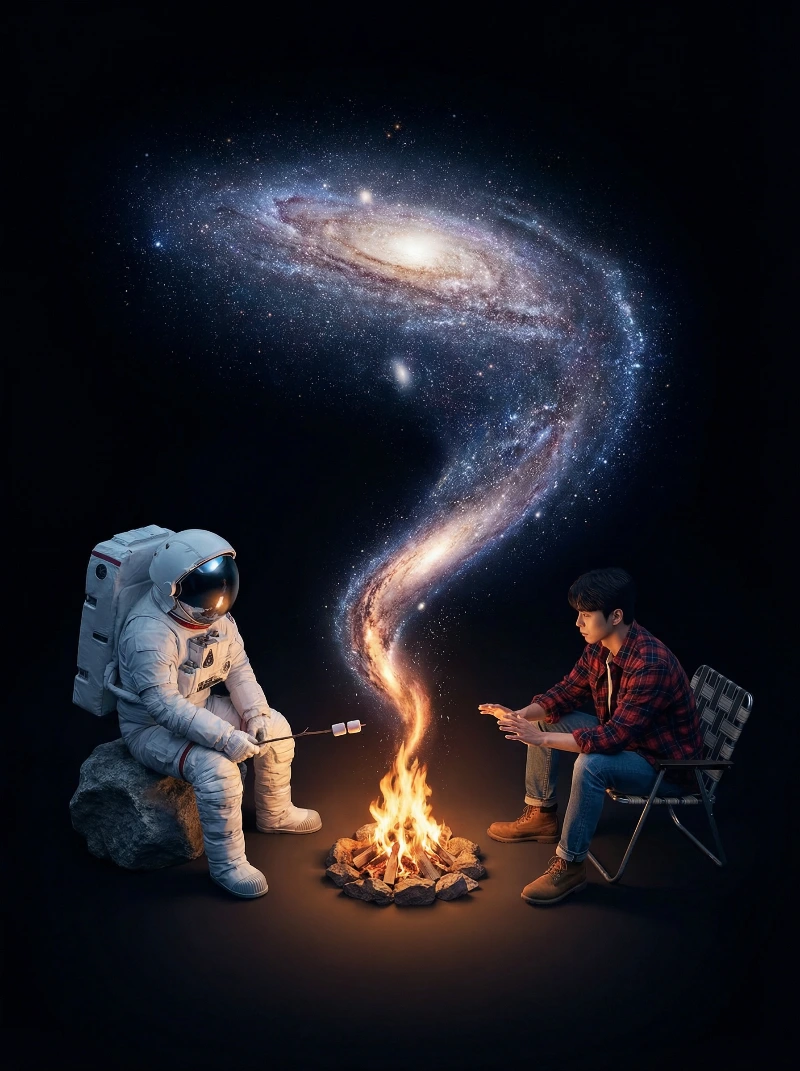
{ "type": "image_generation_prompt", "style": "surreal, cinematic, conceptual art", "camera": { "angle": "high-angle", "shot": "full shot", "composition": "symmetrical balance with central campfire dividing two characters", "background": "pitch-black void with no visible environment" }, "scene": { "setting": "abstract cosmic space", "environment": "dark void emphasizing isolation and contrast", "resolution": "8k", "render_style": "photorealistic" }, "characters": [ { "position": "left", "subject": "astronaut", "pose": "sitting", "seat": "rough gray rock", "appearance": { "suit": "highly detailed realistic white space suit", "helmet": "on, reflective visor" }, "action": "holding a stick and roasting a marshmallow over the fire" }, { "position": "right", "subject": "young man", "pose": "sitting and leaning forward", "seat": "metal folding chair", "appearance": { "hair": "dark hair", "clothing": { "top": "red and black plaid flannel shirt", "bottom": "blue jeans", "footwear": "brown boots" } }, "action": "warming hands by the fire" } ], "central_element": { "object": "campfire", "style": "magical and surreal", "fire_behavior": "flames transition seamlessly into a spiral galaxy", "galaxy": { "type": "photorealistic spiral galaxy", "details": [ "glittering stars", "cosmic dust", "swirling motion" ], "shape": "arching overhead like a celestial canopy" } }, "lighting": { "primary_light": "warm orange glow from the campfire", "secondary_light": "cool blue and purple glow from the galaxy", "mood": "dramatic, cinematic, ethereal", "shadows": "soft but deep, emphasizing contrast" }, "color_palette": { "dominant": ["black", "orange", "blue", "purple"], "accent": ["white", "red", "brown"] }, "themes": [ "human connection", "cosmic wonder", "contrast between the ordinary and the infinite", "shared warmth in an infinite universe" ], "quality_tags": [ "ultra-detailed", "photorealistic textures", "cinematic lighting", "sharp focus", "high dynamic range" ] }

A hyper-realistic 8K close-up portrait of a person's head and upper neck, shot from a slightly low-angle perspective looking upward. Use the uploaded image as the face reference - the face must match 100% exactly (same identity, facial structure, proportions, skin details, and expression). Do not alter the face in any way. The subject is wearing bright yellow sunglasses with reflective lenses showing colorful abstract digital scenes in shades of pink, blue, and yellow. The face is rendered in detailed grayscale, showing realistic skin texture, pores, and light stubble on the jawline, creating strong contrast with the rest of the head. The hair and most of the head and neck are made of glowing digital circuit patterns, abstract shapes, lines, and data streams in vibrant colors like magenta, cyan, blue, green, yellow, and orange. These elements appear layered and complex, with a soft internal glow. Parts of the digital head are breaking apart and dissolving outward into pixels, lines, and glitch fragments that fade into a clean white background, giving a glitch-art, futuristic look. Cinematic lighting highlights one side of the face, with shadows under the chin and subtle rim lighting around the digital elements. Overall style is futuristic, cyber-inspired, high-detail, and photorealistic.
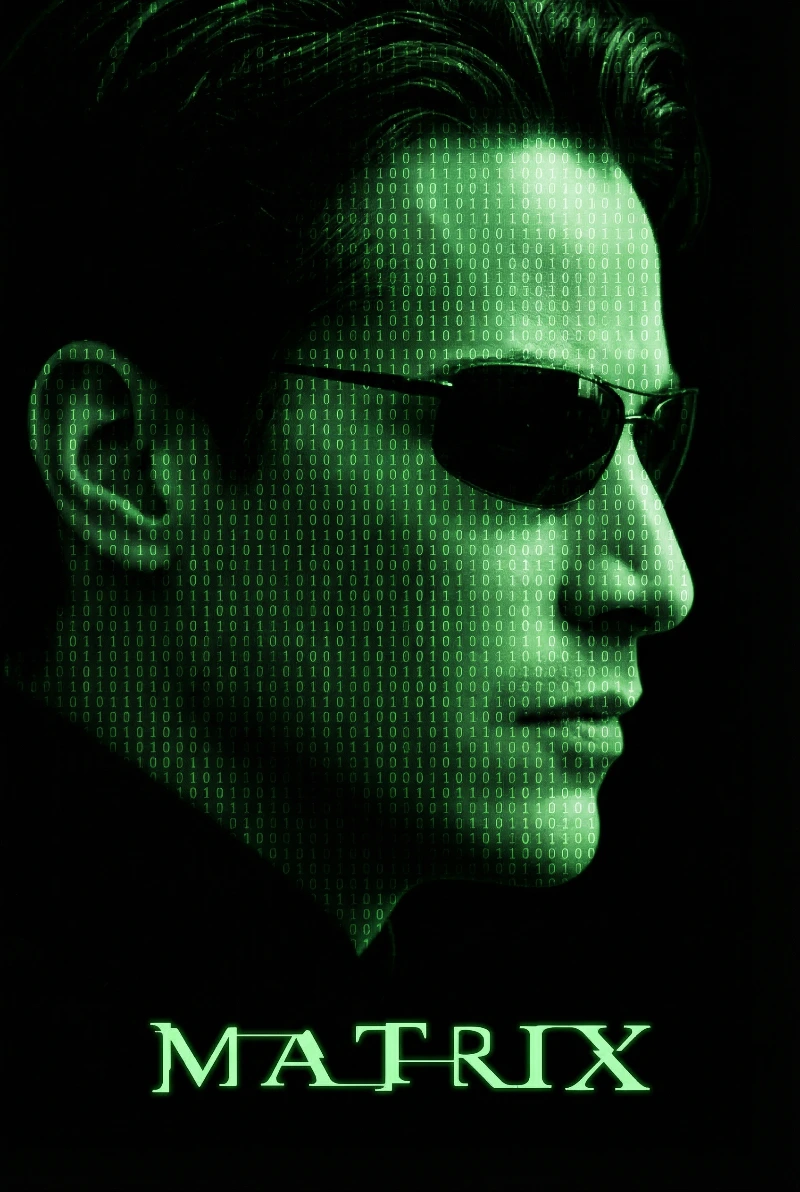
A minimalist movie poster for The Matrix. The central focus is a side profile close-up of Neo, meticulously constructed entirely from cascading green digital 0s and 1s. The glowing green digits vary in brightness to define his facial features and iconic black sunglasses. The background is a void-like deep black. At the bottom, the title "Matrix" is written in its signature futuristic green font. Cinematic lighting, sharp digital rain effect, high-resolution graphic design, professional editorial layout. Negative Prompt: (realistic skin, colorful, human features, 3D render, photograph, messy, blurry, low resolution, white background, orange, red, multiple people, bad typography, misspelled title).
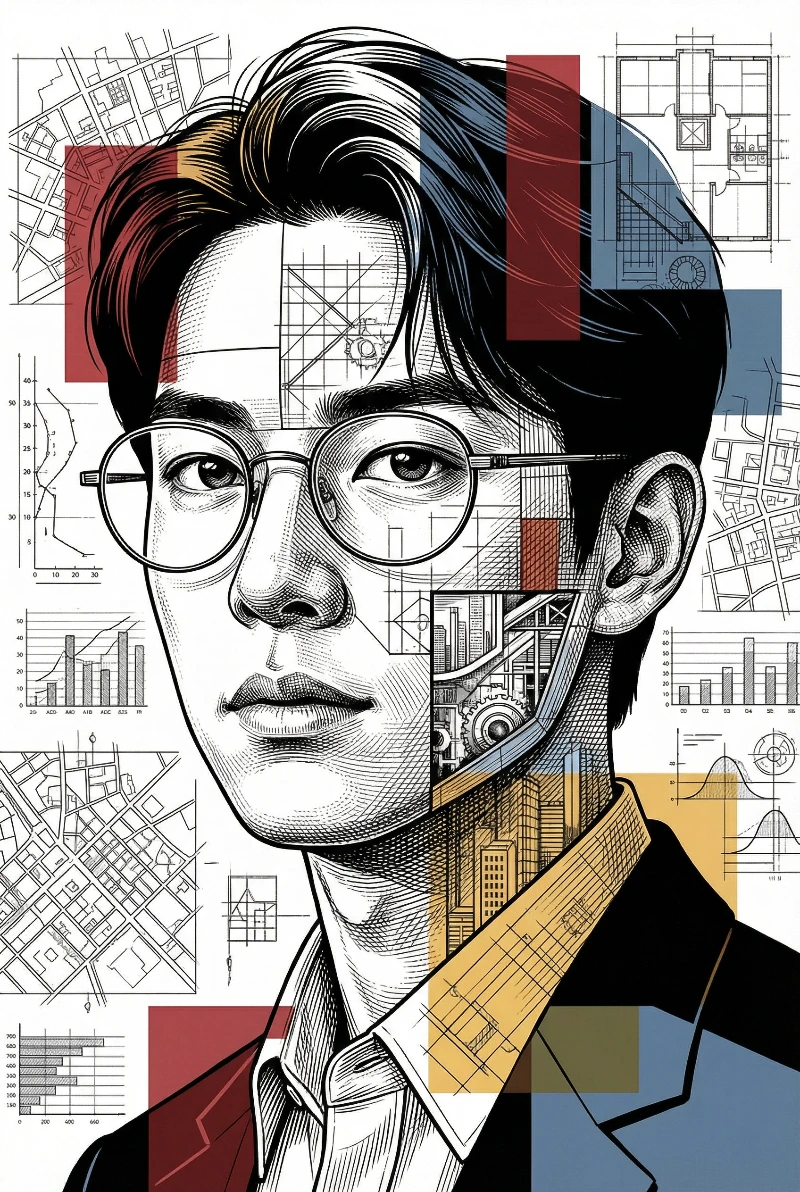
{ "prompt": "Ultra-detailed stylized portrait using my face as reference. Intellectual, modernist illustration style inspired by architectural blueprints and editorial line art. Face split into layered geometric sections with visible technical diagrams, city interiors, structural grids, and abstract architectural elements embedded within the facial planes. Fine ink linework, cross-hatching, and engraving-style shading. Clean white background with dense black line drawings.\n\nBold accent colors only in selected regions: deep red, muted blue, and warm yellow, applied as flat graphic blocks and translucent overlays. Sharp, thoughtful eyes with realistic highlights, wearing thin round glasses. Minimalist yet complex composition, high contrast, crisp edges, poster-grade clarity.\n\nEditorial illustration aesthetic, conceptual portrait, futuristic intellect vibe, data visualization meets human identity. Extremely sharp, ultra-high resolution, professional magazine cover quality, no blur, no distortion, balanced symmetry.", "negative_prompt": "photorealism, soft blur, painterly strokes, oil painting, low detail, messy colors, cartoonish style, exaggerated proportions", "style": [ "modernist illustration", "architectural blueprint", "editorial line art", "engraving", "conceptual portrait", "futuristic intellect" ], "color_palette": { "accent_colors": [ "deep red", "muted blue", "warm yellow" ], "base_colors": [ "black", "white" ] }, "composition": { "background": "clean white", "symmetry": "balanced", "contrast": "high", "detail_level": "ultra-detailed", "resolution": "ultra-high" }, "quality": [ "poster-grade clarity", "professional magazine cover", "extremely sharp", "no blur", "no distortion" ] }
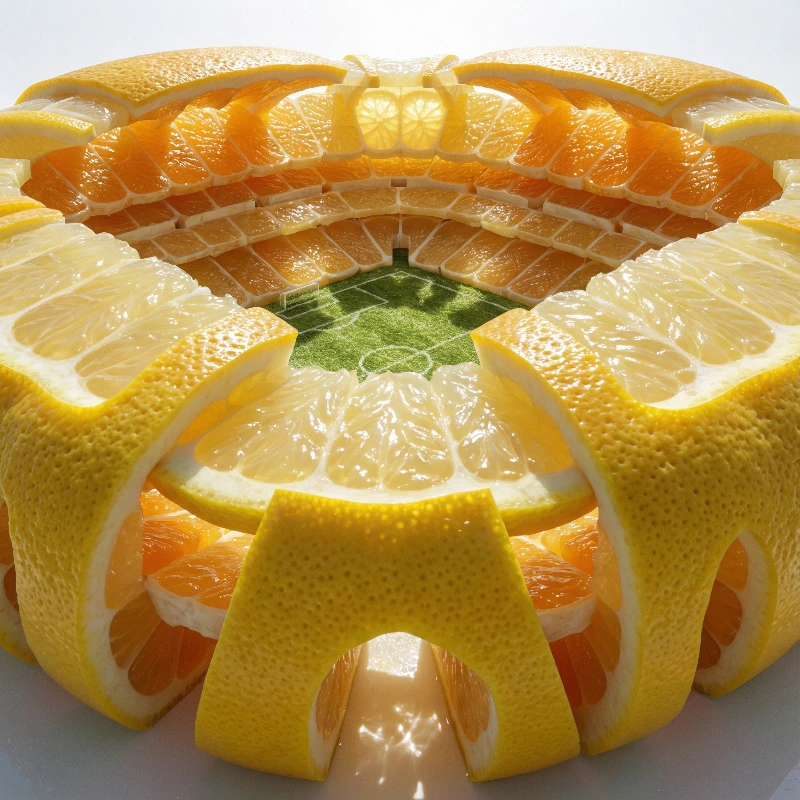
Anchor: [a famous Spain Stadium]::3 Morphology: Segmented citrus geometry, radiating fruit carpentry, rind exoskeleton, pulp-filled seating arrangments::3 Material Physics: Translucent lemon pulp, glistening juice vesicles, porous yellow rind texture, wet organic surface::2.5 Illumination: High-key daylight, subsurface scattering through pulp, bright caustic refraction::2 Render Stack: Macro-architectural fusion, hyper-realism, wet lens effect, wide angle::1 Negative: [Concrete, dry, plastic, grey, bleachers, steel beams]:: -1
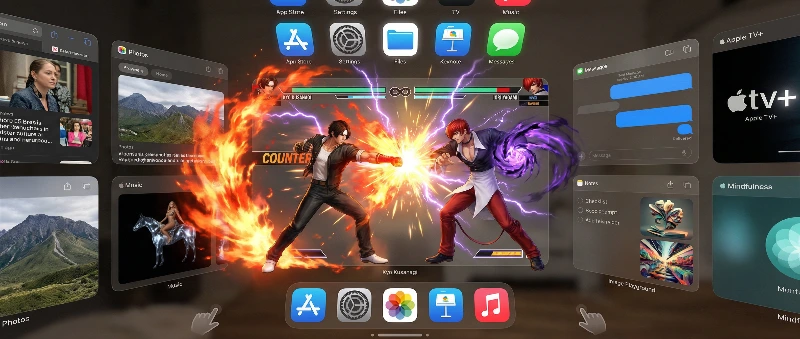
Highly detailed photorealistic screenshot of Apple Vision Pro visionOS 26 operating interface from user's first-person immersive view, spatial computing home screen, CENTER FOCUS: TWO LARGE 3D VOLUMETRIC HOLOGRAPHIC KING OF FIGHTERS CHARACTERS in INTENSE COMBAT ACTION, Kyo Kusanagi throwing fiery crimson flames punch toward Iori Yagami blocking with purple energy, explosive impact moment with MASSIVE FIRE EFFECTS orange red flames bursting, PURPLE LIGHTNING dark energy, bright yellow white IMPACT SPARK EXPLOSION between them, energy shockwaves radiating, dramatic motion blur showing speed, life-sized 3D fighters jumping OUT OF SCREEN with strong depth, naked-eye 3D stereoscopic effect protruding forward, volumetric flames casting dynamic colored lighting onto windows, LEFT SIDE windows: Safari browser window with multiple tabs and news content on upper left, Photos app window showing mountain landscape on middle left, Music app window with Beyoncé Renaissance album artwork on lower left, RIGHT SIDE windows: Messages window with blue chat bubbles on upper right, Notes window with checklist on middle right, Image Playground window showing generated images in Animation/Sketch/Illustration styles with prompt field on lower right, ADDITIONAL windows: Apple TV+ preview window, Mindfulness app with glowing breathing orb, small floating windows balanced on both sides, UPPER AREA: curved grid of volumetric glowing app icons (App Store, Settings, Files, Keynote, Messages icons) arranged symmetrically, LOWER AREA: another row of app icons (App Store, Settings, Photos, Keynote, Music icons) centered below, semi-transparent KOF game UI with health bars and COUNTER text behind 3D fighters, hand gesture pointers visible at bottom corners, semi-transparent frosted glass material on all windows, 3D fire effects and fighters casting volumetric shadows and colored reflections on surrounding windows symmetrically, strong spatial depth with balanced composition, ultra-sharp micro-OLED display, vibrant Apple minimalist UI, dramatic cinematic lighting with fire glow illuminating entire scene symmetrically, wide immersive 21:9 format, photorealistic spatial computing with LEFT and RIGHT sides equally populated with app windows
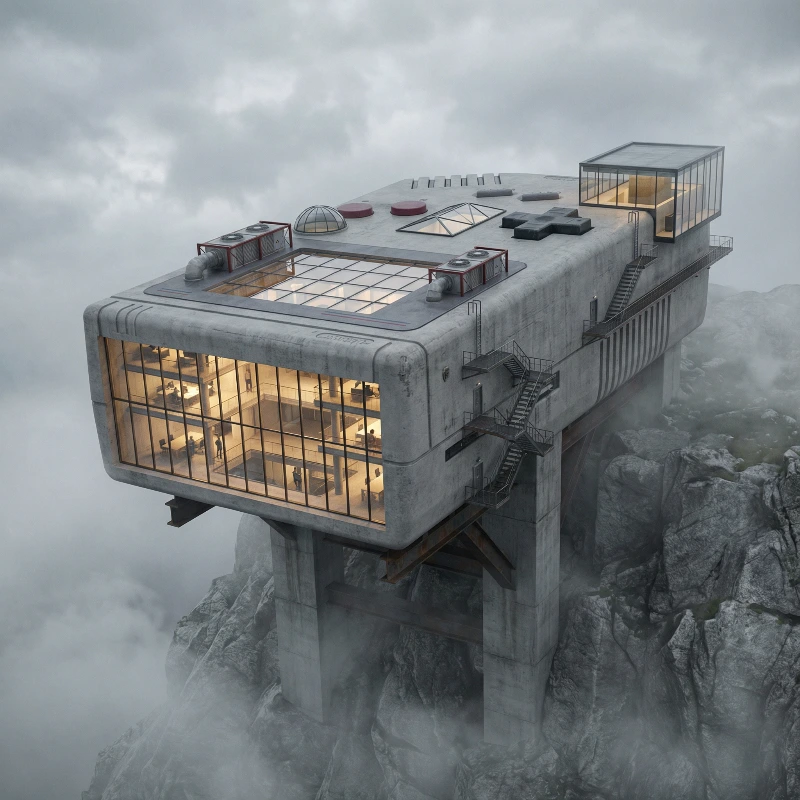
Input A: Gameboy <instruction> 1. Engine: Input A is a Handheld Object or Appliance (e.g., DSLR Camera, Game Boy, Sneaker, Retro Radio). Deconstruct the object into 3 Architectural Functions: The Aperture (The Glazing): Identify the primary glass or screen element (Lens, Screen, Dial). Transform this into a massive, multi-story Panorama Window or Atrium. The Interface (The Roof Deck): Identify the buttons, dials, or switches on the top surface. Transform these into Skylights, Observation Domes, or HVAC Units. The Texture (The Cladding): Analyze the object's surface material (e.g., Pebbled Leather, Matte Plastic, Canvas). Scale this texture up to become the building's exterior siding or concrete facade. The "Immutable" Container (The Site): Goal: A "Gigantism" Architectural Visualization. The Location: A dramatic, isolated Cliffside or Mountain Peak. The Foundation: The object does not sit flat. It is Cantilevered over the edge of the precipice, supported by massive brutalist Concrete Pylons or steel I-beams that anchor it to the rock face. The Weather: Heavy, atmospheric Fog/Mist. The background is obscured, forcing focus on the silhouette of the structure. The Architecture (The Conversion): The Scale Modifiers: Graft human-scale architectural elements onto the giant object to sell the illusion of size. External: Metal fire-escape staircases clinging to the side, safety railings along the edges, and roof access ladders. The Penthouse: A modern glass-box addition built onto the top of the object (e.g., atop the camera flash or handle) to break the silhouette. The Interior: The "Aperture" (Window) must be transparent. Inside, visible warm interior lighting reveals multiple floors, modern furniture, and silhouettes of people, proving the object is habitable. The Narrative Atmosphere (The Mood): Lighting: Nordic Noir. Exterior: Cold, diffuse, soft grey daylight (Overcast). Interior: Warm, inviting Tungsten (3000K) glow spilling out from the lens/window into the fog. Palette: Desaturated Greys, Blacks, and Slate Blues, contrasted only by the warm interior light. Output: ONE image, 1:1 Aspect Ratio, Photorealistic ArchViz Render (Corona/V-Ray style), "Unreal Estate" aesthetic. </instruction>
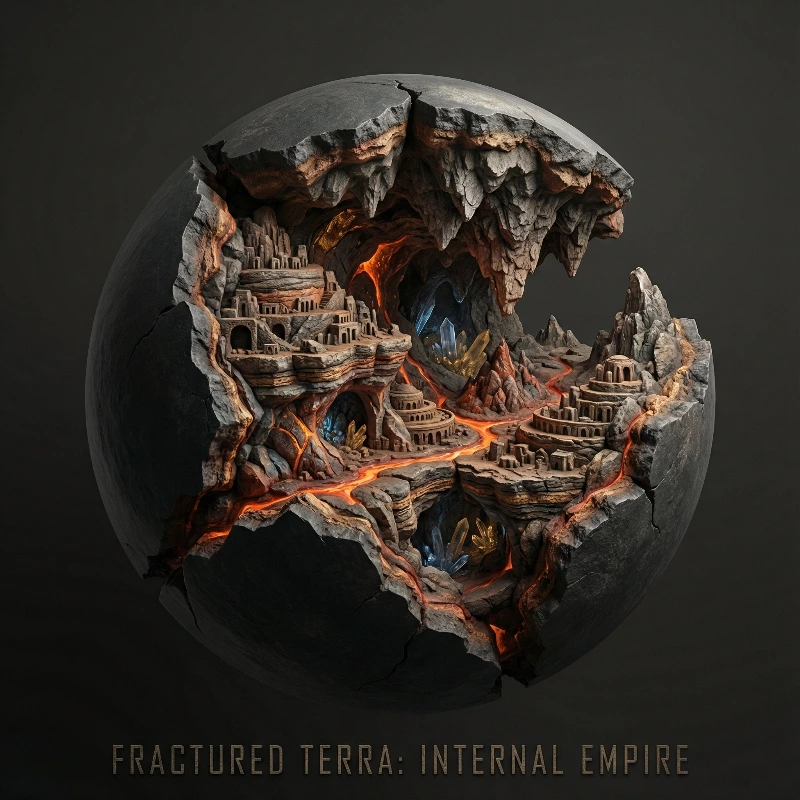
A single [OBJECT - fractured terrestrial planet] suspended in space, frozen at the moment it splits open along tectonic fault lines. Inside the fracture exists a fully realized miniature [INNER WORLD / STRUCTURE - self-contained planetary interior civilization layered by geology and climate] — carved, layered, and constructed entirely from [OBJECT MATERIAL - planetary rock, compressed sediment, crystal veins, and molten mineral]. Internal elements include [ICONIC FEATURES / MICRO-STRUCTURES - terraced underground cities carved into strata, glowing magma rivers acting as transport arteries, crystalline caverns forming energy cores, inverted mountain ranges, atmospheric chambers with floating ecosystems], arranged with clear spatial logic and physical coherence. Intricate forms, repeating patterns, and emergent architecture grow organically from the break, featuring depth, cavities, negative space, and internal structural rhythm. Hyper-detailed 3D bas-relief fused with fine-art poster design. Material realism emphasized — [MICRO-TEXTURES, WEAR, AGING DETAILS - eroded stone edges, mineral grain fractures, sediment layering, pressure cracks, heat-scorched surfaces], subtle imperfections visible at macro scale. Monochrome or tightly controlled palette derived from [MATERIAL COLOR RANGE / AGED TONES - basalt black, oxidized rust red, ash gray, muted mineral gold]. Isolated object, neutral negative space, museum-grade lighting. All complexity exists strictly inside the fractured volume. Exterior remains clean, minimal, and untouched. Ultra-high resolution, dramatic realism, gallery-poster quality.
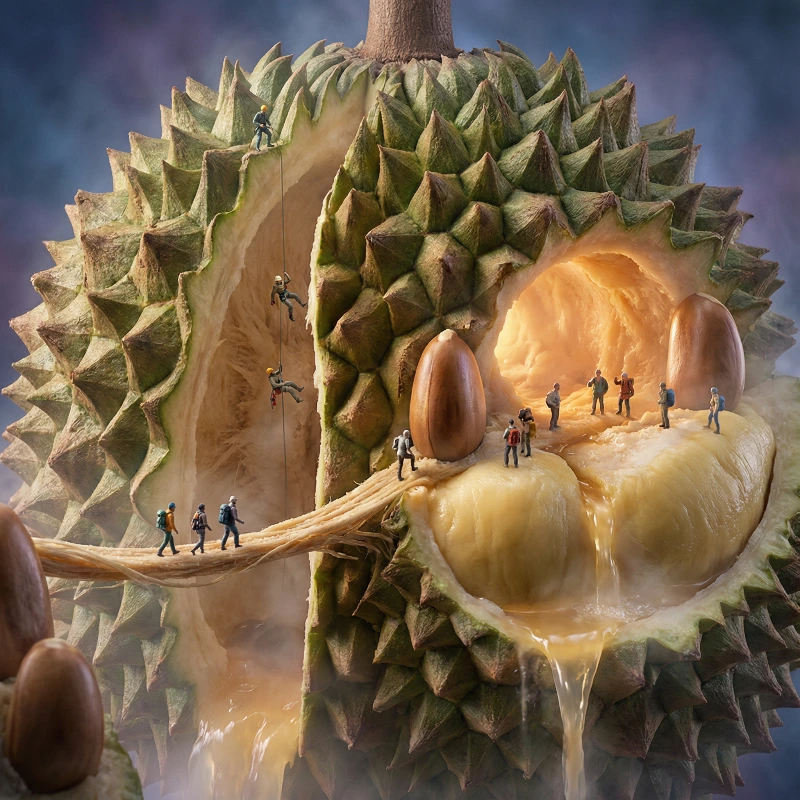
A colossal [Durian] fills the frame like an entire world, so massive it feels planetary rather than edible. Tiny humans—microscopic explorers—are climbing, walking, and exploring its surface as if on a legendary expedition. The natural texture of the fruit becomes the terrain: skin turns into cliffs, seeds become monoliths, fibers form bridges, and juice flows like rivers and waterfalls. Some explorers rappel down steep edges, others disappear into glowing fruit caverns where the flesh is exposed. Light passes through the fruit, making it glow from within, creating a surreal, dreamlike atmosphere. Hyper-real macro textures, god-scale perspective, extreme depth of field, cinematic lighting, surreal realism, ultra-detailed, 8K, HDR, global illumination, atmospheric mist, clean background fading into soft haze, no text, no watermark.