
Reference Images:
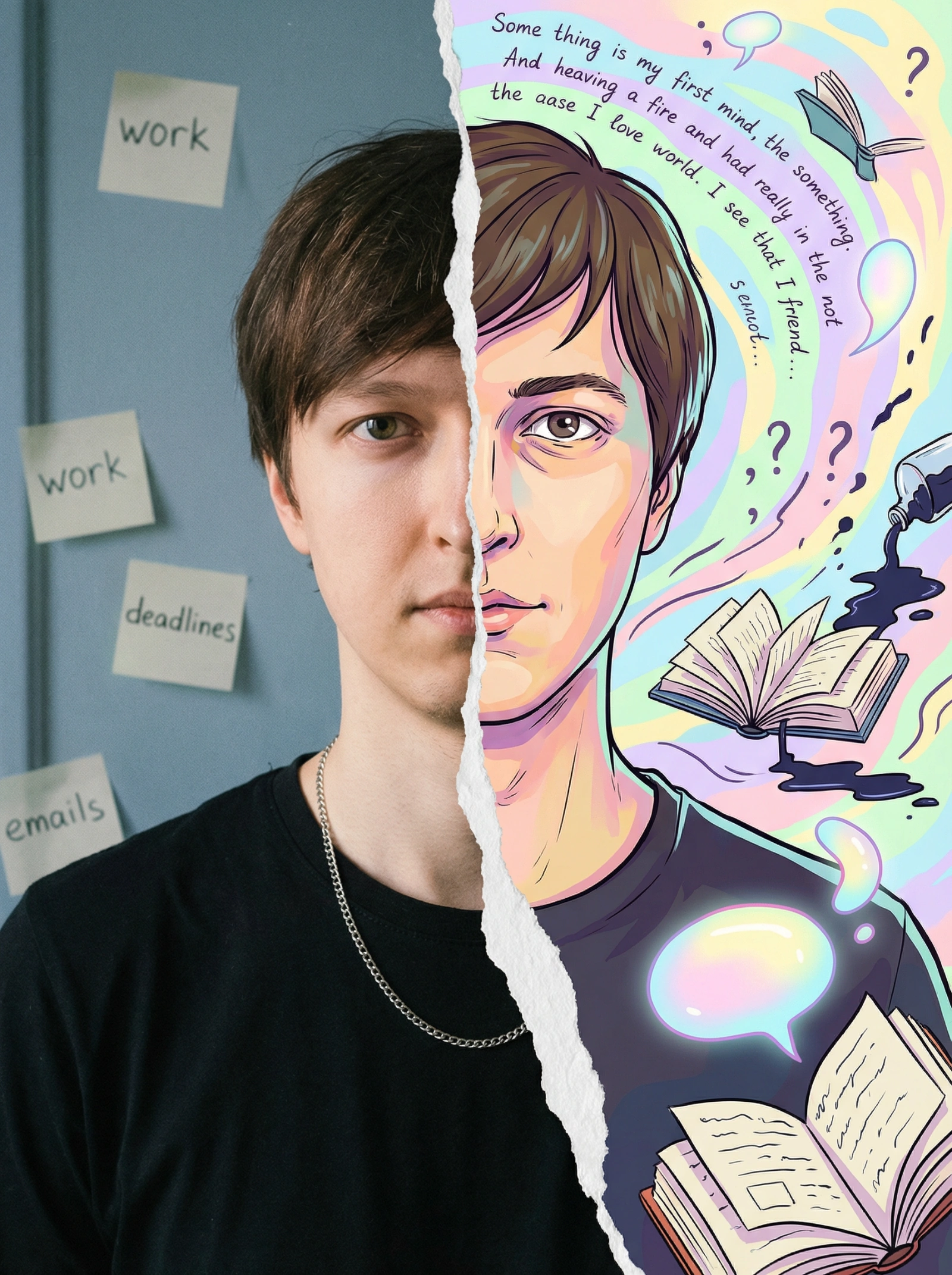
Dual Realms Portrait
Prompt
Chest-up portrait of a man with 100% identical facial accuracy to the reference image, same pose and lighting preserved perfectly. The image is split vertically by an uneven torn-paper rip down the center. Left side (Reality): Hyper-realistic portrait with soft indoor lighting, neutral bluish background, subtle analog grain. The subject wears a simple black T-shirt and silver chain. Minimalist environment. Handwritten sticky notes float faintly in the background with barely readable words like “work”, “deadlines”, “emails”. Right side (Inner Monologue): Stylized illustrated version of the same face in a surreal poetry-comic style. Bright pastel background filled with drifting handwritten sentences, floating punctuation marks, open books, ink spills, glowing thoughts, and abstract speech bubbles. Lines are expressive and bold, colors vibrant but harmonious. Overall tone: introspective, creative, emotionally intelligent. Ultra-high-resolution, seamless blending, crisp tear edge.
Aspect Ratio
Model
Nano Banana ProYou might also like
Sensual Low Squat Fashion Port
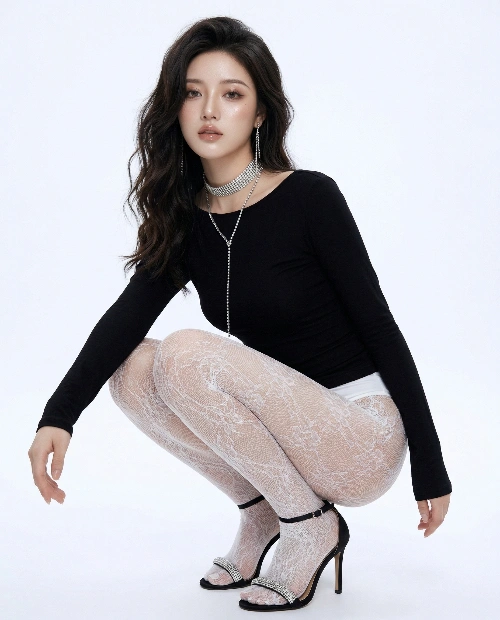
Using the real female subject you uploaded as the visual baseline, generate an ultra-high-detail, photography-grade realistic fashion portrait. The image should focus on a dynamic low squatting pose, presenting a sensual yet high-fashion outfit against a pure white soft-lit background. The overall mood should blend sensuality, confidence, and avant-garde fashion, with detail rendered to an extreme 8K level. Character Baseline and Styling Baseline: Strictly follow the facial features, structure, and personal aura of the woman in the uploaded image. Her distinctive facial contours must be clearly recognizable. Expression: Sensual and confident, with slightly parted lips. Makeup should be a captivating nude glam style, emphasizing highlighted cheekbones, subtly smoky eye makeup, and glossy, hydrated lips. Hairstyle: Voluminous, softly curled long hair, styled into loose waves, side-parted and falling naturally over the shoulders. Clothing, Accessories, and Pose Outfit: Top: A minimalist black long-sleeve top with a wide neckline. Bottom: Paired with white underwear, layered with white lace tights covering the legs and feet; the lace should display a delicate semi-transparent texture. Footwear: A pair of black stiletto heeled sandals, featuring ankle straps and embellished toe straps with sparkling accents, worn over the lace tights. Accessories: Necklaces: A bold, sparkling rhinestone choker, paired with a long, slender Y-shaped necklace extending down toward the abdomen. Earrings: A pair of long dangling earrings. Pose: The subject is in a low squatting position. The right leg is deeply bent, while the left leg casually crosses over the right thigh. The right arm is extended to support the body on the ground, and the left hand rests loosely near the knee. The pose should convey strong balance, dynamic tension, and a sense of relaxed elegance. Environment and Lighting Environment: A clean white seamless studio background with soft diffusion, free of any distractions. Lighting: Bright, even studio lighting. The light should clearly define the body contours, the intricate textures of the clothing (especially the lace), and produce precise highlights and reflections on accessories such as rhinestones and metal, creating a clean, bright, and layered lighting effect. Composition and Image Quality Composition: Medium-to-close framing, focusing on the pose and upper body. The camera angle is slightly top-down to enhance the compositional tension and visual impact of the squatting pose. Technical: Photorealistic, ultra-detailed style. Sharp focus is required, accurately rendering all complex materials including skin texture, hair strands, lace patterns, jewelry facets, and the sheen of the footwear. Image Quality: 8K ultra-high resolution with extremely rich detail. The image must be clean and sharp, achieving the level of polish and artistic quality of top-tier fashion editorials. Mood and Style Overall Style: Sensual, high-end, avant-garde fashion editorial aesthetic. Atmosphere: Within a minimalist setting, use pose, lighting, and fine detail to convey a controlled sensual allure and an effortlessly rebellious fashion attitude.
Elegant Home Fashion Portrait
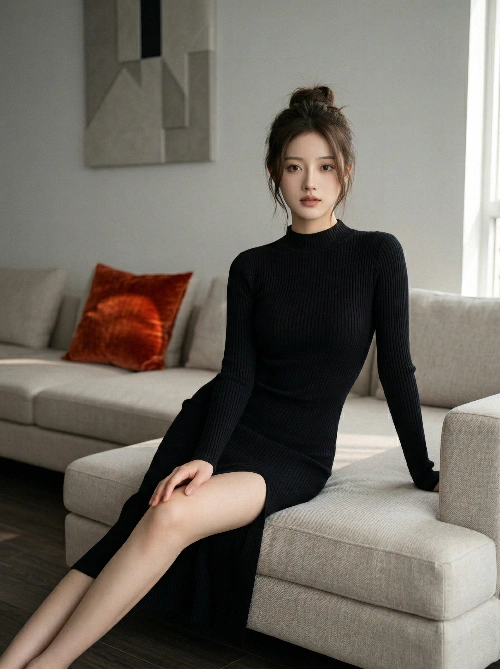
Core Concept Using the uploaded real female subject as the visual reference, generate a magazine-quality fashion indoor portrait. The image should convey a calm, intimate, and luxurious modern atmosphere, capturing the subject’s elegant and relaxed state in a home environment, achieving the realism and artistic expression of high-end editorial photography. Subject Reference and Styling Reference: Strictly follow the facial features, body proportions, and personal aura of the uploaded subject. Emphasize refined facial structure and a slender, elegant figure. Expression: Calm with a subtle sense of focus; soft, confident, and slightly penetrating gaze directed at the camera, creating a delicate and intimate allure. Hairstyle: Long dark brown hair, loosely tied at the back into a slightly messy bun with natural volume, with a few loose strands falling along the sides of the face. Makeup and Accessories: Clean, natural makeup—almost no-makeup look. Accessories should be minimal, such as small earrings or none at all. Outfit and Pose Clothing: A black ribbed knit long-sleeve dress with a high neckline. The dress is form-fitting, contouring the body shape, with a high side slit that subtly reveals the leg depending on the pose. Pose: Seated gracefully on a light beige sectional sofa. The body is slightly angled toward the camera; one leg is bent and placed on the sofa, while the other extends forward, naturally revealing the leg through the slit. One hand rests casually on the bent knee, while the other is relaxed on the sofa cushion. The pose is composed, elegant, with a slight forward-leaning engagement. Environment and Lighting Environment: A modern interior living room. The background wall is gray-white, featuring a warm-toned abstract geometric artwork. The floor is dark wood. The space is clean and minimal, with a single accent color provided by an orange-red cushion on the sofa. Lighting: Soft natural daylight, simulating diffused light entering from a side window. Lighting is even with soft shadows, low to medium contrast. Color temperature is neutral-warm, creating a cozy and inviting atmosphere. Composition and Image Quality Composition: Medium-wide shot capturing the full seated pose on the sofa. The camera is positioned slightly above eye level with a subtle angle. Use the rule of thirds, placing the subject slightly to the right, balanced by the wall art. A slight foreground blur on the right edge (such as a wall or frame edge) can be included. Technical: Simulate a 35mm to 50mm lens perspective, with shallow to medium depth of field—sharp focus on the subject, slightly blurred background. Style and Quality: High-end fashion magazine photography style. Clean, ultra-high resolution image with neutral color grading, slightly warm highlights, and slightly reduced saturation for a refined, understated aesthetic. Avoid harsh shadows, overexposure, cluttered backgrounds, anatomical errors, low resolution, watermarks, or text. Mood and Atmosphere Overall Mood: Minimalist, fashionable, mature, and refined. Atmosphere: Calm, intimate, modern luxury—capturing an effortless sense of sophistication and the quiet charm of everyday living.
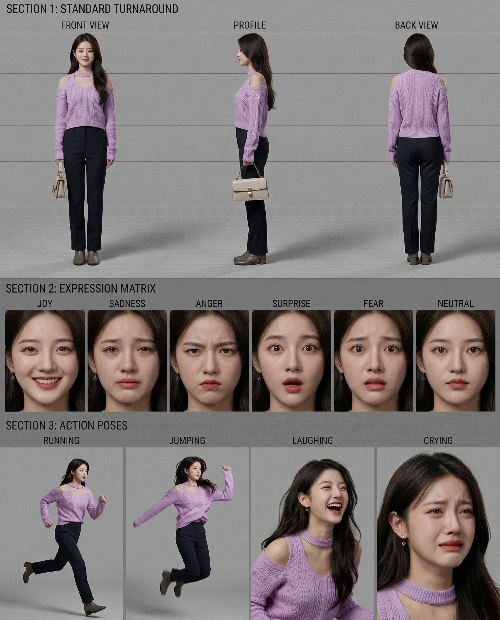
8K Cinematic Character Ref Sheet
[Core Visual Concept] Ultra-high-definition professional live-action character design sheet. Based on the character features from the reference image, create an industrial-grade visual reference set intended for big-screen film production. The overall style must be locked to photorealistic live-action photography, strictly prohibiting any anime or stylized rendering, targeting 8K cinematic-level detail fidelity. [Three Core Sections of the Design Sheet] 1. Standard Turnaround Sheet View Specifications: Includes full-body standing views of the character from three angles: front, profile (side), and back. Visual Alignment: All views must maintain perfectly consistent proportions, ensuring character height, facial feature placement, and clothing folds align precisely across angles. Background Setting: Clean industrial gray or neutral background with subtle physical shadows to enhance depth. 2. Expression Sheet Emotion Matrix: Showcase six fundamental emotional states under realistic lighting conditions: joy, sadness, anger, surprise, fear, and neutral. Facial Realism: Focus on capturing realistic facial muscle movement, including natural forehead lines, compression around the eyes, and dynamic lip changes, while preserving skin texture and pore-level detail. 3. Action Pose Sheet Typical Actions: Depict the character in representative cinematic motions, including running, jumping, laughing, and crying. Gravity and Dynamics: Emphasize the physical behavior of clothing under motion, including natural draping and tension in fabric, as well as accurate muscle engagement, creating an authentic captured-in-motion feel. [Character Attributes and Texture Constraints] Identity Consistency: Strictly replicate the facial features, skin tone, hair texture, and body proportions from the reference image. Prohibited Styles: Absolutely no cel-shading, exaggerated anime proportions, or flat color blocking. Lighting Quality: Use neutral global illumination to ensure consistent color and visible detail across all angles, suitable for 3D modeling reference. [Execution Instructions and Output Specifications] Composition: Clean and organized multi-panel layout. Image Quality: Ultra-high resolution, RAW photographic texture, 8K UHD.
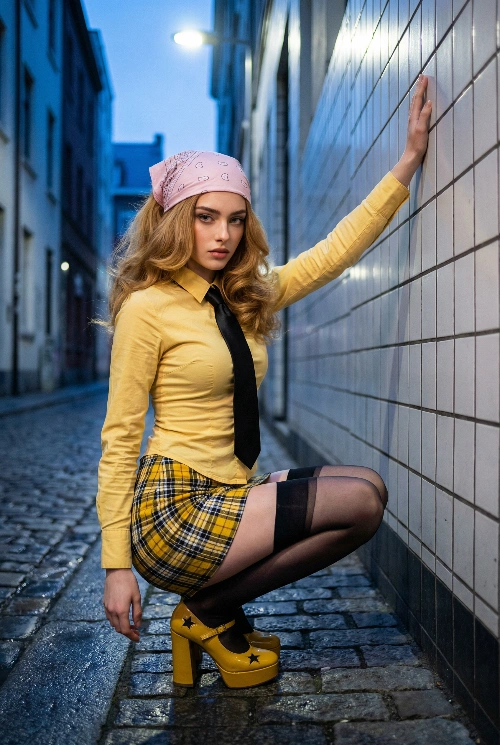
Cinematic Squat Fashion Portrait
{ "subject": { "identity": { "biometric_reference": "female from reference photo", "dentition": "Visible maxillary central incisors with natural alignment and translucent enamel edges, displayed in a slight mouth-open neutral expression.", "ocular_details": "Highly detailed iris patterns featuring radial furrows and Crypts of Fuchs. Iris pigmentation: Light cerulean blue with a hint of golden-green peripupillary ring. Detailed scleral vasculature and wet-look corneal reflections.", "hair": "Voluminous honey blonde hair (Hex: #E2BC74) with visible follicular texture, cascading naturally from under the bandana. Strands exhibit high specular highlights and anisotropic scattering." }, "body": { "morphology": "Mesomorphic-endomorphic somatotype, petite stature, approximately 151cm height. Precise waist-to-hip ratio (WHR) of 0.7. Body positioned in a full squatting stance in side profile.", "skin_physics": "Fair complexion (Hex: #F7E0D2) with subsurface scattering (SSS) effects. High-fidelity skin texture showing pores and natural epidermal micro-details. No beautify smoothing." }, "wardrobe": { "headwear": "Light pink bandana (Hex: #FF91AF) with subtle paisley micro-patterns, tied over the crown of the head.", "top": "Long-sleeved button-down shirt in vibrant yellow (Hex: #FDEE00). Tight-fit tailoring with realistic tension folds across the torso. Paired with a slim black silk necktie.", "bottom": "High-waisted pleated mini skirt featuring a yellow, black, and white plaid weave. Extremely short length with sharp pleats showing fabric tension in the crouching pose.", "hosiery": "Sheer black thigh-high stockings (20 denier) with a thick, opaque black elastic band at the mid-thigh. Clear skin-to-fabric transition above the knee.", "footwear": "Yellow platform heels (Hex: #FDEE00) with wide ankle straps and star-shaped decorative cutouts. Glossy synthetic leather finish with hard-surface reflections." }, "pose_action": "The subject is in a full squatting position viewed from a side-profile. The subject's right arm is extended vertically upwards with the palm pressed flat against the white tiled wall. The left arm hangs naturally by the side. The head is turned toward the camera with a direct, intense gaze. The subject is balanced on the balls of her feet.", "scene": { "environment": "Narrow urban alleyway at night. The wall on the right is composed of white square ceramic tiles with dark grout lines. The ground is grey cobblestone/pavement with a matte texture.", "depth": "Deep perspective showing the continuation of the alleyway and modern architectural structures in the background under a twilight sky.", "atmosphere": "Cinematic nighttime clarity with high contrast between the lit subject and the dark, shadowed urban environment." }, "lighting": { "primary": "Cool-toned overhead street lighting combined with soft ambient blue twilight. Strong directional light creates defined shadows on the tiled wall.", "secondary": "Soft fill lighting to preserve detail in the black tie and plaid skirt textures.", "physics": "Accurate Fresnel reflections on the white tiles and specular highlights on the glossy platform shoes." }, "camera": { "format": "9:16 vertical aspect ratio", "lens": "35mm prime lens for cinematic perspective.", "angle": "Low-angle shot, positioned at knee level to emphasize the posture and the height of the wall.", "settings": "f/2.8 aperture, ISO 100, 8k resolution, raw capture style." }, "negative_constraints": [ "no logos", "no text", "no trademarks", "no beautify smoothing", "no extra limbs", "no watermark", "no jewelry on neck", "reflection integrity rules applied to tiled surfaces" ] } }
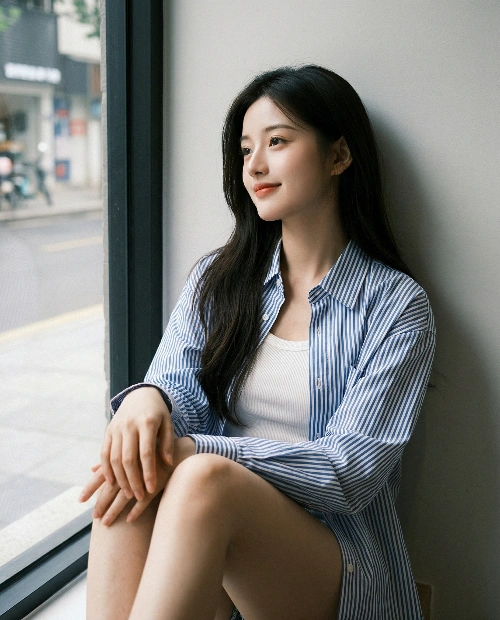
Lazy Afternoon Window Calm
Style Direction: Ultra-photorealistic cinematic lifestyle photography, blending Japanese fresh minimalism with Korean tonal aesthetics. Emphasize a sense of relaxation and emotional softness, with a clean, gentle visual style that combines fashion editorial storytelling with everyday warmth. Theme and Atmosphere: A quiet, lazy afternoon by the window, conveying calmness, softness, and intimacy. Use light and body language to express a “healing daily life” mood. Reference Baseline: Strictly use the uploaded subject as the sole identity reference. Accurately reproduce facial structure, proportions, skin tone, hairstyle, and all recognizable features. No stylization or alteration of the real face. Aspect Ratio and Framing: 4:5 vertical composition. Full-body or half-body framing depending on the reference, prioritizing upper body and leg interaction. Centered alignment with balanced visual weight. Subject Placement: The subject leans by the window in a relaxed posture, occupying the right two-thirds of the frame. The left side is left open to show a softly blurred outdoor street scene, creating an emotional contrast between interior and exterior. Interaction Design: Relaxed posture, hands naturally overlapped and resting between the legs. Back gently leaning against the wall, legs slightly bent, conveying a casual, lived-in interaction. Real Subject (Photorealistic Rendering) Facial Fidelity: 100% preservation of original facial structure, proportions, skin tone, and hair color. Skin texture must be realistic, with visible pores and natural light transitions, avoiding any artificial smoothing. Eyes appear soft and slightly unfocused, with a faint smile conveying relaxed ease. Expression: Calm, slightly distant, with a soft, dreamy gaze and naturally relaxed lips, expressing a gentle and healing presence. Pose: Based on the reference sitting pose — back lightly against the wall, legs slightly bent and overlapped, hands resting naturally on the legs, shoulders fully relaxed with no stiffness. Wardrobe Reconstruction: Inner Layer: White spaghetti-strap tank top with ribbed texture, closely fitting the skin with visible material detail. Outer Layer: Blue-and-white striped shirt, loose fit, sleeves slightly rolled, natural fabric folds, evenly spaced stripes. Bottom: Likely shorts or a short skirt (frame limited to legs), maintaining a casual homewear aesthetic. Material Rendering: Skin-contact softness of the tank top, cotton texture of the shirt, and gravity-driven folds must all be clearly visible and realistic. Lighting and Environment Lighting Setup: Side-back natural light simulating sunlight from the window on the left. Light grazes the face, shoulders, and clothing, creating soft highlights, while shadows transition naturally (e.g., neck, inner arms), enhancing depth and atmosphere. Background: Interior: Light gray matte wall paired with an off-white cushion (soft, voluminous, with natural folds under light). Exterior: Blurred street scene outside the window, with faint silhouettes of buildings and pedestrians in cooler tones, contrasting with the warm interior light. Environmental Details: Dark window frame (metal or wood texture), clean windowsill, realistic cushion volume and folds, minimal clutter to maintain a clean, minimalist home aesthetic. Output Style Image Quality: 8K resolution with RAW-level detail. Hair strands, skin pores, fabric textures, and light gradients must be rendered with extreme realism. Color Grading: Low-saturation soft tones dominated by off-white, light gray, and pale blue, with warm yellow highlights simulating afternoon sunlight. Overall palette should feel fresh, calm, and healing. Post-processing Look: Cinematic grading with preserved shadow detail, soft highlights, and moderate contrast to reinforce the relaxed emotional tone. Lens Language: 35mm prime lens, f/2.8 aperture, with slight background blur and natural depth transition, keeping the subject as the visual focus.
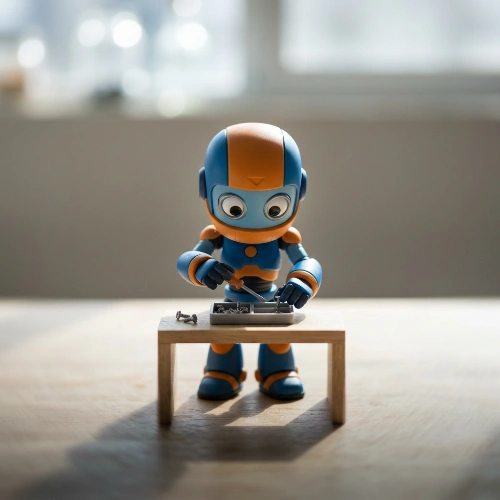
Candid High-Angle Slice
A high-angle tilt-shift cinematic image of the character captured naturally doing an everyday activity. The moment must feel candid and unstaged, like a quiet slice of life observed from above. Likeness Preservation Maintain exact proportions, eye shape, spacing, stylization, and material identity from the reference. Do not humanize. Do not reinterpret anatomy. Do not exaggerate realism. Camera & Perspective High-angle, slightly offset bird’s-eye view. Subtle isometric feeling. Equivalent to a 35mm lens adapted for tilt-shift photography. The character fills approximately 60–65% of the frame vertically. Breathing room above the head. Visible ground plane beneath. No extreme distortion. Focus Discipline (CRITICAL) Extremely shallow depth of field. Only the face and upper torso must be razor sharp. Hands interacting with an object may also be sharp. Lower legs and shoes must be slightly softened. Ground surface must progressively soften toward the bottom edge. Top and bottom edges must show strong optical tilt-shift blur. The focus band must be narrow and centered horizontally. No full-body sharpness. Pose Behavior The character must be naturally engaged in a daily action. Movement must feel subtle and believable. No staged hero poses. No exaggerated symmetry. Silhouette must remain clean and readable. Props or minimal furniture may be included only if necessary to support the action. Keep them simple and secondary. Lighting Control Bright natural daylight with firm directional key light. Light must carve the form clearly. Defined shadow under feet or object. Crisp shadow edge on ground. Subtle rim light separating character from background. No flat studio wash. No overly diffused light. Background Discipline Abstract minimal environment. Soft tonal gradient. Slight atmospheric depth. No detailed storytelling clutter. No heavy furniture unless essential to action. Background must support the character, not compete. Background Directional Structure (CRITICAL) Upper third of frame must contain soft luminous bokeh shapes or circular light blobs, gently out of focus, slightly brighter than mid-ground. Mid-ground remains neutral and unobtrusive. Lower ground plane must have subtle diagonal orientation, with a light-to-dark gradient guiding the eye upward toward the character’s head. Ground texture may contain faint linear perspective cues, but remain soft and minimal. The tonal gradient must travel from slightly darker bottom edge toward brighter mid-upper region behind the head. No flat monotone background. Color & Material Character slightly higher saturation than background. Background slightly muted. Clean premium collectible finish. Subtle surface sheen. No gritty realism. No artificial wear. Emotion Calm presence. Quiet confidence. A simple daily act elevated through composition and light. Not dramatic. Not heroic. Intimate but cinematic. Negative Lock No full-body sharpness No flat background No cluttered environment No stiff symmetrical pose No soft diffused lighting No dramatic battle energy No exaggerated realism
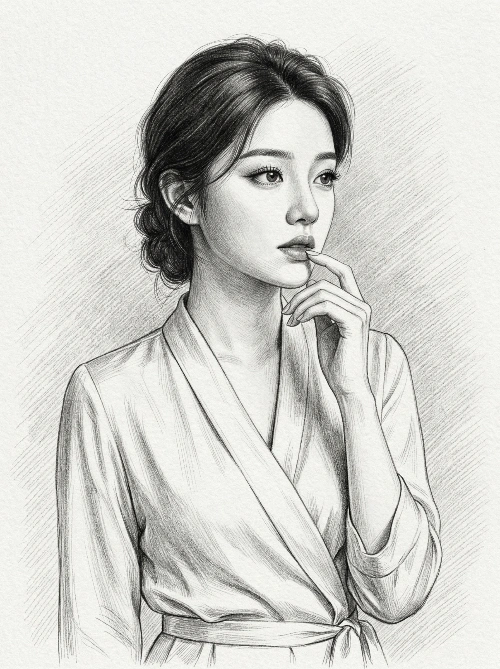
Melancholic B&W Graphite Portrait
Using the uploaded subject as the reference, create an ultra-photorealistic black-and-white graphite pencil portrait. Strictly adhere to her facial proportions, bone structure, jawline, eye shape and spacing, nasal structure, lip shape and fullness, original hairstyle, hairline, and natural parting. Composition and Pose Framing: 3:4 vertical portrait, waist-up composition, including down to the shirt’s waist tie area. Layout: The subject is positioned slightly off-center, leaving open space in the direction of her gaze (to the right). The head is placed roughly in the upper third of the frame. The pose should feel elegant and balanced, using the folds of the shirt and the arm lines to guide visual focus toward the face. Posture: The torso leans slightly to the left, shoulders relaxed and natural, head gently turned to the right. Expression: Soft gaze directed off-frame to the right, with a gentle, distant, and contemplative expression. Hands: The right hand is raised gracefully, wrist slightly bent, index fingertip lightly touching the lower lip, thumb resting beneath the chin, other fingers naturally curled inward. Hand structure must be anatomically accurate, with clearly defined joints and natural nails, conveying a relaxed, introspective feeling. Detail Rendering Face: Use refined graphite shading to emphasize smooth cheekbones, a delicately sculpted nose, and a well-defined jawline. Lips should appear full, with subtle blending along the lip centerline to enhance dimensionality. Eyes must be highly detailed, including delicate eyelid shadows, clear long eyelashes, and naturally full arched eyebrows. Skin should be rendered through seamless blending and smooth tonal gradients. Hair: Dark hair rendered with fine, controlled ხაზwork. Styled in a slightly loose low bun or tied back at the nape, suggesting soft volume. Include loose strands at the temples, forehead, and around the ears, with a single fine strand falling along the left cheek. Use layered strokes to create realistic hair texture and depth. Clothing: An elegant wrap-style V-neck blouse with a soft silk or satin drape. Include the overlapping deep V neckline, waist tie, naturally radiating folds from the knot, and the smooth tension across the torso fabric. Sleeves are slightly loose, with gathered fabric around the forearms and natural deep folds at the inner elbows due to the pose. Cuffs are cleanly structured, featuring a single round button and a vertical slit. The material should convey soft sheen and natural tension lines of the wrapped structure. Background and Lighting Background: Textured sketch paper with extremely subtle diagonal cross-hatching, softly faded edges to enhance depth. Lighting: Soft, diffused studio lighting with smooth tonal transitions, realistically shaping facial volume. Light gently illuminates the face, casting subtle shadows beneath the chin, fingers, and shirt folds. Overall Style Museum-quality classical realism with a romantic and melancholic tone. Technique requires extremely precise linework, controlled hatching, and subtle visibility of paper texture. The image should be rendered in monochrome graphite, with the lower portion of the portrait softly fading into the paper, creating an unfinished artistic effect. Final output should be in 8K ultra-high resolution, 3:4 vertical format.
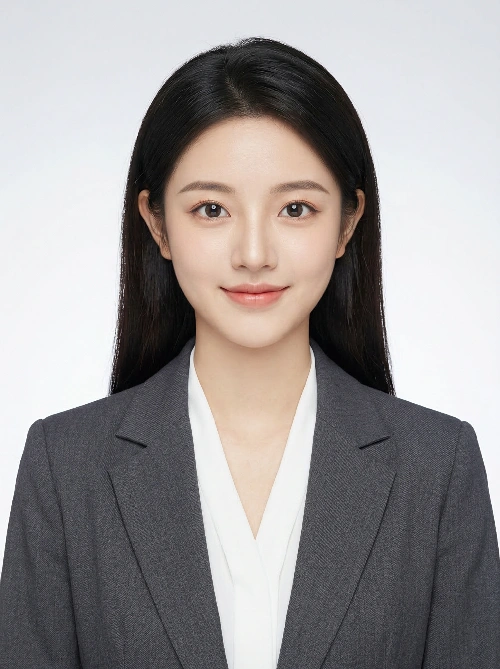
Modern Pro 3:4 Headshot
Intelligent professional portrait headshot in the style of American ID photography. The subject size is balanced and natural within the frame. Use a subtle light gray to white gradient studio background. Lighting is soft and natural, highlighting realistic skin tones and gentle depth. The image should be clear and high-quality with sharp facial focus. Skin texture appears clean, luminous, and healthy. The head-to-shoulder proportion is comfortable and natural. The overall mood is modern and elegant. The subject has a relaxed, natural, and confident expression with bright, lively eyes. Medium portrait framing with the subject centered in the composition. Low contrast lighting to create a refined, professional studio portrait aesthetic. Suitable for business and professional profile photos. Aspect ratio: 3:4.