
Reference Images:
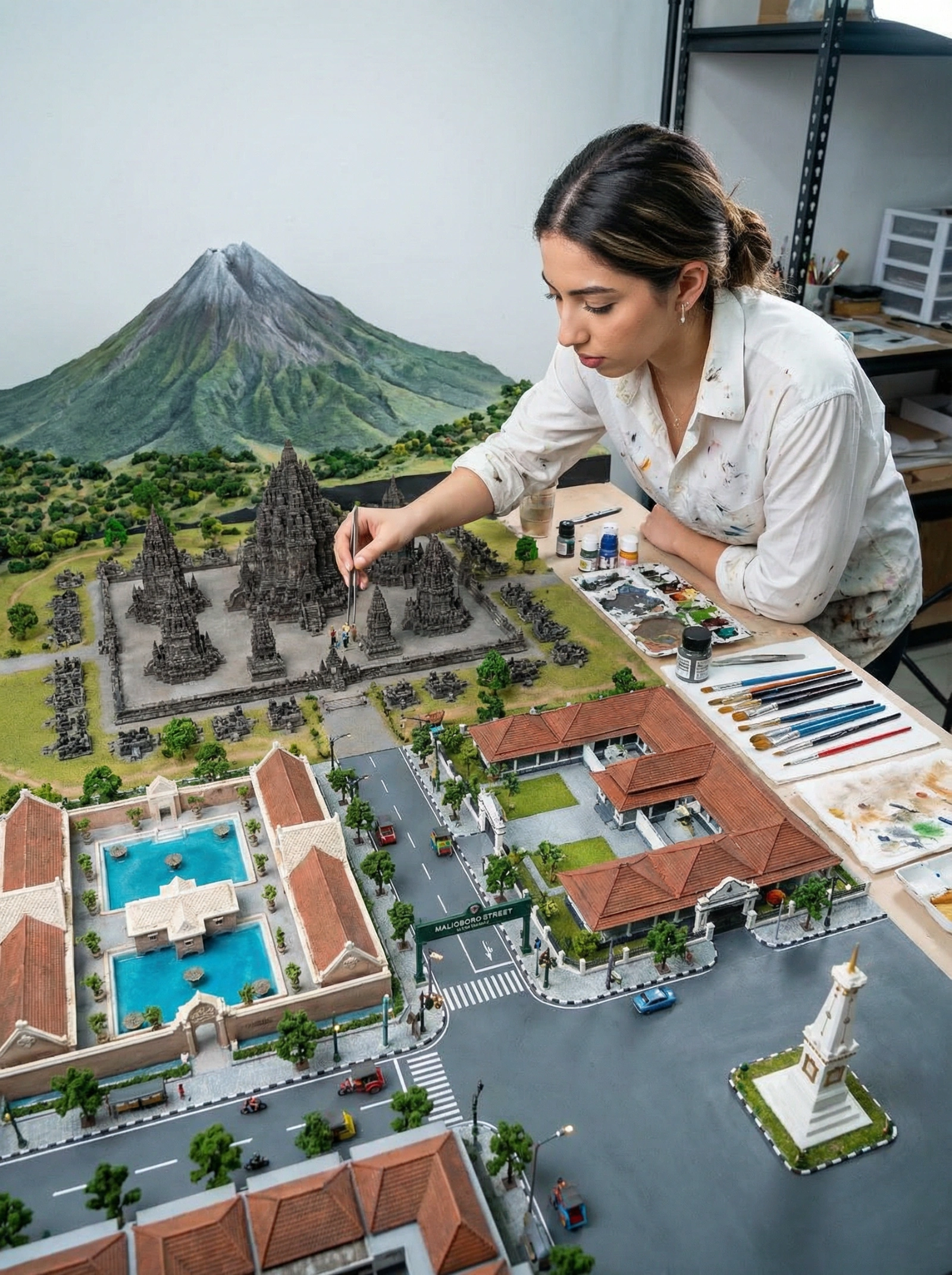
Hyper-Real Yogyakarta Diorama
Prompt
{ "prompt": { "description": "Hyper-realistic wide-lens photo of a woman artisan (face and hair matching the reference photo) meticulously working on a massive, ultra-detailed 2x2 meter diorama of Yogyakarta.", "scene": { "diorama": { "shape": "Accurately matches the geographic map of the Yogyakarta region.", "details": [ "Majestic Mount Merapi with realistic slopes and textures", "Intricately carved Prambanan Temple complex", "Serene pools, arches, and corridors of Taman Sari", "Lively Malioboro Street with tiny readable signage and miniature becak", "Authentic Javanese architectural Kraton palace details", "Iconic Tugu Yogyakarta landmark" ] }, "artisan": { "appearance": "Indonesian woman, face and hair matching the reference photo", "clothing": "White shirt with subtle paint smudges", "action": "Using fine precision tweezers to place a miniature tree or building element", "props": "Various diorama tools and materials arranged neatly beside her" }, "camera": { "viewpoint": "High top-angle perspective", "lens": "Wide-lens cinematic look", "focus": "Razor-sharp across entire diorama surface" }, "quality": { "resolution": "8K", "style": "Cinematic lighting, hyper-realistic, ultra-detailed craftsmanship", "masterpiece": true }, "format": { "ratio": "3:4" } } } }
Aspect Ratio
Model
Nano Banana ProYou might also like
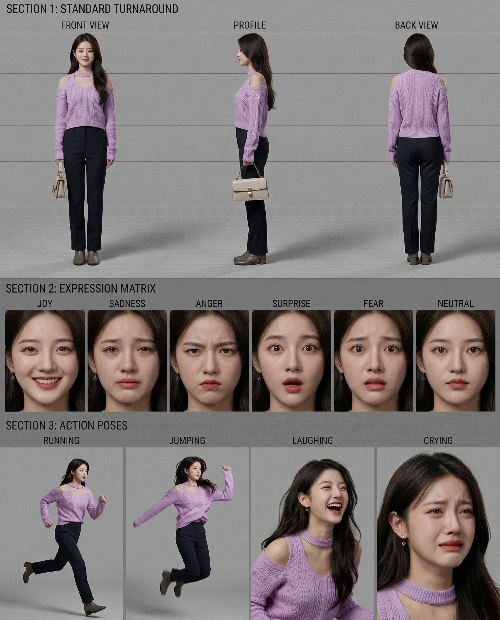
8K Cinematic Character Ref Sheet
[Core Visual Concept] Ultra-high-definition professional live-action character design sheet. Based on the character features from the reference image, create an industrial-grade visual reference set intended for big-screen film production. The overall style must be locked to photorealistic live-action photography, strictly prohibiting any anime or stylized rendering, targeting 8K cinematic-level detail fidelity. [Three Core Sections of the Design Sheet] 1. Standard Turnaround Sheet View Specifications: Includes full-body standing views of the character from three angles: front, profile (side), and back. Visual Alignment: All views must maintain perfectly consistent proportions, ensuring character height, facial feature placement, and clothing folds align precisely across angles. Background Setting: Clean industrial gray or neutral background with subtle physical shadows to enhance depth. 2. Expression Sheet Emotion Matrix: Showcase six fundamental emotional states under realistic lighting conditions: joy, sadness, anger, surprise, fear, and neutral. Facial Realism: Focus on capturing realistic facial muscle movement, including natural forehead lines, compression around the eyes, and dynamic lip changes, while preserving skin texture and pore-level detail. 3. Action Pose Sheet Typical Actions: Depict the character in representative cinematic motions, including running, jumping, laughing, and crying. Gravity and Dynamics: Emphasize the physical behavior of clothing under motion, including natural draping and tension in fabric, as well as accurate muscle engagement, creating an authentic captured-in-motion feel. [Character Attributes and Texture Constraints] Identity Consistency: Strictly replicate the facial features, skin tone, hair texture, and body proportions from the reference image. Prohibited Styles: Absolutely no cel-shading, exaggerated anime proportions, or flat color blocking. Lighting Quality: Use neutral global illumination to ensure consistent color and visible detail across all angles, suitable for 3D modeling reference. [Execution Instructions and Output Specifications] Composition: Clean and organized multi-panel layout. Image Quality: Ultra-high resolution, RAW photographic texture, 8K UHD.
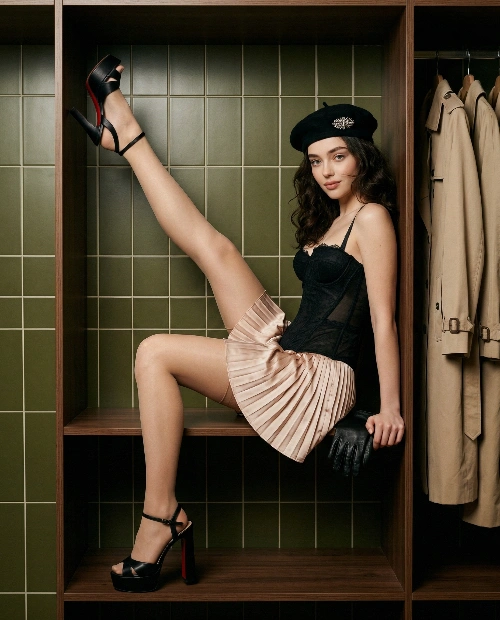
Enclosed Frame Fashion Portrait
[Core Concept] Style Direction: High-fashion editorial portrait photography, blending “frame-within-a-frame” composition with intimate spatial storytelling. Emphasis on precision, restraint, and a gaze-driven visual language. Theme Atmosphere: Refined, intimate, subtly provocative. Capture the subject in a self-presentational moment within an enclosed wardrobe space, conveying composed awareness of being observed through pose and lighting. Reference Baseline: Strictly use the uploaded subject as the sole visual identity source. Accurately reproduce facial structure, proportions, personal aura, and body characteristics without stylization. [Composition and Framing] Aspect Ratio: 4:5 vertical. Camera Angle: Eye-level, aligned with the wardrobe compartment opening (approx. 90 cm height). Visual Focus: “Frame-within-a-frame” — the dark wooden wardrobe compartment acts as a natural frame, fully enclosing the subject. Scene Structure: * The subject is positioned entirely inside the compartment, forming intersecting diagonal body lines. * Left leg raised high, foot pressed against the top frame, forming a strong diagonal from bottom-left to top-right. * Right leg extended horizontally, foot braced against the right inner wall, forming a secondary diagonal. * Torso and head create a third, shorter diagonal line. * Background: deep olive/khaki grid-patterned tiles, contrasting rigid geometry with organic body curves. * Right edge of frame: hanging beige/cream trench coats, adding environmental realism and tonal balance. [Character Rendering] Facial Features: Faithfully reproduce the subject’s facial structure and expression. Expression: Direct eye contact with a subtle smile — composed, slightly provocative. Details: Large expressive eyes, defined lashes, neutral to slightly pouted lips. Head Position: Chin slightly tucked (~5° downward tilt), creating a subtle “looking up through lashes” effect. Skin Tone: Natural with soft blush on cheeks. Hair: * Center-parted, long hair past shoulders. * Left side falls forward over shoulder and chest; right side falls behind. * Soft waves, warm brown tone with subtle highlights under directional light. * A few loose strands fall beneath the beret edge onto the forehead. Body Pose: * Seated inside the compartment. * Back pressed against the left inner wall. * Torso slightly leaning forward and to the right. * Legs form the primary compositional structure (raised left leg, extended right leg). * Arms: left arm mostly hidden behind leg/body; right hand supports on the shelf near the right hip. * Overall body forms a Z-shaped dynamic within the rectangular frame. [Wardrobe and Accessories] Corset: Black structured corset with strong boning; satin or leather finish with subtle sheen. * Sweetheart neckline with black lace trim. * Center front features delicate lacing or bow detail. * Ends at natural waist, revealing transition to skirt. Skirt: Champagne pink satin ultra-mini skirt with pleats, high-waisted. * Fabric catches warm highlights, drawing attention to hips and upper thighs. Footwear: Black platform heeled sandals (ankle strap). * Heel height: 12–15 cm, platform: 3–4 cm. * Open-toe or peep-toe design. * Left raised foot reveals a red sole (Louboutin-inspired), adding a vivid accent. Accessories: * Black military-style beret, tilted to the right side. * Large crystal/rhinestone brooch on the front-right of the beret — brightest specular highlight in frame. * Black leather gloves, removed and placed on the shelf beside the subject. * Nude/transparent stockings with subtle sheen, enhancing leg contours. Color System: Dominant black (corset, shoes, beret, gloves) + champagne pink accent (skirt) + warm nude (skin, stockings) + red highlight (shoe sole) + crystal sparkle (brooch). [Environment and Props] Setting: Luxury walk-in wardrobe interior. Compartment Interior: Deep olive/khaki tiled wall with visible grout lines and subtle matte/metallic finish. Structure: Dark-stained wood frame and surfaces, matte finish. Outer Edge (right): 2–3 hanging garments (beige/cream coats) for realism. Shelf Surface: Black leather gloves placed near the subject’s right hip as a deliberate styling element. [Lighting and Color] Lighting Type: Soft directional key light, editorial and controlled. Direction: From upper-left (~45° angle). * Creates gradient from brighter left to darker right within the compartment. * Soft shadows define face, neck, and body contours without harsh falloff. * Shadows remain detailed, not crushed to black. Material Interaction: * Corset surface captures controlled specular highlights. * Raised left leg (facing light) is brighter than the right, creating tonal separation. * Hanging garments on the right catch slight highlights as secondary accents. Color Science: Inspired by Fujifilm PRO Neg Hi * Professional portrait tones with controlled saturation. * Warm, accurate skin tones (not overly orange). * Champagne pink acts as a controlled highlight accent. * Moderate highlight roll-off; bright but not clipped. * Warm-neutral shadows with depth. * Medium-high contrast for editorial separation. * Minimal grain for clean, professional output. [Emotion and Narrative] Core Mood: Display-case elegance — a living subject consciously presenting herself within a private, enclosed space. Atmosphere: Cocoon-like intimacy — warm, dim, enclosed, and refined. Narrative: Through framing, pose, lighting, and wardrobe, convey themes of self-display, observation, and control within a private environment. [Technical Specifications] Lens: 50mm prime Aperture: f/2.8 Image Quality: Professional digital photography, ultra-detailed, sharp focus on face and pose, 8K resolution Rendering: Hyper-realistic skin and material response, natural light transitions, rich environmental detail, high-end editorial finish
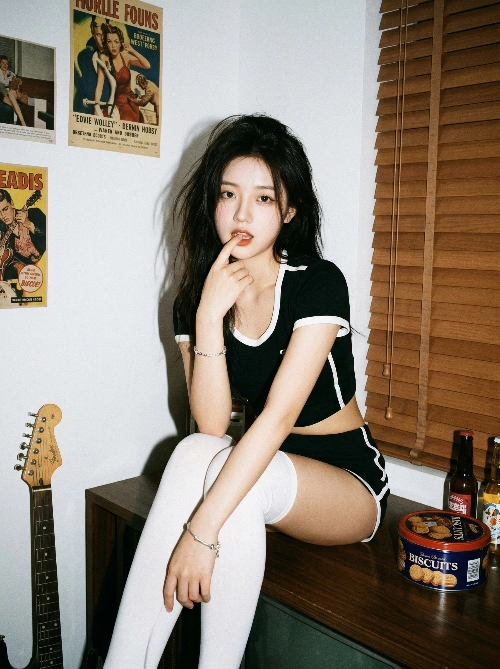
Rebellious 90s Cool Girl Portrait
Using the uploaded real subject as the visual baseline, create a full-body portrait with an independent, rebellious aesthetic and a vintage film texture. Embrace a 1990s point-and-shoot camera style, using direct flash, high-contrast lighting, retro color grading, and casual composition to convey a raw, authentic, and edgy “cool girl” atmosphere. Character Setup (Based on the real uploaded subject) Baseline: Use the real female subject as the foundation, preserving her facial features and body proportions. Hair: Thick, slightly messy long hair (color matching the uploaded subject). Outfit: Sporty black cropped top with white trim, paired with matching black shorts and white over-the-knee socks. Accessories: A silver bracelet worn on the wrist. Pose and Composition Pose: Sitting casually on an elevated dark wooden surface (such as a counter or piano top). The body leans forward slightly, relaxed but with a sharp edge. One hand is raised near the mouth, lightly biting a finger. The gaze is directed straight at the camera, with a sensual yet nonchalant expression. Composition: Full-body shot using a 35mm focal length, slightly low-angle perspective to emphasize leg lines. Medium-distance framing, appearing spontaneous yet visually balanced. Sharp focus on the subject, with the background falling off due to the rapid light decay of direct flash. Scene and Details Background: A white wall decorated with vintage posters taped onto it, along with brown wooden blinds. Foreground and Props: Include visible elements such as the neck of an electric guitar, a tin of cookies, and several bottles to enhance the lived-in, candid atmosphere. Lighting and Color Lighting: Simulate direct on-camera flash with hard lighting. The light should be harsh and frontal, casting sharp, well-defined shadows on the wall behind the subject. High contrast, with no soft lighting or diffusion. Color and Texture: Vintage film aesthetic, emulating Kodak Gold 200 tones. Warm hues from wooden blinds and furniture contrast with the cool white flash. Colors should be deep and slightly muted, with rich blacks and subtle film grain, creating a lo-fi indie visual style. Overall Mood and Style Style: Independent, rebellious “cool girl” aesthetic. Raw, authentic, with a Y2K-inspired retro fashion editorial vibe, resembling a snapshot. Mood: Casual, direct, with a hint of playful defiance. Technical Specifications and Constraints Image Quality: Photorealistic, but intentionally incorporating vintage film imperfections and direct-flash artifacts. Avoid: Soft lighting, studio lighting setups, shallow depth-of-field bokeh effects, polished studio portraits, skin smoothing, 3D-rendered looks, cartoon or illustration styles, distorted hands, missing guitar strings, floating objects, anatomical inaccuracies, stiff posing, excessive post-processing, and HDR effects.
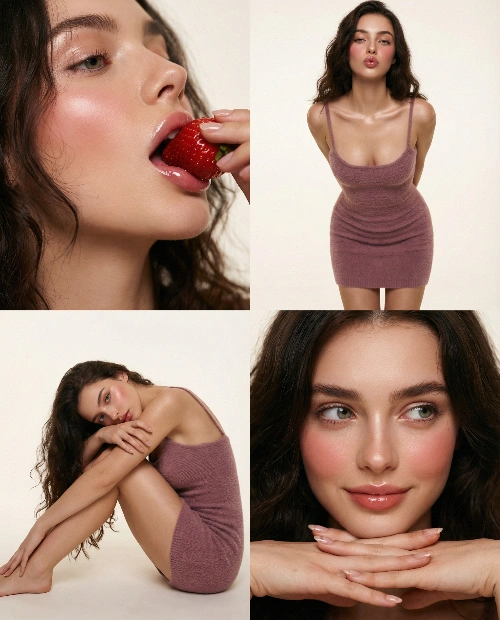
Ultra-Real Beauty Grid
{ "project_specifications": { "format": "2x2 Grid Collage", "aspect_ratio": "4:5", "aesthetic_style": "High-end Beauty Editorial", "rendering_engine_hints": { "realism_level": "Ultra-photorealistic", "texture_quality": "8k", "lighting_simulation": "Ray-traced studio lighting" } }, "global_assets": { "subject_definition": { "hair": { "style": "Long, loosely wavy, voluminous", "texture": "Natural, individual strands defined", "behavior": "Messy but styled, framing face and shoulders" }, "complexion": { "skin_texture": "Porous, hyper-realistic", "finish": "Dewy, glass-skin effect", "makeup": { "cheeks": "Heavy flush/blush", "lips": "High-gloss, plump, natural pink", "eyes": "Clean, defined lashes, natural brows" } }, "wardrobe": { "item": "Mini dress", "fit": "Bodycon / Tight", "fabric": { "material": "Soft textured knit / Boucle", "tactility": "Fuzzy, light-catching fibers", "color": "Soft mauve or neutral taupe" }, "details": "Spaghetti straps, mid-thigh length" } }, "environment_definition": { "studio_setup": { "background": "Seamless paper, soft off-white/beige", "atmosphere": "Clean, warm, intimate" }, "lighting_rig": { "key_light": "Large diffuse softbox (Front-Left)", "fill_light": "Reflector (Right)", "highlights": "Specular highlights on lips, cheekbones, and shoulders" } } }, "panel_architecture": [ { "position": "Top-Left (1)", "shot_type": "Extreme Close-Up (Macro)", "composition": { "angle": "Low angle, looking up slightly", "focus": "Mouth and nose area", "depth_of_field": "Shallow" }, "action": { "primary": "Eating a strawberry", "nuance": "Delicate finger hold, lips slightly parted" }, "visual_anchors": [ "Moisture on strawberry surface", "Gloss reflection on lips", "Baby hairs at temple" ] }, { "position": "Top-Right (2)", "shot_type": "Medium Shot (Thigh-up)", "composition": { "angle": "Eye level", "pose_dynamic": "Leaning forward slightly towards lens" }, "action": { "stance": "Standing straight on", "arms": "Relaxed at sides", "expression": "Direct gaze, alluring pout" }, "visual_anchors": [ "Texture of knit dress", "Collarbone shadows", "Curvature of waist" ] }, { "position": "Bottom-Left (3)", "shot_type": "Full Body (Seated)", "composition": { "angle": "Side profile", "framing": "Subject compacted on floor" }, "action": { "pose": "Knees to chest (fetal position variation)", "interaction": "Cheek resting on knee, arms embracing legs", "hair_flow": "Cascading onto the floor" }, "visual_anchors": [ "Smooth leg definition", "Dress stretching over thigh", "Dreamy gaze" ] }, { "position": "Bottom-Right (4)", "shot_type": "Beauty Portrait (Head & Hands)", "composition": { "angle": "Frontal close-up", "framing": "Chin to hairline" }, "action": { "gesture": "Chin resting on interlaced fingers", "expression": "Soft smile, looking off-camera" }, "visual_anchors": [ "Hand detail and manicure", "Eye clarity", "Flush on cheeks" ] } ] }
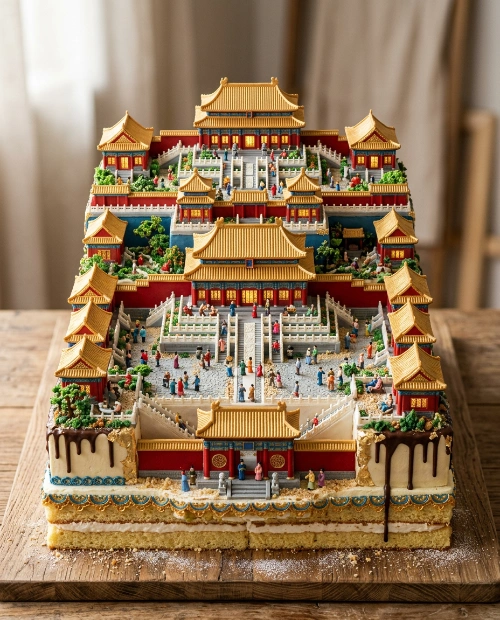
Edible Forbidden City Cake
MONUMENT: The Forbidden City Photorealistic hero product photography shot on Sony A7III with 85mm f/1.4 lens at f/2.8, soft natural daylight from upper left creating gentle realistic shadows and visible surface textures: A giant famous [MONUMENT] masterfully recreated as a delicious multi-tiered edible cake. Visible fluffy sponge cake layers, thick silky buttercream frosting, smooth fondant details, subtle edible gold leaf accents, realistic cake crumbs and ganache drips. The cake tiers ingeniously transformed into a luxurious miniature vibrant living city with tiny glowing windows, staircases, gardens and balconies built into the frosting and sponge. Miniature visitors in tiny colorful clothes walk the buttercream pathways, relax on cake terraces, sip tiny drinks and take photos. Intricate realistic cake textures mixed with whimsical architecture, physically plausible yet surreal. Shot for a luxury architecture magazine cover, ultra-detailed 8K, perfectly centered square composition, no text, no artifacts.
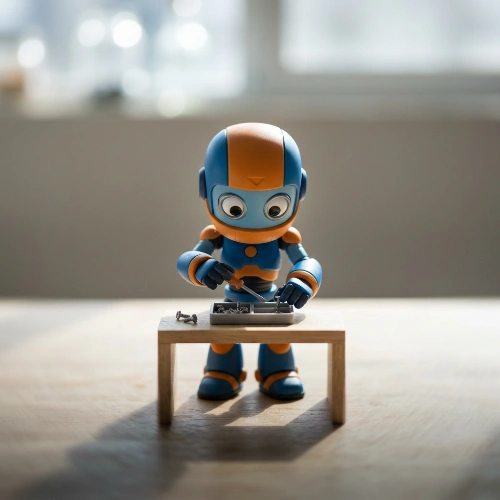
Candid High-Angle Slice
A high-angle tilt-shift cinematic image of the character captured naturally doing an everyday activity. The moment must feel candid and unstaged, like a quiet slice of life observed from above. Likeness Preservation Maintain exact proportions, eye shape, spacing, stylization, and material identity from the reference. Do not humanize. Do not reinterpret anatomy. Do not exaggerate realism. Camera & Perspective High-angle, slightly offset bird’s-eye view. Subtle isometric feeling. Equivalent to a 35mm lens adapted for tilt-shift photography. The character fills approximately 60–65% of the frame vertically. Breathing room above the head. Visible ground plane beneath. No extreme distortion. Focus Discipline (CRITICAL) Extremely shallow depth of field. Only the face and upper torso must be razor sharp. Hands interacting with an object may also be sharp. Lower legs and shoes must be slightly softened. Ground surface must progressively soften toward the bottom edge. Top and bottom edges must show strong optical tilt-shift blur. The focus band must be narrow and centered horizontally. No full-body sharpness. Pose Behavior The character must be naturally engaged in a daily action. Movement must feel subtle and believable. No staged hero poses. No exaggerated symmetry. Silhouette must remain clean and readable. Props or minimal furniture may be included only if necessary to support the action. Keep them simple and secondary. Lighting Control Bright natural daylight with firm directional key light. Light must carve the form clearly. Defined shadow under feet or object. Crisp shadow edge on ground. Subtle rim light separating character from background. No flat studio wash. No overly diffused light. Background Discipline Abstract minimal environment. Soft tonal gradient. Slight atmospheric depth. No detailed storytelling clutter. No heavy furniture unless essential to action. Background must support the character, not compete. Background Directional Structure (CRITICAL) Upper third of frame must contain soft luminous bokeh shapes or circular light blobs, gently out of focus, slightly brighter than mid-ground. Mid-ground remains neutral and unobtrusive. Lower ground plane must have subtle diagonal orientation, with a light-to-dark gradient guiding the eye upward toward the character’s head. Ground texture may contain faint linear perspective cues, but remain soft and minimal. The tonal gradient must travel from slightly darker bottom edge toward brighter mid-upper region behind the head. No flat monotone background. Color & Material Character slightly higher saturation than background. Background slightly muted. Clean premium collectible finish. Subtle surface sheen. No gritty realism. No artificial wear. Emotion Calm presence. Quiet confidence. A simple daily act elevated through composition and light. Not dramatic. Not heroic. Intimate but cinematic. Negative Lock No full-body sharpness No flat background No cluttered environment No stiff symmetrical pose No soft diffused lighting No dramatic battle energy No exaggerated realism
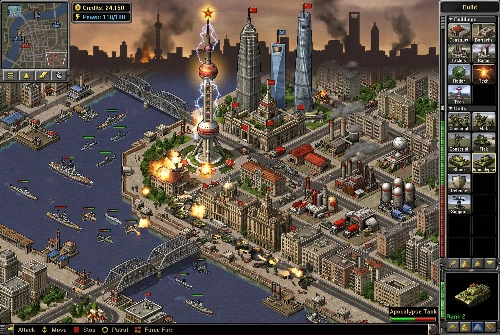
Retro Shanghai RTS Battle
Retro real-time strategy game screenshot in the visual style of the classic 2000s RTS game Red Alert 2. Isometric top-down battlefield map set in modern Shanghai, China. The terrain, roads, rivers, and city layout resemble Shanghai, with recognizable landmarks adapted into RTS game structures: Oriental Pearl Tower functioning as a tech structure, Shanghai Tower and Jin Mao Tower appearing as tall futuristic command buildings, Bund waterfront converted into defensive structures and walls, Huangpu River crossing the map with RTS bridges. Dense Shanghai urban districts turned into RTS base layouts with factories, power plants, radar domes, barracks, and refineries designed using Shanghai architectural elements and Chinese urban aesthetics. Classic RTS base-building scene: construction yards, tank factories, power plants, radar dishes, missile turrets, and supply depots integrated with Shanghai-style buildings and skyline silhouettes. Units include tanks, infantry squads, helicopters, and naval units moving around the Huangpu River. Explosions, smoke, and battle effects typical of early 2000s RTS games. Authentic retro game interface: classic RTS UI panels, minimap in the corner, unit selection boxes, build menu icons, health bars above units, resource counters, and command buttons similar to early RTS interfaces. Pixel-art inspired textures and slightly low-resolution sprites to mimic early 2000s PC game graphics. Camera perspective: classic isometric RTS camera angle from above, showing a large portion of the battlefield and city layout. Bright strategic map colors with clear terrain segmentation for roads, water, buildings, and base structures. Atmosphere: busy battlefield in a stylized Shanghai warzone, tanks rolling through city streets, defensive turrets near landmarks, helicopters flying over the skyline, naval units in the Huangpu River. Nostalgic early-2000s PC game aesthetic, detailed RTS battlefield composition, cinematic but clearly recognizable as a game screenshot.

LV Dynamic Grid Muted
Louis Vuitton. Act as a World-Class Editorial Designer. PHASE 1: DYNAMIC SUBJECT LOGIC. * Subject Selection: Autonomously analyze Louis Vuitton and select an iconic luxury fashion subject, such as a Louis Vuitton monogram travel trunk, a classic LV monogram handbag (e.g., Speedy or Keepall), or a high-fashion model interacting with a Louis Vuitton bag. * Layering (The Sandwich Effect): Interweave the subject with background shapes. Some parts of the bag or model must be hidden behind geometric blocks, while other parts (handles, straps, hands, accessories, luggage tags) must overlap them to create 3D depth. PHASE 2: GRID & GEOMETRY. * Layout: A clean 2x2 grid composition. * Overlays: Superimpose large, bold geometric arcs and circles over the grid. * Visual Balance: Place one iconic Louis Vuitton prop (for example a floating LV luggage tag, padlock, or small monogram coin pouch) in a separate quadrant to balance the main subject. PHASE 3: SOPHISTICATED MUTED PALETTE. * Color Direction: DO NOT use aggressive neon or oversaturated colors. * Palette: Identify the core Louis Vuitton colors and shift them to a sophisticated muted spectrum. * Tones: Use desaturated, earthy, or dusty versions of LV heritage colors such as muted monogram brown, dusty gold, warm tan, soft caramel, aged leather beige, and muted cream. * Finish: Matte, flat color blocks with zero gradients. PHASE 4: PHOTOGRAPHY & LIGHTING. * Subject Style: High-end commercial studio photography. * Lighting: Soft, diffused studio lighting with gentle highlights. No harsh shadows. * Integration: The subject must feel physically embedded into the graphic grid. PHASE 5: MINIMALIST BRANDING. * Logo: Place a clean, single-color Louis Vuitton LV monogram logo in the center of one background block. No taglines, just the iconic symbol.