
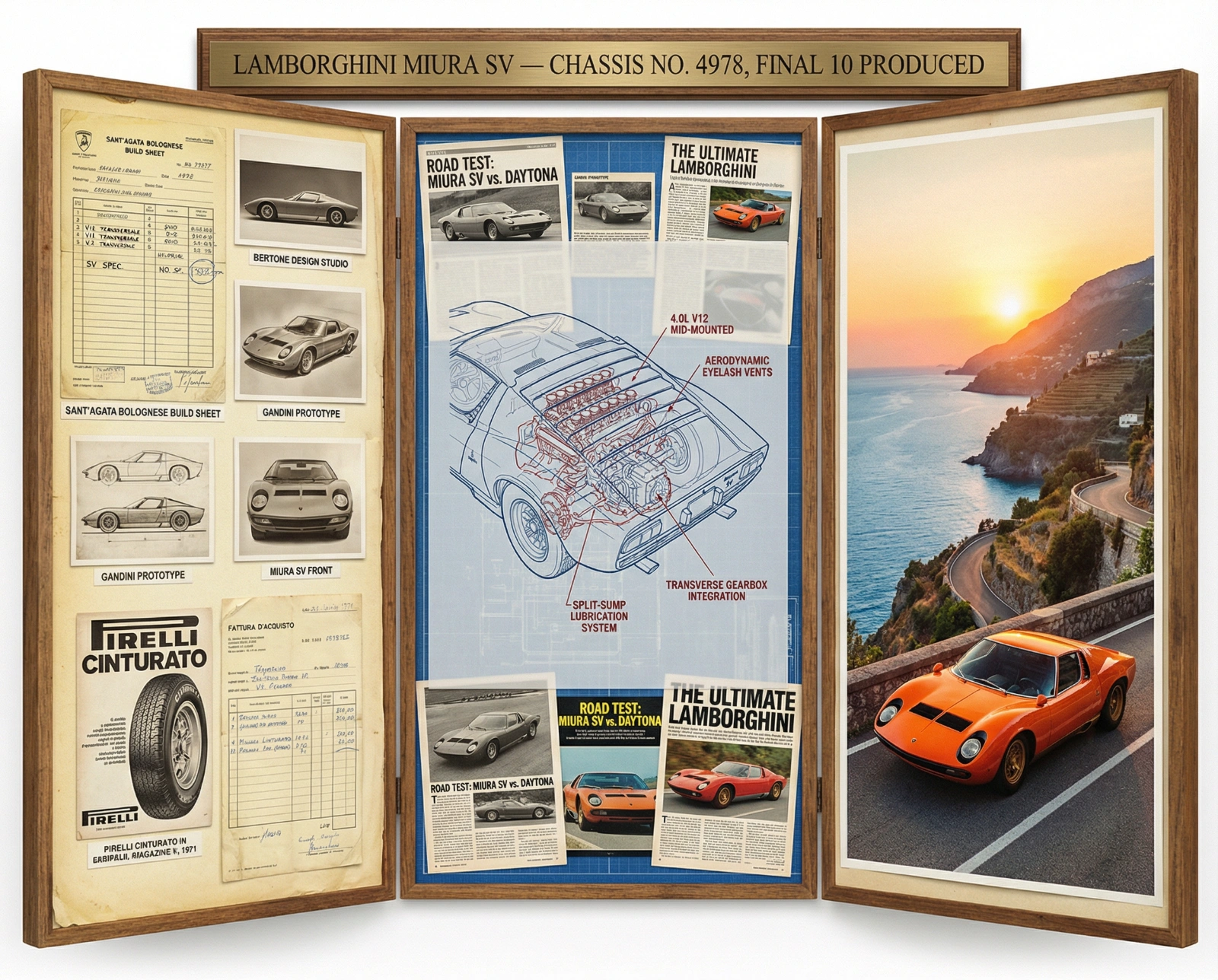
Lamborghini Miura SV Final Evolution
Prompt
A marque historian's documentation board for Lamborghini Miura P400 SV — Final Evolution, 1971. Left section: factory documentation including Sant'Agata build sheet with transverse V12 notations, Bertone design studio photographs showing Gandini's sketches, period Pirelli advertisement, and original purchase invoice in lire. Center section: technical illustration showing mid-mounted 4.0L V12 in phantom view, transverse gearbox integration, Gandini's aerodynamic eyelash vents, and split-sump lubrication callouts, surrounded by magazine road test comparisons. Right section: the vehicle on Amalfi Coast cliff road at sunset, Arancio Miura paint against Mediterranean blue, period saturated Italian photography. Visual style transitions from archival document cream through engineering-drawing precision to saturated automotive photography. Title block reading "LAMBORGHINI MIURA SV — CHASSIS NO. 4978, FINAL 10 PRODUCED".
Aspect Ratio
Source
@AllaAislingModel
Nano Banana ProYou might also like
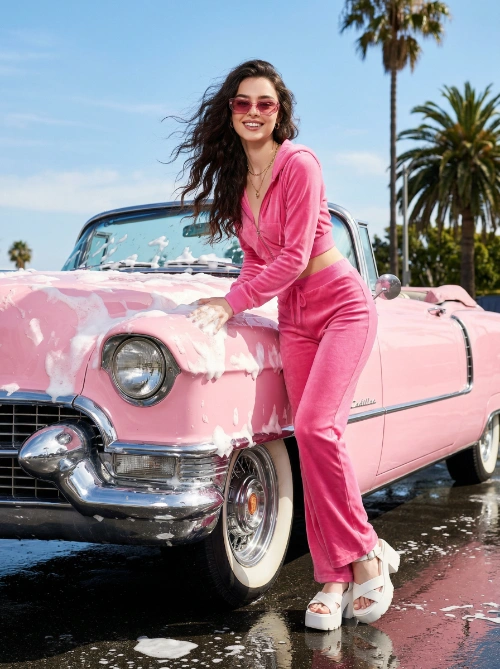
Y2K Retro Summer Drive
Core Concept Using the uploaded real female subject as the visual baseline, generate a high-fashion editorial image infused with Y2K retro aesthetics and strong visual contrast. The scene captures the subject in a summer outdoor setting, interacting with a pink vintage convertible covered in decorative foam, creating a lively, nostalgic, and fashion-forward visual narrative. Character Baseline and Styling Baseline: Strictly follow the facial features, structure, and personal aura of the subject in the uploaded image. Expression: Confident with a playful edge. Skin: Naturally radiant with a healthy glow. Physique: Well-proportioned and fit, with a natural forward-leaning posture. Hair: Long, dynamic wavy hair, gently lifted by a light breeze for a sense of motion. Outfit: Bright pink two-piece casual set paired with matching stylish sandals. Accessories: Fashion sunglasses, a delicate necklace, and minimal rings. Pose, Scene, and Lighting Pose: The subject leans naturally against the car, with both hands lightly touching the foam-covered surface. Scene: Bright outdoor setting featuring a pink vintage convertible coated in decorative foam as the central prop. Environment: Slightly wet ground reflecting ambient daylight, creating natural reflective highlights. Lighting: Bright natural sunlight producing balanced highlights and shadows, enhancing contrast and dimensionality. Color Palette: Dominant pink tones complemented by blue sky and white foam, forming a harmonious and vibrant color scheme. Atmosphere: Playful, nostalgic, and stylish. Composition, Quality, and Style Composition: Eye-level perspective with a slightly wide-angle feel. Technical Settings: Aperture at f/4.0 to maintain clarity across the frame. Image Quality: High-detail photorealism with strong emphasis on material textures and light behavior. Visual Style: Y2K-inspired retro fashion with cinematic storytelling.
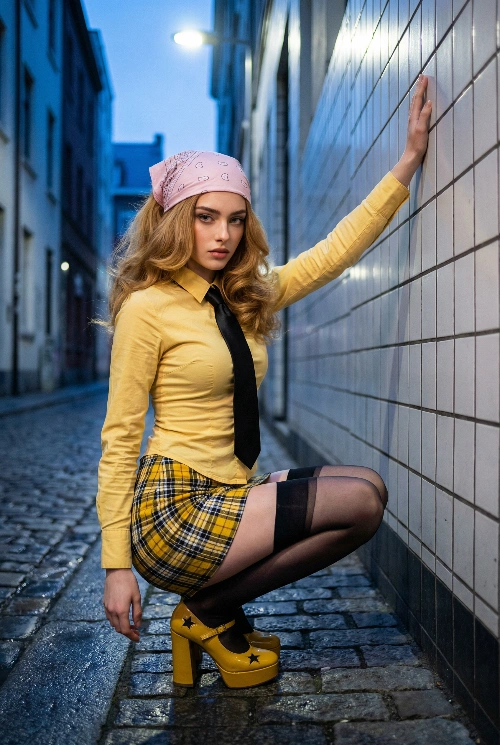
Cinematic Squat Fashion Portrait
{ "subject": { "identity": { "biometric_reference": "female from reference photo", "dentition": "Visible maxillary central incisors with natural alignment and translucent enamel edges, displayed in a slight mouth-open neutral expression.", "ocular_details": "Highly detailed iris patterns featuring radial furrows and Crypts of Fuchs. Iris pigmentation: Light cerulean blue with a hint of golden-green peripupillary ring. Detailed scleral vasculature and wet-look corneal reflections.", "hair": "Voluminous honey blonde hair (Hex: #E2BC74) with visible follicular texture, cascading naturally from under the bandana. Strands exhibit high specular highlights and anisotropic scattering." }, "body": { "morphology": "Mesomorphic-endomorphic somatotype, petite stature, approximately 151cm height. Precise waist-to-hip ratio (WHR) of 0.7. Body positioned in a full squatting stance in side profile.", "skin_physics": "Fair complexion (Hex: #F7E0D2) with subsurface scattering (SSS) effects. High-fidelity skin texture showing pores and natural epidermal micro-details. No beautify smoothing." }, "wardrobe": { "headwear": "Light pink bandana (Hex: #FF91AF) with subtle paisley micro-patterns, tied over the crown of the head.", "top": "Long-sleeved button-down shirt in vibrant yellow (Hex: #FDEE00). Tight-fit tailoring with realistic tension folds across the torso. Paired with a slim black silk necktie.", "bottom": "High-waisted pleated mini skirt featuring a yellow, black, and white plaid weave. Extremely short length with sharp pleats showing fabric tension in the crouching pose.", "hosiery": "Sheer black thigh-high stockings (20 denier) with a thick, opaque black elastic band at the mid-thigh. Clear skin-to-fabric transition above the knee.", "footwear": "Yellow platform heels (Hex: #FDEE00) with wide ankle straps and star-shaped decorative cutouts. Glossy synthetic leather finish with hard-surface reflections." }, "pose_action": "The subject is in a full squatting position viewed from a side-profile. The subject's right arm is extended vertically upwards with the palm pressed flat against the white tiled wall. The left arm hangs naturally by the side. The head is turned toward the camera with a direct, intense gaze. The subject is balanced on the balls of her feet.", "scene": { "environment": "Narrow urban alleyway at night. The wall on the right is composed of white square ceramic tiles with dark grout lines. The ground is grey cobblestone/pavement with a matte texture.", "depth": "Deep perspective showing the continuation of the alleyway and modern architectural structures in the background under a twilight sky.", "atmosphere": "Cinematic nighttime clarity with high contrast between the lit subject and the dark, shadowed urban environment." }, "lighting": { "primary": "Cool-toned overhead street lighting combined with soft ambient blue twilight. Strong directional light creates defined shadows on the tiled wall.", "secondary": "Soft fill lighting to preserve detail in the black tie and plaid skirt textures.", "physics": "Accurate Fresnel reflections on the white tiles and specular highlights on the glossy platform shoes." }, "camera": { "format": "9:16 vertical aspect ratio", "lens": "35mm prime lens for cinematic perspective.", "angle": "Low-angle shot, positioned at knee level to emphasize the posture and the height of the wall.", "settings": "f/2.8 aperture, ISO 100, 8k resolution, raw capture style." }, "negative_constraints": [ "no logos", "no text", "no trademarks", "no beautify smoothing", "no extra limbs", "no watermark", "no jewelry on neck", "reflection integrity rules applied to tiled surfaces" ] } }
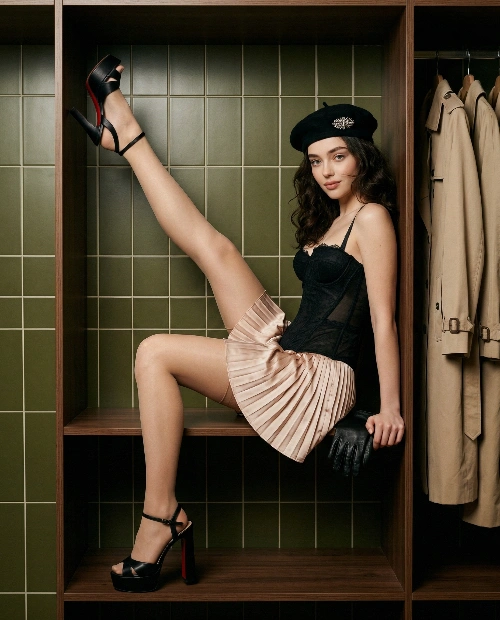
Enclosed Frame Fashion Portrait
[Core Concept] Style Direction: High-fashion editorial portrait photography, blending “frame-within-a-frame” composition with intimate spatial storytelling. Emphasis on precision, restraint, and a gaze-driven visual language. Theme Atmosphere: Refined, intimate, subtly provocative. Capture the subject in a self-presentational moment within an enclosed wardrobe space, conveying composed awareness of being observed through pose and lighting. Reference Baseline: Strictly use the uploaded subject as the sole visual identity source. Accurately reproduce facial structure, proportions, personal aura, and body characteristics without stylization. [Composition and Framing] Aspect Ratio: 4:5 vertical. Camera Angle: Eye-level, aligned with the wardrobe compartment opening (approx. 90 cm height). Visual Focus: “Frame-within-a-frame” — the dark wooden wardrobe compartment acts as a natural frame, fully enclosing the subject. Scene Structure: * The subject is positioned entirely inside the compartment, forming intersecting diagonal body lines. * Left leg raised high, foot pressed against the top frame, forming a strong diagonal from bottom-left to top-right. * Right leg extended horizontally, foot braced against the right inner wall, forming a secondary diagonal. * Torso and head create a third, shorter diagonal line. * Background: deep olive/khaki grid-patterned tiles, contrasting rigid geometry with organic body curves. * Right edge of frame: hanging beige/cream trench coats, adding environmental realism and tonal balance. [Character Rendering] Facial Features: Faithfully reproduce the subject’s facial structure and expression. Expression: Direct eye contact with a subtle smile — composed, slightly provocative. Details: Large expressive eyes, defined lashes, neutral to slightly pouted lips. Head Position: Chin slightly tucked (~5° downward tilt), creating a subtle “looking up through lashes” effect. Skin Tone: Natural with soft blush on cheeks. Hair: * Center-parted, long hair past shoulders. * Left side falls forward over shoulder and chest; right side falls behind. * Soft waves, warm brown tone with subtle highlights under directional light. * A few loose strands fall beneath the beret edge onto the forehead. Body Pose: * Seated inside the compartment. * Back pressed against the left inner wall. * Torso slightly leaning forward and to the right. * Legs form the primary compositional structure (raised left leg, extended right leg). * Arms: left arm mostly hidden behind leg/body; right hand supports on the shelf near the right hip. * Overall body forms a Z-shaped dynamic within the rectangular frame. [Wardrobe and Accessories] Corset: Black structured corset with strong boning; satin or leather finish with subtle sheen. * Sweetheart neckline with black lace trim. * Center front features delicate lacing or bow detail. * Ends at natural waist, revealing transition to skirt. Skirt: Champagne pink satin ultra-mini skirt with pleats, high-waisted. * Fabric catches warm highlights, drawing attention to hips and upper thighs. Footwear: Black platform heeled sandals (ankle strap). * Heel height: 12–15 cm, platform: 3–4 cm. * Open-toe or peep-toe design. * Left raised foot reveals a red sole (Louboutin-inspired), adding a vivid accent. Accessories: * Black military-style beret, tilted to the right side. * Large crystal/rhinestone brooch on the front-right of the beret — brightest specular highlight in frame. * Black leather gloves, removed and placed on the shelf beside the subject. * Nude/transparent stockings with subtle sheen, enhancing leg contours. Color System: Dominant black (corset, shoes, beret, gloves) + champagne pink accent (skirt) + warm nude (skin, stockings) + red highlight (shoe sole) + crystal sparkle (brooch). [Environment and Props] Setting: Luxury walk-in wardrobe interior. Compartment Interior: Deep olive/khaki tiled wall with visible grout lines and subtle matte/metallic finish. Structure: Dark-stained wood frame and surfaces, matte finish. Outer Edge (right): 2–3 hanging garments (beige/cream coats) for realism. Shelf Surface: Black leather gloves placed near the subject’s right hip as a deliberate styling element. [Lighting and Color] Lighting Type: Soft directional key light, editorial and controlled. Direction: From upper-left (~45° angle). * Creates gradient from brighter left to darker right within the compartment. * Soft shadows define face, neck, and body contours without harsh falloff. * Shadows remain detailed, not crushed to black. Material Interaction: * Corset surface captures controlled specular highlights. * Raised left leg (facing light) is brighter than the right, creating tonal separation. * Hanging garments on the right catch slight highlights as secondary accents. Color Science: Inspired by Fujifilm PRO Neg Hi * Professional portrait tones with controlled saturation. * Warm, accurate skin tones (not overly orange). * Champagne pink acts as a controlled highlight accent. * Moderate highlight roll-off; bright but not clipped. * Warm-neutral shadows with depth. * Medium-high contrast for editorial separation. * Minimal grain for clean, professional output. [Emotion and Narrative] Core Mood: Display-case elegance — a living subject consciously presenting herself within a private, enclosed space. Atmosphere: Cocoon-like intimacy — warm, dim, enclosed, and refined. Narrative: Through framing, pose, lighting, and wardrobe, convey themes of self-display, observation, and control within a private environment. [Technical Specifications] Lens: 50mm prime Aperture: f/2.8 Image Quality: Professional digital photography, ultra-detailed, sharp focus on face and pose, 8K resolution Rendering: Hyper-realistic skin and material response, natural light transitions, rich environmental detail, high-end editorial finish
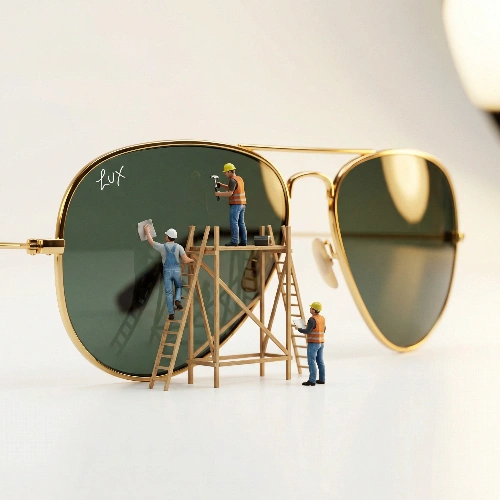
Luxury Sunglasses Diorama
{ "prompt": "Ultra-realistic macro photograph of luxury gold-framed aviator sunglasses placed on a clean white surface. The left lens has a subtle dark green tint with a stylish white handwritten logo in the top corner. Tiny miniature construction workers are building and polishing the sunglasses using wooden scaffolding and ladders positioned directly against the lens surface. Some workers are climbing ladders, others standing on platforms adjusting and cleaning the glass. Highly detailed miniature human figures wearing casual work clothes and helmets. The gold metal frame has realistic reflections and smooth curves. Extremely shallow depth of field with soft background blur. Warm natural studio lighting, soft shadows, photorealistic metal textures, tilt-shift effect, hyper-detailed miniature diorama style, 8K resolution, professional macro lens photography.", "negative_prompt": "blurry, low resolution, cartoon style, exaggerated proportions, distorted frame, messy composition, oversaturated colors, harsh lighting, noise, watermark, extra logos, text artifacts", "settings": { "resolution": "1024x1024", "lighting": "soft warm studio lighting", "camera": "macro lens 100mm", "depth_of_field": "very shallow", "style": "photorealistic miniature diorama", "quality": "ultra high detail" } }
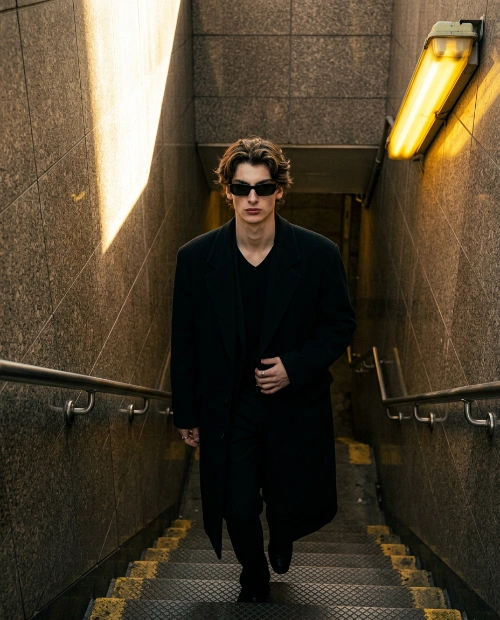
Cinematic Urban Fashion Model
{ "metadata": { "image_type": "photograph", "primary_purpose": "editorial" }, "composition": { "rule_applied": "rule of thirds", "aspect_ratio": "4:5", "layout": "single subject", "focal_points": [ "Subject's face and dark sunglasses", "Yellow fluorescent light fixture leading to the subject" ], "visual_hierarchy": "Eye starts at the subject's face due to contrast with sunglasses, follows the V-neck down the black coat, moves outward along the metallic handrails, and catches the bright sunlight shaft on the left wall and the yellow light on the right.", "balance": "asymmetric" }, "color_profile": { "dominant_colors": [ { "color": "Black", "hex": "#111111", "percentage": "45%", "role": "primary subject" }, { "color": "Warm Gray", "hex": "#7A7269", "percentage": "35%", "role": "background" }, { "color": "Golden Yellow", "hex": "#E5B05C", "percentage": "10%", "role": "accent" } ], "color_palette": "complementary", "temperature": "warm", "saturation": "moderate", "contrast": "high contrast" }, "lighting": { "type": "mixed", "source_count": "multiple sources", "direction": "front", "directionality": "highly directional", "quality": "dramatic", "intensity": "moody", "contrast_ratio": "high contrast (dramatic shadows)", "mood": "mysterious", "shadows": { "type": "harsh defined edges", "density": "deep black", "placement": "under handrails, within stair treads, and engulfing the subject's lower body", "length": "medium" }, "highlights": { "treatment": "blown out", "placement": "on upper left wall from sun shaft, fluorescent light fixture, and reflective handrails" }, "ambient_fill": "present", "light_temperature": "warm (golden)" }, "technical_specs": { "medium": "digital photography", "style": "realistic", "texture": "sharp", "sharpness": "tack sharp", "grain": "digital noise", "depth_of_field": "medium", "perspective": "high angle" }, "artistic_elements": { "genre": "street", "influences": [ "Urban street style fashion photography", "Cinematic cyberpunk/matrix aesthetic" ], "mood": "sophisticated", "atmosphere": "Gritty yet polished urban transit environment with a moody, imposing, and highly stylized fashion presence", "visual_style": "structured" }, "typography": { "present": false, "fonts": [], "placement": "", "integration": "" }, "subject_analysis": { "primary_subject": "Young male model wearing an oversized, structured long black overcoat, black V-neck top, black trousers, and dark rectangular sunglasses, walking down stairs. Hair: Medium length, textured cut (e.g., modern shag/tapered cut). Length: Roughly ear-level/temple-level on the sides, slightly longer and voluminous on top (3-4 inches), with soft layers and natural movement. Texture: Natural wavy texture, showing varied strands, slight frizz, and natural volume (imperfections visible, not 'AI smooth'), styled loosely back from the forehead without a distinct part. Evidence of light matte product application.", "positioning": "center", "scale": "medium", "interaction": "interacting with environment", "facial_expression": { "mouth": "neutral", "smile_intensity": "no smile", "eyes": "direct gaze", "eyebrows": "neutral", "overall_emotion": "serious", "authenticity": "posed" }, "hands_and_gestures": { "left_hand": "resting at waist level, lightly holding the edge of the black overcoat, silver ring visible on finger", "right_hand": "not visible, hidden behind the coat's bulk or swinging backward", "finger_positions": "left hand thumb and index finger slightly curled and gripping fabric, remaining fingers obscured", "finger_interlacing": "none", "hand_tension": "relaxed", "interaction": "holding coat", "naturalness": "deliberately posed" }, "body_positioning": { "posture": "standing", "angle": "facing camera", "weight_distribution": "shifted", "shoulders": "level" } }, "background": { "setting_type": "indoor", "spatial_depth": "medium", "elements_detailed": [ { "item": "Stainless steel handrail", "position": "left", "distance": "foreground", "size": "medium", "condition": "worn", "specific_features": "Tubular metal with distinct mounting brackets and subtle reflections" }, { "item": "Stainless steel handrail", "position": "right", "distance": "midground", "size": "medium", "condition": "worn", "specific_features": "Tubular metal matching the left side, catching edge highlights" }, { "item": "Fluorescent light fixture", "position": "top right", "distance": "background", "size": "medium", "condition": "vintage", "specific_features": "Rectangular housing emitting a strong, warm amber/yellow light" } ], "wall_surface": { "material": "tile", "surface_treatment": "finished", "texture": "perfectly smooth", "finish": "satin", "color": "warm grayish-brown", "color_variation": "patchy", "features": "clean, distinct grid-like grout lines separating large rectangular stone/granite panels, sharp diagonal shaft of warm sunlight hitting the upper left section", "wear_indicators": "industrial" }, "floor_surface": { "material": "concrete", "color": "dark gray with yellow accents", "pattern": "striped" }, "objects_catalog": "Metal diamond-plate stair treads with yellow painted safety edges running horizontally across the bottom and midground, dual tubular stainless steel handrails flanking the stairs, rectangular yellow light fixture mounted to the ceiling angled directly above the stairwell, large rectangular stone tiles covering the walls.", "background_treatment": "sharp" }, "generation_parameters": { "prompts": [ "Editorial street style photography, a handsome young man with medium length, textured modern shag haircut showing natural wavy movement and styled loosely back. He wears dark rectangular sunglasses, a long black oversized wool coat, and an all black outfit, walking down urban subway stairs. The walls are made of large polished brown-gray stone tiles with visible grid grout lines. A dramatic shaft of warm golden sunlight hits the upper left wall. A vintage yellow fluorescent light fixture is on the upper right ceiling. The stairs are concrete with metal edges and yellow safety paint. Stainless steel handrails. Cinematic lighting, deep dramatic black shadows, sharp focus, 85mm lens, high contrast, moody, fashionable underground matrix aesthetic.", "Cinematic fashion portrait, male model in structural black overcoat descending transit stairs, medium length textured hair with soft waves, tinted glasses. High angle shot looking down the steps. Brutalist architecture background, granite wall panels. Mixed lighting featuring harsh geometric sunbeams on the wall contrasting with artificial yellow ambient light. Gritty texture, high dynamic range, hyper-realistic, sophisticated urban mood." ], "keywords": [ "street style", "oversized black coat", "subway stairs", "cinematic lighting", "medium length hair", "textured hair", "modern shag" ], "technical_settings": "85mm lens, f/4.0 aperture for medium depth of field keeping background architectural elements recognizable, 1/250s shutter speed, ISO 400. Metered to preserve the sun shaft highlight while letting shadows fall to deep blacks.", "post_processing": "Color grading to enhance warm golden highlights against neutral/cool shadows, boosted contrast curve, subtle film grain introduced in the deep shadow areas for texture." } }
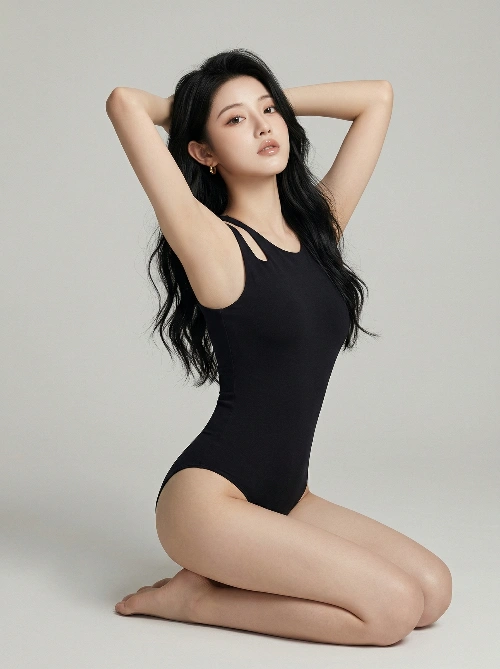
Ultra-Realist Minimalist Fashion
Based on the uploaded reference image, generate an ultra-photorealistic studio fashion photograph in a minimalist high-fashion style. The image should be a full-body portrait, conveying confidence, sensuality, and elegance, with an emphasis on 8K resolution and highly realistic detail. Character Setup Identity Baseline: Strictly follow the facial features of the subject in the uploaded reference image, ensuring strong identity consistency. Present her as a young woman with a well-proportioned figure, graceful curves, toned legs, and a slender waist. Hair and Makeup: Deep black long hair, very long, loose and voluminous with slight waves, naturally falling along the back and sides, smooth and glossy in texture. Makeup is soft and alluring, with smooth radiant skin, full lips with nude gloss, defined eyeliner, clear eyelashes, and naturally shaped brows. Expression and Accessories: Gaze slightly directed toward the camera, expression confident, sensual, and relaxed. Wearing small gold hoop earrings, with no other accessories. Styling and Pose Outfit: A black stretch-fabric bodysuit with a minimalist sleeveless design, featuring an asymmetrical strap detail and a form-fitting cut. Pose: Kneeling on the floor with legs folded beneath the body, heels close to the hips. The torso is upright with a slight arch in the back. Both arms are raised, with hands crossed behind the head. The head tilts slightly backward and to one side. Photography and Lighting Composition: Full-body vertical composition with the subject centered. Shot from a three-quarter angle using an 85mm portrait lens, with shallow to medium depth of field and sharp focus on the subject. Background: Light neutral gray, smooth seamless studio backdrop, maintaining a minimalist environment. Lighting: Key light from the front-left using a softbox, with soft fill light from the front-right, and a very subtle rim light from behind. Natural, soft shadows should form beneath the body. Color Tone: Overall neutral tones, with soft highlights on the skin. Image Quality and Style Aim for ultra-realistic, high-detail 8K image quality. Skin and fabric textures must be rendered with extreme precision, achieving a true photographic realism consistent with top-tier high-fashion editorials.
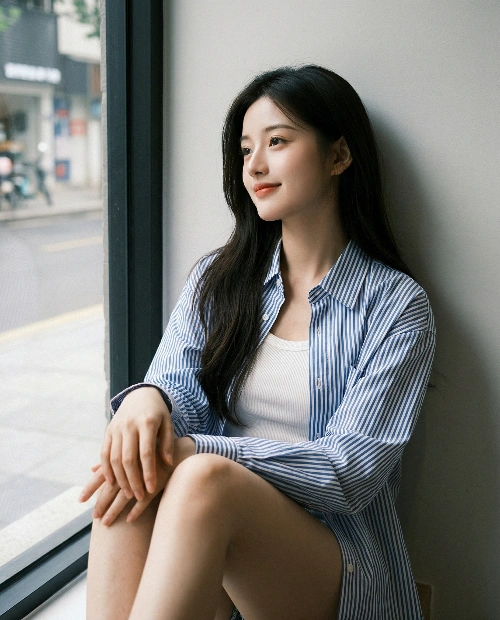
Lazy Afternoon Window Calm
Style Direction: Ultra-photorealistic cinematic lifestyle photography, blending Japanese fresh minimalism with Korean tonal aesthetics. Emphasize a sense of relaxation and emotional softness, with a clean, gentle visual style that combines fashion editorial storytelling with everyday warmth. Theme and Atmosphere: A quiet, lazy afternoon by the window, conveying calmness, softness, and intimacy. Use light and body language to express a “healing daily life” mood. Reference Baseline: Strictly use the uploaded subject as the sole identity reference. Accurately reproduce facial structure, proportions, skin tone, hairstyle, and all recognizable features. No stylization or alteration of the real face. Aspect Ratio and Framing: 4:5 vertical composition. Full-body or half-body framing depending on the reference, prioritizing upper body and leg interaction. Centered alignment with balanced visual weight. Subject Placement: The subject leans by the window in a relaxed posture, occupying the right two-thirds of the frame. The left side is left open to show a softly blurred outdoor street scene, creating an emotional contrast between interior and exterior. Interaction Design: Relaxed posture, hands naturally overlapped and resting between the legs. Back gently leaning against the wall, legs slightly bent, conveying a casual, lived-in interaction. Real Subject (Photorealistic Rendering) Facial Fidelity: 100% preservation of original facial structure, proportions, skin tone, and hair color. Skin texture must be realistic, with visible pores and natural light transitions, avoiding any artificial smoothing. Eyes appear soft and slightly unfocused, with a faint smile conveying relaxed ease. Expression: Calm, slightly distant, with a soft, dreamy gaze and naturally relaxed lips, expressing a gentle and healing presence. Pose: Based on the reference sitting pose — back lightly against the wall, legs slightly bent and overlapped, hands resting naturally on the legs, shoulders fully relaxed with no stiffness. Wardrobe Reconstruction: Inner Layer: White spaghetti-strap tank top with ribbed texture, closely fitting the skin with visible material detail. Outer Layer: Blue-and-white striped shirt, loose fit, sleeves slightly rolled, natural fabric folds, evenly spaced stripes. Bottom: Likely shorts or a short skirt (frame limited to legs), maintaining a casual homewear aesthetic. Material Rendering: Skin-contact softness of the tank top, cotton texture of the shirt, and gravity-driven folds must all be clearly visible and realistic. Lighting and Environment Lighting Setup: Side-back natural light simulating sunlight from the window on the left. Light grazes the face, shoulders, and clothing, creating soft highlights, while shadows transition naturally (e.g., neck, inner arms), enhancing depth and atmosphere. Background: Interior: Light gray matte wall paired with an off-white cushion (soft, voluminous, with natural folds under light). Exterior: Blurred street scene outside the window, with faint silhouettes of buildings and pedestrians in cooler tones, contrasting with the warm interior light. Environmental Details: Dark window frame (metal or wood texture), clean windowsill, realistic cushion volume and folds, minimal clutter to maintain a clean, minimalist home aesthetic. Output Style Image Quality: 8K resolution with RAW-level detail. Hair strands, skin pores, fabric textures, and light gradients must be rendered with extreme realism. Color Grading: Low-saturation soft tones dominated by off-white, light gray, and pale blue, with warm yellow highlights simulating afternoon sunlight. Overall palette should feel fresh, calm, and healing. Post-processing Look: Cinematic grading with preserved shadow detail, soft highlights, and moderate contrast to reinforce the relaxed emotional tone. Lens Language: 35mm prime lens, f/2.8 aperture, with slight background blur and natural depth transition, keeping the subject as the visual focus.