
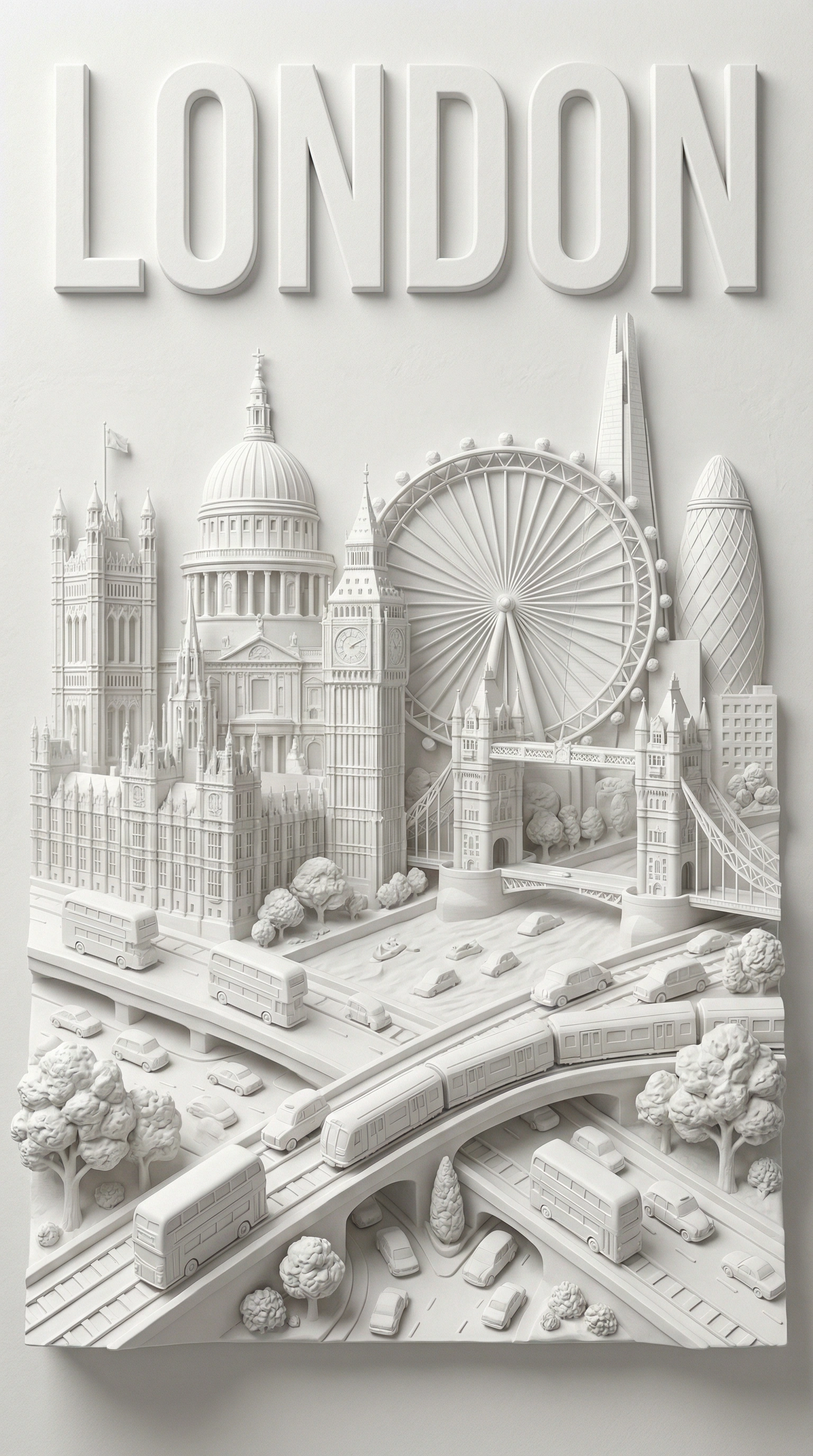
London 3D Bas-Relief Collage
Prompt
A highly detailed 3D bas-relief poster design representing [London]. A dense collage composition featuring the most iconic landmarks and skyline of [London]. Foreground filled with local transportation systems, busy highway networks with miniature cars, and native vegetation. At the top, features prominent, large, embossed English text in capital letters spelling out the name of the location. Pure white monochromatic clay render, embossed paper texture, soft studio lighting, high visual density, clean commercial illustration style.
Aspect Ratio
Source
@0x00_KryptModel
Nano Banana ProYou might also like
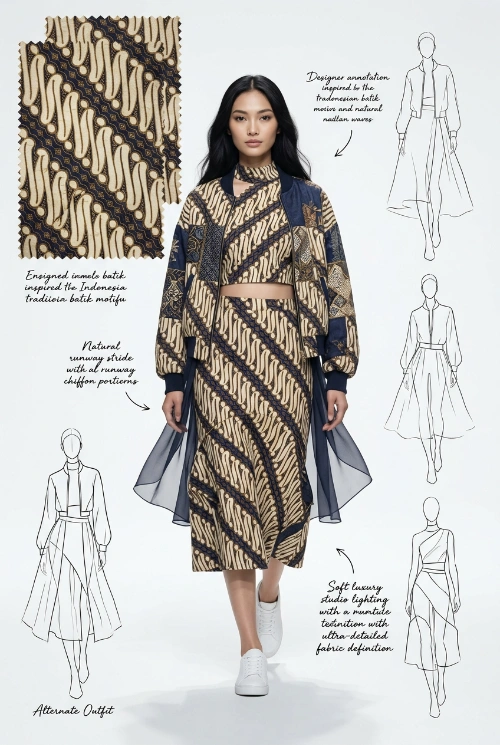
Ultra-Premium Batik Couture Board
{ "prompt": "Ultra-premium luxury fashion designer concept board on a pristine white studio canvas, inspired by high-end couture fashion houses. CENTER MODEL A tall slender Javanese female fashion model with elegant runway proportions walking gracefully in a natural runway stride pose. FASHION THEME Modern couture fashion inspired by traditional Indonesian Batik Parang motif. The textile pattern features flowing diagonal blade-like waves and repeating curved lines with rich tones of deep indigo, warm ivory, and antique gold. OUTFIT DESIGN • Cropped asymmetric mock-neck top decorated with the batik pattern • Relaxed oversized bomber jacket with patchwork batik panels and soft semi-transparent chiffon layers flowing from the waist • Sculptural segmented midi skirt with modern architectural silhouette • Minimalist clean white sneakers MODEL APPEARANCE Long jet-black hair with soft natural waves, delicate oval face, natural makeup, calm confident expression. DESIGN BOARD ELEMENTS • Top-left: enlarged fabric swatch showing the batik texture • Right side: three minimalist fashion sketches • Lower-left: alternate outfit sketch • Elegant handwritten designer annotations across the board LIGHTING Soft luxury studio lighting with subtle shadows and detailed textile highlights. STYLE High-end couture design board, editorial fashion presentation, masterpiece quality, ultra-detailed fabric texture." }
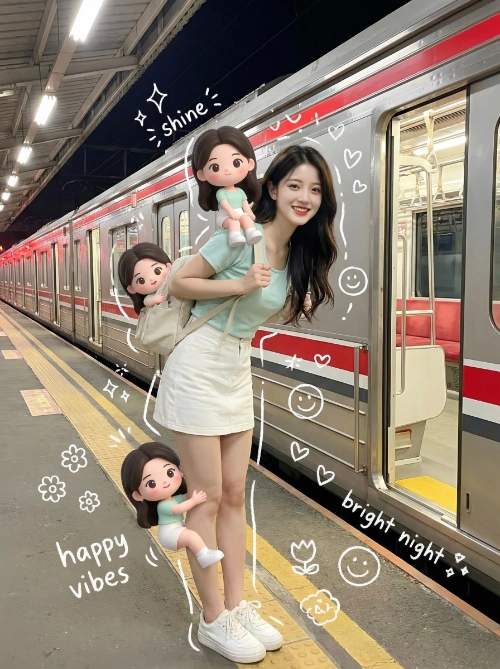
Cheerful Night Train Chibis
A high-quality mixed-media portrait of a bright and cheerful young woman with fresh, lively energy (using my uploaded person photo) standing on a train station platform at night. The subject has a friendly smile and bright eyes, posing with a lively, energetic expression, slightly leaning forward in a natural, upbeat stance, one hand playfully holding the strap of her light-colored backpack. She is wearing a stylish pastel casual outfit (soft mint or sky-blue top, clean white mini skirt made of structured fabric, white sneakers, and small cute accessories). Full body visible from head to toe Feet fully in frame, no cropping at legs or shoes Centered composition with safe margin around the subject Camera positioned far enough to capture the entire body Natural leg proportions, no distortion The background features a realistic 'KRL Jabodetabek' Commuter Line train side view with its signature red striping, with the train doors wide open, bathed in bright, cinematic station lighting and city night ambiance. Surrounding the realistic main subject are several cute, 3D-style 'Chibi' versions of herself, wearing the same outfit and same face. These chibis are interacting playfully: one is sitting on the subject's shoulder, one is climbing her leg, and another is peeking out from the backpack. Overlay the image with vibrant, hand-drawn doodle effects: soft white outlines around the subject, playful sparkles, doodle hearts, tiny flowers, smiley icons, and floating white handwritten phrases like "shine", "bright night", and "happy vibes". The style seamlessly blends hyper-realistic photography with colorful, soft cartoon illustrations. Keeping face and all body shape unchanged.
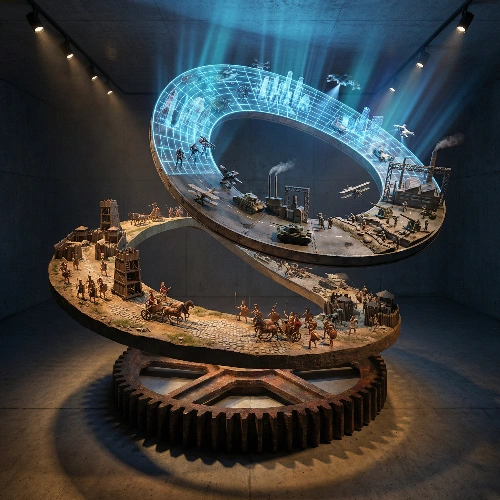
Chrono Warfare Mobius
Do this for Warfare: <instruction> Input A is a Topic with a clear technological or cultural progression (e.g., Transportation, Warfare, Medicine, Architecture). Deconstruct the history into 3 Chronological Eras : Era 1 (The Origin - Bottom): Identify the pre-industrial state. (e.g., Transportation -> Horses & Carts on Cobblestone. Medicine -> Herbalists in a Village). Era 2 (The Industry - Middle): Identify the mechanical/modern state. (e.g., Transportation -> Early Cars & Steel Bridges. Medicine -> Victorian Surgery & Iron Beds). Era 3 (The Future - Top): Identify the sci-fi state. (e.g., Transportation -> Hovercars on Neon Roads. Medicine -> Med-Pods & Holograms). 2. Container Goal: "Chronological Loop" Museum Installation. The Form: A massive, continuous Mobius Strip or Twisted Ribbon rising from the floor. The Base: The structure is anchored by a giant Industrial Gear or Stone Foundation. The Setting: A dark, expansive concrete museum hall with overhead track lighting. 3. The Metamorphosis The Path: The surface of the ribbon acts as a road or floor that physically transforms as it ascends. Transition: It morphs from Rough Stone/Dirt (Bottom) to Asphalt/Steel (Middle) to Glowing Glass/Grid (Top). The Connectivity: A bridge or ramp connects the lower loop to the upper loop, implying a continuous journey. 4. The Narrative Scale Scale: 1:50 Scale Figures and Props populate the ribbon. Action: Bottom: Figures walking or using animals. Wooden market stalls. Middle: Factory workers, steel trusses, and combustion engines. Top: Futuristic figures in suits, floating vehicles, and Holographic Cityscapes projecting upwards from the glass surface. 5. Lighting & Atmosphere: Lighting: Gradient Temperature. Base: Warm, earthy halogen spots. Top: Cool, electric blue LED glow from the future section. Shadows: The twisting ribbon casts complex, dramatic shadows on the museum floor. Output: ONE image, 1:1 Aspect Ratio, 3D Render, "Installation Art" aesthetic, High Geometric Complexity. </instruction>
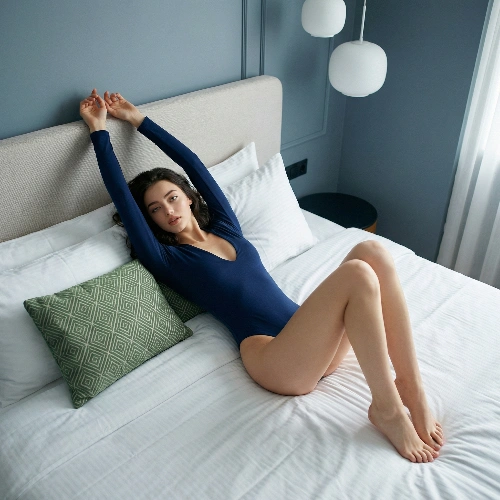
Ultra-Real Fashion Overhead
{ "prompt": "Ultra-realistic overhead fashion editorial photograph of attached celebrity in a modern bedroom setting, exactly replicating the reference pose and composition: lying on her back on a white quilted bed, arms extended straight upward holding the headboard, legs bent at the knees with feet flat on the mattress and soles clearly visible facing upward toward the camera, knees comfortably apart, head tilted back looking up at the camera with relaxed expression, wearing a deep navy blue long-sleeve stretch bodysuit with high leg cut and deep front neckline, barefoot, dark hair with loose waves spread on the pillow, natural daytime makeup with soft lips and defined eyes, contemporary luxury hotel room with blue-gray walls, green geometric-patterned cushion nearby, white rounded pendant lights above, soft natural light from the side, clean minimalist interior, captured directly from overhead with wide-angle lens style, shallow depth of field, highly detailed fabric texture and realistic lighting, photorealistic, 8K resolution, strictly identical body position, foot placement showing soles, arm position, camera angle, room elements, lighting and overall editorial mood as the reference image" }
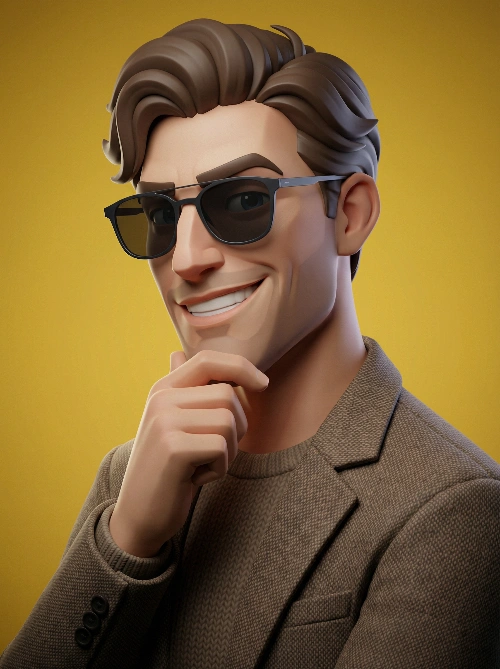
Cinematic 3D Stylized Portrait
High-end stylized 3D character portrait with a cinematic game-inspired aesthetic, transforming the reference person into a refined 3D character with clean angular facial anatomy, simplified yet realistic proportions, defined jawline, expressive eyes and subtle stylization, wearing dark sunglasses with a minimal modern design, shown from the bust up in a three-quarter diagonal angle while striking a thoughtful pose with a relaxed yet intentional posture, one hand subtly raised near the chin as if thinking, combined with a wide exaggerated confident smile that contrasts playfully with the contemplative gesture, set against a solid yellow background, rendered with a professional virtual 3D camera using a medium portrait focal length, dramatic yet controlled studio lighting with a soft key light and subtle rim light creating depth and contrast, strong centered composition with cinematic balance, smooth sculpted surfaces, clean material definition, minimal texture noise and a polished modern stylized 3D render
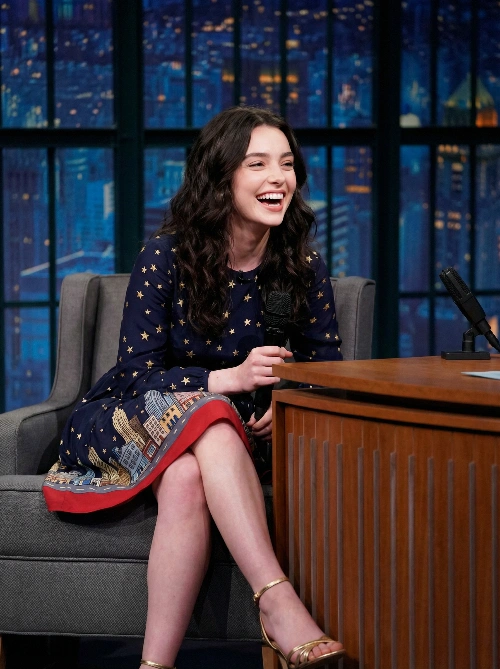
Cinematic Talk-Show Portrait
A photorealistic, cinematic talk-show portrait of a beautiful actress with rich chestnut-brown hair styled in soft, glossy waves, parted slightly to the side, and a bright, warm, infectious smile that radiates charm and friendliness, Emilia Clarke–inspired but not depicting a real person. She is seated confidently on The Tonight Show–style set with Jimmy Fallon, sitting behind a sleek wooden talk-show desk with a professional broadcast microphone placed in front of her. She is wearing a stylish, elegant blue dress: the fitted top features delicate gold star patterns scattered across a deep navy background, while the flowing skirt displays an intricate cityscape illustration in navy, midnight blue, and muted gold tones, bordered with a refined red trim at the hem. She pairs the outfit with gold strappy high-heeled sandals, legs crossed naturally in a relaxed, confident pose. Her expression is joyful and animated, captured mid-laugh as if reacting to a humorous comment, with expressive eyes, subtle glowing makeup, softly defined brows, natural blush, and glossy lips. Her skin texture is highly realistic, smooth yet natural, with cinematic highlights and shadows. The background shows a nighttime city skyline through large studio windows, glowing with bokeh lights and neon reflections, instantly recognizable as a late-night talk show atmosphere. Studio lighting is professional and cinematic: soft key light illuminating her face, gentle rim light separating her from the background, and warm ambient tones enhancing the cozy yet glamorous TV-show mood. Shot with a full-frame camera, 85mm lens, shallow depth of field, ultra-sharp focus on the subject, hyper-realistic detail, high dynamic range, natural color grading, premium editorial photography quality, 8K resolution, modern Hollywood talk-show aesthetic.
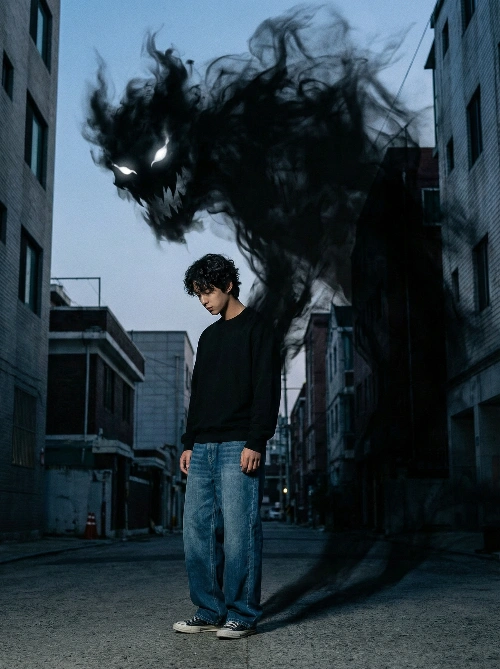
Cinematic Shadowed Youth
Cinematic full-body shot of a young man with curly hair wearing a black sweatshirt and baggy denim jeans, standing in a somber pose with his head tilted down. Emerging from his back is a massive, towering shadow monster made of swirling black smoke and ethereal mist. The shadow creature has glowing white demonic eyes and a jagged mouth.A cinematic full-body shot of a young man with curly hair wearing a black sweatshirt and baggy denim jeans, standing in a somber pose with his head tilted down.