
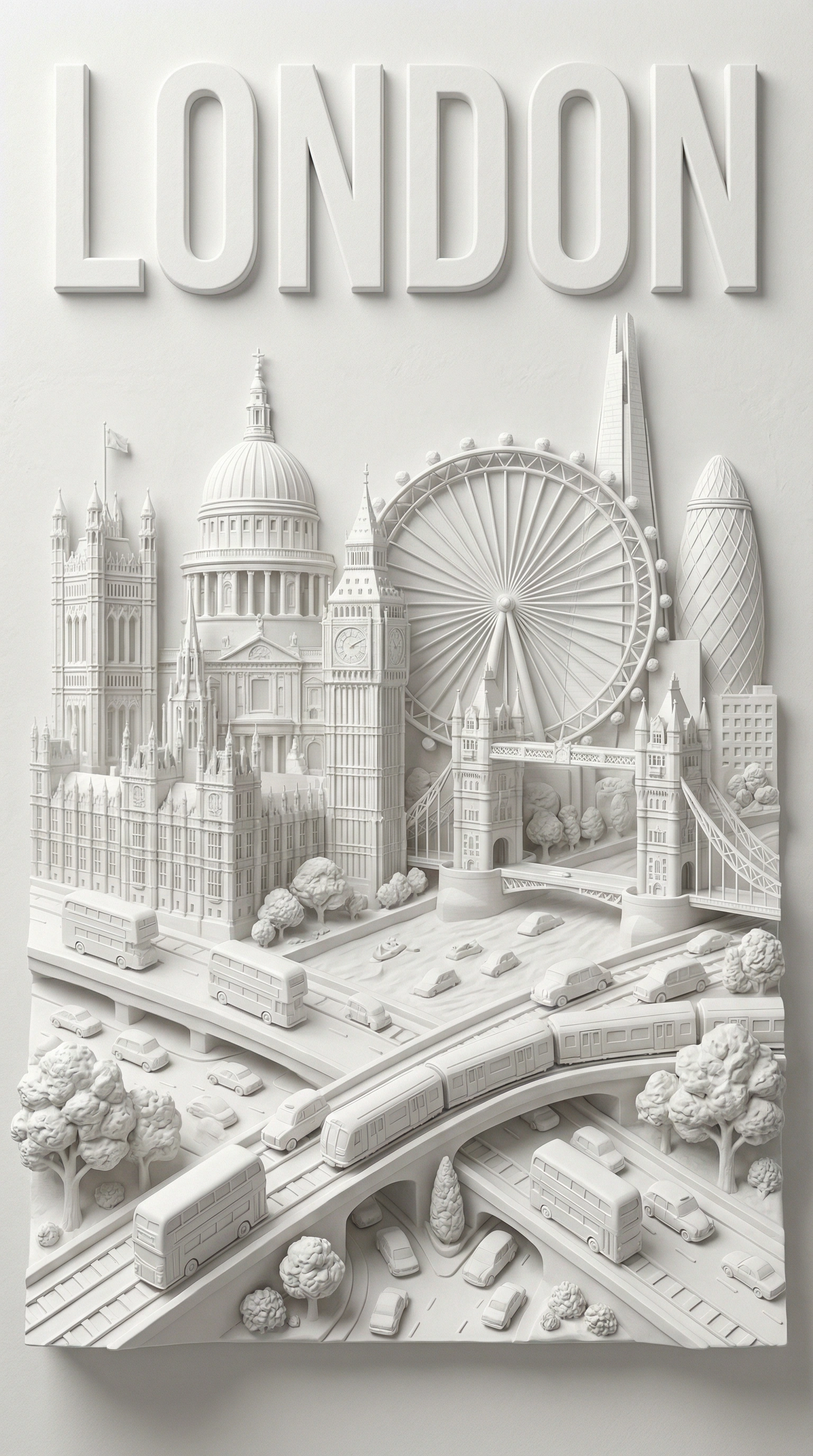
London 3D Bas-Relief Collage
Prompt
A highly detailed 3D bas-relief poster design representing [London]. A dense collage composition featuring the most iconic landmarks and skyline of [London]. Foreground filled with local transportation systems, busy highway networks with miniature cars, and native vegetation. At the top, features prominent, large, embossed English text in capital letters spelling out the name of the location. Pure white monochromatic clay render, embossed paper texture, soft studio lighting, high visual density, clean commercial illustration style.
Aspect Ratio
Source
@0x00_KryptModel
Nano Banana ProYou might also like

LV Dynamic Grid Muted
Louis Vuitton. Act as a World-Class Editorial Designer. PHASE 1: DYNAMIC SUBJECT LOGIC. * Subject Selection: Autonomously analyze Louis Vuitton and select an iconic luxury fashion subject, such as a Louis Vuitton monogram travel trunk, a classic LV monogram handbag (e.g., Speedy or Keepall), or a high-fashion model interacting with a Louis Vuitton bag. * Layering (The Sandwich Effect): Interweave the subject with background shapes. Some parts of the bag or model must be hidden behind geometric blocks, while other parts (handles, straps, hands, accessories, luggage tags) must overlap them to create 3D depth. PHASE 2: GRID & GEOMETRY. * Layout: A clean 2x2 grid composition. * Overlays: Superimpose large, bold geometric arcs and circles over the grid. * Visual Balance: Place one iconic Louis Vuitton prop (for example a floating LV luggage tag, padlock, or small monogram coin pouch) in a separate quadrant to balance the main subject. PHASE 3: SOPHISTICATED MUTED PALETTE. * Color Direction: DO NOT use aggressive neon or oversaturated colors. * Palette: Identify the core Louis Vuitton colors and shift them to a sophisticated muted spectrum. * Tones: Use desaturated, earthy, or dusty versions of LV heritage colors such as muted monogram brown, dusty gold, warm tan, soft caramel, aged leather beige, and muted cream. * Finish: Matte, flat color blocks with zero gradients. PHASE 4: PHOTOGRAPHY & LIGHTING. * Subject Style: High-end commercial studio photography. * Lighting: Soft, diffused studio lighting with gentle highlights. No harsh shadows. * Integration: The subject must feel physically embedded into the graphic grid. PHASE 5: MINIMALIST BRANDING. * Logo: Place a clean, single-color Louis Vuitton LV monogram logo in the center of one background block. No taglines, just the iconic symbol.
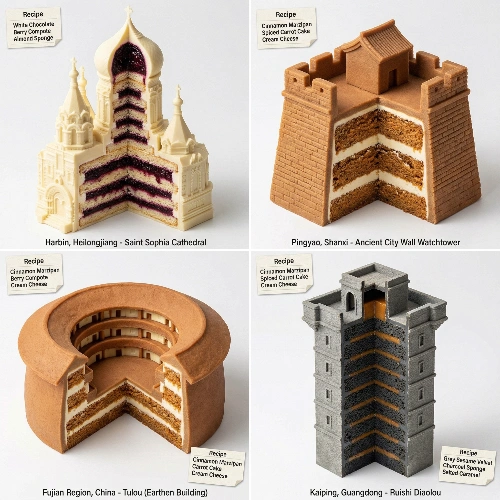
Pastry-Architectural Hidden Gems
input = China --- <instructions> input=continent or country. Find 4 less famous cities or regions, analyze deeply and select their most architecturally distinct building. Function DrawCity($lesser_known){ Concept: Architectural Cross-Section - The building's form containing complex pastry layers. Process: 1. SELECT TARGET: Identify $ BuildingName. 2. EXTRACT GEOMETRY: Define $ Silhouette (The outer profile). Do not simplify the geometry. 3. DEFINE INTERIOR ($FlavorProfile): - Assign distinct color contrast layers (e.g., Red Velvet inside White Marble, Matcha Sponge inside Grey Concrete, Gold flakes in Jelly). 4. SURGICAL SLICE: - Remove 1/4 of the structure or create a vertical cross-section. - CRITICAL: The cut must be clean and sharp. It must reveal $ FlavorProfile layers inside the walls/floors. - The remaining 3/4 of the building must remain architecturally perfect. 5. MATERIAL MAPPING (Apply texture to Exterior): IF Gothic/Ornate → Ext: White Chocolate Sculpting // interior: Layers of dark berry compote & almond sponge. IF Modern/Glass → Ext: Isomalt panes & Mirror Glaze // interior: : Geometric cubes of mango mousse & coconut dacquoise. IF Brutalist/Concrete → Ext: Grey Sesame Velvet Spray // interior: : Dense strata of charcoal sponge & salted caramel. IF Adobe/Organic → Ext: Cinnamon Marzipan // interior: : Spiced carrot cake & cream cheese strata. 6. EXECUTE: Macro shot, 45-degree angle, sharp focus on the "cut" to show texture. } Output: 2x2 grid. Run DrawCity($lesser_known) 4 times. Label: Bottom of each image "City, State/Country - Building Name". Include: A small visual recipe card in corner listing the "Internal Layers". </instructions>
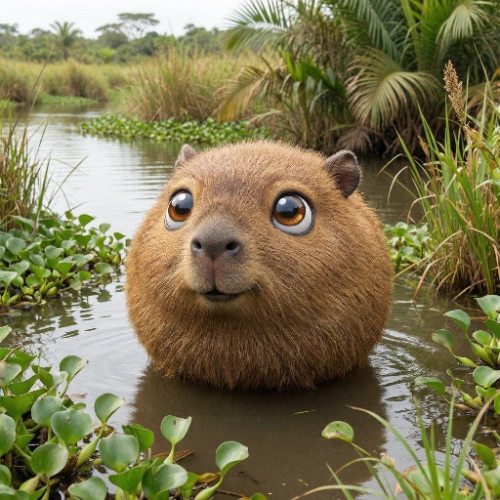
Spherical Cute Animal
Make a photo of a cute ball-shaped version of a [animal: Capybara], with big adorable over-sized eyes, it has no head, instead its face is part of the ball, its head and body are one. They are in their usual habitat. Must be almost spherical and cartoonishly cute. Its eyes are looking up in the most adorable cheeky fashion.
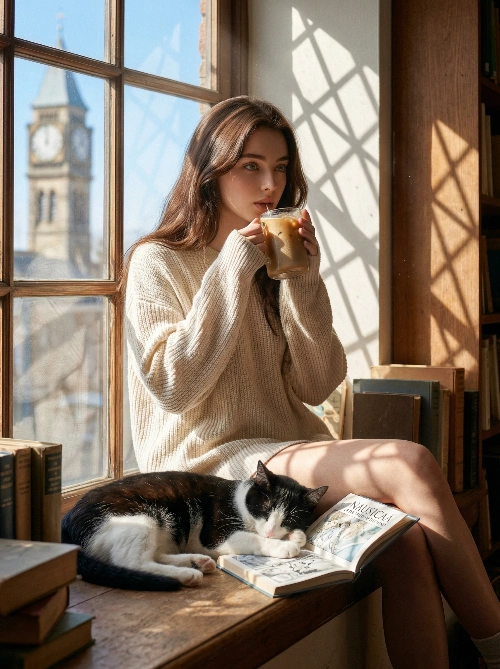
Sunlit Bookstore Cat Moment
Using the uploaded real female subject as the visual baseline, generate an immersive, story-rich environmental portrait with a warm and comforting atmosphere. The scene is set by a sunlit window inside a secondhand bookstore, capturing a quiet afternoon moment shared between a young woman and a cat. The overall style should be cinematic, highly detailed, and photorealistic, using light, texture, and everyday elements to create a cozy, healing, and narrative-driven visual experience. Character Baseline and Styling Baseline: Strictly follow the facial features, structure, and youthful aura of the woman in the uploaded image. She should have long chestnut-brown hair. Expression: Calm and relaxed, immersed in the quiet rhythm of reading and rest. Hair: Long chestnut-brown hair, naturally falling. Clothing: A cream-colored oversized sweater, large enough to cover her hands, enhancing a sense of softness, comfort, and enclosure. Scene, Details, and Interaction Primary Setting: A sunlit secondhand bookstore. The subject is seated on a slightly dusty windowsill. Core Props and Interaction: Books: Vintage manga scattered beneath and around her. An open copy of “Nausicaä of the Valley of the Wind” lies beside her. Cat: A black-and-white tuxedo cat curled up asleep by her legs, with one paw resting gently on the open manga page. Subtle details such as the faint twitching of the cat’s whiskers during sleep should be captured. Action: The subject is sipping iced coffee from a ceramic cup, with visible vapor or condensation gently rising from the cup. Environmental Details: Outside the window is a soft baby-blue sky, with a distant clock tower suggesting midday through lighting cues. The aged yellowed pages of old books, the knit texture of the sweater, and the fine details of the cat’s fur must all be rendered with high clarity. Lighting, Composition, and Image Quality Lighting: Bright natural sunlight streams through the old bookstore window, casting patterned, lattice-like shadows across the subject’s face. Light is the dominant visual element, creating a warm, airy atmosphere that emphasizes a “comfortable afternoon” mood. Composition: Medium-close framing focused on the subject, the cat, and the windowsill area. The perspective should resemble an environmental portrait with strong narrative presence. Color and Tone: Warm overall color palette, soft lighting, delicate shadows, and naturally balanced saturation, highlighting a cozy and nostalgic feeling. Image Quality: 8K ultra-high resolution with extreme detail. Must clearly render volumetric light (Tyndall effect), sweater fibers, aged paper textures, cat fur, glass surface imperfections, and fine dust particles suspended in the air. Mood and Atmosphere Core Mood: Healing, tranquil, lazy, nostalgic, and rich with literary and everyday life ambiance. The image should convey a sense of time slowing down, with a perfect moment of solitude shared harmoniously between a person, her pet, and her books.
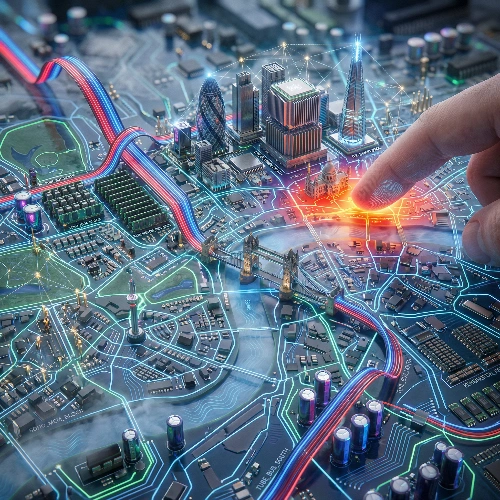
London Smart Circuit
Do this for London: Input Variable: [INSERT CITY NAME] (e.g., Tokyo, Chicago, Rio de Janeiro) System Instruction: Generate a hyper-detailed "Smart City Circuit Board" macro shot. The Concept: The city is a living motherboard. Every urban element is translated into a piece of computer hardware. 1. Urban Translation Analyze the City: Identify the geography (Hills, Water, Grid) and landmarks. Landmarks (The Processors): The iconic buildings act as the "CPUs" or "GPUs." They are the tallest, most intricate metal components. Neighborhoods (The Memory): Residential areas are dense grids of RAM Sticks or Resistor Arrays . Power Grid (The Capacitors): Industrial zones or power plants are represented by cylindrical Capacitors . 2. The Micro-Infrastructure Layer The Transit (The Bus): Train lines and subways are represented by Ribbon Cables arching over the board or buried under the surface layer. The Connectivity (Wi-Fi): Do not just show streets. Show Gold Pins sticking up from rooftops representing antennas. Faint holographic lines connect them (The Network). The Weather (Cooling): If the city is foggy/cloudy (e.g., SF/London), use Dry Ice Fog drifting over the board (simulating Liquid Nitrogen cooling). 3. The Interaction The Hand: A giant finger touches a specific district. The "Boot Up": The touch creates a Heat Map effect. The area under the finger glows Hot Orange/Red, fading to Cool Blue further away. This simulates "System Load" or population density. 4. Visual Syntax: Texturing: The "Water" areas shouldn't just be empty. They should look like Exposed Fiberglass Substrate with faint wave patterns etched into the resin. Labeling: Tiny white silk-screened text on the board identifies neighborhoods (e.g., "SOHO_V1.0", "SHINJUKU_PORT_A"). 5. Lighting & Atmosphere: Glow: Every street trace has a faint bioluminescent pulse. Reflectivity: High gloss. The city looks wet or polished. Output: ONE image, 1:1 Aspect Ratio, Macro Tech Photography, 8k Resolution.
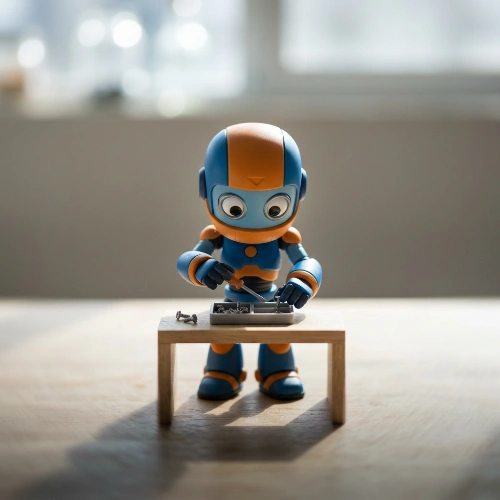
Candid High-Angle Slice
A high-angle tilt-shift cinematic image of the character captured naturally doing an everyday activity. The moment must feel candid and unstaged, like a quiet slice of life observed from above. Likeness Preservation Maintain exact proportions, eye shape, spacing, stylization, and material identity from the reference. Do not humanize. Do not reinterpret anatomy. Do not exaggerate realism. Camera & Perspective High-angle, slightly offset bird’s-eye view. Subtle isometric feeling. Equivalent to a 35mm lens adapted for tilt-shift photography. The character fills approximately 60–65% of the frame vertically. Breathing room above the head. Visible ground plane beneath. No extreme distortion. Focus Discipline (CRITICAL) Extremely shallow depth of field. Only the face and upper torso must be razor sharp. Hands interacting with an object may also be sharp. Lower legs and shoes must be slightly softened. Ground surface must progressively soften toward the bottom edge. Top and bottom edges must show strong optical tilt-shift blur. The focus band must be narrow and centered horizontally. No full-body sharpness. Pose Behavior The character must be naturally engaged in a daily action. Movement must feel subtle and believable. No staged hero poses. No exaggerated symmetry. Silhouette must remain clean and readable. Props or minimal furniture may be included only if necessary to support the action. Keep them simple and secondary. Lighting Control Bright natural daylight with firm directional key light. Light must carve the form clearly. Defined shadow under feet or object. Crisp shadow edge on ground. Subtle rim light separating character from background. No flat studio wash. No overly diffused light. Background Discipline Abstract minimal environment. Soft tonal gradient. Slight atmospheric depth. No detailed storytelling clutter. No heavy furniture unless essential to action. Background must support the character, not compete. Background Directional Structure (CRITICAL) Upper third of frame must contain soft luminous bokeh shapes or circular light blobs, gently out of focus, slightly brighter than mid-ground. Mid-ground remains neutral and unobtrusive. Lower ground plane must have subtle diagonal orientation, with a light-to-dark gradient guiding the eye upward toward the character’s head. Ground texture may contain faint linear perspective cues, but remain soft and minimal. The tonal gradient must travel from slightly darker bottom edge toward brighter mid-upper region behind the head. No flat monotone background. Color & Material Character slightly higher saturation than background. Background slightly muted. Clean premium collectible finish. Subtle surface sheen. No gritty realism. No artificial wear. Emotion Calm presence. Quiet confidence. A simple daily act elevated through composition and light. Not dramatic. Not heroic. Intimate but cinematic. Negative Lock No full-body sharpness No flat background No cluttered environment No stiff symmetrical pose No soft diffused lighting No dramatic battle energy No exaggerated realism
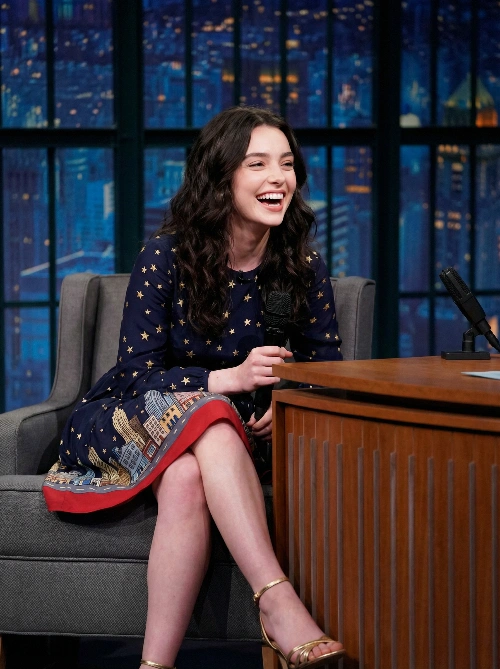
Cinematic Talk-Show Portrait
A photorealistic, cinematic talk-show portrait of a beautiful actress with rich chestnut-brown hair styled in soft, glossy waves, parted slightly to the side, and a bright, warm, infectious smile that radiates charm and friendliness, Emilia Clarke–inspired but not depicting a real person. She is seated confidently on The Tonight Show–style set with Jimmy Fallon, sitting behind a sleek wooden talk-show desk with a professional broadcast microphone placed in front of her. She is wearing a stylish, elegant blue dress: the fitted top features delicate gold star patterns scattered across a deep navy background, while the flowing skirt displays an intricate cityscape illustration in navy, midnight blue, and muted gold tones, bordered with a refined red trim at the hem. She pairs the outfit with gold strappy high-heeled sandals, legs crossed naturally in a relaxed, confident pose. Her expression is joyful and animated, captured mid-laugh as if reacting to a humorous comment, with expressive eyes, subtle glowing makeup, softly defined brows, natural blush, and glossy lips. Her skin texture is highly realistic, smooth yet natural, with cinematic highlights and shadows. The background shows a nighttime city skyline through large studio windows, glowing with bokeh lights and neon reflections, instantly recognizable as a late-night talk show atmosphere. Studio lighting is professional and cinematic: soft key light illuminating her face, gentle rim light separating her from the background, and warm ambient tones enhancing the cozy yet glamorous TV-show mood. Shot with a full-frame camera, 85mm lens, shallow depth of field, ultra-sharp focus on the subject, hyper-realistic detail, high dynamic range, natural color grading, premium editorial photography quality, 8K resolution, modern Hollywood talk-show aesthetic.
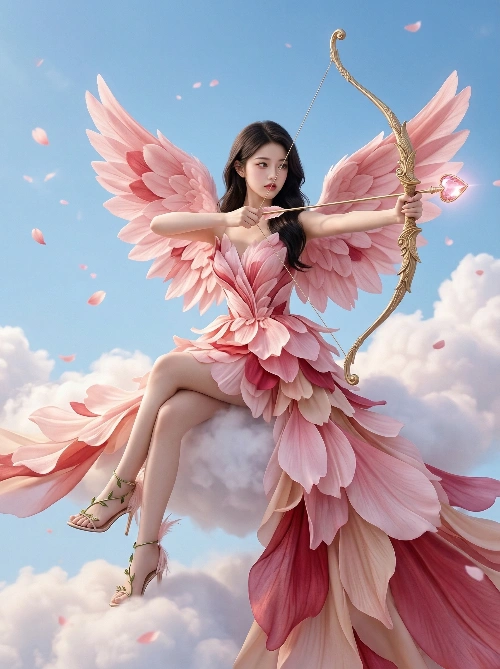
Ethereal Cupid Fashion Port
Using the real female subject you uploaded as the visual baseline, generate an ultra-high-precision photorealistic portrait that blends fantasy storytelling with high-fashion aesthetics. The character is reimagined as a modern Cupid, poised elegantly among the clouds, creating a visual spectacle that is ethereal, dramatic, and fashion-forward. Character Baseline and Styling Baseline: Strictly follow the facial contours, proportions, skin texture, and overall aura from the reference image. Age and ethnic characteristics must remain consistent with the original. Expression: Enhanced soft-glow makeup that remains faithful to her natural features. Expression is focused, with sharp, intent eyes suggesting precise aim. Hairstyle: Fully replicate the hair color, length, texture, and natural form from the reference image. Wardrobe, Accessories, and Pose Main Dress: A fantasy-inspired haute couture gown. Design: Structured, intricately detailed strapless bodice with a long, flowing train. Material: Constructed from layered, realistic soft pink cherry blossom petals, creating a light, semi-transparent, airy effect with clearly defined petal textures. Color: Dominated by soft sakura pink, blended with crimson and nude pink in a natural gradient. Wings: Large petal wings composed of countless cherry blossom petals arranged in a dimensional collage, transitioning naturally from pale pink to near-white. Each petal must exhibit realistic texture and light transmission. Footwear: Ultra-thin high-heeled decorative sandals, wrapped with vines and petals, accented with white feathers. Weapon Accessory: Holding an ornate gilded longbow with intricate engravings. The arrow tip is set with a heart-shaped gemstone, emitting a soft pink-gold glow. Pose and Composition Pose: The subject sits gracefully atop a fluffy cloud. The right leg is bent for support, while the left leg extends forward. The upper body leans slightly forward as she draws the bow, combining elegance with controlled strength. Composition: Medium shot with the subject centered in the frame, wings fully extended. Eye-level perspective. Sharp focus on the face and bow, with the surrounding clouds slightly softened. Environment and Lighting Environment: Suspended in a bright sky, seated on voluminous clouds. The background features a vivid blue sky with scattered floating cherry blossom petals, creating a dreamy, weightless atmosphere. Lighting: Soft directional diffused lighting. The key light from above at an angle defines the silhouette, complemented by fill light to maintain clean shadows. Light creates crystalline highlights on gemstones, metal surfaces, and petals, resulting in an airy yet dimensional tonal quality. Style and Texture Visual: Photography-grade hyperrealism with cinematic impact and extreme detail fidelity. Detail: Supports 8K-level rendering. All materials—skin, petals, metal—must achieve high physical realism. Fusion: Seamlessly combines high-fashion aesthetics, mythological drama, and romantic fantasy imagination. Quality: Achieves the clarity, color depth, and visual impact of top-tier commercial fashion campaigns.