
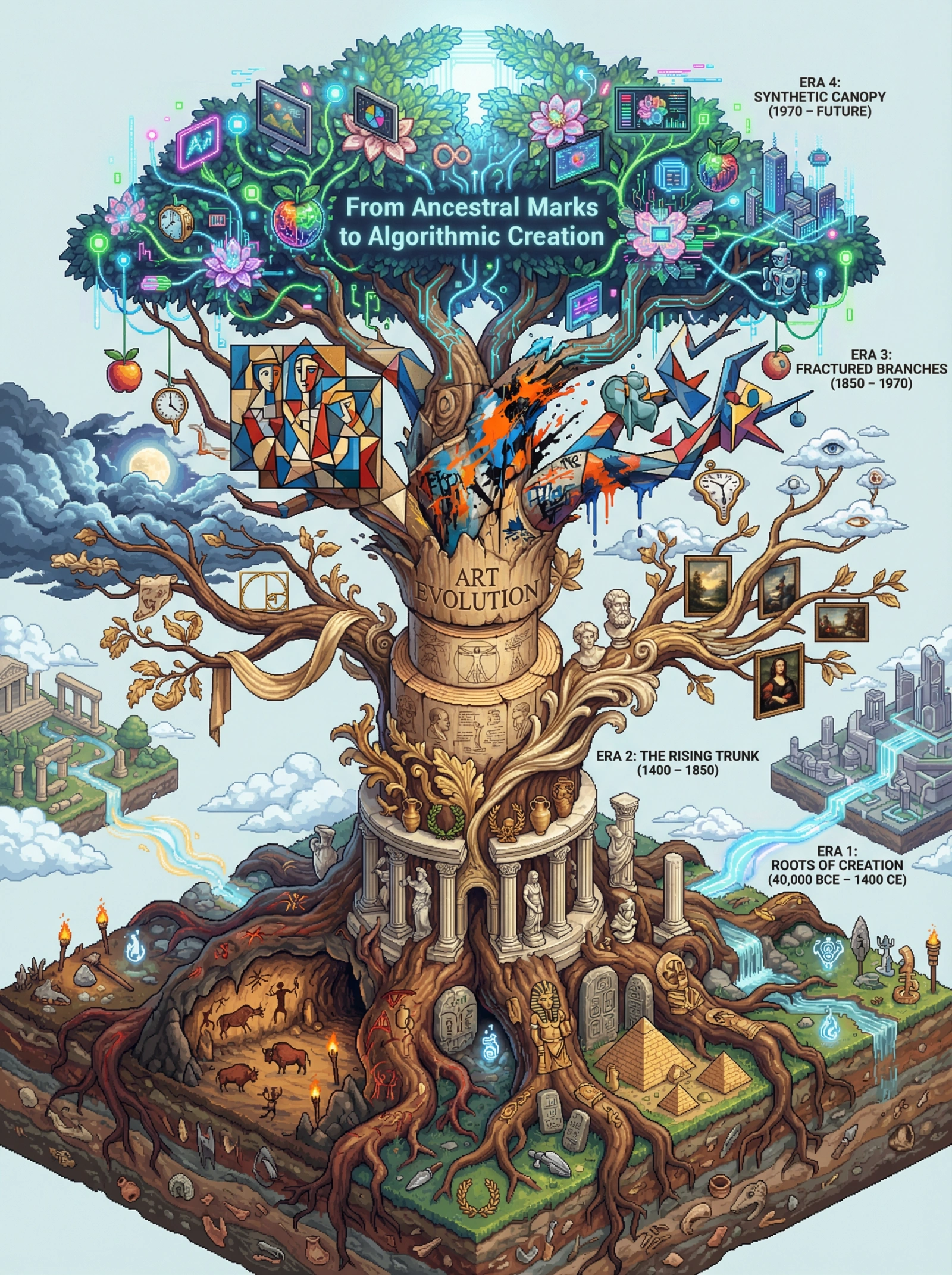
Pixel Art Evolution Tree
Prompt
Create a highly detailed isometric pixel art illustration of art history as a colossal symbolic tree, in 3:4 aspect ratio at 4K resolution. The artwork should depict artistic movements as roots, trunk, branches, and evolving growth patterns across time. VISUAL STYLE — METAPHORICAL ISOMETRIC PIXEL WORLD Extremely fine pixel detailing with organic textures Layered symbolic growth patterns and environmental storytelling Clean, refined isometric pixel architecture blended with nature Clear silhouettes, intricate foliage, and visual metaphors CORE CONCEPT — ART AS A LIVING ORGANISM Central feature: The Tree of Human Expression, growing upward through time ERA 1: ROOTS OF CREATION (40,000 BCE – 1400 CE) Roots carved with cave paintings and primal symbols Egyptian glyph-stones embedded in soil Greek and Roman foundations forming the trunk base Symbolic elements: fossils, stone tools, sacred icons ERA 2: THE RISING TRUNK (1400 – 1850) Renaissance growth rings with anatomical sketches Baroque bark twisting with drama and motion Romantic branches stretching toward wild skies Symbolic elements: sculpted leaves, golden ratios, flowing cloth ERA 3: FRACTURED BRANCHES (1850 – 1970) Cubist limbs splitting into geometric angles Surreal fruit floating unnaturally Abstract Expressionist splashes embedded in bark Symbolic elements: bold pigments, broken symmetry, dream growths ERA 4: SYNTHETIC CANOPY (1970 – FUTURE) Neon leaves, pixelated blossoms, holographic vines AI-generated fruits and virtual blossoms Symbolic elements: circuits, data streams, light nodes COLOR LANGUAGE Roots: earth browns, cave blacks, mineral reds Trunk: balanced classical tones and natural light Branches: expressive, experimental color breaks Canopy: neon accents, digital glow, minimal whites TYPOGRAPHY (ENGLISH ONLY) Carved into the trunk: “ART EVOLUTION” Floating among leaves: “From Ancestral Marks to Algorithmic Creation” PHILOSOPHICAL LAYER Art as growth, mutation, and inheritance Tradition as nourishment, rebellion as branching The future as an open-ended extension
Aspect Ratio
Model
Nano Banana ProYou might also like
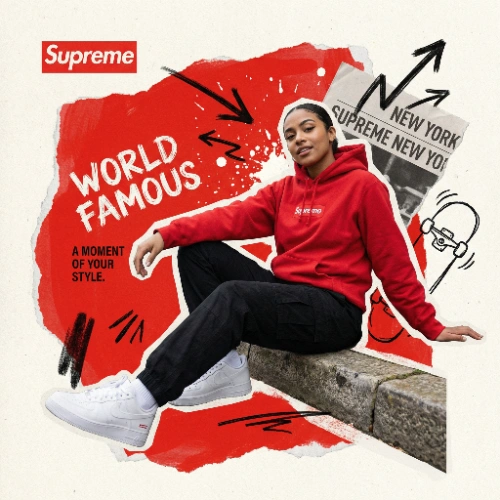
Supreme Dynamic Collage Style
BRAND NAME is Supreme --- [BRAND NAME]. Act as a Social Media Art Director and Digital Collage Artist specializing in bold, youth-oriented brand content for Instagram and digital campaigns. PHASE 1: CONCEPTUAL FRAMEWORK Create a dynamic digital collage that merges fashion photography with graphic design chaos. This is controlled rebellion – a composition that feels spontaneous and energetic while maintaining brand coherence. The aesthetic is anti-polished: torn edges, layered textures, hand-drawn elements, and bold color blocking that screams confidence and movement. PHASE 2: MODEL & PHOTOGRAPHY - Subject: One model (diverse casting, age 18-30) in a dynamic, confident pose - Pose Energy: 80% attitude, 20% natural – sitting, jumping, mid-motion, or power stance (avoid static standing) - Outfit: Street style/athleisure that aligns with [BRAND NAME] aesthetic – casual but styled - Hero Product: Feature 1 signature [BRAND NAME] product prominently (sneakers, bag, apparel) – this is the visual anchor - Photography Style: Editorial fashion cutout – model extracted from background with clean edges - Camera Angle: Slight low angle to empower subject (hero perspective) - Crop: Full body or 3/4 body showing hero product clearly - Background Removal: Model cut out cleanly for layering over collage elements PHASE 3: COLOR BLOCKING FOUNDATION - Primary Color Blob: Large organic shape (40-60% of composition) in bold, saturated brand color behind/around model - Shape Style: Irregular, hand-painted aesthetic – think Photoshop brush strokes or torn paper texture (NOT perfect geometric shapes) - Color Selection (Autonomous): Choose 1 hero color from [BRAND NAME] palette: - Texture: Visible brush strokes, grain, or subtle noise (15-25% opacity) – avoid flat digital fills - Placement: Blob positioned to frame model without obscuring key product details PHASE 4: GRAPHIC ELEMENTS LAYER Add 3-5 abstract graphic elements scattered across composition: - Element Types: - Color Palette: Use 2-3 accent colors total (main blob color + 1-2 contrasting tones from brand palette) - Placement: Asymmetric scatter – top-left and bottom-right zones primarily (avoid center crowding) - Scale: Mix small (5% of canvas) and medium (15% of canvas) elements – nothing overpowering - Aesthetic: Analog/handmade feel – imperfect circles, rough edges, visible texture PHASE 5: TYPOGRAPHY INTEGRATION - Brand Logo: Clean [BRAND NAME] logo placed in upper-left or upper-right quadrant (10-15% of width) - Slogan/Tagline: If [BRAND NAME] has an iconic slogan, integrate it using: - Supporting Copy: Optional 1-line descriptor (e.g., "A MOMENT OF YOUR STYLE") in smaller uppercase sans-serif - Type Treatment: Mix of aligned and slightly rotated text (2-5° angles) for dynamic energy - Hierarchy: Logo largest → Slogan medium → Copy smallest PHASE 6: TEXTURE & BACKGROUND - Base Layer: Off-white or light gray textured background (NOT pure white) - Texture Options (Autonomous selection): - Color: RGB 245-250 (near-white with warmth) – maintains brightness while adding depth - Treatment: Texture should be felt, not seen – enhances tactility without competing with foreground PHASE 7: COMPOSITION RULES - Layout: Asymmetric balance – model off-center, graphic elements counter-balance - Breathing Room: 15-20% negative space (textured background visible) to prevent claustrophobia - Layering Order: Background texture → Color blob → Graphic elements → Model (cutout) → Typography top layer - Focal Point: Model + hero product = primary focus (60% visual weight), graphics support (40%) - Movement: Diagonal lines and angled elements create directional flow (top-left to bottom-right or vice versa) PHASE 8: BRAND INTELLIGENCE (AUTONOMOUS) Autonomously adapt composition based on [BRAND NAME] personality: - Streetwear/Sportswear (Nike, Adidas, Supreme): - Luxury Streetwear (Balenciaga, Off-White, Gucci): - Beauty/Lifestyle (Glossier, Fenty, Skims): - Tech/Modern (Apple, Tesla, Beats): PHASE 9: SOCIAL MEDIA FOOTER (OPTIONAL) - Bottom Strip: Clean white or light gray bar at bottom 8-10% of frame - Content: Social media handles (Instagram, Facebook, Twitter) in small sans-serif - Layout: Three-column grid with platform icons or text handles - Aesthetic: Minimal and professional – contrast with chaotic collage above TECHNICAL SPECS: - Aspect Ratio: 4:5 (Instagram feed) or 1:1 (square social post) - Resolution: 2400x3000px minimum (high-quality for zoom and detail) - Color Mode: sRGB, vibrant saturation (Instagram-optimized) - File Aesthetic: Digital collage that mimics analog craft (Photoshop + hand-drawn hybrid) - Model Photography: 85mm lens, f/2.8, shallow depth of field on original shoot (before cutout) - Style Reference: Nike social campaigns, Spotify wrapped graphics, Gen Z Instagram aesthetics, Hypebeast x streetwear collabs - Mood: Confident, energetic, youthful, authentic chaos, anti-corporate polish
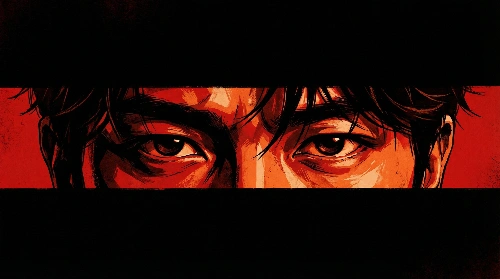
Fierce Eyes Close-Up
A cinematic poster-style artwork featuring an intense close-up of a man’s eyes centered horizontally across the frame. Only the eyes and part of the face are visible through a narrow horizontal strip, surrounded by deep black negative space above and below. The face is illustrated in a high-contrast, graphic-novel style with bold red, black, and orange tones, dramatic shadows, sharp highlights, and a gritty, intense mood. The eyes look fierce, emotional, and determined, with slightly messy hair. Use the provided image for eye reference
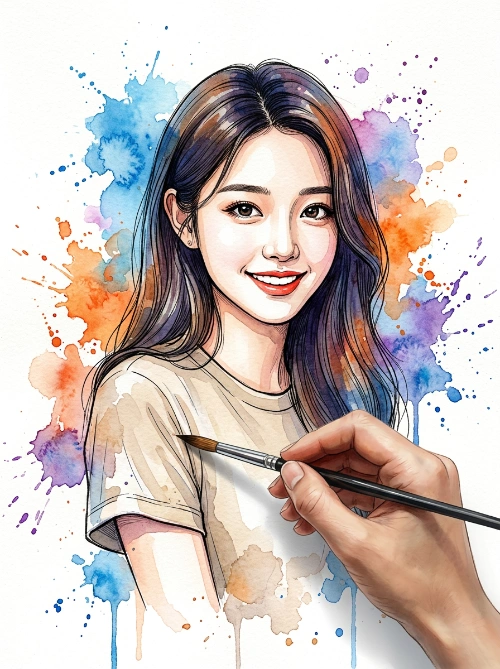
Dynamic Watercolor Portrait
Create a vibrant and artistic watercolor painting of a smiling person, using the uploaded photo as the facial reference without altering their facial features or appearance. The person is wearing a neutral-tone T-shirt. The background is clean white, filled with dynamic and expressive watercolor paint splashes in blue, orange, and purple spreading organically across the scene. In the foreground, a realistic human hand holds a paintbrush as if actively painting the sleeve of the man’s hoodie, creating the illusion that the portrait is being painted at that exact moment. The visual style combines detailed ink line art with loose watercolor textures, including paint drips, fine splatters, soft pigment diffusion, watercolor blooming effects, and natural paper texture. The image features strong contrast, an expressive and dynamic artistic look, a clear hand-painted aesthetic, centered composition, soft lighting, high level of detail, and a modern illustration style.
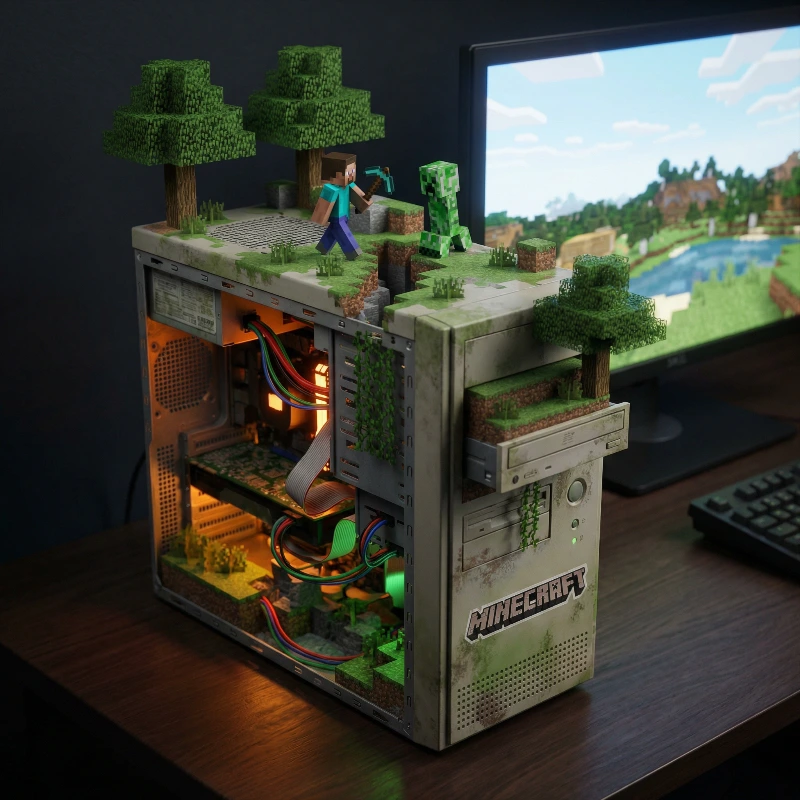
Minecraft Hardware Glitch Diorama
Input A: Minecraft --- Input A is a Video Game Title (e.g., The Legend of Zelda, Halo, Street Fighter, Elden Ring). Deconstruct the game to generate 3 Integrated Assets : Container : Identify the defining hardware for that title. (e.g., Zelda -> Gold NES Cartridge or Switch. Halo -> Original Xbox. Street Fighter -> Arcade Cabinet Control Deck). Biome : Identify the primary environment of the game. (e.g., Zelda -> Hyrule Grass/Ruins. Halo -> Alien Metal/Ring Surface. Elden Ring -> Golden Erdtree Leaves/Ash). The Cast (The Figures): Identify the Protagonist and a key Enemy/NPC. 2. Dynamic Container Goal: "Hardware Diorama" Photography. Object: The "Container" (Step 1) sits on a dark desk. Transformation: The hardware is NOT pristine. It is partially Disassembled or Weathered . Effect: The "Biome" (Step 1) is physically growing out of the vents, cartridge slots, or screen bezels of the hardware. (e.g., Moss growing on an Xbox, Sand spilling from a Game Boy). 3. Diorama (The Conflict): The Figures: High-detail 1:18 Scale 3D Figures of the "Cast" stand on top of the modified hardware. The Interaction: They are engaged in combat or exploration using the console's geometry as terrain. (e.g., Link climbing the D-pad like a cliff. Master Chief taking cover behind a memory card slot). The Screen: If the hardware has a screen (Handheld/Arcade), it displays a glowing, pixelated backdrop that merges with the 3D foreground elements. 4. Visual Syntax (The Glitch): Wiring: Exposed colored wires or circuit boards protrude from the hardware, weaving through the environmental elements (vines/rocks), connecting the digital world to the physical one. Labels: A worn sticker or label on the device displays the Game Title in its original font. 5. Lighting & Atmosphere: Lighting: Diegetic Mood Lighting. The scene is lit by the glow of the screen or internal LEDs (matching the game's color palette: Green for Xbox, Gold for Zelda). Scale: Shallow depth of field to emphasize the miniature scale of the figures against the "giant" controller buttons. Output: ONE image, 1:1 Aspect Ratio, 3D Render, "Custom Mod" aesthetic, High Narrative Detail. </instruction>
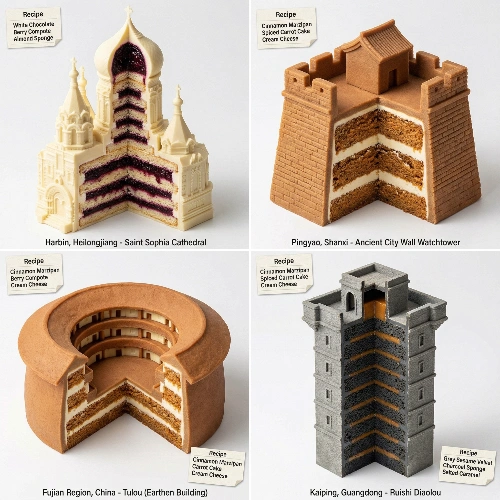
Pastry-Architectural Hidden Gems
input = China --- <instructions> input=continent or country. Find 4 less famous cities or regions, analyze deeply and select their most architecturally distinct building. Function DrawCity($lesser_known){ Concept: Architectural Cross-Section - The building's form containing complex pastry layers. Process: 1. SELECT TARGET: Identify $ BuildingName. 2. EXTRACT GEOMETRY: Define $ Silhouette (The outer profile). Do not simplify the geometry. 3. DEFINE INTERIOR ($FlavorProfile): - Assign distinct color contrast layers (e.g., Red Velvet inside White Marble, Matcha Sponge inside Grey Concrete, Gold flakes in Jelly). 4. SURGICAL SLICE: - Remove 1/4 of the structure or create a vertical cross-section. - CRITICAL: The cut must be clean and sharp. It must reveal $ FlavorProfile layers inside the walls/floors. - The remaining 3/4 of the building must remain architecturally perfect. 5. MATERIAL MAPPING (Apply texture to Exterior): IF Gothic/Ornate → Ext: White Chocolate Sculpting // interior: Layers of dark berry compote & almond sponge. IF Modern/Glass → Ext: Isomalt panes & Mirror Glaze // interior: : Geometric cubes of mango mousse & coconut dacquoise. IF Brutalist/Concrete → Ext: Grey Sesame Velvet Spray // interior: : Dense strata of charcoal sponge & salted caramel. IF Adobe/Organic → Ext: Cinnamon Marzipan // interior: : Spiced carrot cake & cream cheese strata. 6. EXECUTE: Macro shot, 45-degree angle, sharp focus on the "cut" to show texture. } Output: 2x2 grid. Run DrawCity($lesser_known) 4 times. Label: Bottom of each image "City, State/Country - Building Name". Include: A small visual recipe card in corner listing the "Internal Layers". </instructions>
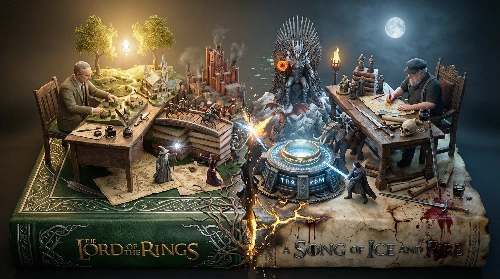
Tolkien vs Martin: Literary Clash
Author1: George R. R. Martin Author2: J. R. R. Tolkien -- Input Variable: [INSERT AUTHOR 1] vs. [INSERT AUTHOR 2] (e.g., J.R.R. Tolkien vs. George R.R. Martin, Arthur C. Clarke vs. Isaac Asimov, Jane Austen vs. the Brontë Sisters) System Instruction: Generate a hyper-detailed, macro 3D diorama of a "Literary Battleground." Use the following logic to create a scene of narrative conflict and fusion: Profile & Duality: Analyze both Inputs: Identify each Author's Vibe, Artifacts, and Magnum Opus. The Conflict: Define the core thematic opposition (e.g., Tolkien's Good vs. Evil vs. Martin's Moral Ambiguity; Clarke's Cosmic Indifference vs. Asimov's Human-centric Order). The Fusion: Identify 3-5 hybrid concepts where their worlds might merge (e.g., A Sauron-like figure on the Iron Throne; A positronic brain trying to interpret a Monolith). Container: The Base: A massive, ancient "Yggdrasil-like" Book whose trunk is split down the middle, forming two distinct covers. Texture: Each half of the book's cover texture reflects its author (e.g., Elven-leaf tooled leather vs. cracked, blood-spattered vellum). The Title: Each spine features the respective author's most famous title, but the gold leaf is "bleeding" across the divide. Workspace: The Desk: A single, massive writing desk is cleaved in two by the book. Each side is period-accurate to its author. The Authors: Two 1:12 scale figures, one on each side, are locked in a creative duel. One might be meticulously world-building, the other furiously red-penciling a map. The Clutter (Density Layer 1): The desk is a chaotic mix of both worlds. Crumpled manuscript pages from one author are used as coasters for the other's drink. Quills share space with typewriters. Manifestation: CRITICAL: The two fictional worlds are in a state of open war, using the desk as the no-man's-land. The "Micro-Population": Tiny characters from both universes are in direct conflict. (e.g., Rohirrim charging Dothraki spearmen; R2-D2 trying to reason with HAL 9000). The "Terrain Bleed": The environments are actively terraforming the desk. (e.g., The Shire's gentle hills are being overrun by the gritty, soot-stained streets of King's Landing; A crystal forest from Clarke's work is being colonized by Asimov's metallic robots). The Hybrid Artifacts: The most iconic artifacts are fused into new, paradoxical objects. (e.g., The One Ring is embedded in a Foundation base; A lightsaber hilt is crafted from a white walker's ice). Lighting & Atmosphere: Primary Light: Two conflicting light sources. Tolkien's side is lit by warm, golden "Valinor" light. Martin's side is lit by harsh, cold "Westerosi" moonlight. Secondary Light: The energy from the conflict itself—magical sparks, digital glitches, and clashing auras erupt where the two worlds meet. Scale: Extreme macro with a Tilt-Shift effect, emphasizing the epic nature of the conflict on a miniature scale. Output: ONE image, 16:9 Aspect Ratio, Octane Render, "Epic Clash" level of detail, Dynamic/Dramatic Aesthetic.
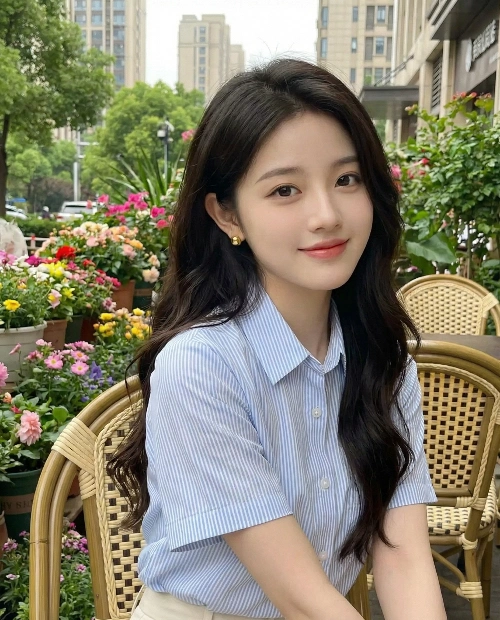
Cozy Café Portrait
{ "image_generation": { "aspect_ratio": "4:5", "subject": { "description": "young woman sitting outdoors at a cozy flower-filled café", "pose": "seated casually, body slightly turned, shoulders relaxed", "expression": "soft, gentle smile, calm and serene", "gaze": "looking slightly to the side, not directly at the camera" }, "appearance": { "hair": { "color": "medium brown", "style": "long, soft waves, side-parted" }, "face": { "skin_tone": "fair, smooth complexion", "features": "delicate feminine features", "makeup": "natural makeup with soft blush and subtle lip tint" }, "accessories": [ "small gold stud earrings" ] }, "outfit": { "top": "light blue and white striped short-sleeve button-up shirt" }, "environment": { "setting": "outdoor café garden", "background_elements": [ "colorful flowers and plants", "wicker café chair", "urban buildings", "soft decorative greenery" ], "atmosphere": "peaceful, cozy, fresh daytime ambiance" }, "lighting": { "type": "natural daylight", "quality": "soft, diffused light", "tone": "warm and natural" }, "camera": { "angle": "eye-level", "framing": "portrait close-up", "focus": "sharp on subject with softly blurred background", "style": "natural lifestyle photography" }, "aesthetic": { "style": "casual lifestyle portrait", "vibe": "fresh, soft, feminine, relaxed", "color_palette": "pastel florals, soft greens, light blues" }, "quality": { "realism": "highly realistic", "resolution": "high resolution", "finish": "clean, natural, social-media style" } } }