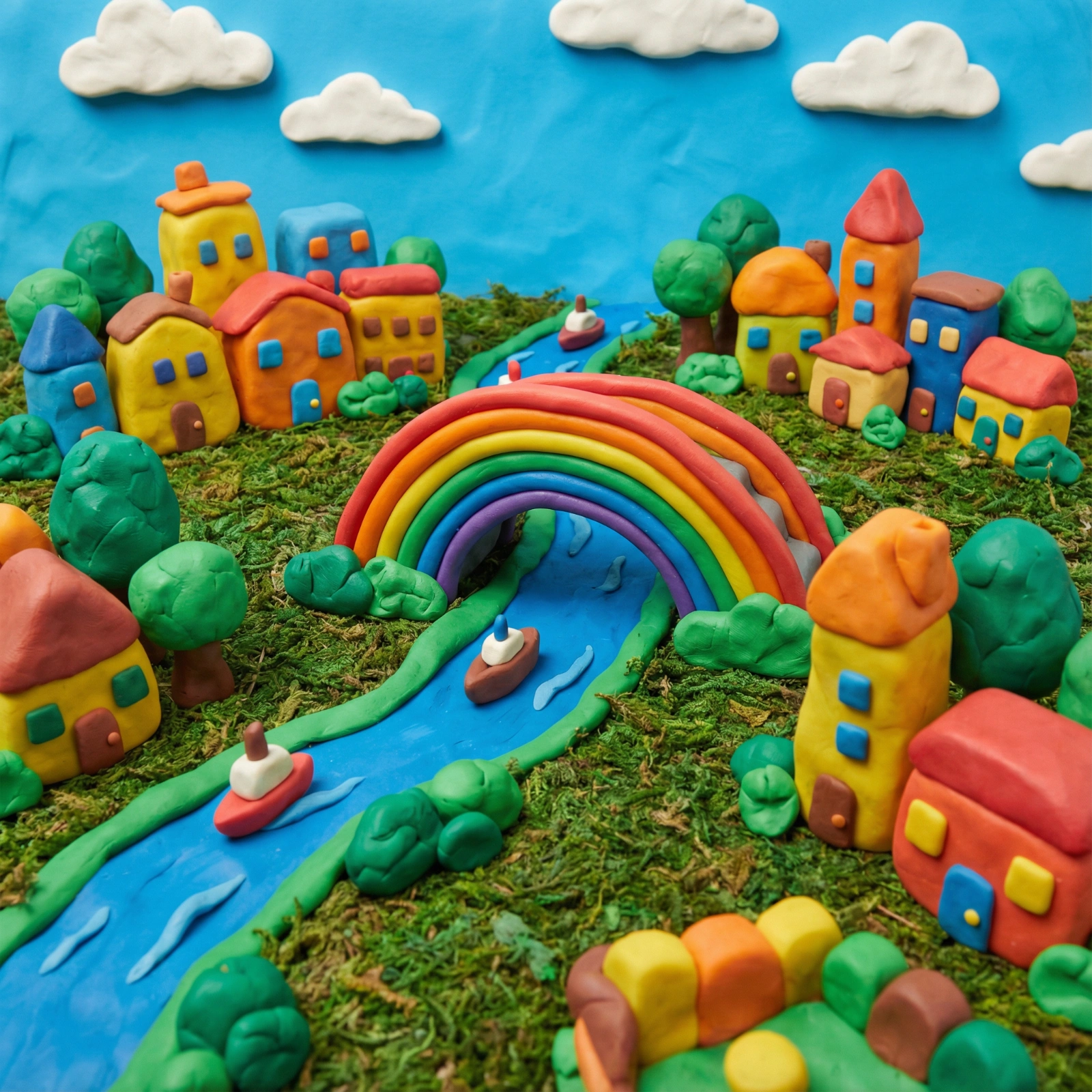
Whimsical Clay Rainbow Town
Prompt
Generate a whimsical miniature world featuring [Rainbow Bridge Town] crafted entirely from colorful modeling clay. Every element buildings, trees, waterways, and urban features should appear hand sculpted with visible fingerprints and organic clay textures. Use a playful, childlike style with vibrant colors: bright azure sky, puffy cream clouds, emerald trees, and buildings in warm yellows, oranges, reds, and blues. The handmade quality should be evident in every surface and gentle curve. Capture from a wide perspective showcasing the entire miniature landscape in a harmonious, joyful composition. Include no text, words, or signage only sculptural clay elements that define the location through recognizable architectural features. 1080x1080 dimension.
Aspect Ratio
Source
@Milo_Bahi_02Model
Nano Banana ProYou might also like
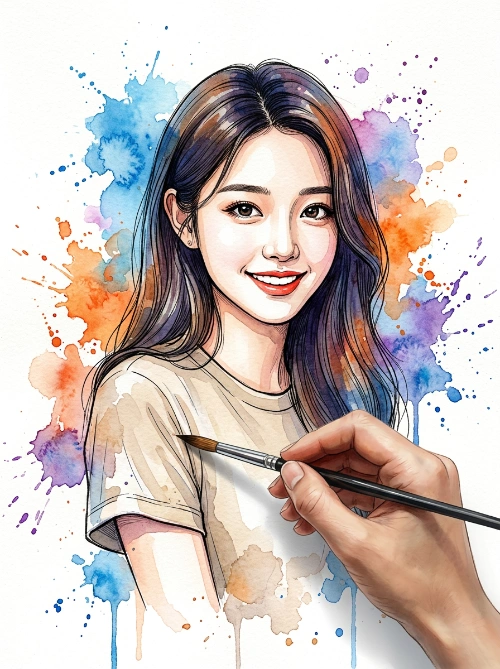
Dynamic Watercolor Portrait
Create a vibrant and artistic watercolor painting of a smiling person, using the uploaded photo as the facial reference without altering their facial features or appearance. The person is wearing a neutral-tone T-shirt. The background is clean white, filled with dynamic and expressive watercolor paint splashes in blue, orange, and purple spreading organically across the scene. In the foreground, a realistic human hand holds a paintbrush as if actively painting the sleeve of the man’s hoodie, creating the illusion that the portrait is being painted at that exact moment. The visual style combines detailed ink line art with loose watercolor textures, including paint drips, fine splatters, soft pigment diffusion, watercolor blooming effects, and natural paper texture. The image features strong contrast, an expressive and dynamic artistic look, a clear hand-painted aesthetic, centered composition, soft lighting, high level of detail, and a modern illustration style.
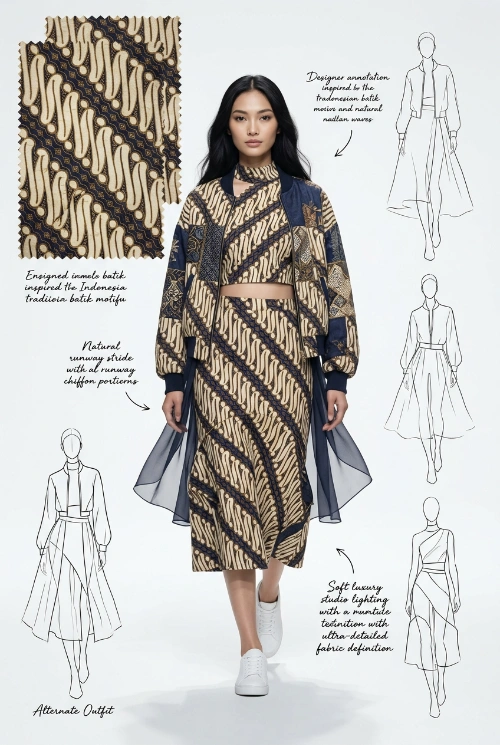
Ultra-Premium Batik Couture Board
{ "prompt": "Ultra-premium luxury fashion designer concept board on a pristine white studio canvas, inspired by high-end couture fashion houses. CENTER MODEL A tall slender Javanese female fashion model with elegant runway proportions walking gracefully in a natural runway stride pose. FASHION THEME Modern couture fashion inspired by traditional Indonesian Batik Parang motif. The textile pattern features flowing diagonal blade-like waves and repeating curved lines with rich tones of deep indigo, warm ivory, and antique gold. OUTFIT DESIGN • Cropped asymmetric mock-neck top decorated with the batik pattern • Relaxed oversized bomber jacket with patchwork batik panels and soft semi-transparent chiffon layers flowing from the waist • Sculptural segmented midi skirt with modern architectural silhouette • Minimalist clean white sneakers MODEL APPEARANCE Long jet-black hair with soft natural waves, delicate oval face, natural makeup, calm confident expression. DESIGN BOARD ELEMENTS • Top-left: enlarged fabric swatch showing the batik texture • Right side: three minimalist fashion sketches • Lower-left: alternate outfit sketch • Elegant handwritten designer annotations across the board LIGHTING Soft luxury studio lighting with subtle shadows and detailed textile highlights. STYLE High-end couture design board, editorial fashion presentation, masterpiece quality, ultra-detailed fabric texture." }

LV Dynamic Grid Muted
Louis Vuitton. Act as a World-Class Editorial Designer. PHASE 1: DYNAMIC SUBJECT LOGIC. * Subject Selection: Autonomously analyze Louis Vuitton and select an iconic luxury fashion subject, such as a Louis Vuitton monogram travel trunk, a classic LV monogram handbag (e.g., Speedy or Keepall), or a high-fashion model interacting with a Louis Vuitton bag. * Layering (The Sandwich Effect): Interweave the subject with background shapes. Some parts of the bag or model must be hidden behind geometric blocks, while other parts (handles, straps, hands, accessories, luggage tags) must overlap them to create 3D depth. PHASE 2: GRID & GEOMETRY. * Layout: A clean 2x2 grid composition. * Overlays: Superimpose large, bold geometric arcs and circles over the grid. * Visual Balance: Place one iconic Louis Vuitton prop (for example a floating LV luggage tag, padlock, or small monogram coin pouch) in a separate quadrant to balance the main subject. PHASE 3: SOPHISTICATED MUTED PALETTE. * Color Direction: DO NOT use aggressive neon or oversaturated colors. * Palette: Identify the core Louis Vuitton colors and shift them to a sophisticated muted spectrum. * Tones: Use desaturated, earthy, or dusty versions of LV heritage colors such as muted monogram brown, dusty gold, warm tan, soft caramel, aged leather beige, and muted cream. * Finish: Matte, flat color blocks with zero gradients. PHASE 4: PHOTOGRAPHY & LIGHTING. * Subject Style: High-end commercial studio photography. * Lighting: Soft, diffused studio lighting with gentle highlights. No harsh shadows. * Integration: The subject must feel physically embedded into the graphic grid. PHASE 5: MINIMALIST BRANDING. * Logo: Place a clean, single-color Louis Vuitton LV monogram logo in the center of one background block. No taglines, just the iconic symbol.
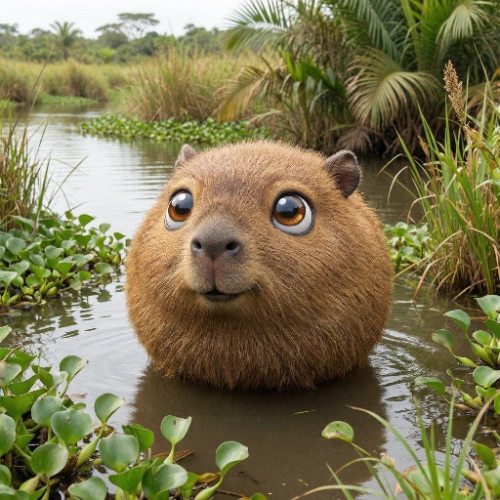
Spherical Cute Animal
Make a photo of a cute ball-shaped version of a [animal: Capybara], with big adorable over-sized eyes, it has no head, instead its face is part of the ball, its head and body are one. They are in their usual habitat. Must be almost spherical and cartoonishly cute. Its eyes are looking up in the most adorable cheeky fashion.
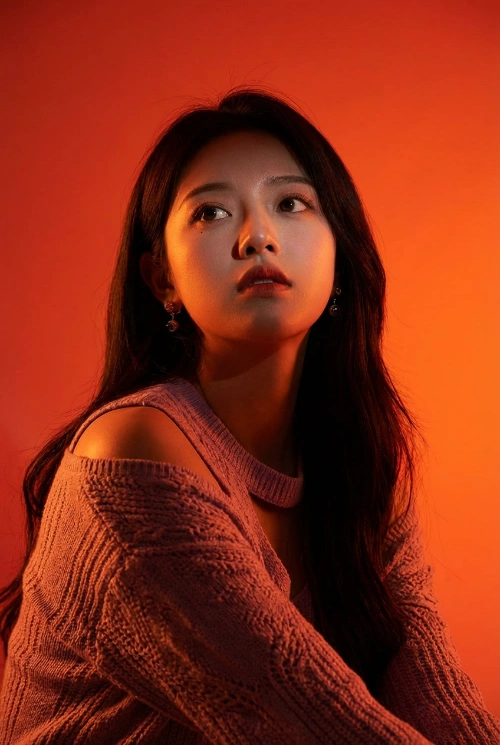
Heroic Dramatic Studio Port
{ "meta": { "title": "Heroic Dramatic Studio Portrait", "role": "World-class photographer specializing in editorial portraits", "aesthetic": "Dramatic, saturated studio lighting with a heroic feel" }, "constraints": { "identity_anchor": { "source": "ATTACHED REFERENCE PHOTO", "strictness": "Critical", "instruction": "Perfectly preserve exact facial features, skin tone, hairstyle, and natural likeness without changes." }, "clothing_anchor": { "source": "EXACTLY AS IN REFERENCE PHOTO", "strictness": "Critical", "instruction": "Style, color, material, and fit must fully correspond to the original without stylization." } }, "subject_details": { "expression": "Serious, tense, focused", "gaze": "Directed away from camera, into space above", "universality": "Lighting and angle applicable regardless of gender" }, "composition": { "background": "Saturated solid orange-red backdrop, smooth intense gradients, no patterns, 'hot' atmosphere", "camera_angle": "Low angle (shot from below upwards) to create dominance", "framing": "Medium close-up, emphasis on face and shoulders" }, "lighting": { "palette": "Dominant bright oranges and deep red shades", "key_light": "Strong directional source, deep dramatic shadows (chiaroscuro), emphasizing facial structure", "backlight": "Powerful expressive rim light or color halo separating subject from background", "mood": "Mysterious, tense, high-contrast" }, "technical_specs": { "style": "Photorealism, high detail", "focus": "Sharp focus on face vs smooth gradient background", "texture_quality": "Preserve natural pores and skin texture" }, "combined_prompt_text": "World-class editorial portrait, dramatic studio lighting, heroic feel. [REFERENCE PHOTO IDENTITY PRESERVED]: Exact facial features, skin tone, hairstyle. [CLOTHING EXACT MATCH]: No changes to fit or material. Expression: serious, tense, focused, looking up and away. Background: Saturated solid orange-red, smooth intense gradients, hot atmosphere. Camera Angle: Low angle shot from below for dominance. Framing: Medium close-up. Lighting: Bright orange and deep red palette, strong directional chiaroscuro key light, powerful rim light separating subject from background. Technical: Photorealistic, high detail, sharp focus on face, natural skin texture and pores." }
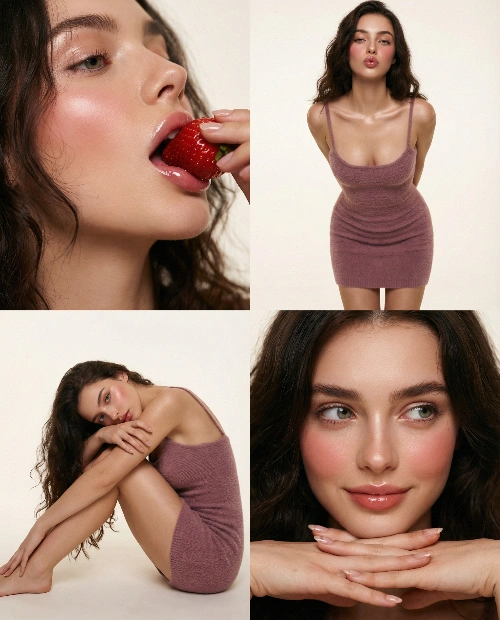
Ultra-Real Beauty Grid
{ "project_specifications": { "format": "2x2 Grid Collage", "aspect_ratio": "4:5", "aesthetic_style": "High-end Beauty Editorial", "rendering_engine_hints": { "realism_level": "Ultra-photorealistic", "texture_quality": "8k", "lighting_simulation": "Ray-traced studio lighting" } }, "global_assets": { "subject_definition": { "hair": { "style": "Long, loosely wavy, voluminous", "texture": "Natural, individual strands defined", "behavior": "Messy but styled, framing face and shoulders" }, "complexion": { "skin_texture": "Porous, hyper-realistic", "finish": "Dewy, glass-skin effect", "makeup": { "cheeks": "Heavy flush/blush", "lips": "High-gloss, plump, natural pink", "eyes": "Clean, defined lashes, natural brows" } }, "wardrobe": { "item": "Mini dress", "fit": "Bodycon / Tight", "fabric": { "material": "Soft textured knit / Boucle", "tactility": "Fuzzy, light-catching fibers", "color": "Soft mauve or neutral taupe" }, "details": "Spaghetti straps, mid-thigh length" } }, "environment_definition": { "studio_setup": { "background": "Seamless paper, soft off-white/beige", "atmosphere": "Clean, warm, intimate" }, "lighting_rig": { "key_light": "Large diffuse softbox (Front-Left)", "fill_light": "Reflector (Right)", "highlights": "Specular highlights on lips, cheekbones, and shoulders" } } }, "panel_architecture": [ { "position": "Top-Left (1)", "shot_type": "Extreme Close-Up (Macro)", "composition": { "angle": "Low angle, looking up slightly", "focus": "Mouth and nose area", "depth_of_field": "Shallow" }, "action": { "primary": "Eating a strawberry", "nuance": "Delicate finger hold, lips slightly parted" }, "visual_anchors": [ "Moisture on strawberry surface", "Gloss reflection on lips", "Baby hairs at temple" ] }, { "position": "Top-Right (2)", "shot_type": "Medium Shot (Thigh-up)", "composition": { "angle": "Eye level", "pose_dynamic": "Leaning forward slightly towards lens" }, "action": { "stance": "Standing straight on", "arms": "Relaxed at sides", "expression": "Direct gaze, alluring pout" }, "visual_anchors": [ "Texture of knit dress", "Collarbone shadows", "Curvature of waist" ] }, { "position": "Bottom-Left (3)", "shot_type": "Full Body (Seated)", "composition": { "angle": "Side profile", "framing": "Subject compacted on floor" }, "action": { "pose": "Knees to chest (fetal position variation)", "interaction": "Cheek resting on knee, arms embracing legs", "hair_flow": "Cascading onto the floor" }, "visual_anchors": [ "Smooth leg definition", "Dress stretching over thigh", "Dreamy gaze" ] }, { "position": "Bottom-Right (4)", "shot_type": "Beauty Portrait (Head & Hands)", "composition": { "angle": "Frontal close-up", "framing": "Chin to hairline" }, "action": { "gesture": "Chin resting on interlaced fingers", "expression": "Soft smile, looking off-camera" }, "visual_anchors": [ "Hand detail and manicure", "Eye clarity", "Flush on cheeks" ] } ] }
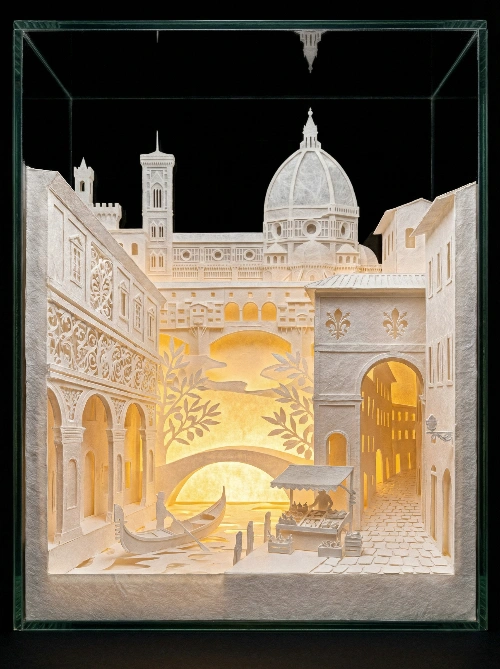
Florence Paper Cut Diorama
CITY_NAME: Florence -- A hyper-detailed 3D layered paper cutting art diorama of [CITY_NAME]. The cityscape features iconic landmarks and recognizable architecture of the city looming in the background, rendered in pure white paper. Buildings and layers are adorned with intricate culturally relevant filigree pattern cutouts and traditional motifs suitable for the location. Characteristic local elements are in the foreground. The entire scene is illuminated by a **radiant, intense warm amber light source from within** the layers. The pure white paper acts as a diffuser, becoming **translucent and glowing brightly**, revealing all intricate details. **Subsurface scattering effect**, **golden hour atmosphere** against a pitch-black background. Miniature world, exquisite texture, 8k resolution. --ar 3:4
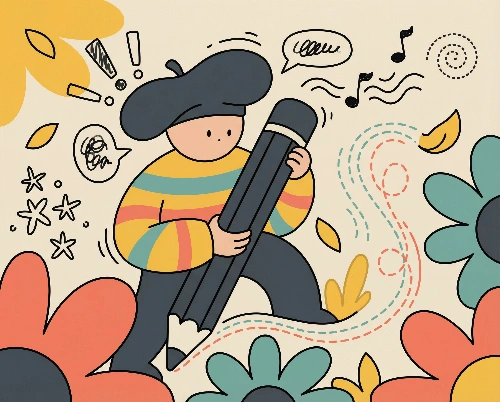
Whimsical Artist's Playful Scene
Create a whimsical, playful illustration featuring [a curious young artist character] as the central focus. The character is drawn with simplified features, a small rounded head, and minimal facial detail, wearing [an oversized beret and a loose striped sweater]. They are positioned among oversized abstract shapes and organic elements such as [giant flowers, floating leaves, and star-like doodles], creating a sense of imaginative scale. The character is interacting with [a large pencil that trails playful lines through the scene], adding narrative interest. Decorative graphic elements like [exclamation points, speech bubbles, hand-drawn scribbles, and musical notes] float around the subject to enhance expression and energy. Use clean, simple linework and a limited color palette of [warm yellow, muted teal, coral, and charcoal gray], keeping the illustration bold and cohesive. The background is a soft neutral tone such as beige or off-white. The overall style is modern, flat, and illustrative, with a lively, creative, and slightly abstract atmosphere.