

Yarn T-Rex Whimsy
Prompt
A macro close-up of a T-Rex made entirely of green crocheted yarn (Amigurumi style). Visible loose fibers and fuzz halo. The eyes are shiny black plastic buttons. It is sitting on a wooden table. Depth of field: Shallow, blurring the background kitchen.
Aspect Ratio
Model
Nano Banana ProYou might also like
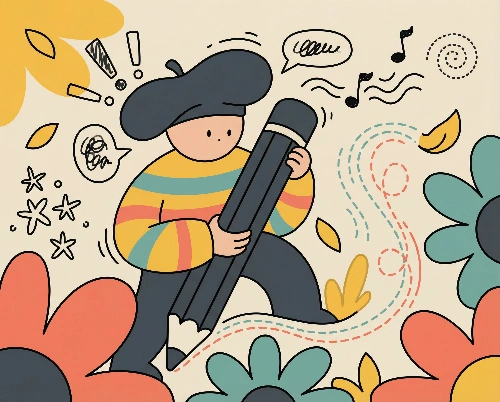
Whimsical Artist's Playful Scene
Create a whimsical, playful illustration featuring [a curious young artist character] as the central focus. The character is drawn with simplified features, a small rounded head, and minimal facial detail, wearing [an oversized beret and a loose striped sweater]. They are positioned among oversized abstract shapes and organic elements such as [giant flowers, floating leaves, and star-like doodles], creating a sense of imaginative scale. The character is interacting with [a large pencil that trails playful lines through the scene], adding narrative interest. Decorative graphic elements like [exclamation points, speech bubbles, hand-drawn scribbles, and musical notes] float around the subject to enhance expression and energy. Use clean, simple linework and a limited color palette of [warm yellow, muted teal, coral, and charcoal gray], keeping the illustration bold and cohesive. The background is a soft neutral tone such as beige or off-white. The overall style is modern, flat, and illustrative, with a lively, creative, and slightly abstract atmosphere.
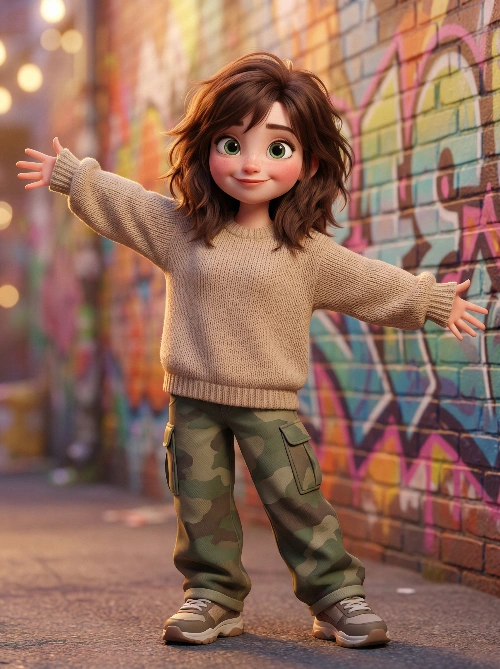
Cute Urban 3D Cartoon Girl
A cute stylized 3D cartoon girl with a Pixar–Disney-inspired look, big expressive green eyes, soft freckles, rosy cheeks, and a warm innocent smile. She is standing confidently in a colorful urban alley with a vibrant graffiti brick wall background, cinematic depth of field and soft bokeh lights. The character has a cozy oversized knitted sweater in a neutral beige tone with long sleeves covering part of the hands. She wears loose-fit cargo pants (olive green / camouflage tone), slightly baggy, paired with chunky casual sneakers. Her pose is joyful and playful with both arms stretched wide outward, conveying happiness and freedom. Hair is medium-length brown, slightly messy yet cute, styled naturally (can be open or lightly tied), with soft realistic strands. Lighting is warm and cinematic, soft ambient glow, ultra-detailed textures, high-quality 3D render, realistic fabric knit details, smooth skin shading, shallow depth of field, vibrant colors, whimsical mood, modern animated movie character style, ultra HD, sharp focus.
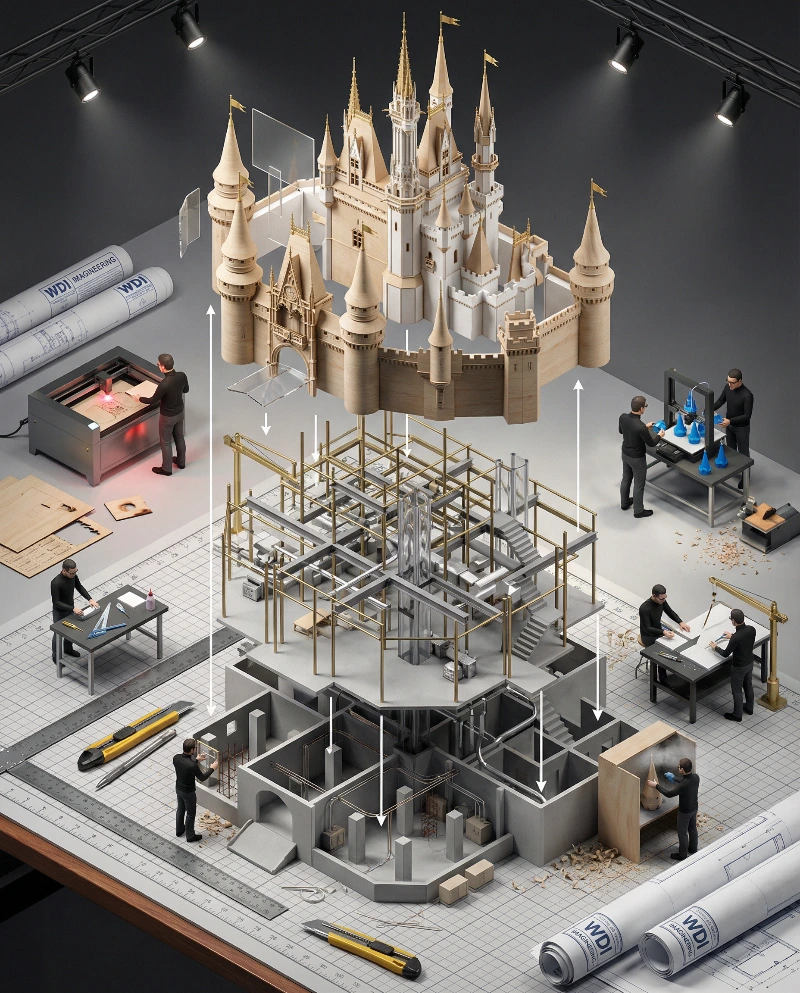
Tiny Workers Structural Diorama
Input: Disney Castle --- Input Variable: [Any Famous Building - Guggenheim, Burj Khalifa, Sydney Opera House, etc.] System Instruction: Generate a hyper-realistic, isometric 3D "Exploded View" diorama showing the Input Building deconstructed into its structural systems with an architectural model-making crew assembling a scale version. 1. Semantic Engineering Analysis: Layer 1 (The Skin): Exterior facade panels, windows, cladding, roofing, entrance canopy Layer 2 (The Structure): Steel framework, floor plates, columns, beams, elevator shafts, stairwells, mechanical systems Layer 3 (The Foundation): Basement levels, support pillars, utility conduits, HVAC units, individual rivets/bolts, rebar cages 2. Container: Surface: Architect's drafting table with cutting mats and T-squares Layout: Building layers stacked vertically showing ground-up construction sequence Connections: White architectural section lines showing structural load paths and circulation Additional Elements: Blueprint sheets, scale rulers, material samples, elevation drawings 3. Micro-Narrative: CRITICAL: This is meta - tiny workers building a model that's being built by tiny workers. Recursive scale concept. Workers: 1:87 scale model makers in black turtlenecks (architect stereotype) Equipment: Laser cutters, 3D printers, basswood cutting stations, acrylic gluing rigs, miniature cranes positioning floor plates Interaction: Architects cutting foam core, assembling balsa wood frames, installing tiny windows, spray painting facades, arranging scale furniture 4. Visual Syntax & Material Physics: Materials: Basswood grain, clear acrylic sheets, white foam core, brass rod framework, museum board textures Lighting: Architecture studio track lighting creating dramatic model shadows Special Effects: Glue strands, wood shavings, spray paint mist, laser cutter burn marks Output: Elevated three-quarter view, architectural presentation, 1:1 ratio, 8K, Archdaily model photography aesthetic
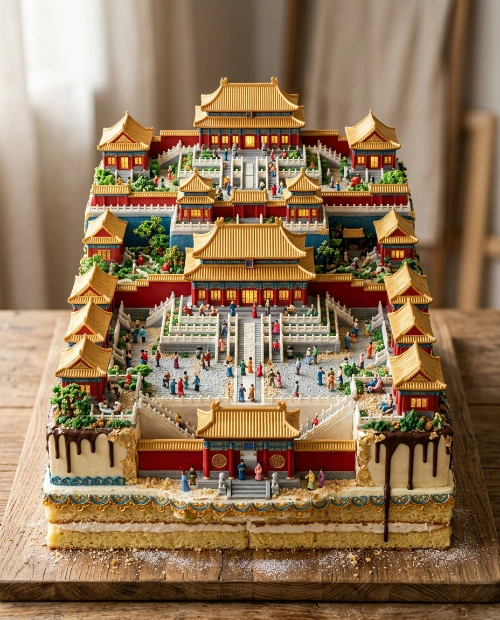
Edible Forbidden City Cake
MONUMENT: The Forbidden City Photorealistic hero product photography shot on Sony A7III with 85mm f/1.4 lens at f/2.8, soft natural daylight from upper left creating gentle realistic shadows and visible surface textures: A giant famous [MONUMENT] masterfully recreated as a delicious multi-tiered edible cake. Visible fluffy sponge cake layers, thick silky buttercream frosting, smooth fondant details, subtle edible gold leaf accents, realistic cake crumbs and ganache drips. The cake tiers ingeniously transformed into a luxurious miniature vibrant living city with tiny glowing windows, staircases, gardens and balconies built into the frosting and sponge. Miniature visitors in tiny colorful clothes walk the buttercream pathways, relax on cake terraces, sip tiny drinks and take photos. Intricate realistic cake textures mixed with whimsical architecture, physically plausible yet surreal. Shot for a luxury architecture magazine cover, ultra-detailed 8K, perfectly centered square composition, no text, no artifacts.
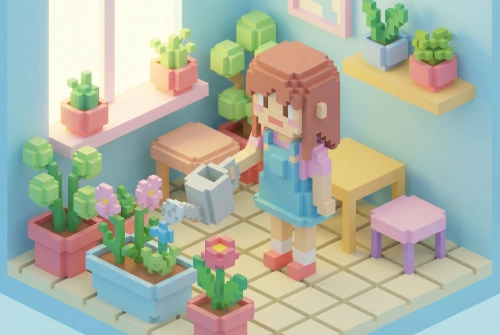
Tolkien vs Martin: Literary Clash
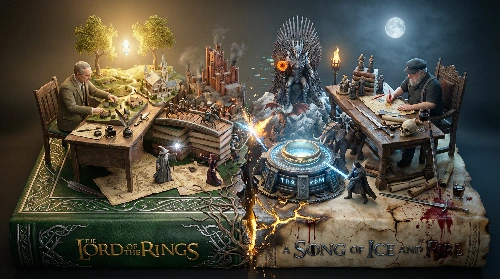
Author1: George R. R. Martin Author2: J. R. R. Tolkien -- Input Variable: [INSERT AUTHOR 1] vs. [INSERT AUTHOR 2] (e.g., J.R.R. Tolkien vs. George R.R. Martin, Arthur C. Clarke vs. Isaac Asimov, Jane Austen vs. the Brontë Sisters) System Instruction: Generate a hyper-detailed, macro 3D diorama of a "Literary Battleground." Use the following logic to create a scene of narrative conflict and fusion: Profile & Duality: Analyze both Inputs: Identify each Author's Vibe, Artifacts, and Magnum Opus. The Conflict: Define the core thematic opposition (e.g., Tolkien's Good vs. Evil vs. Martin's Moral Ambiguity; Clarke's Cosmic Indifference vs. Asimov's Human-centric Order). The Fusion: Identify 3-5 hybrid concepts where their worlds might merge (e.g., A Sauron-like figure on the Iron Throne; A positronic brain trying to interpret a Monolith). Container: The Base: A massive, ancient "Yggdrasil-like" Book whose trunk is split down the middle, forming two distinct covers. Texture: Each half of the book's cover texture reflects its author (e.g., Elven-leaf tooled leather vs. cracked, blood-spattered vellum). The Title: Each spine features the respective author's most famous title, but the gold leaf is "bleeding" across the divide. Workspace: The Desk: A single, massive writing desk is cleaved in two by the book. Each side is period-accurate to its author. The Authors: Two 1:12 scale figures, one on each side, are locked in a creative duel. One might be meticulously world-building, the other furiously red-penciling a map. The Clutter (Density Layer 1): The desk is a chaotic mix of both worlds. Crumpled manuscript pages from one author are used as coasters for the other's drink. Quills share space with typewriters. Manifestation: CRITICAL: The two fictional worlds are in a state of open war, using the desk as the no-man's-land. The "Micro-Population": Tiny characters from both universes are in direct conflict. (e.g., Rohirrim charging Dothraki spearmen; R2-D2 trying to reason with HAL 9000). The "Terrain Bleed": The environments are actively terraforming the desk. (e.g., The Shire's gentle hills are being overrun by the gritty, soot-stained streets of King's Landing; A crystal forest from Clarke's work is being colonized by Asimov's metallic robots). The Hybrid Artifacts: The most iconic artifacts are fused into new, paradoxical objects. (e.g., The One Ring is embedded in a Foundation base; A lightsaber hilt is crafted from a white walker's ice). Lighting & Atmosphere: Primary Light: Two conflicting light sources. Tolkien's side is lit by warm, golden "Valinor" light. Martin's side is lit by harsh, cold "Westerosi" moonlight. Secondary Light: The energy from the conflict itself—magical sparks, digital glitches, and clashing auras erupt where the two worlds meet. Scale: Extreme macro with a Tilt-Shift effect, emphasizing the epic nature of the conflict on a miniature scale. Output: ONE image, 16:9 Aspect Ratio, Octane Render, "Epic Clash" level of detail, Dynamic/Dramatic Aesthetic.
Retro Shanghai RTS Battle
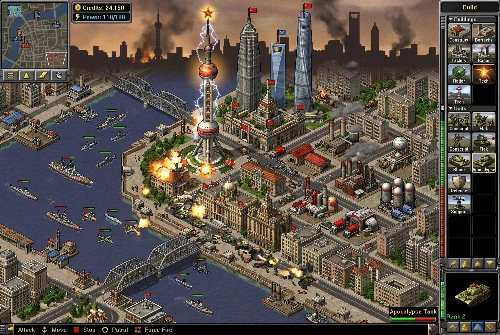
Retro real-time strategy game screenshot in the visual style of the classic 2000s RTS game Red Alert 2. Isometric top-down battlefield map set in modern Shanghai, China. The terrain, roads, rivers, and city layout resemble Shanghai, with recognizable landmarks adapted into RTS game structures: Oriental Pearl Tower functioning as a tech structure, Shanghai Tower and Jin Mao Tower appearing as tall futuristic command buildings, Bund waterfront converted into defensive structures and walls, Huangpu River crossing the map with RTS bridges. Dense Shanghai urban districts turned into RTS base layouts with factories, power plants, radar domes, barracks, and refineries designed using Shanghai architectural elements and Chinese urban aesthetics. Classic RTS base-building scene: construction yards, tank factories, power plants, radar dishes, missile turrets, and supply depots integrated with Shanghai-style buildings and skyline silhouettes. Units include tanks, infantry squads, helicopters, and naval units moving around the Huangpu River. Explosions, smoke, and battle effects typical of early 2000s RTS games. Authentic retro game interface: classic RTS UI panels, minimap in the corner, unit selection boxes, build menu icons, health bars above units, resource counters, and command buttons similar to early RTS interfaces. Pixel-art inspired textures and slightly low-resolution sprites to mimic early 2000s PC game graphics. Camera perspective: classic isometric RTS camera angle from above, showing a large portion of the battlefield and city layout. Bright strategic map colors with clear terrain segmentation for roads, water, buildings, and base structures. Atmosphere: busy battlefield in a stylized Shanghai warzone, tanks rolling through city streets, defensive turrets near landmarks, helicopters flying over the skyline, naval units in the Huangpu River. Nostalgic early-2000s PC game aesthetic, detailed RTS battlefield composition, cinematic but clearly recognizable as a game screenshot.
Gen Z Night Train Chibis
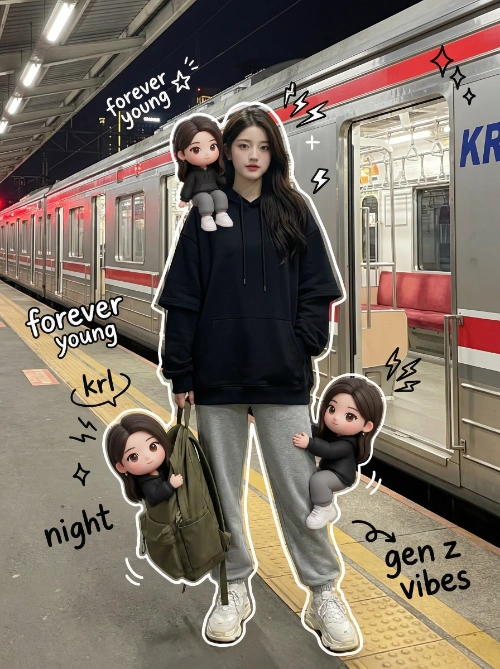
A high-quality mixed-media portrait of a trendy Gen Z teenager (using my uploaded person photo) standing on a train station platform at night. The subject is posing coolly, holding the strap of their olive backpack with one hand. They are wearing a stylish Gen Z outfit (oversized streetwear, layered black hoodie, gray sweatpants, and chunky sneakers). The background features a realistic 'KRL Jabodetabek' Commuter Line train side view with its signature red striping, with the train doors wide open, bathed in bright, cinematic station lighting and city night ambiance. Surrounding the realistic main subject are several cute, 3D-style 'Chibi' versions of the theirself. same wears and same face. These chibis are interacting playfully: one is sitting on the subject's shoulder, one is climbing their leg, and another is peeking out from the backpack. Overlay the image with vibrant, hand-drawn doodle effects: white drawn outlines around the subject, playful scribbles, stars, sparkles, electric sparks, and floating white and black handwritten slogans like 'forever young', 'krl', 'night', and 'gen z vibes'. The style should seamlessly blend hyper-realistic photography with colorful, flat cartoon illustrations. Keeping face and all shape person unchanged.