
You might also like
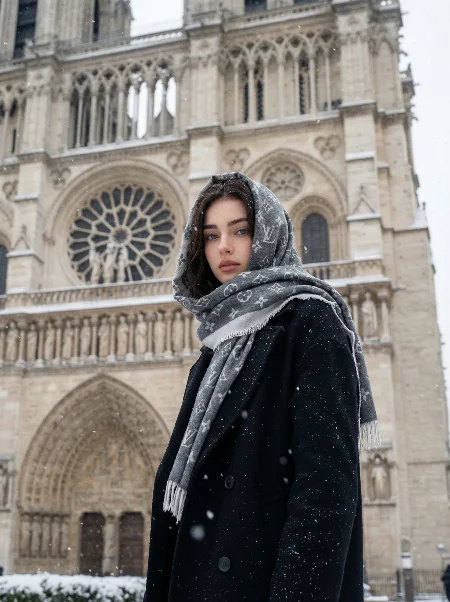
Snowy Notre-Dame Woman
A hyper-realistic medium shot of a beautiful woman standing Slightly sideways in front of the Notre-Dame Cathedral in Paris during a heavy snowfall. She is wearing a thick black wool coat and a luxury grey Louis Vuitton monogram scarf draped over her head like a hood, with white fringed edges visible. The cathedral's gothic architecture, including the rose window and stone statues, is visible in the background, partially covered in snow. Cinematic soft lighting, snowflakes drifting in the air, winter aesthetic, cold atmosphere, muted color palette (black, grey, white, and beige stone). High detail, 8k resolution, photorealistic texture on the wool and scarf fabric
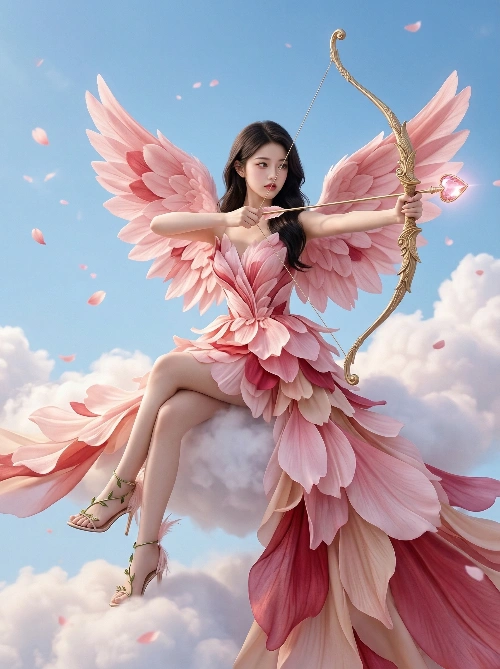
Ethereal Cupid Fashion Port
Using the real female subject you uploaded as the visual baseline, generate an ultra-high-precision photorealistic portrait that blends fantasy storytelling with high-fashion aesthetics. The character is reimagined as a modern Cupid, poised elegantly among the clouds, creating a visual spectacle that is ethereal, dramatic, and fashion-forward. Character Baseline and Styling Baseline: Strictly follow the facial contours, proportions, skin texture, and overall aura from the reference image. Age and ethnic characteristics must remain consistent with the original. Expression: Enhanced soft-glow makeup that remains faithful to her natural features. Expression is focused, with sharp, intent eyes suggesting precise aim. Hairstyle: Fully replicate the hair color, length, texture, and natural form from the reference image. Wardrobe, Accessories, and Pose Main Dress: A fantasy-inspired haute couture gown. Design: Structured, intricately detailed strapless bodice with a long, flowing train. Material: Constructed from layered, realistic soft pink cherry blossom petals, creating a light, semi-transparent, airy effect with clearly defined petal textures. Color: Dominated by soft sakura pink, blended with crimson and nude pink in a natural gradient. Wings: Large petal wings composed of countless cherry blossom petals arranged in a dimensional collage, transitioning naturally from pale pink to near-white. Each petal must exhibit realistic texture and light transmission. Footwear: Ultra-thin high-heeled decorative sandals, wrapped with vines and petals, accented with white feathers. Weapon Accessory: Holding an ornate gilded longbow with intricate engravings. The arrow tip is set with a heart-shaped gemstone, emitting a soft pink-gold glow. Pose and Composition Pose: The subject sits gracefully atop a fluffy cloud. The right leg is bent for support, while the left leg extends forward. The upper body leans slightly forward as she draws the bow, combining elegance with controlled strength. Composition: Medium shot with the subject centered in the frame, wings fully extended. Eye-level perspective. Sharp focus on the face and bow, with the surrounding clouds slightly softened. Environment and Lighting Environment: Suspended in a bright sky, seated on voluminous clouds. The background features a vivid blue sky with scattered floating cherry blossom petals, creating a dreamy, weightless atmosphere. Lighting: Soft directional diffused lighting. The key light from above at an angle defines the silhouette, complemented by fill light to maintain clean shadows. Light creates crystalline highlights on gemstones, metal surfaces, and petals, resulting in an airy yet dimensional tonal quality. Style and Texture Visual: Photography-grade hyperrealism with cinematic impact and extreme detail fidelity. Detail: Supports 8K-level rendering. All materials—skin, petals, metal—must achieve high physical realism. Fusion: Seamlessly combines high-fashion aesthetics, mythological drama, and romantic fantasy imagination. Quality: Achieves the clarity, color depth, and visual impact of top-tier commercial fashion campaigns.
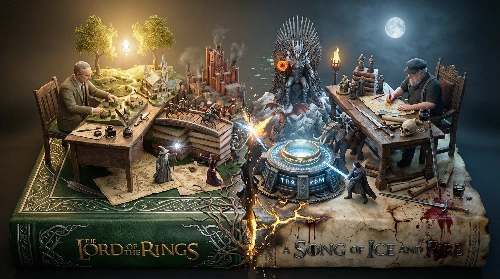
Tolkien vs Martin: Literary Clash
Author1: George R. R. Martin Author2: J. R. R. Tolkien -- Input Variable: [INSERT AUTHOR 1] vs. [INSERT AUTHOR 2] (e.g., J.R.R. Tolkien vs. George R.R. Martin, Arthur C. Clarke vs. Isaac Asimov, Jane Austen vs. the Brontë Sisters) System Instruction: Generate a hyper-detailed, macro 3D diorama of a "Literary Battleground." Use the following logic to create a scene of narrative conflict and fusion: Profile & Duality: Analyze both Inputs: Identify each Author's Vibe, Artifacts, and Magnum Opus. The Conflict: Define the core thematic opposition (e.g., Tolkien's Good vs. Evil vs. Martin's Moral Ambiguity; Clarke's Cosmic Indifference vs. Asimov's Human-centric Order). The Fusion: Identify 3-5 hybrid concepts where their worlds might merge (e.g., A Sauron-like figure on the Iron Throne; A positronic brain trying to interpret a Monolith). Container: The Base: A massive, ancient "Yggdrasil-like" Book whose trunk is split down the middle, forming two distinct covers. Texture: Each half of the book's cover texture reflects its author (e.g., Elven-leaf tooled leather vs. cracked, blood-spattered vellum). The Title: Each spine features the respective author's most famous title, but the gold leaf is "bleeding" across the divide. Workspace: The Desk: A single, massive writing desk is cleaved in two by the book. Each side is period-accurate to its author. The Authors: Two 1:12 scale figures, one on each side, are locked in a creative duel. One might be meticulously world-building, the other furiously red-penciling a map. The Clutter (Density Layer 1): The desk is a chaotic mix of both worlds. Crumpled manuscript pages from one author are used as coasters for the other's drink. Quills share space with typewriters. Manifestation: CRITICAL: The two fictional worlds are in a state of open war, using the desk as the no-man's-land. The "Micro-Population": Tiny characters from both universes are in direct conflict. (e.g., Rohirrim charging Dothraki spearmen; R2-D2 trying to reason with HAL 9000). The "Terrain Bleed": The environments are actively terraforming the desk. (e.g., The Shire's gentle hills are being overrun by the gritty, soot-stained streets of King's Landing; A crystal forest from Clarke's work is being colonized by Asimov's metallic robots). The Hybrid Artifacts: The most iconic artifacts are fused into new, paradoxical objects. (e.g., The One Ring is embedded in a Foundation base; A lightsaber hilt is crafted from a white walker's ice). Lighting & Atmosphere: Primary Light: Two conflicting light sources. Tolkien's side is lit by warm, golden "Valinor" light. Martin's side is lit by harsh, cold "Westerosi" moonlight. Secondary Light: The energy from the conflict itself—magical sparks, digital glitches, and clashing auras erupt where the two worlds meet. Scale: Extreme macro with a Tilt-Shift effect, emphasizing the epic nature of the conflict on a miniature scale. Output: ONE image, 16:9 Aspect Ratio, Octane Render, "Epic Clash" level of detail, Dynamic/Dramatic Aesthetic.

LV Dynamic Grid Muted
Louis Vuitton. Act as a World-Class Editorial Designer. PHASE 1: DYNAMIC SUBJECT LOGIC. * Subject Selection: Autonomously analyze Louis Vuitton and select an iconic luxury fashion subject, such as a Louis Vuitton monogram travel trunk, a classic LV monogram handbag (e.g., Speedy or Keepall), or a high-fashion model interacting with a Louis Vuitton bag. * Layering (The Sandwich Effect): Interweave the subject with background shapes. Some parts of the bag or model must be hidden behind geometric blocks, while other parts (handles, straps, hands, accessories, luggage tags) must overlap them to create 3D depth. PHASE 2: GRID & GEOMETRY. * Layout: A clean 2x2 grid composition. * Overlays: Superimpose large, bold geometric arcs and circles over the grid. * Visual Balance: Place one iconic Louis Vuitton prop (for example a floating LV luggage tag, padlock, or small monogram coin pouch) in a separate quadrant to balance the main subject. PHASE 3: SOPHISTICATED MUTED PALETTE. * Color Direction: DO NOT use aggressive neon or oversaturated colors. * Palette: Identify the core Louis Vuitton colors and shift them to a sophisticated muted spectrum. * Tones: Use desaturated, earthy, or dusty versions of LV heritage colors such as muted monogram brown, dusty gold, warm tan, soft caramel, aged leather beige, and muted cream. * Finish: Matte, flat color blocks with zero gradients. PHASE 4: PHOTOGRAPHY & LIGHTING. * Subject Style: High-end commercial studio photography. * Lighting: Soft, diffused studio lighting with gentle highlights. No harsh shadows. * Integration: The subject must feel physically embedded into the graphic grid. PHASE 5: MINIMALIST BRANDING. * Logo: Place a clean, single-color Louis Vuitton LV monogram logo in the center of one background block. No taglines, just the iconic symbol.
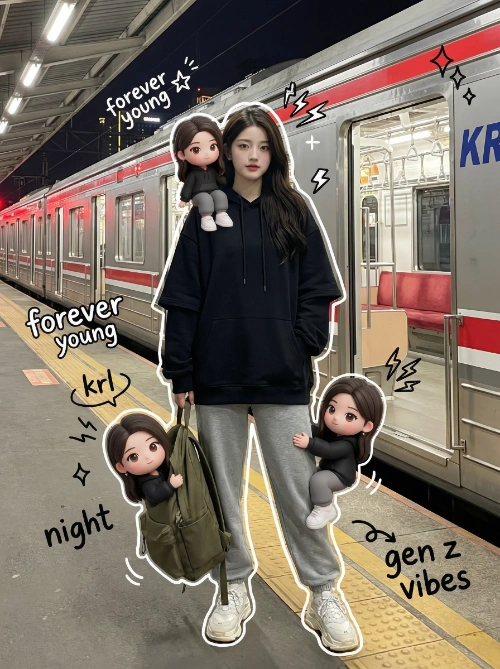
Gen Z Night Train Chibis
A high-quality mixed-media portrait of a trendy Gen Z teenager (using my uploaded person photo) standing on a train station platform at night. The subject is posing coolly, holding the strap of their olive backpack with one hand. They are wearing a stylish Gen Z outfit (oversized streetwear, layered black hoodie, gray sweatpants, and chunky sneakers). The background features a realistic 'KRL Jabodetabek' Commuter Line train side view with its signature red striping, with the train doors wide open, bathed in bright, cinematic station lighting and city night ambiance. Surrounding the realistic main subject are several cute, 3D-style 'Chibi' versions of the theirself. same wears and same face. These chibis are interacting playfully: one is sitting on the subject's shoulder, one is climbing their leg, and another is peeking out from the backpack. Overlay the image with vibrant, hand-drawn doodle effects: white drawn outlines around the subject, playful scribbles, stars, sparkles, electric sparks, and floating white and black handwritten slogans like 'forever young', 'krl', 'night', and 'gen z vibes'. The style should seamlessly blend hyper-realistic photography with colorful, flat cartoon illustrations. Keeping face and all shape person unchanged.

Whimsical 3D Cartoon Character
A 3D cartoon-style render of a [subject], with a soft matte translucent body in [color1] and glowing [color2] accents. Features include oversized head, exaggerated facial features, and fun accessories. Subtle internal glow and ambient lighting, centered on a dark gradient background. Stylized in a playful and imaginative atmosphere.
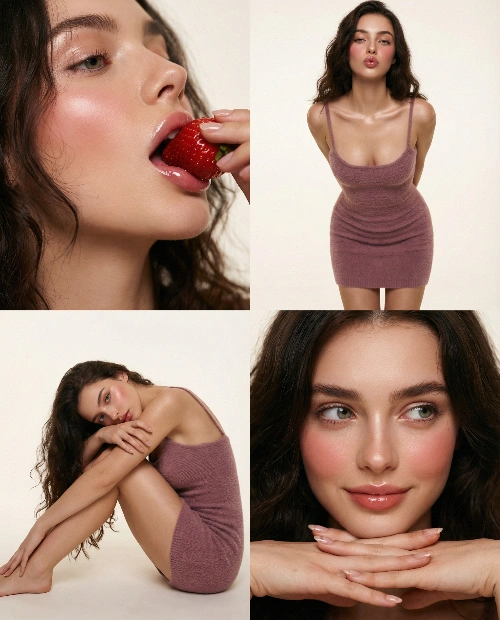
Ultra-Real Beauty Grid
{ "project_specifications": { "format": "2x2 Grid Collage", "aspect_ratio": "4:5", "aesthetic_style": "High-end Beauty Editorial", "rendering_engine_hints": { "realism_level": "Ultra-photorealistic", "texture_quality": "8k", "lighting_simulation": "Ray-traced studio lighting" } }, "global_assets": { "subject_definition": { "hair": { "style": "Long, loosely wavy, voluminous", "texture": "Natural, individual strands defined", "behavior": "Messy but styled, framing face and shoulders" }, "complexion": { "skin_texture": "Porous, hyper-realistic", "finish": "Dewy, glass-skin effect", "makeup": { "cheeks": "Heavy flush/blush", "lips": "High-gloss, plump, natural pink", "eyes": "Clean, defined lashes, natural brows" } }, "wardrobe": { "item": "Mini dress", "fit": "Bodycon / Tight", "fabric": { "material": "Soft textured knit / Boucle", "tactility": "Fuzzy, light-catching fibers", "color": "Soft mauve or neutral taupe" }, "details": "Spaghetti straps, mid-thigh length" } }, "environment_definition": { "studio_setup": { "background": "Seamless paper, soft off-white/beige", "atmosphere": "Clean, warm, intimate" }, "lighting_rig": { "key_light": "Large diffuse softbox (Front-Left)", "fill_light": "Reflector (Right)", "highlights": "Specular highlights on lips, cheekbones, and shoulders" } } }, "panel_architecture": [ { "position": "Top-Left (1)", "shot_type": "Extreme Close-Up (Macro)", "composition": { "angle": "Low angle, looking up slightly", "focus": "Mouth and nose area", "depth_of_field": "Shallow" }, "action": { "primary": "Eating a strawberry", "nuance": "Delicate finger hold, lips slightly parted" }, "visual_anchors": [ "Moisture on strawberry surface", "Gloss reflection on lips", "Baby hairs at temple" ] }, { "position": "Top-Right (2)", "shot_type": "Medium Shot (Thigh-up)", "composition": { "angle": "Eye level", "pose_dynamic": "Leaning forward slightly towards lens" }, "action": { "stance": "Standing straight on", "arms": "Relaxed at sides", "expression": "Direct gaze, alluring pout" }, "visual_anchors": [ "Texture of knit dress", "Collarbone shadows", "Curvature of waist" ] }, { "position": "Bottom-Left (3)", "shot_type": "Full Body (Seated)", "composition": { "angle": "Side profile", "framing": "Subject compacted on floor" }, "action": { "pose": "Knees to chest (fetal position variation)", "interaction": "Cheek resting on knee, arms embracing legs", "hair_flow": "Cascading onto the floor" }, "visual_anchors": [ "Smooth leg definition", "Dress stretching over thigh", "Dreamy gaze" ] }, { "position": "Bottom-Right (4)", "shot_type": "Beauty Portrait (Head & Hands)", "composition": { "angle": "Frontal close-up", "framing": "Chin to hairline" }, "action": { "gesture": "Chin resting on interlaced fingers", "expression": "Soft smile, looking off-camera" }, "visual_anchors": [ "Hand detail and manicure", "Eye clarity", "Flush on cheeks" ] } ] }
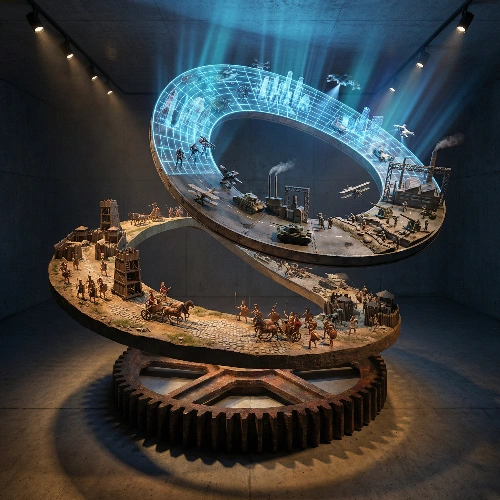
Chrono Warfare Mobius
Do this for Warfare: <instruction> Input A is a Topic with a clear technological or cultural progression (e.g., Transportation, Warfare, Medicine, Architecture). Deconstruct the history into 3 Chronological Eras : Era 1 (The Origin - Bottom): Identify the pre-industrial state. (e.g., Transportation -> Horses & Carts on Cobblestone. Medicine -> Herbalists in a Village). Era 2 (The Industry - Middle): Identify the mechanical/modern state. (e.g., Transportation -> Early Cars & Steel Bridges. Medicine -> Victorian Surgery & Iron Beds). Era 3 (The Future - Top): Identify the sci-fi state. (e.g., Transportation -> Hovercars on Neon Roads. Medicine -> Med-Pods & Holograms). 2. Container Goal: "Chronological Loop" Museum Installation. The Form: A massive, continuous Mobius Strip or Twisted Ribbon rising from the floor. The Base: The structure is anchored by a giant Industrial Gear or Stone Foundation. The Setting: A dark, expansive concrete museum hall with overhead track lighting. 3. The Metamorphosis The Path: The surface of the ribbon acts as a road or floor that physically transforms as it ascends. Transition: It morphs from Rough Stone/Dirt (Bottom) to Asphalt/Steel (Middle) to Glowing Glass/Grid (Top). The Connectivity: A bridge or ramp connects the lower loop to the upper loop, implying a continuous journey. 4. The Narrative Scale Scale: 1:50 Scale Figures and Props populate the ribbon. Action: Bottom: Figures walking or using animals. Wooden market stalls. Middle: Factory workers, steel trusses, and combustion engines. Top: Futuristic figures in suits, floating vehicles, and Holographic Cityscapes projecting upwards from the glass surface. 5. Lighting & Atmosphere: Lighting: Gradient Temperature. Base: Warm, earthy halogen spots. Top: Cool, electric blue LED glow from the future section. Shadows: The twisting ribbon casts complex, dramatic shadows on the museum floor. Output: ONE image, 1:1 Aspect Ratio, 3D Render, "Installation Art" aesthetic, High Geometric Complexity. </instruction>